
1. Background
According to the Global Cancer Observatory (GCO), breast cancer (BC) ranks as the second most prevalent cancer globally in terms of incidence, accounting for 11.5% of all new cancer cases worldwide (1, 2). Although the incidence of BC has increased, the overall survival rate has also improved to approximately 90% (3, 4). However, despite significant advances in therapeutic approaches for BC, recurrence and metastasis remain pitfalls affecting patient survival. Evidence indicates that 5 - 40% of patients with BC experience chest wall involvement, which represents the most common form of locoregional recurrence and typically occurs within the first 2 years after treatment and over a 10-year period (5). Since BC is one of the most prevalent carcinomas associated with skin metastasis, approximately two-thirds of chest wall recurrences involve the skin and subcutaneous tissue and are not accompanied by systemic metastasis (6, 7). This condition most frequently manifests as multiple nodules, initially in the mastectomy scar area, which can cause ulceration and severe neuropathic pain. Consequently, the treatment of skin nodules in these patients has substantial clinical value because of its significant effect on quality of life (6, 8). Although resection is the treatment of choice for isolated cutaneous lesions, these lesions are often unresectable because of their size. Moreover, other treatment strategies, including chemotherapy and hormonal therapy, are usually ineffective. Postmastectomy radiation has been shown to decrease chest wall recurrence and improve survival outcomes (9). However, the development of postradiation sarcomas, such as angiosarcoma, can significantly undermine the effectiveness of radiotherapy in these patients (10).
Electrochemotherapy (ECT), a nonthermal approach for cancer cell destruction, uses electric field pulses to create temporary pores in the cell membrane, thereby enhancing the uptake of impermeable drugs, such as bleomycin, by up to 1000-fold (9, 11). This method offers a novel strategy to overcome multidrug resistance in solid tumors because it allows localized drug delivery at lower concentrations and reduces systemic adverse effects (12). Currently, this therapeutic strategy is specified in clinical guidelines, such as the European Standard Operating Procedures of Electrochemotherapy (ESOPE) and standard operating procedures (SOPs), for the management of primary or metastatic skin nodules (13, 14). Previous research has demonstrated the efficacy of this technique in treating skin and subcutaneous tumors of various origins, such as BC, and in alleviating symptoms, including bleeding, oozing, pain, and infection associated with skin metastasis (11, 15). Furthermore, patients with low-volume and scattered skin metastases tend to experience fewer new skin lesions after ECT, and partial responses can potentially lead to complete clearance with subsequent treatment sessions (16).
2. Objectives
This study presents the first human-model investigation of ECT for the treatment of skin metastases in patients with BC in Iran. The treatment was used not only to mitigate the adverse effects of cutaneous metastasis but also to treat chemotherapy- or radiotherapy-resistant, nonresectable breast tumors, thereby facilitating the possibility of mastectomy with free skin margins.
3. Methods
3.1. Study Design and Participants
This preliminary report describes a case series study of ECT in patients with BC. The study was conducted in 2 cancer referral centers, Imam Khomeini Cancer Institute and Rasoul Akram Hospital, from April 2023 to November 2024. The University of Tehran Ethics Committee approved the study, and all tests were conducted in accordance with the ethical code IR.TUMS.IKHC.REC.1401.125.
Patients with BC who experienced treatment failure with skin metastasis or chest wall recurrence were included in this study. Patients were categorized into primary and recurrent groups. Patients resistant to standard treatments were considered primary cases. Patients who had been previously treated, experienced a disease-free period, and subsequently developed local chest wall recurrence were considered recurrent cases. The goals of this study were local palliative treatment or conversion of an inoperable tumor into an operable tumor in patients who did not respond to chemotherapy or radiotherapy. A survival of at least 3 months was considered conceivable for these patients, and they were required to have a Karnofsky performance score (KPS) of 0 - 1. After discussion by a multidisciplinary team comprising a surgeon, an oncologist, a pathologist, and a radiologist, patients were selected and informed. They could choose trial treatment or conventional treatment, such as chemotherapy. In cases of acceptance, informed consent was obtained. Patients were required not to have a defibrillator, pacemaker, cardiac arrhythmia, chronic lung disease, pulmonary fibrosis, or pulmonary insufficiency.
Finally, 10 cases that met the inclusion criteria were recruited in this study. All patients had received at least 2 lines of chemotherapy before entering the study. Eight patients with breast carcinoma had previously been treated with radiotherapy. Four patients were inoperable and entered the study to make surgery possible; the others underwent ECT to palliate their symptoms. Five patients underwent a second ECT session around 30 to 40 days after the first session. Patient characteristics are shown in Table 1.
Table 1.
Patients’ Characteristics and Electrochemotherapy and Disease Data
| No. | Age | Tumor Location | Primary/Recurrence | Site of Metastasis | Tumor Histotype | Tumor Grade | ER | PR | HER2 | Ki67 | ECT Session | Tumor Area (cm²) | Pain | Oozing | Bleeding | Infection | MRM |
|---|---|---|---|---|---|---|---|---|---|---|---|---|---|---|---|---|---|
| 1 | 47 | Bilateral breasts | Recurrence | Lung | IDC | 3 | - | - | - | 70 | 2 | 569 | + | + | + | + | - |
| 2 | 43 | Bilateral breasts | Recurrence | Lung | IDC | 3 | - | - | + | 50 | 2 | 213 | + | + | - | - | - |
| 3 | 41 | Bilateral breasts | Primary | Upper trunk skin and cervical-contralateral axillary LNs | IDC | 2 | + | + | - | 45 | 2 | 598 | + | + | + | + | - |
| 4 | 36 | Right breast | Recurrence | Widespread bone | IDC | 3 | - | - | + | 20 | 2 | 207 | + | - | - | - | - |
| 5 | 48 | Right breast and left axilla | Recurrence | Contralateral breast skin | IDC | 3 | - | - | - | 65 | 1 | 78 | + | + | - | + | - |
| 6 | 41 | Right breast | Recurrence | None | IDC | 3 | - | - | - | 30 | 2 | 283 | + | + | + | + | - |
| 7 | 55 | Left breast | Recurrence | Liver and cervical LNs | IDC | 2 | + | + | + | 45 | 1 | 268 | + | + | - | + | + |
| 8 | 38 | Left breast | Primary | Cervical LNs | IDC | 3 | + | + | - | 40 | 1 | 191 | + | - | - | - | + |
| 9 | 64 | Right breast | Primary | None | IDC | 3 | - | - | - | 35 | 1 | 861 | + | + | - | + | + |
| 10 | 66 | Right breast | Recurrence | None | Angiosarcoma | 3 | N/A | N/A | N/A | 30 | 2 | 17 | + | - | - | - | - |
Abbreviations: LNs, lymph nodes; IDC, invasive ductal carcinoma; IHC, immunohistochemistry; ER, estrogen receptor; PR, progesterone receptor; HER2, human epidermal growth factor receptor 2; ECT, electrochemotherapy; MRM, modified radical mastectomy; N/A, not applicable.
3.2. Electroporation Operating Procedure and Patient Follow-up
For these patients, needles were placed in the lesions so that the distance between the needles was at most 1 cm. Then, 1000 IU/m² of body surface area of bleomycin was injected intravenously, and after 8 minutes, electrical pulses were delivered.
Patients were followed daily during the first week for clinical complaints, including pain, fever, weakness, bleeding, oozing, and wound infection. They were then followed weekly and monitored clinically and through laboratory tests until the fourth week, and then at the sixth and twelfth weeks thereafter. Laboratory tests included complete blood cell count, erythrocyte sedimentation rate (ESR), and C-reactive protein (CRP). The tumor-covered area was measured using patient photographs to investigate treatment response. Except for the first 3 days of treatment, pain was controlled by administering analgesics, such as acetaminophen, gabapentin, oxycodone, nonsteroidal anti-inflammatory drugs (NSAIDs), and glucocorticoids. Nonsteroidal anti-inflammatory drugs and glucocorticoids were not used during the first 3 days of ECT to avoid inhibiting immune responses. Pain was assessed by comparing both analgesic use and patient-reported scores based on a 1 - 10 pain scale before and after intervention.
3.3. Statistical Analysis
The results were analyzed using SPSS software version 26.
4. Results
4.1. Patient Characteristics
In this study, 9 patients had invasive ductal carcinoma (IDC), and 1 patient had angiosarcoma in the context of previously treated IDC. There were different IDC subtypes, as follows: 4 patients with triple-negative BC, 2 with HER2-positive BC, and 3 with luminal B disease. Of the 10 patients with advanced (4/10) or metastatic (6/10) BC, 4 were primary cases and 6 were recurrent cases.
4.2. Tumor Response and Palliation
In total, 10 patients with approximately 3285 cm² of involved skin area were treated. The mean decrease in the involved area, based on clinical examination, was approximately 17%, 30%, 34%, 43%, and 46% after 1, 2, 3, 4, and 6 weeks, respectively. During this study, 2 patients experienced complete clinical response after 2 sessions (No. 2 and 6), 7 patients experienced partial response (No. 3, 4, 5, 7, 8, 9, and 10), 1 patient had stable disease (No. 1), and none of the patients experienced progression based on Response Evaluation Criteria in Solid Tumors (RECIST) criteria (17). A second ECT session was applied at the sixth week of treatment in 6 patients (No. 1, 2, 3, 4, 6, and 10). Three patients had good medical condition and underwent mastectomy after partial response at the sixth week after ECT (No. 7, 8, and 9).
Moreover, the palliative goals, including reductions in bleeding and oozing and eradication of infection, were followed in this study and are shown in Table 2. The mean pain scores reported by patients were 6.7 (3 - 10), 6.4 (3 - 10), 4.8 (1 - 6), 2.1 (0 - 5), 4.6 (0 - 9), and 1.3 (0 - 4) at the first, second, third, fourth, sixth, and twelfth weeks of treatment, respectively. Because 6 patients underwent a second ECT session in the sixth week of treatment, pain was higher in the sixth week than in the fourth week. Analgesic use decreased by approximately 40% after 7 days after ECT.
Table 2.
Palliative Goals of Electrochemotherapy
| Goals (Number of Patients) | First Week | Second Week | Third Week | Fourth Week | Sixth Week | Twelfth Week |
|---|---|---|---|---|---|---|
| Bleeding (3) | 2 | 3 | 3 | 3 | 3 | 3 |
| Oozing (7) | 4 | 6 | 7 | 7 | 5 a | 7 |
| Infection (6) | 3 | 4 | 5 | 5 | 6 | 6 |
a Two patients who had responded completely in the fourth week had oozing again at the sixth week; therefore, their treatment was repeated.
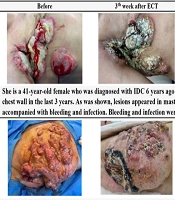
The 3 examples of patients who underwent ECT are shown in Figure 1.

Figure 1.
Three examples of patients who underwent electrochemotherapy (ECT)
4.3. Adverse Effects
Blood tests were performed to evaluate the adverse effects of ECT. Erythrocyte sedimentation rate, CRP, and complete blood count were assessed before treatment and weekly thereafter. Mean ESR and CRP values are shown in Table 3. No pancytopenia, including leukopenia, anemia, or thrombocytopenia, was observed during the study.
Table 3.
Mean Erythrocyte Sedimentation Rate and C-Reactive Protein
| Laboratory Test | Before Treatment | First Week | Second Week | Third Week | Fourth Week | Sixth Week | Twelfth Week |
|---|---|---|---|---|---|---|---|
| ESR (mm/h) | 92 (75 - 106) | 91 (80 - 105) | 73 (59 - 91) | 64 (55 - 80) | 53 (44 - 78) | 67 (44 - 79) | 27 (10 - 38) |
| CRP (mg/dL) | 36 (19 - 46) | 30 (18 - 41) | 25 (14 - 33) | 21 (15 - 24) | 18 (14 - 23) | 24 (12 - 36) | 12 (9 - 21) |
Abbreviations: ESR, erythrocyte sedimentation rate; CRP, C-reactive protein.
4.4. Overall Survival
Patients were followed up for a median of 8 months (5 - 10 months). Three patients underwent mastectomy after a mean of 34 days (21 - 60 days). Three patients with pulmonary metastasis died after a mean of 54 days (48 - 60 days). One patient with liver metastasis died after 76 days. Median progression-free survival after implementation of ECT was 3 months (1 - 7 months).
5. Discussion
Because breast tumor recurrence and metastasis to other organs, such as the skin and chest wall, remain significant therapeutic challenges, BC remains one of the leading causes of mortality among affected patients (18, 19). According to scientific evidence, conventional treatment methods for cutaneous metastasis generally have low effectiveness, and the management of these lesions can often be difficult (20). Moreover, in most patients with metastasis, surgery cannot be performed, and radiotherapy and chemotherapy do not have significant effects; thus, local treatment is necessary to address curative or palliative concerns. The results of this study demonstrated that 10 patients with metastatic or advanced BC underwent ECT, confirming its potency in facilitating surgical intervention and palliating symptoms (21).
Recent guidelines from 2013 recommended ECT as a safe palliative treatment method for skin and subcutaneous tissue metastases of breast tumors, highlighting its therapeutic role in managing these conditions (22, 23). This direct skin treatment modality has a high overall response rate of 75.4% and low toxicity, with fewer than 6% of patients experiencing severe adverse effects, which is consistent with our findings (24, 25). In our intervention, the obtained results demonstrated tumor necrosis in a time-dependent manner. The highest clinical response rate was reached at approximately the sixth week of treatment; thereafter, clinicians can decide whether to perform resection surgery or a second session of ECT. In general, none of the patients had tumor progression. Complete clinical response was obtained in 2 patients, and free margins were reported in the postoperative pathology evaluation of all 3 patients who underwent mastectomy after ECT.
Considering tumor-associated symptoms, such as pain, oozing, infection, and bleeding, strong local control was achieved in all cases after the first treatment session. Consistent with our findings, a recent study reported achievement of palliative goals in 13 patients with chest wall recurrence after ECT (26). Bleeding from skin lesions was controlled in all our patients with large metastatic tumors, leading to improved quality of life, which is consistent with another recent study (11).
5.1. Conclusions
Finally, as shown in many previous studies, ECT was performed safely, with minor adverse effects, such as pain and inflammation, that could be controlled with analgesics and anti-inflammatory agents. In addition, the reproducibility of this procedure makes it possible to repeat it if new lesions appear. In scattered skin metastases of BC with large tumors (> 5 cm), we achieved an overall response in all cases, ranging from complete tumor destruction (2/10) to achieving clear skin margins for mastectomy (3/10) and managing pain and bleeding (5/10). These findings shed new light on the application of ECT as a helpful procedure in the curative and palliative management of patients with BC and skin metastasis.