
1. Background and Objectives
Cancer remains one of the leading causes of morbidity and mortality worldwide (1). An estimated 9.7 million cancer - related deaths were reported globally. In Vietnam, the burden is also considerable, with approximately 180,480 newly diagnosed cases (2). In clinical practice, chemotherapy is a treatment approach used to inhibit tumor growth and prevent the spread of cancer cells. Although effective, chemotherapy is often accompanied by a range of adverse effects that may negatively affect patients’ health (3). Previous studies have shown that cancer treatments and chemotherapy - related side effects can exacerbate symptoms of insomnia and other sleep disturbances (4). For example, Belloumi et al. reported that 45% of patients experienced poor sleep quality following chemotherapy (5). Another study reported that the prevalence of sleep disturbances reached 79.7%, which was attributed to the cumulative effects of repeated chemotherapy cycles during treatment (6). Sleep disturbances in cancer patients are considered a multifactorial condition, involving both non - modifiable factors such as older age, female sex, and a history of psychiatric disorders, as well as modifiable factors including smoking, physical activity level, living conditions, lifestyle habits, and disease-related symptoms. In addition, sleep quality may be further compromised by the presence of symptom clusters, particularly fatigue, pain, and gastrointestinal symptoms throughout the course of treatment (7).
Although a growing body of international evidence has highlighted the importance of sleep quality in cancer care, research on sleep quality among cancer patients undergoing chemotherapy in Vietnam remains limited. Therefore, identifying factors associated with poor sleep quality is important for informing supportive care strategies to improve patient well-being during treatment. The aim of this study was to identify factors associated with poor sleep quality among cancer patients undergoing chemotherapy in Vietnam. To provide a conceptual interpretation of the findings, we used Spielman’s 3P model of insomnia as a theoretical framework (8). This model classifies factors related to sleep disturbance into three domains: Predisposing factors, which reflect individual vulnerability; precipitating factors, which trigger sleep problems; and perpetuating factors, which maintain or worsen them over time. In this study, the 3P model was used as an interpretive framework to contextualize the observed associations rather than as a formally tested causal model.
2. Methods
2.1. Study Design and Participants
A cross-sectional study was conducted among cancer patients undergoing chemotherapy at the University Medical Center Ho Chi Minh City (UMC) from June 2025 to December 2025. Eligible participants were patients aged 18 years or older who were receiving chemotherapy at UMC and who provided informed consent to participate. This study was part of a larger project assessing sleep quality and mental health status in oncology patients receiving chemotherapy at UMC. Patients were excluded if they were unable to complete the survey because of communication barriers (inability to understand Vietnamese) or cognitive impairment or dementia that precluded autonomous participation. Patients who received only the first chemotherapy cycle at UMC and then continued subsequent treatment at local hospitals were also excluded from the final analytical sample.
2.2. Data Collection
The sample size was determined using the formula for estimating a single proportion, with a type I error α = 0.05 and Z1 - α/2 = 1.96. The estimated prevalence P = 0.798 was derived from a previous study by Nguyen et al. (9), with an allowable margin of error d = 0.04. The minimum required sample size was calculated to be 388 participants. To account for an anticipated 10% loss of samples or incomplete data, the final sample size was increased to 432 participants. In addition, a pilot study was conducted on 30 participants (approximately 10% of the sample size) to evaluate the reliability of the measurement scale.
Data were collected through face - to - face interviews using a predesigned questionnaire. The questionnaire consisted of 3 sections: Part A included socio - demographic characteristics (sex, year of birth, age group, educational level). Part B included clinical characteristics such as BMI, comorbid conditions, cancer type, duration since diagnosis, cancer stage, chemotherapy cycle, chemotherapy - related side effects, and use of sleeping medication. These variables were extracted from physicians’ documentation in the medical records. “Other comorbidities” referred to comorbid conditions other than hypertension and diabetes. For statistical analysis, variables including fatigue, peripheral neuropathy, diarrhea, and sleep medication use were categorized as binary variables (yes/no). Part C assessed sleep quality using the PSQI.
2.3. Main Outcome (Pittsburgh Sleep Quality Index Scale)
The primary outcome of this study was the prevalence of poor sleep quality and its associated factors among cancer patients undergoing chemotherapy. Sleep quality was assessed using the PSQI, which evaluates sleep quality over the previous month. The PSQI is a standardized instrument developed by Buysse et al. in 1989 (10). Permission for the copyrighted PSQI questionnaire was obtained. The instrument consists of 19 items categorized into 7 components, including subjective sleep quality, sleep latency, sleep duration, habitual sleep efficiency, sleep disturbances, use of sleeping medication, and daytime dysfunction. The global PSQI score is calculated by summing the scores of these seven components, with a total ranging from 0 to 21, with scores >5 indicating poor sleep quality (10).
2.4. Study Process
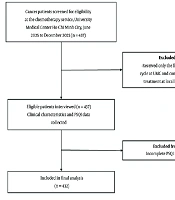
A pilot study involving 30 participants was conducted before the main survey to assess the internal reliability of the PSQI and refine the questionnaire. During the main study, 457 patients were screened for eligibility. Of these, 20 were excluded because they received only the first chemotherapy cycle at our hospital and continued subsequent treatment at local hospitals, and 5 were excluded because of incomplete PSQI responses. A total of 432 patients were included in the final analysis. The participant recruitment process is summarized in Figure 1.

Figure 1.
Participant recruitment flowchart
2.5. Statistical Analysis
After data cleaning, the dataset was entered into EpiData and analyzed using Stata 14. Descriptive statistics summarized categorical variables as frequencies and percentages, and continuous variables as mean ± SD or median (IQR), as appropriate. Associations between sleep quality and independent variables were examined using the Chi - square test or Fisher’s exact test, as appropriate. Because poor sleep quality was common in the study population, prevalence ratios (PRs) with 95% confidence intervals (CIs) were estimated using a generalized linear model with a Poisson distribution, log link, and robust variance estimator. Variables with P < 0.05 in univariate analysis were included in the multivariable model to identify factors associated with poor sleep quality.
3. Results
3.1. Baseline Characteristics
A pilot test was conducted on 30 eligible patients to assess the internal reliability of the PSQI. The Cronbach’s alpha coefficient was 0.758, indicating acceptable internal consistency. As presented in Table 1, females accounted for 55.3% of the participants. The median age was 59 (IQR: 47.5 - 66), with an overall age range from 18 to 85 years. Age group distribution indicated that patients aged 60 years and older represented the largest proportion at 48.4%.
Table 1.
Socio-demographic Characteristics of the Study Participants (N = 432) a
| Characteristics | Values |
|---|---|
| Gender | |
| Male | 193 (44.7) |
| Female | 239 (55.3) |
| Age | |
| Median (IQR) | 59 (47.5 - 66) |
| Min-max | 18 - 85 |
| Age group (y) | |
| ≤ 30 | 19 (4.4) |
| 31 - 59 | 204 (47.2) |
| ≥ 60 | 209 (48.4) |
| Educational level | |
| Primary or below | 88 (20.4) |
| Secondary/high school | 236 (54.6) |
| University/postgraduate | 108 (25.0) |
a Values are as expressed as No. (%) unless indicated.
Table 2 presents the clinical characteristics of the study population. The median BMI was 21.9 (IQR: 20.0 - 24.1), ranging from 14.4 to 31.6. Regarding comorbid conditions, hypertension was the most common (34.9%), followed by diabetes (17.6%) and other comorbidities (19.0%). Regarding cancer type, gastrointestinal cancer accounted for the highest proportion (55.3%) in our study. Most patients were in advanced stages of the disease, with stage IV accounting for 38.9%. Chemotherapy cycles were mainly concentrated in the early to mid - phases of treatment, with cycle T2 accounting for the highest proportion (17.4%). Chemotherapy - related side effects were reported in 80.6% of patients. The most common adverse effects included loss of appetite (58.6%). Concerning sleep medication use, 10.4% of patients reported using sleep medication.
Table 2.
Clinical Characteristics of the Study Population (N = 432) a
| Characteristics | Values |
|---|---|
| BMI | |
| Median (IQR) | 21.9 (20.0 - 24.1) |
| Min-max | 14.4 - 31.6 |
| Comorbid conditions (yes) | 234 (54.2) |
| Cancer type | |
| Gastrointestinal | 239 (55.3) |
| Thoracic | 43 (10.0) |
| Gynecological | 26 (6.0) |
| Breast | 72 (16.7) |
| Urological | 22 (5.1) |
| Hematological | 14 (3.2) |
| Other cancer types | 16 (3.7) |
| Duration since diagnosis (mo) | |
| 0 - 3 | 136 (31.5) |
| 3 - 6 | 111 (25.7) |
| > 6 | 185 (42.8) |
| Cancer stage | |
| Stage I | 30 (6.9) |
| Stage II | 82 (19.0) |
| Stage III | 152 (35.2) |
| Stage IV | 168 (38.9) |
| Chemotherapy cycle | |
| T1 | 59 (13.6) |
| T2 | 75 (17.4 |
| T3 | 64 (14.8) |
| T4 | 59 (13.7) |
| T5 | 42 (9.7) |
| T6 | 35 (8.1) |
| T7 | 30 (6.9) |
| T8 | 24 (5.6) |
| > T8 | 44 (10.2) |
| Chemotherapy related side effects (yes) | 348 (80.6) |
| Chemotherapy related side effects | |
| Nausea/vomiting (yes) | 217 (50.2) |
| Loss of appetite (yes) | 253 (58.6) |
| Fatigue (yes) | 246 (56.9) |
| Skin hyperpigmentation (yes) | 162 (37.5) |
| Nail discoloration (yes) | 108 (25.0) |
| Hair loss (yes) | 162 (37.5) |
| Abdominal bloating (yes) | 120 (27.8) |
| Constipation (yes) | 80 (18.5) |
| Peripheral neuropathy (yes) | 142 (32.9) |
| Diarrhea (yes) | 59 (13.7) |
| Use of sleeping medication | |
| Use | 45 (10.4) |
a Values are as expressed as No. (%) unless indicated.
3.2. Characteristics of Sleep Quality
The prevalence of poor sleep quality in our study was 49.8% (Table 3). The median PSQI score was 5.0 (IQR: 4.0 - 8.5). The median sleep latency was 30 minutes (IQR: 15 - 60), and the median sleep duration was 7 hours (IQR: 6 - 8).
Table 3.
Sleep Quality Characteristics Among Cancer Patients Undergoing Chemotherapy (N = 432) a
| Characteristics | Values |
|---|---|
| Good sleep (score ≤ 5) | 217 (50.2) |
| Poor sleep (score > 5) | 215 (49.8) |
| PSQI score | 5.0 (4.0 - 8.5) |
| Time to fall asleep (min) | 30 (15 - 60) |
| Sleep duration per night (h) | 7 (6 - 8) |
a Values are as expressed as No. (%) or median (IQR).
3.3. Related Factors
Univariate analysis (Table 4) revealed a significant association between poor sleep quality and factors such as sex, education, comorbidities, cancer stage, chemotherapy cycle, and side effects (P < 0.05). In the adjusted model, poor sleep quality was associated with other comorbidities (PR 1.31, 95% CI 1.06 - 1.63), stage III cancer (PR 2.03, 95% CI 1.08 - 3.84), stage IV cancer (PR 1.98, 95% CI 1.04 - 3.73), fatigue (PR 1.38, 95% CI 1.02 - 1.87), peripheral neuropathy (PR 1.24, 95% CI 1.01 - 1.54), diarrhea (PR 1.38, 95% CI 1.08 - 1.76), and sleep medication use (PR 1.93, 95% CI 1.62 - 2.29). In contrast, university/postgraduate education was associated with a lower prevalence of poor sleep quality (PR 0.70, 95% CI 0.53 - 0.93), and patients in chemotherapy cycle T8 also had a lower prevalence compared with those in the first cycle (PR 0.19, 95% CI 0.09 - 0.39).
Table 4.
Univariate and Multivariable Analysis of Factors Associated with Poor Sleep Quality Among Cancer Patients Undergoing Chemotherapy
| Characteristics | Univariate Analysis | Multivariate Analysis | ||
|---|---|---|---|---|
| P - Value | PR (95% CI) | P - Value | PR (95% CI) | |
| Gender | ||||
| Female | 0.004 | 1.24 (1.01 - 1.50) | 0.904 | 1.01 (0.83 - 1.24) |
| Educational level | ||||
| University/postgraduate | 0.017 | 0.70 (0.53 - 0.94) | 0.015 | 0.70 (0.53 - 0.93) |
| Other comorbidities | 0.044 | 1.26 (1.02 - 1.55) | 0.013 | 1.31 (1.06 - 1.63) |
| Cancer stage | ||||
| Stage II | 0.020 | 2.44 (1.15 - 5.16) | 0.174 | 1.58 (0.82 - 3.07) |
| Stage III | 0.009 | 2.66 (1.28 - 5.54) | 0.029 | 2.03 (1.08 - 3.84) |
| Stage IV | 0.010 | 2.62 (1.26 - 5.44) | 0.036 | 1.98 (1.04 - 3.73) |
| Chemotherapy cycle | ||||
| T8 | 0.044 | 0.51 (0.26 - 0.98) | <0.001 | 0.19 (0.09 - 0.39) |
| Chemotherapy related side effects (yes) | 0.032 | 1.32 (1.09 - 1.61) | 0.075 | 1.62 (0.95 - 2.76) |
| Nausea/vomiting (yes) | 0.032 | 1.33 (1.00 - 1.77) | 0.670 | 1.05 (0.84 - 1.31) |
| Loss of appetite (yes) | 0.006 | 1.32 (1.08 - 1.62) | 0.618 | 0.93 (0.70 - 1.24) |
| Fatigue (yes) | <0.001 | 1.53 (1.24 - 1.89) | 0.037 | 1.38 (1.02 - 1.87) |
| Skin hyperpigmentation (yes) | <0.001 | 1.45 (1.21 - 1.74) | 0.161 | 1.17 (0.94 - 1.46) |
| Nail discoloration (yes) | 0.003 | 1.36 (1.12 - 1.64) | 0.616 | 1.06 (0.84 - 1.34) |
| Hair loss (yes) | 0.024 | 1.25 (1.03 - 1.50) | 0.174 | 1.16 (0.94 - 1.43) |
| Abdominal bloating (yes) | 0.001 | 1.39 (1.16 - 1.68) | 0.224 | 1.14 (0.92 - 1.40) |
| Constipation (yes) | <0.001 | 1.48 (1.22 - 1.78) | 0.989 | 1.00 (0.80 - 1.25) |
| Peripheral neuropathy (yes) | <0.001 | 1.53 (1.27 - 1.83) | 0.043 | 1.24 (1.01 - 1.54) |
| Diarrhea (yes) | 0.007 | 1.40 (1.13 - 1.73) | 0.010 | 1.38 (1.08 - 1.76) |
| Sleep medication use | <0.001 | 2.15 (1.89 - 2.44) | <0.001 | 1.93 (1.62 - 2.29) |
4. Discussion
Chemotherapy is a cornerstone treatment modality in cancer care. However, chemotherapy - related adverse effects may substantially affect sleep quality and hinder patient recovery when not adequately controlled. Although international meta-analyses have reported a high prevalence of sleep disturbances ranging from 57.4% to 60.7% (11, 12), most studies have focused on the general cancer population rather than specifically on patients undergoing active chemotherapy. Currently, cancer care at the University Medical Center Ho Chi Minh City is shifting toward a comprehensive patient - centered approach. Evaluating factors associated with poor sleep quality among cancer patients undergoing chemotherapy in Vietnam is important for supportive cancer care. In our study, 432 outpatients were included, and 49.8% had poor sleep quality. To help interpret these findings, we applied Spielman’s 3P model of insomnia (8). This model classifies factors related to sleep disturbances into three domains: predisposing, precipitating, and perpetuating factors (8).
Regarding predisposing factors, our study found that patients with higher educational attainment had a lower risk of poor sleep quality. This finding differs from the review by Souza, which reported that lower educational level was associated with poor sleep quality among cancer patients undergoing chemotherapy (7). This discrepancy may be explained by the fact that Souza’s review synthesized data from 16 studies involving populations with diverse ethnic, cultural, and healthcare system backgrounds. In addition, the presence of comorbidities was associated with an increased risk of poor sleep quality in our study. This finding is consistent with the review by Souza and the study by Taskaynatan, which reported that comorbid conditions were associated with sleep disturbances and increased the risk of insomnia by up to 2.5 times (7, 13).
Regarding precipitating factors, patients with stage III and IV cancer had nearly double the risk of poor sleep quality compared with those at stage I. These findings are consistent with previous studies. Gyawali reported that 56% of patients with stage III - IV cancer experienced poor sleep quality (14), while Belloumi et al. reported that the prevalence increased from 15.6% to 45.3% after chemotherapy (5). Similarly, Taskaynatan found that insomnia was more common among patients with metastatic cancer (13). The association between advanced cancer stage and poor sleep quality may be partly explained by systemic inflammation. In advanced disease, tumors and the tumor microenvironment produce large amounts of cytokines (15). These cytokines can cross the blood - brain barrier and activate microglial cells in the central nervous system, leading to neuroinflammation and altered activity of brain regions involved in sleep regulation. Chronic activation of the NOD - like receptor signaling pathway and the NLRP3 inflammasome has also been shown to disrupt sleep architecture (16).
In addition to disease stage, several chemotherapy-related adverse effects were associated with poor sleep quality. Souza et al.’s review identified fatigue as one of the most important precipitating factors affecting sleep among cancer patients undergoing chemotherapy (7). Fatigue and sleep disturbances have a bidirectional relationship, in which poor sleep reduces physical activity and further exacerbates fatigue (17). For chemotherapy - induced peripheral neuropathy (CIPN), the prevalence of poor sleep quality may reach 75%, with 41% of patients reporting CIPN as a cause of sleep disturbance (18). Symptoms such as numbness, paresthesia, and neuropathic pain may directly disrupt sleep (19).
The influence of precipitating factors may change over the course of treatment. Our results showed that poor sleep quality gradually decreased across chemotherapy cycles from T2 - T8 compared with the first cycle. This finding is consistent with the report by Ju, suggesting that during the first chemotherapy cycle, patients often experience increased anxiety and stress regarding treatment outcomes and potential adverse effects, which may negatively affect sleep (20). As patients become more familiar with the treatment regimen and its side effects, psychological adaptation improves and sleep quality tends to improve in subsequent cycles.
Regarding perpetuating factors, the use of sleep medication was associated with poor sleep quality. Although only 10.4% of patients in our study reported using sleep medication, previous studies suggest that sedative medications often provide only temporary symptom relief without addressing the underlying causes of sleep disturbances. Alem reported that sleep medication use scores did not change after sleep education intervention (21). Studies by Berger et al. and Kustriyani and Prasetyorini also indicated that sleep medication did not significantly improve sleep quality among cancer patients undergoing chemotherapy (22, 23). Therefore, reliance on sleep medication may become a perpetuating factor when patients depend on temporary pharmacological solutions without addressing the underlying precipitating causes, highlighting the need for a comprehensive approach to managing sleep disturbances. In addition, both psychological and non-pharmacological supportive interventions have shown potential to improve sleep quality and overall well - being in patients with chronic illnesses, supporting the need for broader supportive - care strategies beyond medication alone (24, 25). Broader oncology literature has also emphasized the importance of supportive interventions to improve sleep quality in cancer - related conditions (26).
This study has several strengths. First, it is one of the few studies conducted in Vietnam that specifically investigates sleep quality and factors associated with poor sleep quality among cancer patients undergoing chemotherapy, thereby addressing a significant gap in the local literature. Second, the application of Spielman’s 3P model of insomnia as a theoretical framework strengthens the conceptual interpretation of the findings and provides a more comprehensive understanding of how predisposing, precipitating, and perpetuating factors may relate to sleep disturbances in this population. However, several limitations should be acknowledged. The cross - sectional design does not allow temporal or causal relationships to be established. In addition, participants were recruited using convenience sampling from a single hospital, which may have introduced selection bias and may limit the generalizability of the findings. Several clinical variables were obtained from medical records, and symptom ascertainment may have varied according to routine clinical documentation. Residual confounding also cannot be excluded. Future longitudinal and multicenter studies are needed to further confirm these findings.
4.1. Conclusions
This study identified advanced cancer stage and chemotherapy cycle as factors associated with poor sleep quality among cancer patients undergoing chemotherapy. Poor sleep quality was more common among patients with stage III - IV disease, whereas later chemotherapy cycles were associated with a lower prevalence of poor sleep quality than the first cycle. These findings highlight the importance of early screening and supportive sleep care from the initiation of chemotherapy. A comprehensive management approach focusing on treatment - related symptom control and patient education may help improve sleep quality in cancer patients.