
1. Background
Cancer is a major public health challenge and the fourth leading cause of death among adolescents, following accidents, suicide, and homicide, accounting for approximately 5% of deaths in this age group (1). Adolescents diagnosed with cancer face unique challenges arising from the intersection of a life-threatening illness and a critical developmental period. Physical symptoms, emotional distress, social disruption, and spiritual concerns (2) may profoundly affect their well-being and developmental trajectory. The life-threatening nature of cancer, repeated diagnostic and therapeutic procedures, disruption of school attendance and peer relationships, and heightened feelings of social isolation can undermine adolescents' sense of hope. Hope, defined as an individual's perceived ability to identify pathways toward desired goals and sustain the motivation necessary to pursue them, is often profoundly influenced by the cancer experience (3). As a fundamental human need and an essential dimension of well-being, hope provides meaning and purpose in life while fostering optimism and a positive outlook toward the future (4).
According to the International Classification of Nursing Practice (ICNP), hope encompasses a sense of possibility, trust in the future and in others, enthusiasm for life, inner peace, optimism, and the capacity to establish goals and mobilize energy toward achieving them. Among adolescents with cancer, hope has been described through themes of acceptance, meaning, support, empowerment, and faith. Adolescents often perceive hope as an intrinsic source of strength that enables them to cope with the challenges associated with illness and treatment (3). Consequently, hope functions as an important internal resource influencing treatment adherence, psychological well-being, and self-management behaviors (5).
Conversely, receiving a cancer diagnosis may give rise to feelings of hopelessness, which can adversely affect treatment adherence and diminish quality of life among adolescents (6). In nursing practice, hope is recognized as a multidimensional concept that may be addressed as a nursing diagnosis (hopelessness), a therapeutic intervention (hope promotion), or a desired patient outcome (hope). Accordingly, fostering hope is considered a fundamental component of nursing care and an important professional and ethical responsibility. Nurses play a pivotal role in understanding the meaning of hope and facilitating its development in patients and their families throughout the illness trajectory (7). Therefore, assessing and promoting hopefulness is essential for delivering comprehensive, person-centered care to adolescents living with cancer.
Hope also represents a key adaptive resource in pediatric palliative care, helping adolescents maintain a sense of normality and purpose despite the challenges of serious illness (5). Assessing and monitoring hopefulness enables healthcare professionals, particularly nurses, to identify resilience, motivation, and coping capacity (8, 9), while also evaluating the effectiveness of interventions designed to enhance hope and improve quality of life (10). Recent evidence also suggests that supportive interventions, including psychosocial, educational, family-centered, and recreational programs, may improve physical, emotional, and social aspects of quality of life in children and adolescents with cancer.
Several instruments have been developed to assess hope among adolescents (10-13). Commonly used measures, including the Dispositional Hope Scale (13), the Hope Index for Brazilian Adolescents (14), and the Herth Hope Index, were designed for general adolescent populations. However, these instruments may not fully capture the multidimensional and context-dependent nature of hope experienced during life-threatening illnesses such as cancer. In particular, dimensions related to coping with illness, uncertainty, and supportive caregiving relationships may require more specific assessment (15). Furthermore, hope among adolescents is dynamic and sensitive to situational changes, highlighting the need for instruments capable of capturing hopefulness within the context of chronic and serious illness (16). Recent Iranian psychometric research in adolescent mental health has also emphasized the importance of evaluating the validity and reliability of psychological instruments within the specific cultural and clinical context in which they are intended to be used (17).
The Hopefulness Scale for Adolescents (HSA) was originally developed by Hinds and Gattuso in 1991 (16) and has subsequently undergone several revisions and been applied in diverse populations (16). This 24-item instrument measures adolescents' positive expectations regarding the future and assesses constructs related to illness adaptation, including self-worth, perseverance, coping, autonomy, and psychological adjustment (18).
The HSA has been translated and validated across several cultural contexts and has demonstrated acceptable psychometric properties in diverse adolescent populations (18, 19). In Iran, a Persian version of the instrument was psychometrically evaluated in 2010 among adolescents residing in residential care centers and demonstrated satisfactory validity and reliability.
However, this Persian adaptation, developed for Iranian high school students, differed substantially from the original scale, comprising 22 items organized into two dimensions derived through exploratory factor analysis. This structure differs substantially from the original version with respect to the number of factors, the number of retained items, and the allocation of items across dimensions, suggesting potential population-specific variations in the conceptualization and measurement of hopefulness.
Importantly, adolescents living in residential care settings differ substantially from adolescents with cancer. Unlike physically healthy adolescents, those undergoing cancer treatment face ongoing uncertainty, treatment-related burden, symptom distress, and frequent fluctuations in emotional well-being, all of which may influence hopefulness (20). Moreover, hope in the context of cancer may be shaped by disease prognosis, illness progression, access to palliative and supportive care, cultural beliefs, and the availability of social and economic support (5, 21). Consequently, further psychometric evaluation of the HSA within this specific Iranian clinical population is warranted.
2. Objectives
Given nurses' professional and ethical responsibility to assess and promote hope (7), and the absence of a psychometrically validated instrument specifically designed to assess hopefulness among Iranian adolescents with cancer, this study aimed to evaluate the validity and reliability of the Hopefulness Scale for Adolescents in this population.
3. Methods
This methodological study used a cross-sectional psychometric validation design to evaluate the measurement properties of the HSA among Iranian adolescents with cancer. Study reporting was guided by the Strengthening the Reporting of Observational Studies in Epidemiology (STROBE) recommendations for observational research. Data were collected between November 2023 and September 2024. The psychometric evaluation included assessments of content validity, face validity, construct validity (confirmatory factor analysis, convergent validity, and known-groups validity), and internal consistency reliability.
3.1. Study Design
This methodological study was conducted to examine the psychometric properties of the HSA in a clinical sample of Iranian adolescents diagnosed with cancer.
3.2. Setting
The study was conducted in seven major referral teaching hospitals in large Iranian cities, including Tehran, Isfahan, Arak, Mashhad, Ahvaz, Shiraz, and Tabriz. These centers serve as major oncology referral hospitals and provide specialized diagnostic, treatment, and supportive services for adolescents with cancer from different regions of the country.
3.3. Participants and Sampling
A total of 191 adolescents with cancer were recruited from the oncology wards and outpatient clinics of the participating hospitals using convenience sampling. Eligibility criteria were: (A) age between 12 and 18 years; (B) willingness to participate in the study; (C) a confirmed cancer diagnosis at least six months before enrollment, allowing sufficient time for adaptation to the illness; (D) awareness of their diagnosis; (E) ability to understand and communicate in Persian; and (F) absence of a documented psychiatric disorder. Adolescents experiencing acute symptoms, including fever, severe fatigue, nausea, or vomiting at the time of data collection, as well as those in the terminal stage of illness, were excluded.
Initially, 201 adolescents with cancer were assessed for eligibility. After application of the inclusion and exclusion criteria and evaluation of questionnaire completeness, 10 participants were excluded. Five adolescents did not meet the required age criterion (12 - 18 years), and five were excluded because of incomplete questionnaire responses. Consequently, data from 191 adolescents with cancer were included in the final analyses.
The sample size was determined based on recommendations for CFA. Previous methodological studies suggest that samples ranging from 100 to 200 participants are generally adequate for stable parameter estimation in CFA. Furthermore, a minimum sample size of approximately 150 participants has been recommended for normally distributed data in the absence of substantial missing values (22). Considering these recommendations, the study eligibility criteria, and the potential for participant attrition, a final sample of 191 participants was considered sufficient for the planned psychometric analyses.
3.4. Instruments and Measures
3.4.1. Demographic and Clinical Characteristics Questionnaire
A researcher-developed questionnaire was used to collect demographic and clinical information, including age, sex, educational level, number of siblings, cancer diagnosis, duration of illness, and the presence of comorbid medical conditions.
3.4.2. Hopefulness Scale for Adolescents (HSA)
The HSA consists of 24 items rated on a five-point Likert scale ranging from strongly disagree to strongly agree. The instrument assesses adolescents' positive expectations and perceptions regarding their future over a time frame of approximately five weeks to six months. Higher scores indicate greater levels of hopefulness (16). A Persian version of the HSA was previously psychometrically evaluated in 2010 among Iranian adolescents living in residential care settings. In the present study, the Persian version was developed using a standard translation and back-translation procedure. Its psychometric properties were re-examined, including content validity, face validity, construct validity (via confirmatory factor analysis and convergent validity), and internal consistency reliability.
3.4.3. Self-Transcendence Scale-Adolescent Version (STS-A)
The STS-A was used to assess the convergent validity of the HSA. Developed by Pamela Reed in 1987, the instrument comprises 15 items scored on a four-point Likert scale ranging from 1 (never) to 4 (always). Total scores range from 15 to 60, with higher scores indicating greater levels of self-transcendence. The Persian version of the scale was translated and psychometrically validated in 2015. In the present study, the instrument demonstrated good internal consistency, with a Cronbach's alpha coefficient of 0.84.
3.5. Content Validity
Qualitative content validity was assessed by a panel comprising three experts in pediatric nursing and oncology nursing, along with one specialist in instrument development. Panel members evaluated each item in terms of clarity, simplicity, relevance, and necessity (23).
3.6. Face Validity
Qualitative face validity was evaluated through cognitive interviews with five adolescents who met the study eligibility criteria. Participants were asked to comment on the comprehensibility, clarity, wording, and relevance of the questionnaire items, as well as the ease of responding to them. The average time required to complete the instrument was also recorded (24).
3.7. Construct Validity
Construct validity refers to the extent to which an instrument accurately measures the theoretical construct it is intended to assess (25). In the present study, construct validity was evaluated using CFA, convergent validity, and known-groups validity.
3.7.1. Confirmatory Factor Analysis (CFA)
CFA was conducted to evaluate the fit of previously reported factor structures of the HSA in a clinical sample of adolescents with cancer. The original version of the instrument proposes a one-factor structure comprising 24 items, whereas a previous Persian psychometric study reported a two-factor, 22-item solution. Given these competing models, CFA was considered the most appropriate approach to test the applicability and generalizability of these predefined structures in the target population. Accordingly, both factor structures were specified a priori and tested using AMOS with maximum likelihood estimation and multiple model fit indices.
3.7.2. Convergent Validity
Convergent validity was evaluated by examining the correlation between HSA scores and scores on the Self-Transcendence Scale-Adolescent Version (STS-A). Convergent validity reflects the extent to which a measure is associated with another instrument assessing a theoretically related construct (26).
Self-transcendence is regarded as a developmental process that enhances awareness of oneself and the surrounding environment and facilitates adaptation to illness-related challenges. Adolescents experiencing serious illnesses, such as cancer, often draw upon self-transcendence as a source of meaning, resilience, and hope. Because previous theoretical and empirical evidence suggests a positive association between self-transcendence and hopefulness, the STS-A was used to evaluate convergent validity in the present study.
3.7.3. Known-Groups Validity
Known-groups validity is a form of construct validity in which predefined hypotheses are tested to determine whether an instrument can distinguish between groups that are theoretically expected to differ on the construct being measured (27). In the present study, differences in hopefulness scores were examined across groups defined by age, duration of illness, educational level, and the presence of additional medical conditions.
3.8. Reliability
Internal consistency reliability was assessed using Cronbach's alpha coefficient based on responses from the 191 participants included in the study. In accordance with established psychometric recommendations, alpha coefficients of ≥ 0.60 were considered indicative of acceptable reliability (28). Reliability assessment in the present study was limited to internal consistency. Given the cross-sectional design and the clinical characteristics of the study population, test–retest reliability and measurement error were not evaluated.
3.9. Procedure
After approval was obtained from the relevant institutional authorities, the study instruments, including the demographic and clinical characteristics questionnaire, the Persian version of the HSA, and the Persian version of the STS-A, were uploaded to Porsline, a secure online survey platform widely used in academic research in Iran. A list of eligible adolescents and the contact information of their parents or legal guardians was obtained from seven major referral teaching hospitals in Tehran, Isfahan, Arak, Mashhad, Ahvaz, Shiraz, and Tabriz. These centers provide specialized oncology and chemotherapy services for adolescents with cancer. To facilitate recruitment and data collection, dedicated groups were established using Bale and Eita, two widely accessible messaging applications commonly used in Iran. Information regarding the study objectives, eligibility criteria, informed consent procedures, and links to the online questionnaires was distributed through these platforms. Eligible adolescents and their parents or legal guardians were invited to participate and complete the study instruments electronically.
Because data collection was conducted through an online survey link, only fully completed questionnaires submitted by eligible participants were included in the final analyses. Incomplete questionnaires and responses from individuals who did not meet the eligibility criteria were excluded before statistical analysis.
Details of the study aims, informed consent procedures for both adolescents and their parents or legal guardians, and links to the study questionnaires were shared via the aforementioned messaging platforms. Adolescents who met the eligibility criteria were then invited to participate by completing the online survey.
3.10. Data Analysis
Descriptive statistics, including frequencies and percentages, were used to summarize participant characteristics and study variables.
Competing factor structures of the HSA were evaluated using CFA. Model fit was assessed using multiple goodness-of-fit indices, including the chi-square to degrees-of-freedom ratio (χ2/df), Comparative Fit Index (CFI), Tucker–Lewis Index (TLI), Normed Fit Index (NFI), and Root Mean Square Error of Approximation (RMSEA). Selection of the final model was based on established fit criteria, together with considerations of theoretical coherence and parsimony. For the retained model, standardized factor loadings, item-total correlations, communalities, Cronbach's alpha if item deleted, modification indices, Average Variance Extracted (AVE), and Composite Reliability (CR) were examined. As a sensitivity analysis, EFA using principal axis factoring with oblique rotation was also performed, and the results were compared with those obtained from parallel analysis to further evaluate dimensionality.
Internal consistency reliability was assessed using Cronbach's alpha coefficient.
All analyses were conducted using SPSS version 21 and AMOS version 24. Statistical significance was set at P value < 0.05. The normality of continuous variables was assessed using the Kolmogorov–Smirnov test.
3.11. Ethical Approval and Consent to Participate
Ethical approval for the study was obtained from the Ethics Committee of Shahid Beheshti University of Medical Sciences, Tehran, Iran (Approval No. IR.SBMU.CRC.REC.1402.012). The study was conducted in accordance with the ethical principles outlined in the Declaration of Helsinki. All participants provided written informed consent before participation. For adolescents younger than 16 years of age, written consent was obtained from a parent or legal guardian in addition to participant assent. Where literacy limitations existed, consent procedures were completed through legally authorized representatives. Participants were assured that their information would remain confidential and that participation was entirely voluntary. They were also informed of their right to withdraw from the study at any stage without consequence.
4. Results
A total of 191 adolescents with cancer were included in the final analyses. The demographic and clinical characteristics of the participants are presented in Table 1.
Table 1.
Demographic and Clinical Characteristics of the Participants (N = 191)
| Variables and Categories | No. (%) |
|---|---|
| Gender | |
| Female | 94 (49.2) |
| Male | 97 (50.8) |
| Age (y) | |
| 11 | 29 (15.2) |
| 12 | 32 (16.8) |
| 13 | 28 (14.7) |
| 14 | 24 (12.6) |
| 15 | 22 (11.5) |
| 16 | 16 (8.4) |
| 17 | 13 (6.8) |
| 18 | 27 (14.1) |
| Educational level | |
| Second Elementary | 25 (13.1) |
| First High School | 98 (51.3) |
| Second High School | 68 (35.6) |
| Type of cancer | |
| Leukemia | 84 (44) |
| Lymphoma | 35 (18.3) |
| Osteosarcoma | 32 (16.8) |
| etc. | 40 (20.9) |
| Number of siblings | |
| 0 | 25 (13.1) |
| 1 - 2 | 130 (68.1) |
| 3 - 5 | 36 (18.8) |
| Other illnesses | |
| Yes | 31 (16.2) |
| No | 160 (83.8) |
| Duration of illness (mo) | |
| 6 - 12 | 94 (49.2) |
| 13 - 24 | 61 (31.9) |
| ≥ 25 | 36 (18.8) |
Analysis of demographic and clinical correlates of hopefulness indicated that several participant characteristics were significantly associated with HSA scores. Kruskal–Wallis tests showed statistically significant differences in hopefulness by age (χ2 = 37.07, df = 7, P < 0.001), educational level (χ2 = 27.67, df = 2, P < 0.001), and duration of illness (χ2 = 12.05, df = 2, P = 0.002). In addition, the Mann–Whitney U test indicated a significant difference in hopefulness between adolescents with and without a comorbid medical condition (Z = −3.54, P < 0.001). These findings suggest that hopefulness levels varied significantly by age, educational attainment, disease duration, and the presence of additional illnesses. In contrast, no significant associations were observed for sex, number of siblings, or cancer type.
4.1. Content and Face Validity
Assessment of content and face validity indicated that all items were considered clear, understandable, relevant, and culturally appropriate by both the expert panel and participating adolescents. Consequently, no modifications were made to the Persian version of the HSA.
4.2. Construct Validity
Construct validity was evaluated using confirmatory factor analysis, convergent validity, and known-groups validity.
4.2.1. Confirmatory Factor Analysis (CFA)
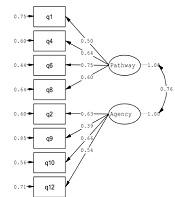
Confirmatory factor analysis (CFA) was conducted to evaluate the factor structure of the HSA and to compare previously reported competing models. Model fit indices and their recommended threshold values are presented in Table 2. Figure 1 illustrates the standardized factor structure of the retained model for the Persian version of the HSA.
Table 2.
Goodness-of-Fit Indices for the Persian Version of the Hopefulness Scale for Adolescents a
| Fit index | Acceptable Criterion | Obtained Value | Interpretation |
|---|---|---|---|
| χ2 | — | 595.33 | — |
| df | — | 245 | — |
| χ2/df / CMIN/DF | Good < 3; acceptable < 5 | 2.43 | Good fit |
| GFI | > 0.90 | 0.79 | Slightly below acceptable |
| RFI | > 0.90 | 0.87 | Slightly below acceptable |
| IFI | > 0.90 | 0.93 | Acceptable |
| TLI | > 0.90 | 0.92 | Acceptable |
| CFI | > 0.90 | 0.93 | Acceptable |
| NFI | > 0.90 | 0.89 | Slightly below acceptable |
| RMSEA | < 0.08 | 0.08 | Acceptable |
a Abbreviations: CFI, Comparative Fit Index; TLI, Tucker-Lewis Index; NFI, Normed Fit Index; RFI, Relative Fit Index; IFI, Incremental Fit Index; GFI, Goodness-of-Fit Index; RMSEA, Root Mean Square Error of Approximation; CMIN/DF, minimum discrepancy divided by degrees of freedom.
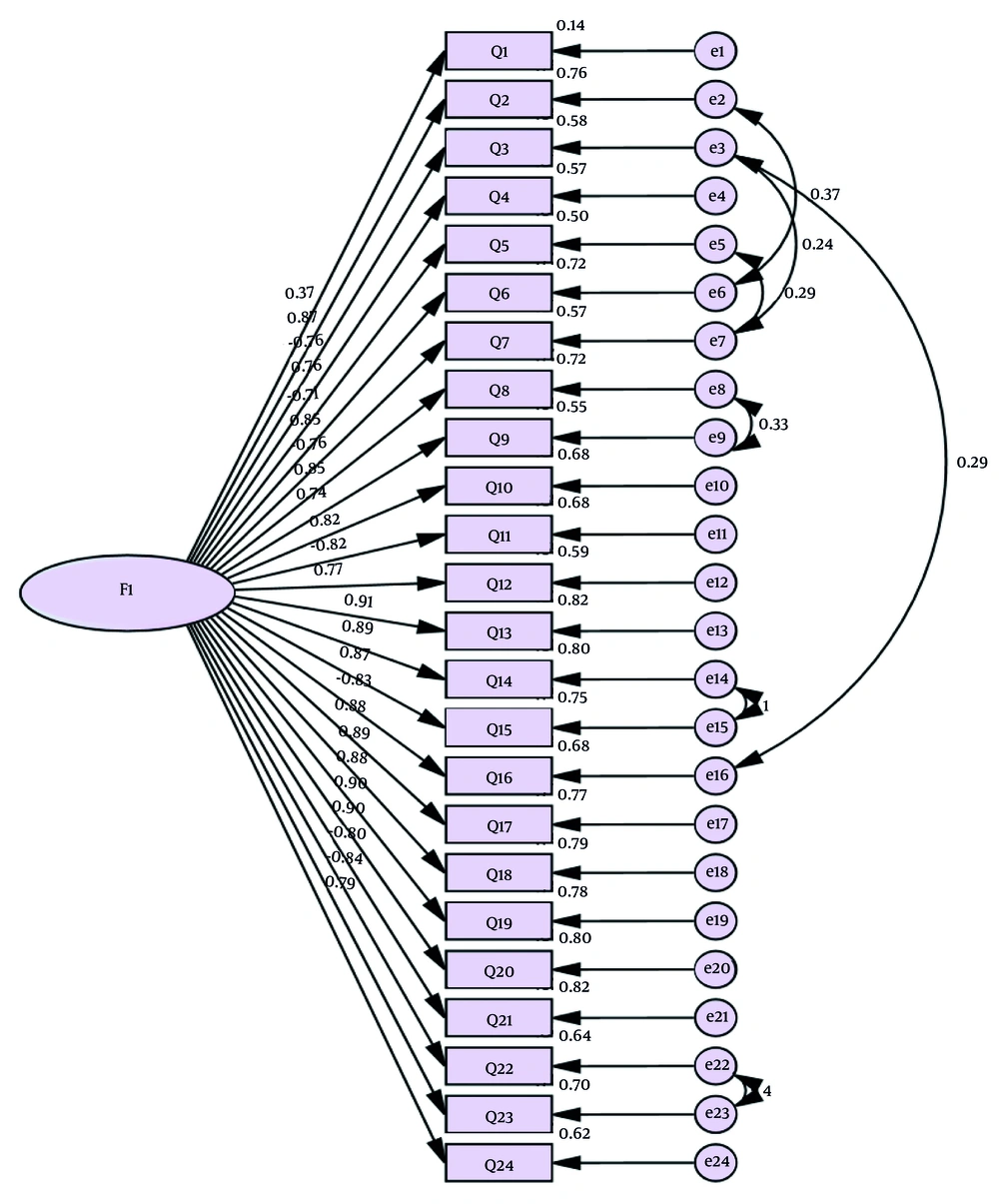
Figure 1.
Structural Model of the Persian Version of the Hopefulness Scale for Adolescents
The previously published Persian two-factor 22-item model demonstrated inadequate fit to the data. In contrast, the original one-factor 24-item model showed acceptable fit and was therefore retained as the preferred solution. Fit statistics for the retained model were as follows: χ2 = 595.33, df = 245, χ2/df = 2.43, CFI = 0.93, TLI = 0.92, NFI = 0.89, and RMSEA = 0.08. Standardized factor loadings ranged from 0.38 to 0.96. Although Item 1 demonstrated the lowest loading, it exceeded the minimum acceptable threshold and was therefore retained to preserve the theoretical integrity of the original scale. Examination of modification indices and residual correlations did not identify any theoretically justifiable cross-loadings or correlated error terms requiring model modification. Item-level psychometric indicators included standardized factor loadings, item-total correlations, communalities, and Cronbach's alpha if item deleted. The Average Variance Extracted (AVE) and Composite Reliability (CR) values for the retained model were 0.650 and 0.978, respectively, providing additional support for construct validity.
4.2.2. Convergent Validity
Convergent validity was examined by correlating HSA scores with scores on the Self-Transcendence Scale-Adolescent Version. Significant positive correlations were observed between hopefulness and the self-acceptance dimension (r = 0.50, P < 0.001), the maturity dimension (r = 0.93, P < 0.001), and the total self-transcendence score (r = 0.60, P < 0.001).
4.2.3. Known-Groups Validity
Known-groups validity was evaluated by examining differences in hopefulness scores across demographic and clinical subgroups.
Kruskal–Wallis test results demonstrated statistically significant differences in hopefulness by age, educational level, and duration of illness. Furthermore, Mann–Whitney U test results indicated significant differences in hopefulness scores between adolescents with and without comorbid medical conditions. These findings support the ability of the HSA to discriminate between groups expected to differ in hopefulness levels and therefore provide evidence of known-groups validity. Detailed results are presented in Table 3.
Table 3.
Known-Groups Validity Analysis of the Hopefulness Scale for Adolescents
| Variables and Categories | HSA Score (Mean ± SD) | Statistical Test | Test Statistic | P-Value |
|---|---|---|---|---|
| Other illnesses | Mann–Whitney U test | |||
| Yes | 67.12 ± 10.11 | Z = -3.54 | < 0.001 | |
| No | 75.35 ± 8.96 | Z = -3.54 | < 0.001 | |
| Duration of illness, months | Kruskal–Wallis test | |||
| 6 - 12 | 76.37 ± 7.30 | χ2 = 12.05; df = 2 | 0.002 | |
| 13 - 24 | 72.13 ± 11.75 | χ2 = 12.05; df = 2 | 0.002 | |
| ≥ 25 | 71.08 ± 9.72 | χ2 = 12.05; df = 2 | 0.002 | |
| Educational level | Kruskal–Wallis test | |||
| Second elementary | 80.52 ± 11.19 | χ2 = 27.67; df = 2 | < 0.001 | |
| First high school | 75.79 ± 7.29 | χ2 = 27.67; df = 2 | < 0.001 | |
| Second high school | 74.02 ± 9.62 | χ2 = 27.67; df = 2 | < 0.001 | |
| Age (y) | Mann–Whitney U test | |||
| 11 | 78.41 ± 9.81 | — | < 0.001 | |
| 17 | 70.61 ± 11.68 | — | < 0.001 |
4.3. Reliability
Internal consistency reliability of the HSA was assessed using Cronbach's alpha coefficient. The overall Cronbach's alpha for the scale was 0.70, indicating acceptable internal consistency in this sample of adolescents with cancer. Owing to the cross-sectional study design, reliability assessment was limited to internal consistency analysis.
5. Discussion
The availability of culturally appropriate and psychometrically sound instruments is essential for accurately assessing health-related constructs and evaluating the effectiveness of interventions designed to improve them. Hopefulness is a key determinant of psychological well-being and quality of life among adolescents with cancer (16). Therefore, this study aimed to evaluate the psychometric properties of the HSA among Iranian adolescents with cancer. To provide comprehensive evidence regarding the instrument’s performance in this population, multiple aspects of validity and reliability were examined.
Following qualitative assessments of content and face validity by both expert reviewers and members of the target population, no modifications to the translated Persian version of the instrument were considered necessary. Consequently, the existing Persian version, previously validated among Iranian adolescents living in residential care settings, was retained in its original form. This finding suggests that the instrument has adequate clarity, relevance, and comprehensibility across different adolescent populations within the Iranian cultural context, supporting its applicability as a standardized measure of hopefulness.
Construct validity was evaluated using CFA, convergent validity, and known-groups validity. The findings supported a unidimensional structure for the HSA, consistent with the original conceptualization proposed by Hinds and colleagues (16). This result is noteworthy because it confirms the theoretical coherence of the original scale within a clinical population of adolescents with cancer. The findings also align with previous psychometric investigations conducted among Iranian adolescents residing in residential centers, which similarly supported the overall conceptual structure of the instrument. Collectively, these results provide evidence for the structural stability of the HSA across both clinical and non-clinical adolescent populations.
Nevertheless, some discrepancies have been reported in previous Iranian validation studies. For example, Another study identified a two-factor, 22-item structure among Iranian high school students, comprising the dimensions "optimistic thinking about the future" and "pessimistic thinking about the future." Items 4 and 9 were excluded because they did not load satisfactorily on either factor.
Such differences may reflect variations in sample characteristics rather than limitations of the instrument itself. Unlike healthy school-based populations, adolescents with cancer are exposed to substantial physical and psychological stressors that may influence the organization and expression of hope-related cognitions. These findings underscore the influence of population-specific characteristics, including psychological, social, and cultural contexts, on the measurement and conceptualization of hopefulness.
Similar variability in factor structures has been reported for other measures of hope. For example, the Children's Hope Scale (CHS) was validated among Indian adolescents, and a two-factor structure was identified comprising the dimensions of agency and pathways, which explained 46.55% of the total variance (29). In contrast, Richter et al. reported a unidimensional structure for the CHS in individuals aged 8 - 18 years (30). These findings, together with the results of the present study, suggest that the dimensionality of hope-related constructs may vary across populations and settings. Such variability underscores the influence of cultural, linguistic, developmental, and contextual factors on the psychometric performance of psychological instruments and reinforces the importance of validating measures within the specific populations in which they are intended to be used.
One notable strength of the HSA is that its psychometric properties have been examined specifically among adolescent populations using multiple validation approaches. In addition to factorial validity, previous studies have demonstrated convergent validity through positive associations with self-esteem, self-efficacy, and general health, as well as predictive validity in distinguishing adolescents experiencing depressive symptoms from those without depression (31). Taken together, these findings support the utility of the HSA as a comprehensive measure of hopefulness and strengthen confidence in its application in both research and clinical settings.
Furthermore, the HSA captures both the current level of hopefulness and its potential variation over time and across clinical contexts (31). Consequently, the HSA may be especially useful for longitudinal studies and intervention research aimed at enhancing hope among adolescents with serious illnesses.
Convergent validity was supported by the significant positive association observed between hopefulness and self-transcendence. This finding is consistent with previous research demonstrating meaningful relationships between these constructs across diverse populations. For example, Haugan et al. (32) reported a significant association between self-transcendence and hope among cognitively intact older adults residing in nursing homes. The consistency of these findings across age groups suggests that hopefulness may function as a universal psychological resource that facilitates adaptation, resilience, and meaning-making in the face of adversity.
Self-transcendence has been described as a developmental resource that enables individuals to expand their perspective beyond immediate circumstances, derive meaning from adversity, and maintain a sense of purpose despite illness. This conceptualization is consistent with Erikson's developmental theory and suggests that hope and self-transcendence may represent complementary psychological processes that facilitate adaptation to cancer and its associated challenges (32).
The relationship between hope and self-transcendence may also be understood within broader psychosocial and spiritual frameworks. Previous literature suggests that hope is often nurtured through supportive interpersonal relationships, meaning-making processes, and opportunities for reflection during periods of adversity. For adolescents confronting cancer, such experiences may foster a sense of connectedness, purpose, and optimism, thereby strengthening both hope and resilience (33). These findings highlight the potential value of psychosocial and spiritually sensitive interventions aimed at promoting meaning, connection, and adaptive coping in this population. In line with this perspective, recent cancer-related intervention research has shown that psychological approaches such as acceptance and commitment therapy may help address disease-related emotional difficulties and improve supportive care programs for patients undergoing cancer treatment (34).
Furthermore, self-transcendence has been associated with greater psychological adaptation and coping among individuals facing serious illness (32, 35). Conceptually, it shares important similarities with post-traumatic growth (PTG), a construct describing positive psychological changes that emerge following highly stressful life events (36). Several studies have reported positive associations between hope and dimensions of PTG, including stronger interpersonal relationships, greater personal strength, appreciation of life, and openness to new possibilities. Individuals with higher levels of hope also appear more likely to engage with supportive social networks and demonstrate greater resilience when confronted with adversity (37). Collectively, these findings suggest that interventions designed to foster self-transcendence, meaning-making, and personal growth may contribute to strengthening hope and resilience among adolescents with cancer.
Known-groups validity analyses further supported the construct validity of the HSA. Significant differences in hopefulness scores were observed according to age, educational level, illness duration, and the presence of comorbid conditions. Adolescents with cancer who also reported additional chronic health conditions, such as asthma, demonstrated lower levels of hopefulness than those without comorbid conditions. This finding is consistent with evidence suggesting that chronic illness may adversely affect sexual development, psychological well-being, social participation, educational experiences, independence, and perceptions of the future, all of which can undermine hope (38-40). In contrast, higher levels of hopefulness were observed among older adolescents and those with higher educational attainment. Similar age-related increases in hope have been reported in previous studies, including those conducted in Portugal, suggesting that developmental maturity and the acquisition of more effective coping strategies may strengthen hopeful thinking over time (41-43). Likewise, the positive association between longer illness duration and greater hopefulness may reflect progressive adaptation to the disease, improved symptom management, and the development of resilience as adolescents gain experience in coping with the challenges of cancer (21).
In the present study, Cronbach's alpha for the unidimensional HSA was 0.70. The original version does not explicitly report an overall alpha coefficient (31); however, prior studies have demonstrated moderate to strong internal consistency, with values ranging from 0.86 to 0.92 (16, 31, 44, 45). In a study of adolescents with cancer in the United States, Cronbach's alpha was reported as 0.92 (46). Similarly, Heidarzadeh et al. reported an overall alpha of 0.83, with subscale values of 0.80 and 0.70 for "optimistic thinking about the future" and "pessimistic thinking about the future," respectively. Although slightly lower than previous reports, the observed internal consistency remains acceptable for psychological measurement, supporting the reliability of the HSA in assessing hopefulness in the target population (36).
Although the HSA demonstrated acceptable internal consistency in the present sample, evidence for reliability was limited to Cronbach's alpha. Other important reliability indicators, including test–retest reliability, measurement error, item–total correlations, and alpha-if-item-deleted statistics, were not examined. Consequently, conclusions regarding the overall reliability and temporal stability of the instrument should be interpreted with caution. Future psychometric studies should incorporate these additional reliability assessments to provide a more comprehensive evaluation of the HSA's measurement properties among adolescents with cancer.
In a psychometric study conducted among Iranian adolescents residing in residential care centers, Cronbach's alpha for the unidimensional instrument was reported as 0.83. Similarly, Hinds et al. (31) reported internal consistency estimates ranging from 0.89 to 0.92 across different measurement occasions. Collectively, these findings support the reliability of the HSA as a measure of hopefulness among adolescents, although additional psychometric evaluation is warranted to further strengthen the evidence base and optimize the instrument's measurement performance.
5.1. Study Limitations
Several limitations should be considered when interpreting the findings of this study. First, the sample size available for CFA represents an important limitation. Although participants were recruited from multiple referral centers located in different regions of Iran, access to a larger sample of adolescents with cancer was challenging. Variations in hospitalization pathways and treatment settings for adolescents with cancer, including admission to pediatric versus adult wards and management in specialized hematology-oncology versus general medical or surgical units, restricted access to eligible participants. Consequently, future psychometric studies involving larger samples and more diverse cultural and clinical contexts are warranted to further evaluate the stability of the HSA factor structure.
A second limitation relates to the use of convenience sampling and online questionnaire distribution through social media and messaging platforms. This recruitment strategy may have affected sample representativeness and, consequently, the generalizability of the findings. Adolescents with easier access to referral hospitals, internet connectivity, higher levels of digital literacy, stronger family support, or greater willingness to participate in research may have been overrepresented. Conversely, adolescents with more severe illness, poorer psychological well-being, limited internet access, or lower digital literacy may have been underrepresented. As a result, caution is warranted when generalizing the present findings to all Iranian adolescents with cancer. Future studies should employ more diverse and representative sampling approaches to strengthen external validity.
A further limitation is that reliability assessment was restricted to internal consistency. Although the HSA demonstrated acceptable internal consistency in the present sample, other important reliability indicators, including test–retest reliability, measurement error, and item-level reliability indices, were not evaluated. Consequently, the current findings provide only partial evidence regarding the reliability of the HSA. Future psychometric investigations should assess these additional measurement properties to provide a more comprehensive evaluation of the scale's temporal stability and measurement precision among adolescents with cancer.
5.2. Conclusions
The findings of this study provide evidence that the Hopefulness Scale for Adolescents (HSA) is a valid and reliable instrument for assessing hopefulness among Iranian adolescents with cancer. The results support the original 24-item, single-factor structure of the scale and demonstrate satisfactory psychometric performance in this clinical population. Given its brevity, ease of administration, and acceptable validity and reliability, the HSA may serve as a useful instrument for both research and clinical assessment of hopefulness among adolescents with cancer.
Because hope is a critical determinant of psychological well-being, adaptation, and quality of life during adolescence, systematic assessment of hopefulness may assist nurses and other healthcare professionals in identifying adolescents who require additional psychosocial support. Furthermore, the HSA may facilitate the evaluation of interventions designed to enhance hope, resilience, and coping throughout the cancer trajectory, including psychosocial, family-based, peer-support, and spiritually oriented programs. Nevertheless, further psychometric investigations involving larger and more diverse samples are recommended to confirm the stability and generalizability of the present findings.