
1. Background
Multiple Sclerosis (MS) is one of the central nervous system diseases (1). Genetic (e.g., female sex), environmental, and behavioral factors (tobacco use, low vitamin D levels, Epstein-Barr virus infection), and most likely gene-environment interactions are factors affecting MS development (2). MS impairs many neuronal functions, including cognition, vision, coordination, and balance, which cause functional limitations and disability. MS patients are therefore more likely to experience mental health problems than healthy individuals (3).
MS usually affects young women who are at the peak of their family and personal responsibilities and sexual activity, and have varying degrees of disability. There is an increased risk of MS in females (4). It has been reported that females are three times more likely to be affected by MS than males (5). A number of physical, psychological, social, and cultural changes can be caused by this disease, including a loss of femininity, a lack of attractiveness, and infections and premature births (6).
Patients with MS can become frustrated as a result of uncertainty, fear, and anxiety. Life expectancy is considered an essential adaptation mechanism and a potentially influential factor of adaptation and recovery in chronic diseases such as MS (7). Females with MS can benefit from hope since feelings of hopelessness are common and can pose a severe threat to their health and well-being (8). Many women suffering from this disease experience despair due to the unpredictability of the disease. Hope helps people as an essential source of coping in the face of challenging and stressful situations (9).
Similar to hope, self-efficacy emphasizes the way individuals respond to a particular event (10). While self-efficacy focuses on how a person appears to be able to do the necessary activities, it does not emphasize the purpose for doing those activities. Hence, self-efficacy consists of thinking in terms of agency or a person’s ability to take the first steps toward achieving a goal (11). Self-efficacy and hope are both future-oriented behaviors with a tangible function in achieving goals and are significantly more negatively related to posttraumatic stress symptoms than the other constructive expectations (12). Positive mental health and mental illness, such as anxiety and depression, are more likely to be associated with hope (13). Furthermore, hope may counteract stress and anxiety-related disorders (14).
Measurement tools for evaluating hope include the State Hope Scale (1996), the Miller Hope Scale (1988), the Herth hope index (1991), the Integrative Hope Scale (2010), and the Children Hope Scale (1997). The Adult Hope Scale (AHS) is one of these instruments. This scale has been used in various countries such as the United States, Australia, Kuwait, the Philippines, Spain, Slovakia, Brazil, and China in academic, general population, hospital, elementary school, high school, and rehabilitation programs with favorable outcomes (15). The Adult Hope Scale (AHS) consists of 12 items grouped into the agency thinking and pathway thinking dimensions. Agency thinking is the motivation to pursue goals and belief in one’s ability to achieve desired goals. Pathway thinking is based on developing ways to achieve goals. The original scale has been translated into Arabic (16), and Hungarian (17) versions are available.
The purpose of this study was to investigate a valid and reliable measure for assessing perceived hope in Iranian females with multiple sclerosis based on statistical analysis. The study identifies hope levels among Persian people living in varied life circumstances, with a range of experiences and values, as well as investigating the sources and different dimensions of hope than people in other countries. Currently, no studies have been conducted on general levels of hope in Iranian females with MS. Still, the Persian Adult Hope Scale (AHS) psychometric characteristics are available for the general adult population (18).
2. Objectives
The purpose of this study was to evaluate the psychometric characteristics (validity, reliability) of the Persian version of the AHS for Iranian females with multiple sclerosis (MS).
3. Materials
This cross-sectional study was conducted on female patient members of the Iran MS Society of Tehran Province from November to August 2019. Hence, 321 Iranian females were selected using convenience sampling.
Informed consent was obtained from participants before the survey began. Obtaining informed consent and maintaining confidentiality were important aspects of this study. Respondents were sent links to social networks to help them complete online questionnaires using a Google Form. As well as this, the survey included a reminder that participation was voluntary, and it was coded to evaluate test-retest reliability. The respondents chose whether to participate in the study and provide information or withdraw-the Cohen's kappa coefficient (K = 0.76) indicates that the inter-rater agreement was satisfactory. The participants completed self-assessment questionnaires including sociodemographic and MS-related information, AHS, BAI, BDI-II, and GSE.
3.1. Participants
The inclusion criteria were the age range of 18 - 70 years old, being female, having a definitive diagnosis of multiple sclerosis (based on McDoland diagnostic criteria), compliance with the study conditions, willingness to complete questionnaires in Persian, and signing written informed consent. The exclusion criteria were other severe neurological problems such as neuromyelitis optica spectrum disorder (NMOSD), clinically isolated syndrome (CIS), or Parkinson’s disease, determined by an experienced neurologist, brain tumors, severe psychiatric disorders such as mental retardation, schizophrenia spectrum disorder, severe mood disorders, substance use disorders, personality disorders, status of acute relapse, and current use of mood- and sleep-altering medications, including steroids. A total of 342 participants completed the questionnaires, but the final sample size was as much as 321.
3.2. Measures
Age, marital status, educational status, substance use in the family, as well as the onset of substance abuse, was collected as part of the demographic characteristics checklist used by the researcher.
• The Adult Hope Scale was used to assess hope (19), which is a 12-item measure for determining a respondent’s level of hope. This scale has been divided into two subscales comprising Snyder’s cognitive model of hope: (1) Agency (i.e., goal-directed energy) and (2) Pathways (i.e., planning to accomplish goals). Among the 12 items, 4 are part of the Agency subscale and 4 are part of the Pathways subscale. The remaining four items are fillers. Each item is answered using an 8-point Likert-type scale ranging from definitely false to definitely true (20). Higher scores indicate a higher life expectancy in the respondent and vice versa. Khodarahimi reported the reliability by Cronbach’s alpha as much as 0.82 (21).
• Beck Anxiety Inventory: The Beck Anxiety Inventory has rapidly identified and differentiated from other disorders, particularly depression and anxiety. This inventory assesses the anxiety during the past week using a 21-question multiple-choice self-report rated from 0 (not at all) to 3 (severely). Osman et al. reported a test-retest validity of 0.75 (22). Iranian studies demonstrate that this instrument is psychometrically sound, and that the Persian version of the BAI shows acceptable test-retest reliability (r = 0.67) as well as internal consistency over time (α = 0.88) (23).
• Beck Depression Inventory (BDI-II): The 21-item BDI-II was developed to measure the level of depression in adults and adolescents. The measure uses a 4-point Likert scale ranging from 0 to 3, with a score of 0 - 13 (minimal), 14 - 19 (mild), 20 - 28 (moderate), and 29 - 63 (severe) (24). The study by Magan et al. found that this instrument captures a dimension of general depression with a high degree of internal consistency (α = 0.89) (25). The BDI-II indicated significant positive internal consistency (Alpha = 0.92) and test-retest reliability (r = 0.64).
3.3. General Self-efficacy (GSE)
The scale was developed in 1979 by Schwarzer and Jerusalem and consists of ten items that measure self-efficacy in general, but has been revised in 1981 into ten items. The scoring process for the scale is based on a Likert scale ranging from 1 to 4, where 1 is the lowest score and 4 is the highest score. The Cronbach’s alpha coefficient of this scale was 0.82 (26). The Cronbach’s alpha coefficient of this scale in Iran was 0.81 (27).
3.4. Procedure
The initial phase consisted of three steps in line with the conventional back-translation method (28). There were three main phases involved in the study, which included translation techniques for the instrument and cultural adaptations for the instrument. In the second phase of the research project, the psychometric characteristics of the instrument were analyzed, which was used to test its validity. Backtranslation was used to translate the Adult Hope Scale (AHS) into Persian (Farsi) in the first phase of the project. The measurement is translated into the target language by one translation team, and then back into the source language by a second translation team. Translators were judged based on how closely they matched the source text. The study was conducted with the help of three translators, who worked independently. Therefore, there were no significant differences in interpretation and presentation. In the next procedure, the authors reached an agreement with the translators. Finally, an English professor changed some possible points to make them more understandable to the general public. The items have been kept as close to the original scale as possible. As part of the questionnaire, sociodemographic questions were included to characterize the sample in terms of their education, marital status, and type of MS. The third stage of the study examined confirmatory factor analysis (CFA), reliability, and validity of AHS. In the first phase of the study, a CFA was conducted to determine the study's factor structure. The reliability of the questionnaire was determined by Cronbach's alpha and test-retest reliability. A further examination of the construct validity of the scale was conducted by examining its convergent and divergent validity (29). The second step of the study involved collecting data from current women with MS since it is appropriate to use a new sample for the calculation of the CFA.
3.5. Data Analysis
Pearson correlation between the Adult Hope Scale (AHS) and anxiety, depression, and general self-efficacy subscales was analyzed using IBM SPSS Statistics Version 26.0 (IBM SPSS Statistics, Inc., Armonk, USA). A confirmatory factor analysis (CFA) model was also used. Cronbach's alpha was used to determine the internal consistency of the Adult Hope Scale (AHS). Based on the two-factor structure of the Adult Hope Scale (AHS), an analysis of its performance was conducted using LISREL 8.8. The root mean square error of approximation was assessed using the root mean square error of approximation (RMSEA), the parsimony normed fit index (PNFI), the comparative fit index (CFI), the incremental fit index (IFI), and the standardized root mean square residual (SRMR). It is crucial for well-fit models to have CFI, IFI, NFI values above 0.90, AGFI values above 0.80, PNFI values above 0.50, RMSEA values below 0.08, and SRMR values below 0.09. In addition, the Cronbach’s alpha coefficient of the Adult Hope Scale (AHS) was estimated.
3.6. Ethical Consideration
Research processes involving humans followed the National Research Committee's ethical values, the Helsinki Declaration of 1964, as modified, or equivalent ethical standards. A consent form was completed by all participants when they returned the survey, and all scales were completed anonymously. The authors declared no conflict of interests.
4. Results
4.1. Descriptive Statistic
The age range of participants was 20 to 69 years old (Mean = 40.61 years, SD = 9.89), and their disease duration was 2 to 23 (Mean = 10.91, SD = 7.81 years). The mean and standard deviation (SD) for the Adult Hope Scale (AHS) was calculated as much as 31.28 (4.58) (Table 1 and Table 2). The Cronbach’s alpha for AHS overall was measured as much as 0.78. The temporal stability was performed after two weeks for 321 women, and the coefficient of retest and test was 0.79 (CI = 0.77 - 0.81).
Table 1.
The Relationship Between AHS with the Sociodemographic and Clinical Characteristics of the Sample (N = 321)
| No. (%) | Mean ± SD | F | P-Value | |
|---|---|---|---|---|
| Educational status | 0.74 | 0.52 | ||
| High school and less | 116 (36.1) | 31.30 ± 4.19 | ||
| Diploma | 118 (36.8) | 31.61 ± 4.33 | ||
| Bachelor | 73 (22.7) | 30.69 ± 4.15 | ||
| Above bachelor | 14 (4.4) | 31.42 ± 3.64 | ||
| Marital status | 2.09 | 0.039 | ||
| Married | 198 (61.68) | 31.75 ± 4.22 | ||
| Single/widow, divorced | 123 (38.32) | 30.78 ± 4.16 | ||
| Type of MS | 0.89 | 0.44 | ||
| RRMS | 229 (71.34) | 31.44 ± 4.47 | ||
| SPMS | 36 (11.21) | 31.23 ± 4.15 | ||
| PPMS | 32 (9.97) | 31.15 ± 3.98 | ||
| PRMS | 24 (7.48) | 29.92 ± 3.76 |
Table 2.
The Descriptive Statistics for all Adult Hope Scale (AHS) Items (N = 321)
| Item | Component | Item Statistics | Item-Total Statistics | |||
|---|---|---|---|---|---|---|
| Min - Max | Mean ± SD | V | I.T. | C.D. | ||
| Item 1 | Pathways thinking | 1 - 5 | 3.93 ± 0.858 | 14.217 | 0.428 | 0.759 |
| Item 2 | Agency thinking | 1 - 5 | 3.90 ± 0.853 | 13.625 | 0.535 | 0.741 |
| Item 4 | Pathways thinking | 1 - 5 | 4.02 ± 0.720 | 14.330 | 0.527 | 0.745 |
| Item 6 | Pathways thinking | 1 - 5 | 4.03 ± 0.776 | 13.775 | 0.581 | 0.735 |
| Item 8 | Pathways thinking | 1 - 5 | 3.84 ± 0.811 | 13.866 | 0.530 | 0.742 |
| Item 9 | Agency thinking | 1 - 5 | 4.15 ± 0.844 | 14.850 | 0.332 | 0.775 |
| Item 10 | Agency thinking | 1 - 5 | 3.78 ± 0.925 | 13.438 | 0.506 | 0.746 |
| Item 12 | Agency thinking | 1 - 5 | 3.63 ± 0.944 | 13.933 | 0.412 | 0.764 |
| Pathway thinking | - | 4 - 20 | 15.45 ± 2.460 | - | - | - |
| Agency thinking | - | 7 - 20 | 15.83 ± 2.355 | - | - | - |
| AHS | 18 - 41 | 31.28 ± 4.58 | ||||
Abbrevieions: SD, standard deviation; V, scale variance if item deleted; I.T., corrected item-total correlations; C.D., Cronbach’s alpha if item deleted; PT, pathways thinking; AT, agency thinking.
4.2. Confirmatory Factor Analysis
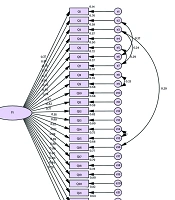
The confirmatory factor analysis (CFA) findings for a two-factor structure are demonstrated in Figure 1. The Kaiser–Meyer–Olkin (KMO) index was 0.79, surpassing the advised value of 0.6 (30). The Bartlett's Test of Sphericity (31) reached statistical significance (x2 = 625.52, P < 0.001). Therefore, the data were suitable for factor analysis. These results are acceptable, given that the factor loadings for all items are significant.
The Confirmatory factor analysis indicated that the two-factor structure provided a good fit to the data: sbX2 = 66.93 (P < 0.01), SRMR = 0.07, CFI = 0.91, NFI = 0.90, IFI = 0.92, PNFI = 0.61, GFI = 0.93, and RMSEA =0.079. All items loadings showed a significant factor (Tables 3, Figure 1). As shown in Table 3, the model fit indicators in the two-factor model are better than the single-factor model.
Table 3.
Model Fit Index (N = 321)
| Model | sbX2 | SRMR | CFI | NFI | IFI | PNFI | GFI | RMSEA |
|---|---|---|---|---|---|---|---|---|
| Single-factor | 143.06 | 0.076 | 0.88 | 0.86 | 0.88 | 0.62 | 0.90 | 0.139 |
| 2-Factor | 66.93 | 0.070 | 0.91 | 0.90 | 0.92 | 0.61 | 0.93 | 0.079 |
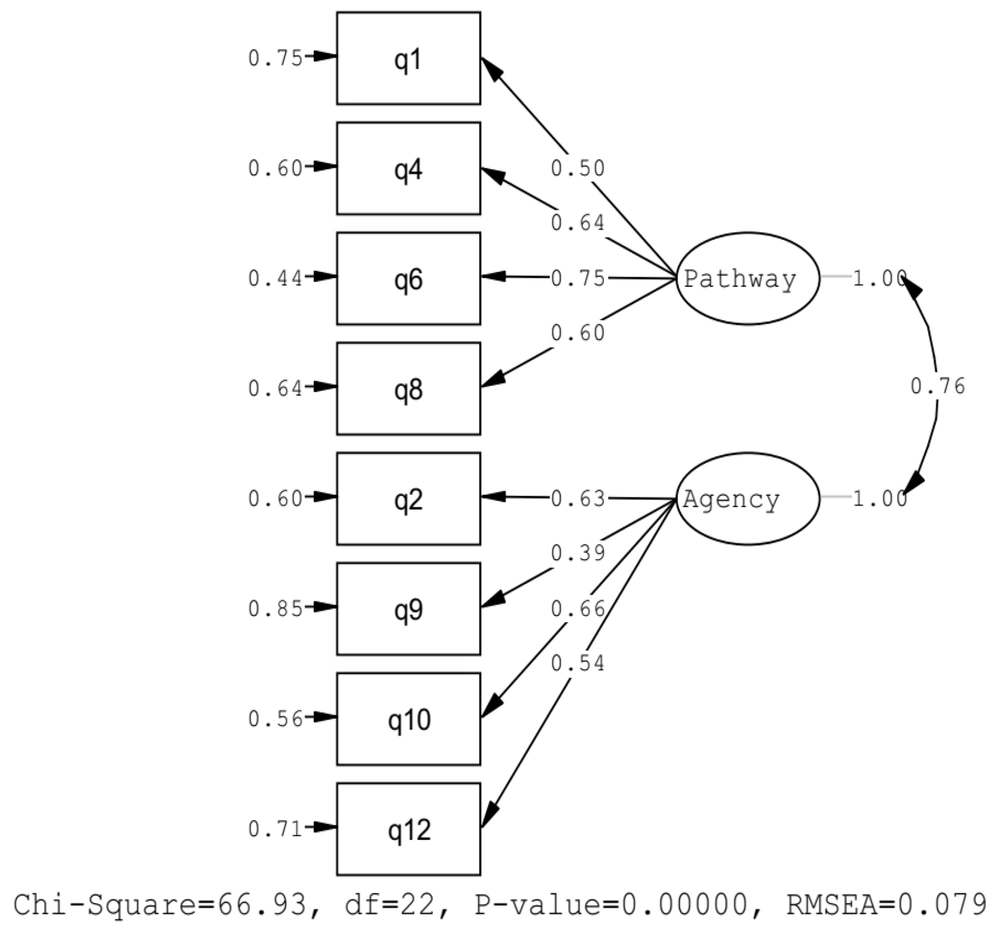
Figure 1.
Results of the confirmatory factor analysis of the Adult Hope Scale (AHS) in Iranian females with MS.
4.3. Convergent and Divergent Validity
Divergent validity was indicated by the correlations of the Adult Hope Scale (AHS) with Beck's Depression Inventory (BDI) and Beck's Anxiety Inventory (BAI). There was a significant negative correlation between AHS with the Beck’s Depression Inventory (r = -0.51; P < 0.01) and Beck’s Anxiety Inventory (r = -0.42; P < 0.01). In addition, there was a positive correlation between AHS and self-efficacy (r = -0.41; P < 0.01). These results present acceptable divergent and convergent validity (Table 4).
Table 4.
Pearson’s Correlation Between AHS with Depression, Anxiety, and Self-efficacy
| α a | 1 | 2 | 3 | 4 | 5 | 6 | |
|---|---|---|---|---|---|---|---|
| 1. Adult Hope Scale (AHS) | 0.78 | 1 | |||||
| 2. Agency thinking | 0.68 | 0.88** | 1 | ||||
| 3. Pathway thinking | 0.73 | 0.86** | 0.53** | .1 | |||
| 4. Beck’s Depression Inventory (BDI) | 0.83 | -0.51** | -0.46** | -0.42** | .1 | ||
| 5. Beck’s Anxiety Inventory (BAI) | 0.76 | -0.42** | -0.43** | -0.39** | 0.67** | .1 | |
| 6. General Self-efficacy Scale | 0.81 | 0.41** | 0.34** | 0.37** | -0.26** | -0.23** | .1 |
a Cronbach’s alpha
4.4. Reliability Test Results
Reliability refers to the consistency and repeatability of the results of an instrument. Internal consistency is assessed using Cronbach's alpha coefficient (29), which was 0.73 for the Pathways thinking factor and 0.68 for the Agency thinking factor. The Cronbach's alpha for the whole scale was 0.78 (Table 4). These results indicate that AHS has an acceptable level of internal consistency.
5. Discussion
This study aimed to evaluate the psychometric characteristics of the Persian version of the Adult Hope Scale (AHS) in a sample of Iranian females with MS. Patients with MS in the Iranian population need a hope scale. However, few measures are validated in this group. Hope assessments, such as AHS, need to be culturally adapted and validated in Iran. It has been shown that the reliability of the AHS has been confirmed by Cronbach's alpha, which shows high internal consistency both for the full scale (α = 0.78) and for the subscales of agency thinking (will to achieve the goal) (α = 0.68), pathways thinking (ways to achieve the goal) (α = 0.73), which is consistent with the results of (17, 18, 32).
All case coefficients and items showed high internal consistency and adequacy, echoing and expanding previous studies' findings. There was a sufficient factorial load on all items of the present study, and the reliability of the subscales was satisfactory. No items were removed in the current population, and all of the items had a high factor. Finally, the scale had 12 questions. In both clinical and general population samples, there is a high level of internal consistency (AHS) (32, 33).
Correlational and causal designs confirm construct validity for the AHS and its subscales, as well as divergent validity. The results could be explained in terms of other related self-report indicators related to anxiety, depression, and self-efficacy. According to Snyder et al. (19), People with a high dispositional hope have a positive attitude toward goal-pursuit processes. People who are more optimistic believe they have a better chance of realizing their goals, resulting in more positive feelings. This effect of hope was consistent with the mechanism of the stress-buffering effect, as it buffered the adverse effects of excessive stress in the brain. When high levels of stress are present in the environment, hope appears to have beneficial effects.
In the study, married women with MS had higher levels of hope than single women (34, 35). As a results, many sufferers learn to trust their partners when performing daily activities and managing symptoms. Some researchers believe that social factors contribute to the prevalence of cognitive impairment. Marital identity plays an essential role in the health of people with MS and reduce stress during caregiving. Females supported by their husbands and essential people in their lives are more robust in facing their illness and have a better mood than other females (36).
According to the results, this scale has convergent validity with self-efficacy in patients with MS. Self-efficacy is considered a predictor of health to improve health status in people with chronic diseases such as MS (37, 38). This study also indicated the divergent validity of AHS in depression and anxiety. According to Fischer et al., patients’ hope level is negatively related to anxiety and depression (39).
The disorders associated with MS, such as fatigue, sleep disturbances, pain, and restricted daily activities, make women with MS more susceptible to anxiety disorders and depression (40). Compared to other chronic neurological diseases, MS has a higher prevalence of depression disorders (39). A significant correlation has been found between hope and depression (35). Hope plays a crucial role in patients with MS, especially in females with the disease because of the emotional and physiological support patients receive in coping with the disease. Therefore, hope can be considered a barrier to depression (41).
The recent results are from Iranian females with; therefore, MS Several cautions should be taken in explaining the results. Any generalization to specific situations should be made with caution. Additionally, further research is needed to determine the psychometric characteristics of male MS patients in Iran. Such statistics depend on self-report to assess experience, which may be difficult to capture accurately and reliably. Despite the extensive use of self-report methods in personality and individual differences research, multiple strategies must also be employed when studying. Future use of the AHS should include its use alongside other tools such as quality of life and well-being measures among women with MS. This study has the limitation that most of the participants were women. Therefore, it would be beneficial to broaden the sampling so as to include a broader range of educational levels. To explore possible differences in gender, future research should extend the proportion of males and females.
The high prevalence of MS and the fact that many people with MS are women, as well as the fact that hope plays an important role in different stages of chronic diseases, including MS, make the availability of a standard instrument important. A larger sample size of clinical populations should be studied in the near future to compare the levels of hope between these groups. This will enable us to verify the results presented here. Future researchers and clinicians may consider administering the Adult Hope Scale to women with MS based on these preliminary findings.
5.1. Conclusions
According to the results, future research could be undertaken on the male population because this study was conducted on females with MS. Patients, physicians, nurses, and caregivers with MS can benefit from more research on clinical samples, such as other chronic diseases and comparisons to a healthy population, cross-cultural research, and treatment packages based on these results. The results of this study will allow future research to incorporate other variables, including suggestions, as well as conduct longitudinal studies.
The 12-item AHS indicated good psychometric characteristics in evaluating hope among Iranian females with MS. In clinical and research settings, the AHS is widely used in the assessment of hope. In this study, the AHS scale was found to be a reliable tool for assessing hope in Iranian females with MS and supports the use of the AHS scale in Iranian females with MS. In the future, the scale is expected to be integrated into Iranian psychological research, allowing the study of perceived hope to continue and become deeper.