1. Background
Securing and improving people’s health is one of the foremost goals and priorities of each community. Happiness is a psychological and mental concept with several meanings and elements (1). Over the past years, researchers have always investigated the positive and negative aspects of potential human abilities. In recent years, several psychologists have defined the concepts, correlated factors, and predictors of positive psychology, such as happiness and hope (2). Hopefulness is one of the life mechanisms. It is associated with better health and may be integral for stress and anxiety adaptation and resilience (3). In terms of monotheistic worldview, hope is a divine grant that moves life and provides motivation for effort. If humans are deprived of hope, they will get stuck a static situation. Most studies on happiness have emanated in WEIRD countries (Western, Educated, Industrialized, Rich, and Democratic) (2). In these countries, happiness is a self-centered worldview that emphasizes personal worthiness and hard work to obtain positive outcomes (4) and sees happiness as a personal achievement (5). In the Eastern Mediterranean worldview, on the other hand, the self is more entwined with others, such that personal happiness depends on positive connections in social relationships (2) Happiness is one of the most central concepts in mental health that has an impact on different aspects of young people’s lives (6). Since the youth experience disproportionately high rates of health and social problems, there is a need to identify protective factors for reducing high-risk behaviors among them (7). Moreover, young people who are hopeful are better able to take care of themselves than others (8).
Due to their special condition and their personality evolution, some people may be unable to encounter problems. In this situation, their mental problems in their individual and social life can be solved by paying attention to the issue of hope. Hopefulness is a mental condition that motivates people to work. Naturally, hope motivates people in their optional activities and eliminates their fear of failure. Hope makes humans move to achieve their goals. It is obvious that hope influences individuals’ thoughts, emotions, and achievements. However, this issue has not been received enough attention in theoretical studies. Researchers believe that hopefulness is necessary for encountering problems and uncertainties, and it plays a key role in mental health. According to studies, hope is a reliable predictor of academic achievement, especially among the youth. Hope equips people with energy and acts as a catalyst of activity. Also, it provides people with flexibility, viability, and the ability to get rid of life damages (9).
Theoreticians have conceptualized hope as a construct including two important categories, namely the ability to design some pathways for moving toward the favorable goals despite the existing obstacles and the ability to create motivation for starting and continuing the movement in these pathways. Hope consists of the two mentioned components (10). Snyder’s hope theory is a cognitive theory by which people can actively seek their goals (11, 12). The main variables involved in hopefulness include hopefulness in academic, family, occupational, and social areas, friendship, and leisure time. Snyder and Simpson have mentioned some of the effective factors based on which hopefulness can be evaluated, including academic achievement, relationship between family members, individuals’ occupational position, hope to get a better job, successful social relationships and trying to improve them, sincere relationships with friends, and planning for leisure time (11).
Evaluation of hopefulness based on the hope theory started with designing and validating the adult disposition hope scale, and different scales have been proposed for the evaluation of hopefulness over the past decades. Despite the expanded studies of western psychologists on the area of hopefulness, its components, and its effect on different dimensions of life, and the emphasis of Islam on the role of hope in quality of life, there is a significant research gap in this area in Iran. According to Mehrdadi’s report in 2016, the cultural, political, social, and economic conditions in Iran have led to the adoption of the age range of 15 - 29 years for young people in Iran become not a matter of choice but a necessity (6). There is a lack of an appropriate tool for the evaluation of hopefulness, and few studies have been performed on this issue in Iran. However, obtaining reliable results requires the use of valid tools with strong theoretical backgrounds and reliable psychometric properties. Therefore, every construct should be evaluated by its proportional tools based on scientific principles. So far, the hopefulness questionnaire has not been validated in Iran.
2. Objectives
This study aimed to evaluate the hopefulness questionnaire among the youth population. The results of this study will lead to the review and approval of the questionnaire and will allow further studies and reviews in the future.
3. Methods
This was a cross-sectional study carried out by an exploratory approach among the Iranian youth population in 2020. Factor analysis is one of the strong techniques used in different areas, especially social sciences (7). This technique not only helps to scientific saving but also provides the researcher with the possibility of index creation and reducing a complex set of data to a few factors. Also, it can determine which tests and measurement tools belong to each other and which of them has the capacity of measuring a variable. In this way, this method reduces the variables with which the researcher has to deal. The primary data of factor analysis is the correlation matrix. Meanwhile, factor analysis does not have any predetermined dependent variables (13).
3.1. Population and Sampling
In this study, the population included all students of Shahed University of Tehran (estimated as 5000 people). The samples were selected by the simple random sampling method. A simple random sample is a subset of a statistical population in which each member of the subset has an equal probability of being chosen. The sample size was determined by the Krejcie-Morgan table since the maximum number of samples in this table is 384, the sample size was considered 600 to increase the test power and prevent a decrease in the number of collected questionnaires.
3.2. Data Collection Tools
To validate the hopefulness questionnaire, several tests were used, including the Snyder’s hopefulness test. This test has been designed by Snyder et al. (1991) to evaluate hopefulness. It has 12 items and is used as a self-assessment test (14). Out of the 12 items, four items measure agency thinking, four items measure strategic thinking, and four items are misleading. Thus, this questionnaire includes two subscales, namely the agent and the strategy. The hopefulness questionnaire is used for the evaluation of hopefulness and includes 33 items scored based on a six-point Likert scale (15). The initial questions of the questionnaire were obtained from Schneider studies.
To determine the validity of the tool, the questionnaire was given to four professors of the Department of Educational Sciences, and they were asked to comment on the questions. In this study, inappropriate questions were removed, and some vague questions were placed in more appropriate dimensions. After establishing the content validity, the questionnaire was given to 30 students who were randomly selected, and Cronbach's alpha coefficient was calculated to be 0.730.
3.3. Data Analysis
Data analysis was performed by SPSS v. 21 and LISREL v. 8.80. An Alpha Cronbach coefficient was used to investigate the reliability of the questionnaire. Alpha Cronbach values > 0.7 were considered as acceptable (16, 17). Also, confirmatory and exploratory factor analysis (CFA and EFA) were conducted to disclose the factorial structure of the questions. The model fit in the present study was considered acceptable if at least two of the following three criteria were met: a root mean square error of approximation (RMSEA) values < 0.08, P-value > 0.05, and relative chi-square < 3 (18, 19).
The Ethics Committee of Roudehen Islamic Azad University approved the study protocol. Students were ensured that their information will be kept confidential.
4. Results
In the study, 600 students (387 females and 213 male) were participated. The mean age of the participants was 22 ± 3.1 years. This research seeks to determine the reliability of the questionnaire by Cronbach’s alpha coefficient. For the 33 items in the questionnaire, this coefficient was obtained 0.80, which was significantly higher than the pre-determined experimental level (0.7). Thus, the questionnaire is reliable enough. Table 1 presents the reliability of the questionnaire in the case of omitting each of the items. A study of the reliability coefficients in these conditions showed that in the case of omitting each of the items, Cronbach’s alpha coefficient will be higher than 0.7, and the questionnaire will still be reliable.
Table 1.
Cronbach's Alpha Coefficients of the Hopefulness Questionnaire’s Componentsa
| Questions | Scale Mean | Scale Variance | Total Correlation | Cronbach's Alpha | |
|---|---|---|---|---|---|
| 1 | How difficult is it for you to enjoy life? | 89.96 | 194.07 | 0.415 | 0.795 |
| 2 | How much do you try to give meaning to life as much as possible? | 88.25 | 205.96 | 0.149 | 0.805 |
| 3 | How hard is it for you to laugh? | 90.46 | 199.25 | 0.374 | 0.798 |
| 4 | How optimistic are you about most of the things you do? | 90.01 | 198.23 | 0.339 | 0.799 |
| 5 | How cheerful are you? | 88.47 | 206.50 | 0.153 | 0.805 |
| 6 | How motivated are you usually to keep working in difficult situations? | 88.73 | 201.34 | 0.302 | 0.800 |
| 7 | To what extent does nothing to motivate you? | 90.31 | 197.02 | 0.431 | 0.795 |
| 8 | How confident are you in your ability to deal with problems? | 88.37 | 210.47 | 0.018 | 0.809 |
| 9 | How frustrated do you find yourself in a person's life? | 90.61 | 197.20 | 0.519 | 0.794 |
| 10 | How much hope do you have not for the future? | 90.60 | 194.91 | 0.515 | 0.793 |
| 11 | How often do you feel like you are failing before starting a new job? | 90.50 | 197.69 | 0.440 | 0.795 |
| 12 | How frustrated are you by the problems? | 90.40 | 195.82 | 0.484 | 0.794 |
| 13 | How much did you sometimes fear of life so much that your body would shiver? | 90.50 | 201.26 | 0.326 | 0.799 |
| 14 | How much hope do you have in life? | 88.58 | 211.36 | -0.026 | 0.813 |
| 15 | How upset would you really be if you could not socialize with so many people? | 89.15 | 201.01 | 0.254 | 0.802 |
| 16 | How often do others upset you? | 89.72 | 197.89 | 0.338 | 0.799 |
| 17 | How often do you feel desperate for no apparent reason? | 90.38 | 196.69 | 0.448 | 0.795 |
| 18 | How often do you feel tired of living? | 90.51 | 194.19 | 0.488 | 0.793 |
| 19 | How much others know you as motivated person? | 88.54 | 203.34 | 0.260 | 0.802 |
| 20 | To what extent do you think about something for a long time and feel remorse when you do something wrong? | 89.22 | 205.25 | 0.147 | 0.806 |
| 21 | How much do you sometimes wish you were not born? | 90.47 | 192.46 | 0.515 | 0.791 |
| 22 | How much do you believe you should be happy in life? | 88.62 | 204.85 | 0.149 | 0.806 |
| 23 | How much do you stand up to problems and pursue your first goal? | 88.67 | 201.83 | 0.287 | 0.801 |
| 24 | To what extent do you think life is absurd and vain? | 90.68 | 197.55 | 0.479 | 0.795 |
| 25 | How much do you regret wishing you were as happy as others? | 89.86 | 193.93 | 0.380 | 0.797 |
| 26 | How often do you feel like you are really useless? | 90.54 | 197.40 | 0.442 | 0.795 |
| 27 | How full of energy do you sometimes feel? | 88.44 | 202.92 | 0.246 | 0.802 |
| 28 | How heartbreaking is the criticism of others? | 89.81 | 198.73 | 0.337 | 0.799 |
| 29 | How much happier do you always feel than others? | 88.74 | 204.94 | 0.184 | 0.804 |
| 30 | How much do you feel that success in life is always yours? | 88.82 | 201.51 | 0.251 | 0.802 |
| 31 | To what extent do small successes give you hope in life? | 88.34 | 199.52 | 0.175 | 0.809 |
| 32 | To what extent do you think that not trying is equal to failure? | 88.38 | 204.27 | 0.176 | 0.805 |
| 33 | How important do you think it is not to fall, but to get up again? | 88.11 | 207.72 | 0.096 | 0.807 |
aCronbach's Alpha = 0.805, N of Items = 33
To evaluate the saturation of the questionnaire by an overall factor (second question), exploratory factor analysis was applied. For this purpose, first, the number of latent factors of the questionnaire was determined by scree plot (Figure 1), and then latent concepts were identified by the factor loadings estimated for the indices. After identifying the confounding factors of the questionnaire, path analysis, and structural equation analyses were used for testing model saturation.
The scree plot of the questionnaire indices has been drawn as the following:
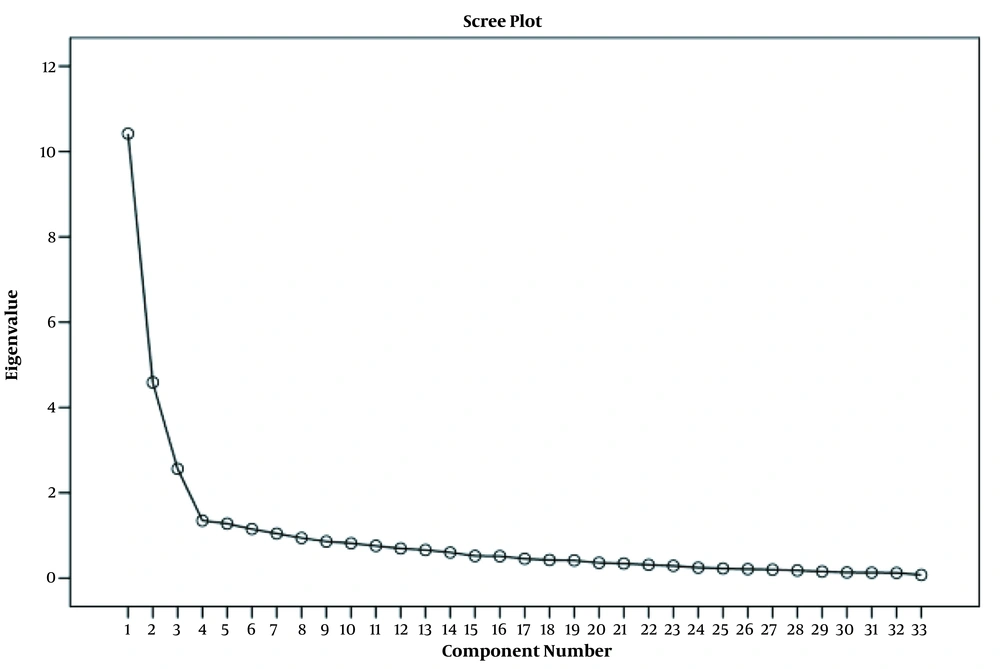
Figure 1.
Scree plot of the hopefulness questionnaire factors
As presented in the plot, there are three latent factors in the questionnaire whose special values are significantly higher than those of the other concepts. According to this plot, the number of factors was determined such that the majority of changes in the questionnaire were identified by the least possible confounding concepts.
To classify the variables among the factors based on their factor loadings, we used the rotated factor matrix. The results are shown in Table 2. This table shows the correlation matrix between the variables and the factors after rotation, where the correlation value fluctuates between -1 and +1 and is categorized based on the largest factor loading of the variables.
Table 2.
Hopefulness Questionnaire Factors After Varimax Rotation
| Items | 1 | 2 | 3 |
|---|---|---|---|
| 1 | - | - | 0.758 |
| 2 | - | 0.399 | - |
| 3 | 0.536 | - | - |
| 4 | - | - | 0.749 |
| 5 | - | 0.620 | - |
| 6 | - | 0.765 | - |
| 7 | 0.602 | - | - |
| 8 | - | 0.649 | - |
| 9 | 0.803 | - | - |
| 10 | 0.812 | - | - |
| 11 | 0.740 | - | - |
| 12 | 0.790 | - | - |
| 13 | 0.595 | - | - |
| 14 | - | - | -0.791 |
| 15 | - | - | 0.379 |
| 16 | 0.598 | - | - |
| 17 | 0.778 | - | - |
| 18 | 0.796 | - | - |
| 19 | - | 0.749 | - |
| 20 | 0.465 | - | - |
| 21 | 0.791 | - | - |
| 22 | - | 0.628 | - |
| 23 | - | 0.773 | - |
| 24 | 0.781 | - | - |
| 25 | - | - | 0.740 |
| 26 | 0.741 | - | - |
| 27 | - | 0.714 | - |
| 28 | -.609 | - | - |
| 29 | - | 0.757 | - |
| 30 | - | 0.785 | - |
| 31 | - | 0.405 | - |
| 32 | - | 0.613 | - |
| 33 | - | 0.640 | - |
To determine the saturation of the questionnaire by the overall factors, path analysis was used for the indices allocated to the above-mentioned factors. The significance level of the fitted pathway to the indices and confounding concepts was estimated lower than the type one error (0.05). Thus, the assumption of saturation of the model was rejected. It means that there is still a relationship between the indices of the questionnaire, but this relationship has not been observed in the model. Therefore, regarding the allocation of the indices to the identified factors, the saturated model could not be achieved. In this regard, to determine the saturation of the model by the number of factors, the structural equation was only fitted between the identified and confounding factors of hopefulness.
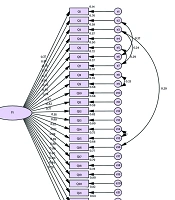
According to Figure 2, when the indices of the questionnaire were observed in the model, their relationships indicated that the model was not saturated with the three factors and indices. As an overall conclusion, the model was not saturated with the 33 indices studied in the questionnaire and the three confounding factors.
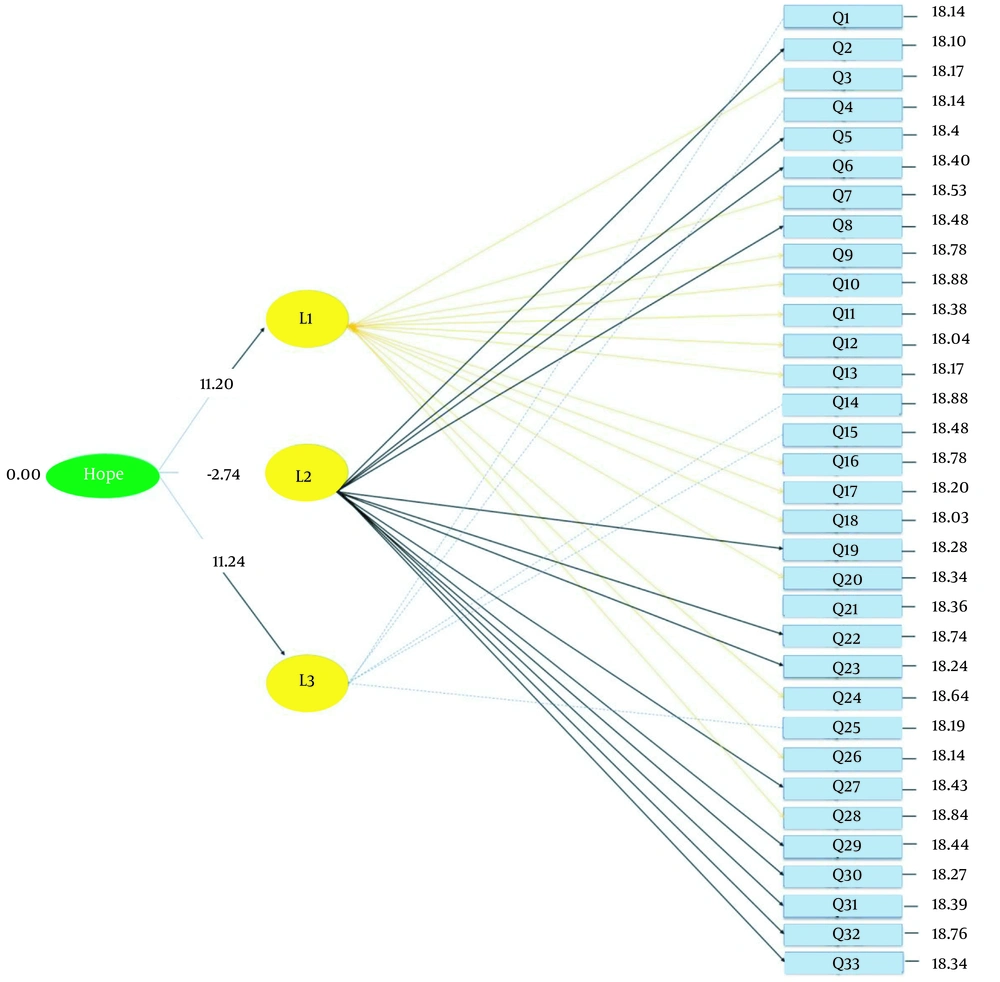
Figure 2.
Factor loading of the hopefulness questionnaire: Factors in confirmatory factor analysis
As seen in Figure 3, the hopefulness questionnaire was saturated with the three studied latent variables, and the significance level of the model saturation was equal to 1, while the RMSEA error was estimated as zero. Therefore, the hopefulness questionnaire was significantly saturated with three confounding factors.
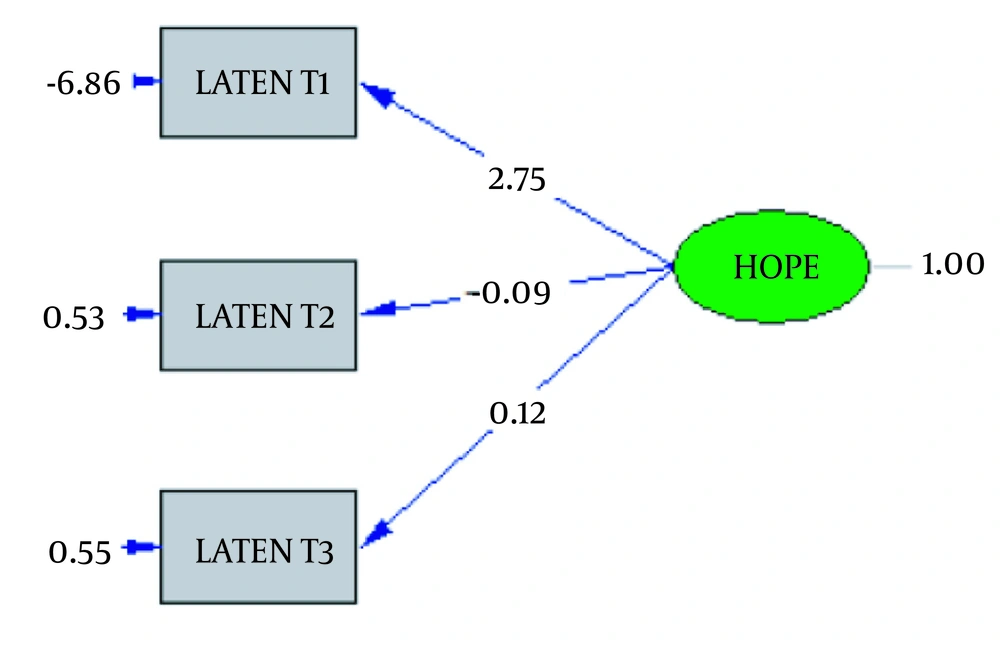
Figure 3.
Factor loading of the hopefulness questionnaire: Three latent factors in confirmatory factor analysis
5. Discussion
This study aimed to evaluate the hopefulness questionnaire among the youth in a university in Iran. The reliability of the hopefulness questionnaire was determined 0.80 based on Cronbach’s alpha coefficient. This finding is consistent with the results of Hamid study, which established the reliability of this questionnaire at about 0.90 (20). Also, Kermani et al. approved the validity and reliability of the questionnaire about 0.86 (21). In another study by Bonab confirmed the tool’s reliability at 0.82 (22). According to the findings, the significance level of the model saturation was equal to one, while the RMSEA error was estimated as zero. Since hopefulness is believed to be a significant element in the human response to illness (23), having an appropriate tool can be worthwhile in examining the psychological dimensions of people, especially young people. The use of this standard tool will help in predicting and controlling deviation and preventing social harms. In this regard, Berry reported that hopefulness is arguably of central importance to the recuperation of the youth with major or complex depression (23). Moreover, Reisi reported that young people who are hopeful are better able to take care of themselves than others (8).
As mentioned before, hopefulness is associated with better health and may be integral for stress and anxiety adaptation and resilience (3). It is a kind of thought process and entails the two components of factor thinking and paths. First, the person chooses the goal and then determines the route to reach the goal, and then they use the necessary motivation and move along this path (24, 25).
In addition, there was an adequate level of internal validity between the items. The intragroup correlation coefficient was equal to 0.80. In case of no information about the mutual effects between the indices and sizes, this correlation coefficient was estimated at 0.11. Regarding the significance level of the test, both correlation coefficients were at a significantly high level. Thus, the questionnaire had acceptable internal validity.
According to the exploratory factor analysis results, the hopefulness questionnaire items were saturated by an overall factor. Moreover, there were three confounding factors in the questionnaire whose special values were significantly higher than the other concepts. The significance level of the fitted pathway to the indices and confounding concepts was estimated lower than the type one error (0.05). Therefore, the assumption of the model saturation was rejected. Thus, the hopefulness questionnaire was significantly saturated with three confounding factors.
5.1. Limitations of the Study
Our findings should be interpret in light of the following study limitations. First, studies in this area were limited, and it was difficult to find reliable sources. Second, this study was conducted in a city. It is suggested that further studies be conducted in this field among the youth residing in other cities and regions.
5.2. Conclusions
In general, this study showed that the questionnaire constructs were useful in predicting hopefulness intention. Theoretical saturation on a definition was achieved. The scales consisted of three factors, which did not completely replicate the factors found in previous studies. The use of this tool is recommended for all age groups. The present study showed that the hopefulness scale can be a suitable and valid tool for use in the Iranian society, especially among the youth; This tool can be used in research institutes, student research studies, counseling centers, and workshops.