1. Background
Breast cancer is the most common cancer in women (1). Moreover, the incident of breast cancer has increased in Iran (2). Women with breast cancer have psychological distress during diagnosis and treatment (3, 4). Psychological symptoms in breast cancer patients are depression, anxiety, and anger (5). The previous studies showed that depression and anxiety in breast cancer patients led to severe symptoms, longtime of recovery, and poor outcome (6). Many studies indicated that negative effects of chemotherapy and psychological symptoms influence function and quality of life of breast cancer patients (7, 8). In other words, fear of disease progression (9), fear of being separated from family (10), fear of complication (11), impairment of body image (12), decreased sexual desire (13) and fear of recurrence (14) cause distress in breast cancer patients. These stress sources contribute to low self-esteem (15), feeling of disappointment and helplessness (16). Therefore, quality of life plays an important role in improving treatment and could even be considered as a medical factor in cancer prognosis. Furthermore, in recent years, quality of life is considered as a major factor in the life of cancer patients. Quality of life is a multidimensional concept that was defined according to the individual’s perception of mental, physical, emotional, and social functioning (17). According to the prior studies quality of life in breast cancer patients is less than the normal group (18, 19). As a result, the intervention for breast cancer must target psychological and physical issues. Therefore, the intervention which could offer the patients coping strategies and reframing positive beliefs may reduce the psychological pressures. Prior studies indicated that psychological interventions such as; cognitive behavioral therapy (20), modification of dysfunctional thoughts (21), problem-solving therapy (22) hypnosis (23) and stress management (24) have effective roles to reduce the psychological symptoms. Diverse behavioral and cognitive techniques (such as; coping strategies, record of thought, cognitive assessment, teaching assertiveness), also, systematic approaches and psychological techniques are used in the stress management such as; imagination, relaxation, meditation and autogenic training. Accordingly, this intervention provides training to increase awareness of sources and indicators of stress, training to notice and replace negative thoughts, and training in cognitive and interpersonal coping skills to improve the ways patients manage stressors and maintain their social support networks (25). Also, the previous findings reveal that optimism (26), coping strategies (27) (such as; acceptance) decrease distress in breast cancer patients. Accordingly as noted above, the aim of the current study is to examine the effectiveness of stress management model in quality of life for breast cancer patients.
2. Objectives
The aim of the current study is to examine the effectiveness of stress management model in quality of life for breast cancer patients.
3. Patients and Methods
3.1. Methodology
This study was conducted in 2014 in Tehran, Iran. The present study is a quasi-experimental research with pre-post test and treatment group. The sample group was composed of 24 breast cancer patients who were interested in the training program from cancer institute, Imam Khomeini Medical Center. This sample was assigned to the treatment and control group with random assignment. The sample size was selected by two main reasons: first previous researches carried out of this section had the same sample size, second the present research was quasi-experimental. In all these research methods, the sample size was fifteen participants in each group. After this selection, 3 patients of control group and 2 patients from treatment group relinquished this study.
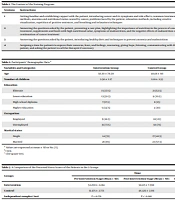
Stress management was implanted in 10 sessions (two hours for each session) for the treatment group. So the appropriate techniques of stress management designed to help patients to cope with their stress of disease problem. The material of therapeutic intervention are mentioned below: understanding the concept of stress management (2 sessions), automatic thoughts and Cognitive distortions (2 sessions), rational thoughts replacement (1 session), adaptability and social support (1 session), anger management (1 session), increasing self-esteem to adapt with their current situation (1 session) and training self-assertiveness (2 sessions).
The inclusion criteria were as follows: Patients are not in hard condition of disease process, Patients must have a high school diploma as the minimum level of education, Patients must be without any severe mental and physical illnesses, All patients received surgery on their breasts as the main treatment, They did not use narcotic drug, All of the patients did not participate in psychological classes or treatment at the same time.
3.2. Measurement
The core quality of life questionnaire (QLQ-C30) is a questionnaire developed to assess the quality of life of cancer patients. It comprised 30 items that measure physical health, emotional, cognitive and social functioning, also 9 subscales; fatigue, pain, nausea, diarrhea, constipation, sleep, appetite and a total dimension’s quality of life (28). The consistency reliabilities internal (Cronbach’s alpha > 0.70) were reported in Persian version. Then collected data was analyzed by SPSS-20 software. Data was analyzed by utilizing independent and dependent t-test.
4. Results
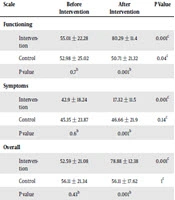
In Table 1, the results of socio-demographic characteristics of all of the participants were indicated. As shown in Table 1, the higher category of age belonged to 41 - 50 (%57.8) and high level of education was for less than diploma (%47.3). In addition, 42.1 percent of illness stage of participants was local and loco-regional. As shown in Tables 2 - 4, there is no significant difference between means of quality of life’s subscales and the other variables such as age, education and illness stage. As shown in Table 5, there is a significant difference between two groups in quality of life and its subscales in the past-test. Table 6 provides the means, standard deviations, and t-test scores of all the variables. These results demonstrate that stress management has major influence on the quality of life in breast cancer patients. Therefore, the 3 subscales of quality of life changes significantly; physical health: t = -5.89, df = 17. P = 0.002; functional health: t = 6.87, df =17, P = 0.000; total: t = 3.94, df = 17, P = 0.009. The results in Table 3 showed the significant difference of quality of life between pretest and past test in treatment group; physically health: t = 11.57, df = 9. P = 0.00; functional health: t = -8.85, df =9, P =0.00; total: t = 7.44, df =9, P = 0.000. Therefore, there is a significant difference between the subscales after intervention (P < 0.05).
Table 1.
Socio-Demographic Characteristic of All Participants in Percent
| Variables | ni | Cfa |
|---|---|---|
| 30 - 40 | 7 | 36.8 |
| 41 - 50 | 11 | 57.8 |
| Higher than 50 | 3 | 5.2 |
| Less than diploma | 9 | 47.3 |
| Diploma | 8 | 42.1 |
| Higher than diploma | 2 | 10.5 |
| Local | 8 | 42.1 |
| Loco-regional | 8 | 42.1 |
| 3 | 15.7 |
Table 2.
The Comparison of the Functional Dimension of Quality of Life in Patients’ Age, Education and Disease Stage
| Variable/Source Effect | Total Square | df | Mean Square | F | Significance Level |
|---|---|---|---|---|---|
| 0.61 | 0.552 | ||||
| Between group | 243.17 | 2 | 121.58 | ||
| Within group | 3153.70 | 16 | 197.10 | ||
| Total | 3396.87 | 18 | - | ||
| 0.003 | 0.991 | ||||
| Between group | 371.1 | 2 | 88.99 | ||
| Within group | 3395.50 | 16 | 212.21 | ||
| Total | 3396.87 | 18 | - | ||
| 0.64 | 0.553 | ||||
| Between group | 253.39 | 2 | 123.96 | ||
| Within group | 3143.48 | 16 | 196.46 | ||
| Total | 3396.87 | 18 | - |
Table 3.
The Comparison of the Total Dimension of Quality of Life in Patients’ Age, Education and Disease Stage
| Variable/Source Effect | Total Square | df | Mean Square | F | Significance Level |
|---|---|---|---|---|---|
| 0.37 | 0.692 | ||||
| Between group | 197.53 | 2 | 98.76 | ||
| Within group | 423.90 | 16 | 264.43 | ||
| Total | 4428.44 | 18 | - | ||
| 1.38 | 0.241 | ||||
| Between group | 651.68 | 2 | 325.84 | ||
| Within group | 3776.76 | 16 | 236.04 | ||
| Total | 4428.44 | 18 | - | ||
| 1.42 | 0.258 | ||||
| Between group | 667.55 | 2 | 333.77 | ||
| Within group | 3760.89 | 16 | 235.05 | ||
| Total | 4428.44 | 18 | - |
Table 4.
The Comparison of the Physically Dimension of Quality of Life in Patients’ Age, Education and Disease Stage
| Variable/Source Effect | Total Square | df | Mean Square | F | Significance Level |
|---|---|---|---|---|---|
| 0.26 | 0.971 | ||||
| Between group | 121.60 | 2 | 60.80 | ||
| Within group | 1096.56 | 16 | 68.53 | ||
| Total | 1100.10 | 18 | - | ||
| 0.25 | 0.775 | ||||
| Between group | 48.34 | 2 | 17.24 | ||
| Within group | 1065.61 | 16 | 66.60 | ||
| Total | 1100.10 | 18 | - | ||
| 0.54 | 0.599 | ||||
| Between group | 69.97 | 2 | 34.97 | ||
| Within group | 1030.12 | 16 | 64.37 | ||
| Total | 1100.10 | 18 | - |
Table 5.
Mean, Standard Deviation and T Value of Quality of Life in Participants at Pretest
| variable | Values | T | P Value |
|---|---|---|---|
| -5.89 | 0.002 | ||
| Group 1 | 31.39 ± 4.35 | ||
| Group 2 | 43.05 ± 5.98 | ||
| 6.87 | 0.000 | ||
| Group 1 | 63.1 ± 5.13 | ||
| Group 2 | 41.10 ± 10.51 | ||
| 3.94 | 0.009 | ||
| Group 1 | 53.86 ± 9.27 | ||
| Group 2 | 36.10 ± 16.13 |
a Values are presented as mean ± SD.
b df = 17.
Table 6.
Mean SD and T Value of Quality of Life in Treatment Group at Present and Past Test
| Variable/Stage | Values | T |
|---|---|---|
| 11.57 | ||
| Pre | 45.84 ± 4.87 | |
| Past | 31.39 ± 4.35 | |
| -8.85 | ||
| Pre | 38.17 ± 8.35 | |
| Past | 63.01 ± 5.13 | |
| -7.44 | ||
| Pre | 33.29 ± 11.16 | |
| Past | 53.76 ± 9.27 |
a Values are presented as mean ± SD.
b df = 17.
c P Value = 0
5. Discussion
The current study investigated the effectiveness of stress management in quality of life among the breast cancer patients. This finding is consistent with previous studies conducted in this field (29-32). In other words, the breast cancer patients who received the stress management training have a higher quality of life in comparison with the control group. Irrational and negative automatic beliefs, cognition and thoughts impact the perceptions of patients from breast cancer and their expectation of treatment (33). Therefore, this procedure leads to increasing hopelessness and it causes anxiety and depression in patients (34). Then, it can influence the interpersonal relationships and it contribute to losing family support and social network (35). On the other hand, the principal coping strategies are avoidance and approach. The procedure of avoidance strategy includes ignoring stressor and denial. Avoidant behavior associated with increased anxiety and stress in patients (31). Previous finding showed quality of life in breast cancer patients predicted by coping avoidance strategy. Similarly, Carver et al. suggested several coping such as; acceptance and humor prospectively predicted the lower distress in breast cancer patients (36). Likewise, Dupont et al. (37) showed that intrusive thoughts increased pain, depressive symptoms, and physical function. Training coping strategy with cognitive distortion and negative automatic thoughts can help the patients to replace them with rational thoughts. Then this method influence on the interpersonal relationships and social skills. Also, stress management influenced social life and increased self-esteem with training anger management skills and increased assertiveness.
Prior findings revealed that psychosocial and relaxation treatments can improve emotional adjustment and quality of life in breast cancer patients (38). So, quality of life is considered a goal of any psychosocial and cognitive intervention in breast cancer patients. Based on the results of the current and previous studies, patients can control their complications disease through concept of stress management, rational thoughts replacement, adaptability, anger management, and increasing self-esteem. Although one of the possible limitations of the current study is the lack of willingness of patients to cooperate in the study. It suggests that it applied stress management to improve quality of life in patients with Hepatitis, other types of cancer and Multiple sclerosis.
Stress management model is an effective psychological intervention for chronic disorders like Cancer, Multiple sclerosis, heart attack and so on. In these disorders, patients are facing hard situations in their life and need new coping strategies to stand strong and keep the life going. Stress management offers new viewpoints to patients which can be used to reach the quality of life and challenging the problems of sickness.