
1. Background
Cancer is one of the main causes of fatality in the world. It is a rising problem in Middle Eastern countries (1). In Iran, cancer is the third most common cause of death, after heart disease and road accidents. The incidence of cancer in Iran is anticipated to be around 48 - 112 and 51 - 144 cases per year per million people for women and men (2).
Cancer causes many physical and emotional problems, and has detrimental effects on the patients’ lives (3). Psychosocial distress has long been known as a significant problem for patients diagnosed with cancer. There are many elements to psychosocial concerns in cancer (4). Psychosocial distress generally refers mostly to anxiety, depression and adjustment disorders associated to the cancer experience (5). In this condition, cancer patients need palliative care (3). Palliative care is presented for life threatening illnesses and is a comprehensive approach centralized on increasing the quality of life in its terminal stages. This form of care may prove helpful in confronting chronic disease and its purpose is to reduce patients’ suffering by helping them figure out their pain, and physical, spiritual and emotional troubles (6). It is a humanitarian need for cancer patients throughout the world (7). Conversely, palliative care progress, in terms of accessibility and services, occurs in varying levels in the developing world (8).
The main dilemma of the nursing system in Iran in offering palliative care to cancer patients is lack of a clear structure for nurses, as palliative care does not receive serious consideration in the formal education curriculum (3). There is only one referral public hospital which provides palliative care services to cancer patients in Iran (9). Thus, palliative care is still a topic under discussion in the Iranian healthcare organization (3). Unhappily, the incorrect cultural ideas about cancer are still present among people, demonstrating that the cancer taboo has not yet been broken and many Iranians think that cancer is equivalent to death and end of life (10).
A wide range of studies about palliative care have been documented. The results of a qualitative research in the United Kingdom explained that the social relationships are considered as the core of palliative care for patients with life-limiting circumstances (11). Also, in a qualitative research carried out in the USA to study the aspects associated with the palliative care offered to patients at the end of life, the main theme shown was the subject of relationship (12). A qualitative research conducted by Borimnejad et al. (2014) (10) in Iran indicated that palliative care for cancer patients is of a comprehensive nature, and humane cares commonly employ a holistic approach concentrating on all characteristics of the patient. Several other researches, accomplished in multiple countries with differing degrees of development, including the USA, Canada, and Sri Lanka, have highlighted the necessity of supporting cancer patients (13-17). In addition, Seyedfatemi et al. (2014) (2) in Iran found that nurses helped to treat cancer patients’ psychological distress. In their study nurses believed that palliative care for patients with cancer pain contains both supervision of physical pain and facilitation of psychological empowerment. Admi et al. (2011) (18) in their qualitative study also pointed out the emotional role of nurses in caring of cancer patients in Israel.
We believe that psychological considerations are an essential part of palliative care for patients with cancer. These considerations that were mainly characterized by respect, altruism, understanding, listening, and paying attention to patient values seem to be essential for cancer patients (3). Hence, it is important for nurses to address these issues. Therefore, studying these nurses and their lived experiences regarding psychological palliative care (PPC) for cancer patient is essential. In addition, for oncology nurses, an understanding of other nurses’ opinions of PPC would offer a chance to develop their own care.
Reviewing literature, we found that there are few qualitative studies on PPC for cancer patients within the context of Iranian culture. It is therefore appropriate to carry out a qualitative research in this area. Also, due to cultural differences, experiences of affected Iranian nurses may be different from those of persons formerly studied.
2. Objectives
The aim of this study was to explore the lived experiences of nurses providing PPC for cancer patients in Iran.
3. Methods
3.1. Design
This qualitative study was accomplished using a hermeneutic phenomenological approach. It assists us to identify the meaning of ‘being in the world’. In other words, the findings of hermeneutic research show meaning embedded in lived experiences. Also, the nature of meaning in life experiences can be considered in depth (19). Thus, contributing in nursing care is a way of ‘being in the world’. Furthermore, hermeneutic phenomenological approach in present study would permit nurses to focus on their lived experiences through explanation of their personal experiences of providing PPC to cancer patients.
3.2. Ethical Consideration
The ethics committee of Tehran University of Medical Sciences approved the study. The data gathering was carried out after obtaining verbal consent and a signed informed consent outline from the nurses. The participants were guaranteed that all the data would remain confidential. They had the right to exit the study at any time during or after the interviews. If they wished, they could obtain the audio files. The interview setting was a silent place in oncology wards, on the basis of nurse convenience and preference.
3.3. Participants
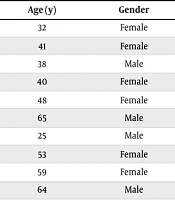
This research was performed in the oncology wards of two teaching hospitals specializing in the cure of cancer patients in Tehran, Iran. We employed a purposeful maximum variation sampling of 11 baccalaureate nurses (6 women and 5 men). The nurses ranged from 28 to 46 years of age. They had been working in oncology wards from 3 to 14 years. Also, their nursing job experience varied from 4 to 18 years. Potential nurses were introduced to the second author by the head of each ward. To make sure that all appropriate nurses were offered a chance to participate, the wards were frequently visited by the second author, covering all three nursing shifts (days, evenings, and nights). The key criterion for inclusion was the experience of giving PPC to cancer patients, the phenomena under study.
3.4. Data Collection and Data Analysis
We employed a face-to-face, semi-structured interview technique, lasting 45 - 60 minutes, for data collection. Second authors conducted all the interviews in Persian. Those parts of the interviews that were related to present article were translated into English by an expert translator and then the English form was translated back into Persian for confirmation by the fourth author, who is an Iranian bilingual translator. Since four participants were interviewed twice (due to their long stories or fatigue), a full number of 15 interviews were performed. The recordings were evaluated after each interview. Each interview was transcribed word by word. The interviews were continued until no new theme appeared. Data saturation was obtained after all of the interviews. Our interviews were carried out using “What is the meaning of giving PPC to cancer patients?” as the major research question. The nurses were requested to explain their lived experiences in their own words. After the participants responded to the above question, more questions were asked to gain wealthier data, such as: “Could you clarify this further?”, “What is the meaning of that idea?”, and “Could you please provide me an instance in order to assist us to more suitably comprehend your point of view?”
Data gathering and analysis occurred in parallel. Teamwork was used in our study to analyze the data. In this regard, to analyze and gain a greater understanding and interpretation of the lived experiences of the nurses, we employed a seven-stage process of data analysis (20).
Stage 1: Each interview text was firstly checked as a total to gain a general understanding.
Stage 2 and 3: Probable common meaning units were then recognized, using extracts to support the interpretation. The second author repeatedly listened to the tape recordings to extract the true meaning of the data.
Stage 4: Then, the research group evaluated their interpretations for similarities and dissimilarities, getting more illumination and agreement by revisiting the primary text.
Stage 5: All texts were then revised to verify emergent themes. Next, the emerging themes were classified by research team.
Stage 6: A constitutive pattern was recognized that showed the relationship between themes across all texts.
Stage 7: The research team created a final report, including quotes permitted for confirmation by the person who read it.
The trustworthiness of present study is supported by four criteria: credibility, dependability, conformability, and transferability (21). To achieve credibility, opinions of the research group professors were used in the procedure of interviews and data analysis. Interview texts, extracted meaning units and themes were discussed by some participants and 2 persons who hold a PhD in nursing. To determine data dependability, views of an external viewer, who was a researcher well-known with both clinical settings and phenomenological research and was not a member of the research team, were used. There was an agreement on the results. To obtain conformability, all the actions were recorded, and a report was arranged on the research progression. To obtain data transferability, data collected from 2 nurses outside of the study who had circumstances similar to those of the participants were discussed and confirmed.
4. Results
Study participants’ lived experiences of PPC were grouped into three main themes including stress management, empathetic behavior, and all-embracing outlook. These themes reflected the meaning of PPC provided by our participating nurses to patients with cancer. The constitutive pattern of the study was ‘palliative care as the driving force for providing psychological comfort to patients with cancer’. The study themes and the participants’ quotations are explained below.
4.1. Stress Management
Whenever our participants felt that their patients needed psychological help, they provided them with verbal counseling.
We had a young patient who was extremely worried about her university entrance exam. She wanted to study law. She constantly said, “If I’m going to die, I would like to enter university before it. I told her, “You shouldn’t feel incapable. You need to resist. You should defeat the disease” (Participant 4).
Besides verbal counseling, our participants also employed the humor technique for alleviating patients’ stress.
Patients come here with great fear and horror of cancer and chemotherapy. We talk to them, calm them down, and give them psychological comfort. We alleviate their fear of the disease. I use humor and have found that it reduces patients’ fear (P9).
Moreover, our participating nurses supplemented their verbal counseling with practical approaches in order to manage patients’ stress.
We had a patient who was going to undergo a surgery and had great fear and anxiety over it. To relieve her fear, I showed her other patients who had recently undergone surgery. I even told her that although these patients’ surgeries had been more extensive than hers, they weren’t afraid. On the day of surgery, she voluntarily agreed to go to the operation room while I thought that she would have difficulties in accepting surgery (P10).
Relaxation, guided imagery, and physical exercise were the other strategies which our participants employed to relieve patients’ stress.
Sometimes, I take a number of patients to the hospital yard and encourage them to do physical exercise. Moreover, whenever possible, we use relaxation techniques for them. I have found these techniques useful for relieving patients’ stress (P2).
Sometimes, I ask patients to remember a beautiful day from their past; for example, a day when they were at the seashore or something like this (P7)
4.2. Empathetic Behavior
Our participants had found empathetic behavior as a key aspect of PPC. Accordingly, they empathized with patients through listening to them.
Sometimes, when I greet patients, they start voicing their grievances and continue until they reach a point where they apologize for wasting my time and bothering me. Patients are looking for an ear to listen to them and calm them. I have found listening to patients’ talks to be effective in calming them. Sometimes patients thank us for listening to and empathizing with them. When nurses strive to fulfill such needs of patients, they are actually providing palliative care (P1).
According to our nurses, a key aspect of empathizing with patients was to have shared feelings with them. Sometimes, they cried concurrently with patients and found it useful for relieving patients’ stress.
Sometimes, administrating a drug takes me a great deal of time because some patients start expressing their grievance during drug administration and I cry with them. I don’t avoid crying with patients. I have experienced that this technique calms patients (P6).
Moreover, our participants placed themselves in patients’ shoes and considered them as their own family members.
There was a patient who I noticed nobody understood. She had lost her hair subsequent to chemotherapy. I [usually] strive to understand patients. I consider them as my own sister, father, mother, or my own relatives (P5).
4.3. All-Embracing Outlook
The third main theme of the study was all-embracing outlook which denoted that by providing palliative care, nurses pay attention to all aspects of patients’ health. Our participants’ palliative care was not confined to a particular time or place and hence, it was not exclusively provided when patients were in hospital. In other words, the participating nurses strived to provide palliative care whenever they could.
When providing spiritual care, we pay attention to patient’s minds and bodies and all factors that might have affected them. We had a patient who had different cancer-related personal and familial problems. We helped her. We help patients in all situations (P8).
Even when patients are discharged from hospital, we take their phone number and pursue their health status, answer their questions, and guide them if they need re-hospitalization (P3).
Our participating nurses greatly emphasized the importance of having an all-embracing outlook when providing end-of-life care.
I try to pay attention to all aspects of cancer patients’ lives. For instance, improving a terminally-ill patient’s quality of life is important for me even if he/she is in his/her last day of his/her life. Accordingly, I do not neglect some aspects of patients’ lives and have a broad outlook on them (P11).
4.4. The Constitutive Pattern: Palliative Care as the Driving Force for Providing Psychological Comfort to Patients With cancer
Based on the participating nurses’ lived experiences, palliative care is an all-embracing care which incorporates empathy and stress management techniques. This type of care is a driving force for providing psychological comfort to patients with cancer. Nurses employ both verbal and non-verbal techniques as well as mental and physical activities for providing palliative care. The underpinnings of palliative care are accurate understanding of patients’ conditions, having a shared feeling with them, and empathizing with them. Palliative care is not restricted to a particular time or place. A key aspect of palliative care is that nurses continually strive for improving patient’s quality of life even if s/he is in the last day of her/his life. Palliative care as the driving force for providing psychological comfort to patients with cancer is the common pattern emerging from the themes.
5. Discussion
The aim of this study was to explore nurses’ lived experiences of PPC. The phenomenon of PPC embraced three main concepts including stress management, empathetic behavior, and all-embracing outlook. Generally, our participating nurses considered PPC as the driving forces for providing psychological comfort to cancer patients. Nurses recognized patients’ concerns and strived to help them effectively cope with their concerns. Accordingly, the delivery of PPC makes it easier for patients to stay in oncology care ward and provides them with greater psychological comfort. Studies conducted in Czech Republic and Australia also showed that psychological needs are among the most essential needs of patients with cancer (22, 23). Accordingly, healthcare providers should pay special attention to cancer patients’ psychological needs and provide them with appropriate PPC in order to improve their quality of life.
Study findings revealed that nurses established verbal communication with patients and talked to them to relieve their stress. The results of a qualitative study conducted in Belfast also revealed that establishing effective communication with patients in the late stages of life significantly contributed to palliative care delivery (24). Another study which was conducted in Norway also revealed that cancer patients experienced significant levels of cancer-related stress which can be relieved by talking to them and providing them with counseling services (25). Moreover, our participants employed humor for alleviating patients’ stress. The results of a concept analysis study revealed that humor is a subjective emotional response in nurse-patient communication which helps patients have pleasant encounters while experiencing the difficulties of cancer (26).
We found that nurses also employed non-verbal techniques in conjunction with verbal ones to reduce patients’ stress. For instance, they familiarized patients who were going to have surgery with patients who had successfully undergone it. Borimnejad et al. (2014) (10) also noted that nurses strived to alleviate cancer patients’ irritability and emotional distress through employing non-verbal techniques and recognizing patients’ preferences and expectations. In addition, our participants implemented techniques such as relaxation and encouraged patients to do physical exercise to lessen their stress. Albrecht and Rosenzweig (2012) (27) also highlighted the importance of recognizing and managing cancer patients’ stress by nurses. The results of a qualitative study conducted in the United States also showed that reducing patients’ stress through providing palliative care preserved their peace and serenity (12).
Our findings indicated that nurses used empathetic behavior and actively listened to them when providing PPC. Our clinical and professional experience also supports that empathy helps nurses enter the world of patients, understand their feelings, and take appropriate measures to alleviate their stress throughout the process of care. The results of a study conducted in Germany also showed that the delivery of palliative care to cancer patients is the ongoing process of understanding patients and making sense of their conditions. On the other hand, an essential prerequisite to empathy is active listening which significantly reduces patients’ stress (28). As an empathetic behavior, our participants strived to place themselves in patients’ shoes or considered them as their own family members. Heijkenskjold et al. (2010) (29) also found that nurses’ considered empathy as a key concept in nursing. They reported that considering patients as one’s own family member improves their mental status. Empathizing with patients constitutes the essence of nursing care and is a key aspect of it (30). Our participants also tried to have shared feeling with patients as a key technique for empathizing with them. According to Heyn et al. (2013) (25), cancer patients have different feelings and hence, they need to receive empathy during the process of care. All these findings show the importance of empathetic care in different cultures. However, our findings revealed that Iranian nurses cannot consider patients who are suffering from critical illnesses as outsiders to themselves and hence, they strived to have great empathy with them.
We also found that our participants’ other strategy for providing PPC was having an all-embracing outlook. Our participants noted that nurses need to assess and know about different aspects of patients’ health and lives. The results of a study in Canada also showed that cancer has different short- and long-term effects on physical, social, and psychological aspects of patients’ lives (31). Accordingly, paying attention to different aspects of their lives would minimize the negative effects of cancer on patients’ lives and improve their quality of life (32). In general, malignant conditions are associated with physical, social, and psychological distresses which finally exhaust afflicted patients. Accordingly, adopting an appropriate approach to cancer care can help nurses and other healthcare professionals alleviate such distresses (33). According to Feldman-Stewart et al. (2011) (34), a holistic approach to cancer care empowers nurses for managing cancer patients’ problems in all stages of the disease.
Our participants did not limit their PPC to the period of patients’ hospital stay. Instead, they strived to provide follow-up palliative care after patients were discharged from hospital. Seyedfatemi et al. (2014) (2) highlighted that maintaining the continuity of palliative care and providing follow-up care are crucial to successful cancer management. In other words, palliative care can be provided to cancer patients both during their hospital stay and at their homes. However, palliative care which is provided during hospitalization is more effective because it is all-embracing (35).
The findings of this study highlighted the necessity for focusing on the psychological aspects of cancer care. Our findings present understanding of lived experiences of Iranian nurses regarding PPC for patients with cancer. It is also suggested that more widespread qualitative researches be done in this regard. Researches on the lived experiences of other health-care group members would enhance our understanding of PPC for cancer patients. On the other hand, given that this is the first study on the PPC for cancer patients performed in the cultural context of Iran, the findings obtained in present study could show some sides of PPC of cancer patients in this culture. This research was conducted on a limited number of participants. The small sample size and the nature of the study limited the capacity to generalize the results. However, as with all qualitative studies, the findings were not proposed to be generalized. Nevertheless, the results of this research add to the body of knowledge in this field.