
1. Background
Globally, several studies intended to identify palliative care needs, and more than 20.4 million individuals are reported to need such services each year. The majority of this need (19 million) comprises adults, and 38.5% have cardiovascular diseases, and 34% suffer from cancer. Especially the increase in the aging population in developed countries indicates an expected increase in the number of adults who need palliative care (1, 2).
The World Health Organization (WHO) reported that palliative care aims to relieve patients’ physical, psychosocial, and moral symptoms; support families, friends, and caregivers; and decrease pain through a comprehensive evaluation and treatment (3). According to the American Society of Clinical Oncology (ASCO), palliative care is the integration of the relief of the painful and problematic symptoms affecting the quality of life of patients and families into cancer care (4).
Palliative care, which is also indicated in the initial definition of the WHO, is considered appropriate only for patients with terminal cancer who have no treatment options left; however, today, there is a tendency to emphasize the early provision of palliative care in order to relieve the pain experienced by individuals facing a life-threatening illness or living with these problems, which in turn translates into increased quality of life. In addition, palliative care is not a care option given only in the last period of life; it is a care that starts with the diagnosis and continues with curative care until death, and it also extends to support the family after death (5).
Providing care to a dying or about to die patient as part of palliative care is a specialized area for healthcare professionals, particularly nurses who spend more time with patients. Death is a painful phenomenon that deeply affects individuals, and nurses providing palliative care to a dying patient are no exception, so it affects the emotional dimensions of their life. As the primary member of palliative care teams, nurses are expected to support families before, at, and after the patient’s death and help them maintain their psychosocial well-being (6, 7).
Moreover, nurses working in the landscape of death and dying are frequently exposed to existential issues, psychological difficulties, and emotional problems related to care at the end of life (8). Palliative care nursing is described in the literature as doing everything you can; developing closeness, working as a team, creating meaning about life; and maintaining myself (9).
Globally, palliative care education is a key factor in improving access to qualified palliative care (10, 11). As a result, altough positive patient outcomes are reported regarding the integration of palliative care in the perioperative period, integration of palliative care into surgical settings has been slow. Also, the integration of palliative care concepts is not adequate in surgical and nursing education (12).
As the palliative care centers in Turkey are new, clinical nurses and lecturers have limited experience with palliative care patients. In addition, as the nursing education includes no or highly limited palliative care courses/units, there is a need for educating nurses equipped with theoretical knowledge to serve in the field of palliative care both at undergraduate level and in-service training (13, 14). In addition, a study performed in our country reported that palliative care courses had positive effects on participating students and increased their knowledge. Palliative care courses were then recommended to be included in the curriculum of nursing as a compulsory or elective courses (13).
Palliative care nurses and nursing students, who are in constant and one to one relationships with patients as primary care providers, should provide patients and their families with clear information by using effective communication techniques, listen to patients carefully, help them to cope with anxiety, be capable of recognizing the changes in patients’ general condition, and constantly refresh their knowledge (13, 15). Nurses providing care to palliative care patients in surgical clinics should have sufficient knowledge and practice skills, which not only helps them to relieve pain and relieve other symptoms but also results in increased quality of life. It also can increase patients’ satisfaction and prevent complications, leading to decreased duration of hospitalization. In addition, palliative care contributes to the effective allocation of expenditures. Moreover, positive changes experienced while providing patients with care and treatment are considered to have positive effects on nurses’ life satisfaction.
This study is considered to be important because it reveals the association between nurses’ palliative care knowledge levels and their life satisfaction and can provide evidence to guide future studies.
2. Objectives
Because the education programs and expertise fields about palliative care are limited in number in our country, the purpose of this study is to identify the association between knowledge about palliative care and life satisfaction of nurses, as a major player in the provision of surgical care.
3. Methods
3.1. Study Design
Following a cross-sectional design, this study was conducted in a hospital located in eastern Turkey between November and December 2018.
3.2. Study Population
No sampling was used, and the study was conducted on 110 nurses who worked in the Departments of Emergency, General Surgery, Orthopedics, Plastic Surgery, and Intensive Care Unit of a hospital. Of 110 eligible nurses, 64 agreed to participate in the study. Totally, 58% of the target universe has been reached. Nurses who had sick leave or were on leave during the study period were not involved in the study. The present study included all nurses who volunteered to participate.
3.3. Ethical Considerations
Prior to the study, the Ethics Committee Approval was obtained from the Scientific Research Ethics committee of the university where the study was conducted (code: 95531838-050.99). Written informed consent was obtained from all participants before entering the study and after a comprehensive introduction to the study protocol.
3.4. Data Collection
Data collection was performed using a “Socio-demographic Form”, the “Satisfaction with Life Scale”, and the “Palliative Care Knowledge Test”. Necessary permissions were obtained from the researchers who developed the scales. Data were collected using face-to-face interviews.
(1) The Socio-demographic Form: This researcher-developed form contained eight items on the personal and professional characteristics of participants;
(2) Satisfaction with Life Scale (SWLS): This scale was developed by Diener, Emmons, Laresen, and Griffin in 1985 (16). It was adapted to Turkish by Köker in 1991 and Yetim in 1993 (17, 18). It contains five items concerning life satisfaction, scoring on a 7-point Likert scale ranging from strongly disagree (1) to strongly agree (7). The scale, which aims to measure general life satisfaction, could be used for all ages ranging from adolescents to adults. Köker found the test-retest reliability coefficient of the scale as 0.85 (17). Yetim found the Cronbach’s alpha coefficient of the scale as 0.86 (18). In this study, Cronbach’s alpha coefficient was found to be 0.85.
(3) The Palliative Care Knowledge Test (PCKT): The test that was developed by Nakazawa et al. in 2009 has 20 items categorized in 5 sub-scales of “philosophy”, “pain”, “dyspnea”, “gastrointestinal problems”, and “psychiatric problems”. The knowledge test is responded as “true”, “false”, and “I do not know”, each rated on a 2-point scale. Scoring is done as “false” in those who responded as “I do not know”. While correct answers are scored as “one”, incorrect answers are scored as “zero”. Ten items are reverse scored. The total score ranges from zero to 20; the higher the score, the higher the knowledge level about palliative care (19). Turkish reliability and validity were performed by Seven and Sert, and Cronbach’s Alpha value was 0.91 (20). Cronbach’s Alpha coefficient was reported to be 0.85 in this study.
3.5. Statistical Analysis
Data analysis was administered by SPSS. Numbers, means, percentages, as well as Kolmogorov Smirnov test, Mann Whitney U, Kruskal Wallis, and Friedman and Spearman correlation tests were utilized to analyze the data. The results obtained from the study were assessed using a 95% confidence interval. Statistical significance was considered when the P-value < 0.05.
4. Results
4.1. Demographics
The mean age of participants was 27.9 ± 6.85 years. Also, the average years of experience was 5.1 ± 6.5. Of all participating individuals, 65.6% were women, 51.6% were married, 90.6% had an undergraduate degree, 59.4% were knowledgeable about palliative care, 28.1% received palliative care education in the undergraduate education, and 31.3% worked in the intensive care unit (Table 1). PCKT total mean score indicated significant differences between nurses’ having received information about palliative care and the departments they worked in (P < 0.01; Table 1).
Table 1.
Distribution of the Palliative Care Knowledge Test (PCKT) and Satisfaction with Life Scale (SWLS) Total Mean Scores According to the Nurses’ Socio-Demographic Features (n = 64) a
| Variables | No. (%) | PCKT | SWLS | PCKT | SWLS |
|---|---|---|---|---|---|
| Gender | U = 400.5; P = 0.383 | U = 394.5; P = 0.339 | |||
| Male | 22 (34.4) | 10.6 ± 5.01 | 18.5 ± 7.1 | ||
| Female | 42 (65.6) | 9.7 ± 4.6 | 20.1 ± 6.9 | ||
| Marital status | U = 495; P = 0.614 | U = 474; P = 0.824 | |||
| Married | 33 (51.6) | 10.09 ± 4.5 | 19.1 ± 7.8 | ||
| Single | 31 (48.4) | 10.1 ± 5.1 | 20.03 ± 6.1 | ||
| Education level | KW = 1.22; P = 0.541 | KW = 3.78; P = 0.151 | |||
| Health high school | 5 (7.8) | 8.6 ± 4.7 | 22.06 ± 7.9 | ||
| Undergraduate | 58 (90.6) | 10.2 ± 4.8 | 19.07 ± 6.7 | ||
| Postgraduate | 1 (1.6) | 8 ± 0 | 34 ± 0 | ||
| Having received information about palliative care | U = 271; P = 0.002 b | U = 467.5; P = 0.717 | |||
| Yes | 38 (59.4) | 11.7 ± 3.2 | 19.7 ± 7.4 | ||
| No | 26 (40.6) | 7.6 ± 5.5 | 19.2 ± 6.4 | ||
| Source of the knowledge about palliative care | KW = 4.01; P = 0.548 | KW = 1.37; P = 0.927 | |||
| Undergraduate education | 18 (28.1) | 10.7 ± 3.5 | 19.8 ± 8.3 | ||
| Congress/symposium | 2 (3.1) | 10.5 ± 2.1 | 19 ± 19.7 | ||
| In-service trainings | 6 (9.4) | 12 ± 2.5 | 19.8 ± 4.1 | ||
| Books and magazines | 2 (3.1) | 13.5 ± 0.7 | 16 ± 14.1 | ||
| Internet | 4 (6.3) | 13.5 ± 4.4 | 19.7 ± 2.9 | ||
| Undergraduate education and books | 4 (6.3) | 12.5 ± 2.08 | 23 ± 4.08 | ||
| In-service trainings and internet | 2 (3.1) | 14.5 ± 4.9 | 17 ± 5.6 | ||
| The units nurses worked in | KW = 14.3; P = 0.006 b | KW = 3.74; P = 0.442 | |||
| Emergency | 17 (26.6) | 6.8 ± 5.5 | 17.1 ± 7.3 | ||
| General surgery | 14 (21.9) | 11.2 ± 4.5 | 18.9 ± 6.6 | ||
| Orthopedics | 8 (12.5) | 13.6 ± 1.5 | 21.1 ± 4.3 | ||
| Plastic surgery | 5 (7.8) | 7.8 ± 4.8 | 20 ± 7.5 | ||
| Intensive care | 20 (31.3) | 11.2 ± 3.4 | 21.3 ± 7.6 | ||
| Age | 27.9 ± 6.85; (min: 19, max: 56) | ||||
| Years of experience | 5.1 ± 6.5; (min: 1, max: 35) | ||||
a Values are expressed as mean ± SD.
b P < 0.01
4.2. PCKT and SWLS Total Mean Scores
An analysis of the participants’ PCKT and SWLS total mean scores showed that PCKT total score was 10.09 ± 4.78, and SWLS total score was 19.58 ± 7.02 (Table 2). The pain sub-scale mean score was significantly higher than the philosophy, dyspnea, psychiatric problems, and gastrointestinal problems mean scores (P < 0.01; Table 3).
Table 2.
PCKT and SWLS Total Mean Scores
| Scales | Min | Max | |
|---|---|---|---|
| PCKT total score | 10.09 ± 4.78 | 0 | 20 |
| SWLS total score | 19.58 ± 7.02 | 5 | 35 |
Table 3.
Comparison of PCKT Sub-scale Total Mean Scores
| Sub-scales | χ2 a | df | P | |
|---|---|---|---|---|
| Philosophy | 1.61 ± 0.74 | 26.0 | 4 | 0.000 b |
| Pain | 2.64 ± 1.80 | |||
| Dyspnea | 1.98 ± 1.20 | |||
| Psychiatric problems | 1.77 ± 1.09 | |||
| Gastrointestinal problems | 2.09 ± 1.34 |
a χ2 = Friedman test
b P < 0.01
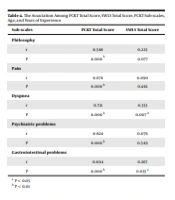
Analysis of the association between PCKT total score and sub-scales total scores indicated a positive, highly significant association between PCKT total score and sub-scales total scores (P < 0.01; Table 4). PCKT total score and SWLS total score, age, and years of experience demonstrated no significant association (P > 0.05; Table 4). There was a positive, significant association between SWLS total score and the sub-scales of dyspnea and gastrointestinal problems (P < 0.05; Table 4).
Table 4.
The Association Among PCKT Total Score, SWLS Total Score, PCKT Sub-scales, Age, and Years of Experience
| Sub-scales | PCKT Total Score | SWLS Total Score |
|---|---|---|
| Philosophy | ||
| r | 0.588 | 0.223 |
| P | 0.000 b | 0.077 |
| Pain | ||
| r | 0.876 | 0.090 |
| P | 0.000 b | 0.482 |
| Dyspnea | ||
| r | 0.731 | 0.333 |
| P | 0.000 b | 0.007 b |
| Psychiatric problems | ||
| r | 0.624 | 0.076 |
| P | 0.000 b | 0.549 |
| Gastrointestinal problems | ||
| r | 0.804 | 0.267 |
| P | 0.000 b | 0.033 a |
a P < 0.05
b P < 0.01
5. Discussion
One of the most important factors affecting the successful administration of palliative care services is the knowledge, attitudes, beliefs, and experiences that determine health professionals’ behaviors during the patient’s assessment and treatment (21). Palliative care nurses have the chance to experience a journey with patients, their families, and health team members throughout the last phases of their life. This journey was defined as the personal development process that affects nurses’ thoughts about life and sense of self (9, 22). PCKT mean scores of the nurses who worked in the intensive care unit and who had knowledge about palliative care were found to be higher. This finding is considered to result from the intensive care unit environment, where the frequency of encountering patients who need palliative care is higher and where symptom management is applied more.
Palliative care increases patients’ quality of life through the symptom management of the diseases that limit life. At this stage, it is important for nurses or team members who provide care to patients to know palliative care (23). Of all the participating nurses, 59.4% had knowledge about palliative care, and the majority of them had this information during their undergraduate education. The literature indicates that from the nurses’ points of view, palliative care is an enriching experience that enables nurse-patient communication and enables relationship, meaning, and feeling of well-being for the dying patient (9, 24, 25).
Some international institutions claim that palliative care should be included as a regular and obligatory education component for health professionals.10 Recently, some countries have formed national palliative education programs (15, 26). A study that utilized the Palliative Care Knowledge Test (PCKT) reported the PCKT score as 7.16 ± 2.69; it was also reported that female nurses received higher scores in comparison to their male counterparts; however, the difference was not statistically significant (27). The participating nurses’ palliative knowledge levels were medium, and their life satisfaction was above medium.
In addition, PCKT mean scores of male nurses were higher than female nurses, but their life satisfaction was lower. However, there was no significant association between nurses’ palliative knowledge levels and life satisfaction. Despite being affected by various factors, life satisfaction is an individual concept (28, 29). This study detected a positive, significant association between nurses’ life satisfaction and dyspnea and gastrointestinal sub-scales. High knowledge about respiration and gastrointestinal problems, which are the fundamental signs of life, might increase the professional nurses’ self-confidence and life satisfaction. Palliative care and access to care (prevention or diagnosis of physical, emotional, social, or psychological pain (starting from diagnosis history)) are the core of the right to health and fundamental for health. Relieving all types of acute and chronic pain and distress is an ethical responsibility of societies and healthcare professionals. However, access to palliative care and pain relief still have insufficiencies globally, and patient relatives experience various problems (30, 31). The participating nurses’ pain knowledge level was higher in the palliative knowledge test, but there is still a need for improvements on this issue. In addition, a positive, statistically significant association was detected between PCKT total score and sub-scale total scores. Hence, designing practical educational programs related to philosophy, pain, dyspnea, and gastrointestinal and psychiatric problems sub-scales in palliative care would increase nurses’ palliative care knowledge levels.
Particularly regarding the growing rate of the aging population in developed countries, the need for palliative care is expected to increase. Additionally, nurses working in the landscape of death and dying are frequently exposed to existential concerns, psychological difficulties, and emotional problems related to end-of-life care. This way, awareness of institutions and workers could be increased about palliative care, which is an ignored topic that is not given much importance. Nurses need to be empowered to foster patient outcomes with appropriate palliative care training and surgical-palliative care collaborations.
5.1. Limitations
It is necessary to mention some limitations of our study, including the small number of participants who were working in a single hospital. Therefore, the findings of the study cannot be generalized to all nurses; generalizations could be made to the nurses working in the hospital where the study was conducted. Hence, there is a need to perform similar studies in hospitals with different systems and in larger groups. This way, awareness of institutions and workers could be increased about palliative care, which is an ignored topic that is not given much importance. Nurses need to be empowered to foster patient outcomes with appropriate palliative care training and surgical-palliative care collaborations.
5.2. Conclusions
This study demonstrated that nurses’ general knowledge about palliative care was at a medium level, and their life satisfaction was above the medium level. In addition, as it was found in nurses’ PCKT, they had more information about pain. Nurses’ knowledge about palliative care and its management enables them to successfully control symptoms such as pain and dyspnea.
Moreover, individuals’ satisfaction with life is expected to increase nursing care quality and satisfaction levels of patient or their relatives. There is also a need for clinical guidelines that can be prepared to facilitate the work of palliative nurses and ease their emotional burden.