1. Introduction
Cancer staging provides adequate counselling for disease outcome and treatment. A good staging system should have 3 basic characteristics: it must be valid, reliable, and practical (1). In 1988 system, stage 1A and 1B endometrium cancer are defined as limited in endometrium and myometrial invasion < 50%, respectively. In 2009, FIGO revised endometrial cancer staging system where both stages 1A and 1B are classified as stage 1A (2). In 1988, stage 1C which was defined as myometrial invasion > 50%, is reclassified as 1B in a new category. In addition, in 1988 stage 2A (cervical glandular involvement) is reclassified as stage 1A or 1B dissease according to myometrial invasion in 2009. In the new staging system, stage 2 is described with cervical stromal involvement. Another difference is in stage 3; positive pelvic washing is not accepted as stage 3A (it should be noted separetely from stage). So cases who were previously staged as 3A were downstaged as 1A, 1B or 2 according to the new system. Finally, stage 3C is separated into stage 3C1 and 3C2 including patients who have positive pelvic nodes and positive para-aortic nodes, respectively.
In the present study, we aimed to investigate the benefit of new stating system and to compare OS and DFS rates in patients with endometrial carcinoma.
2. Methods
This is a retrospective study of 132 patients who were treated for endometrium cancer in Haseki research and training hospital, Istanbul between 2001 and 2011. The local ethics committee approved the study design. All patients underwent surgical staging including total abdominal hysterectomy (TAH), bilateral salpingo-ooferectomy (BSO), pelvic and para-aortic lymphadenectomy, partial or total omentectomy, and peritoneal washing cytology. Cases with stage 4 cancer and incomplete surgery patients were excluded. Hystologic type, grade, lymphovascular space invasion (LVSI), myometrial invasion, pelvic/ para-aortic lymph node metestasis, recurrence, and peritoneal washing cytology were also noted. Adjuvant radiotheraphy (RT) and chemotheraphy were applied to all patients with high risk for recurrence.
Chemotheraphy including cisplatin (50 - 75 mg/m2), adriamycin (40 mg/m2), and cyclophosphamide (350 mg/m2) every 3 weeks for four to six cycles were performed. The follow up visits were planned every 3 months for the first two years, after every 6 months for the next 3 years and after that annually.
Patients’ overall survival and disease free survival were compared with 1988 and 2009 staging system.
2.1. Statistics
SPSS 15.0 (SPSS inc., Chicago, IL, USA) was used for statistical analyses. Patients data were scanned with descriptive statistics. For patient survical, the Kaplan Meier method was used and the survival difference was investigated with log-rank test. P<0.05 was considered statistically significant.
3. Results
The mean age was 58.9 (32 - 86), gravidy and parity were 4.62 (0 - 14), 3.58 (0 - 12) respectively. Pathologic characteristics and descriptive statistics are shown in Table 1.
Table 1.
Descriptive Statisticsa
| Ort ± SD | |
|---|---|
| Age, y | 58.95 ± 10.17 |
| Min-Max | 32 - 86 |
| Gravida | 4.62 ± 2.65 |
| Min-Max | 0 - 14 |
| Parity | 3.58 ± 2.34 |
| Min-Max | 0 - 12 |
| Height | 158.66 ± 6.92 |
| Min-Max | 144 - 174 |
| Weight | 85.95 ± 15.13 |
| Min-Max | 48 - 130 |
| Ca 125 | 30.67 ± 42.4 |
| Min-Max | 4 - 333 |
| Washing sitology | 9 (6.8) |
| Grade | |
| 1 | 65 (49.2) |
| 2 | 38 (28.8) |
| 3 | 19 (14.4) |
| Clear cell | 7 (5.3) |
| Serous cell | 2 (1.5) |
| Villoglanduler | 1 (0.8) |
| Myometrial invasion, % | |
| 50 > | 59 (44.7) |
| 50 < | 73 (55.3) |
| Uterine Serousal invasion | 10 (7.6) |
| LVSI | 35 (26.5) |
| Servical stromal invasion | 18 (13.6) |
| Pelvic LN | 15 (11.4) |
| Paraaortic LN | 7 (5.3) |
| Omentum | 5 (3.8) |
| Recurrence | 33 (25.0) |
| Menopause | 106 (80.3) |
| Mortality | 17 (12.9) |
aValues are expressed as mean ± SD or No. (%).
All cases who had stage 1C cancer according to 1988 staging system were reclassified as stage 1B (n: 19) according to 2009 staging system. Also 5 cases with stage 2A according to 1988 staging system restaged as 1A (n: 2) and 1B (n: 3) according to 2009 staging system. All 2B patients were reclassed as stage 2. Cases with stage 3A who had positive peritoneal washing cytology were restaged as 1A (n: 1), 1B (n: 2), 2 (n: 1) according to the new staging system. Finally cases with stage 3C (n: 17) were reclassified as 3C1 (n: 8) and 3C2 (n: 9) according to the new system (Table 2).
Table 2.
Reclassified Patients
| No. (%) | |
|---|---|
| Old stage | |
| 1A | 27 (20.5) |
| 1B | 53 (40.2) |
| 1C | 19 (14.4) |
| 2A | 5 (3.8) |
| 2B | 6 (4.5) |
| 3A | 4 (3.0) |
| 3B | 1 (0.8) |
| 3C | 17 (12.9) |
| New stage | |
| 1A | 83 (62.9) |
| 1B | 24 (18.2) |
| 2 | 7 (5.3) |
| 3B | 1 (0.8) |
| 3C1 | 8 (6.1) |
| 3C2 | 9 (6.8) |
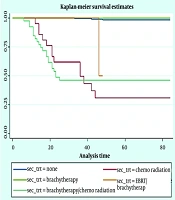
According to the previous staging system, cases with stage 1, 2 and 3 had overall survival rate 97%, 100%, 49%, respectively. Also disease free survival were 88%, 81%, 21%, respectively. In the new stage, overall survival rates were 97%, 100%, 37% respectively and dissease free survival rates were 87%, 86%, 7% for stages 1, 2 and 3, respectively (Table 3). OS rates were not statistically different between stage 1 and 2 (P > 0.05). But OS rates for stage 3 were significantly lower than stage 1 and 2 (P < 0.05) in both the old system and the new one.
Table 3.
Survival Analysis of Old Stage and New Stage
| Old Stage | N | 5 Years Overall Survive Rate, % | Dissease Free Survival Rate, % | SD, % | New Stage | N | 5 Years Overall Survive Rate, % | Dissease Free Survival Rate | SD |
|---|---|---|---|---|---|---|---|---|---|
| Stage 1 | 99 | 97 | 88 | 2 | 107 | 97 | 87 | 2 | |
| Stage 2 | 11 | 100 | 81 | 18 | 7 | 100 | 86 | 12 | |
| Stage 3 | 22 | 49 | 21 | 12 | 18 | 37 | 7 | 14 |
4. Discussion
FIGO revised the endometrial stating system in 2009. The specific purpose of the new staging was to merge old stages 1a and 1B because these stages had similar survival rates (3). In contrast, conflicting OS rates were reported in recent publications after the new stating system. Some studies discussed that 2009 system produced better discrimination in survival outcomes compared to the 1988 staging system (4-6). Werner at al. reported that the new system had improved prediction of prognosis with less complexity (7). On the other hand, some studies published contradictory results (8, 9).
Five years OS and DFS rates according to 1988 staging system for stage 1 were 97% and 88% respectively. For 2009 stating system OS and DFS at stage 1 were 97% an 87% respectively. Our data showed that there is not a major difference in OS and DFS rates between stages for 1988 and 2009 staging system as well. Similar to our results, Gultekin et al. reported that the new staging system failed to show a discriminatory ability in patients with early stage endometrial carcinoma (10). However, the discrimination of survival failed according to our findings. The newly revised FIGO 2009 staging system is clearer and less complex as discussed previously. Although the revised 2009 FIGO system is simplified, especially stage 1 subgroups; it did not improve its predictive ability over the 1988 system (11). However, Kato et al. reported that the new staging sytem discriminates survival of nodal disease better in the patients who underwent sistematic lymhadenectomy (6).
The new system posed a big question about whether we need to perform sytemic pelvic and para-aortic lymphadenectomy or not. MRC ASTEC trial did not show any benefit with lymphadenectomy and they reported that lymhadenectomy is not recommended (12). On the other hand, some studies recommend lymphadenectomy to determine postoperative treatment strategy (13, 14). The addition of lymph node evaluation represented the most significant and controversial component of the 1988 system (15). Pelvic and para-aortic lymph node invasion were 11.4% and 5.3% respectively in our data. By the way of higher rates of pelvic and para-aortic lymph node invasion; lyphadenectomy seems valuable for endometrial cancer surgery (14, 16-18).
Aristizabal et al. demonstrated that the distinction according to the lymphovascular space invasion (LVSI) status is more relevant than the distinction between stages 1A and 1B for the survival prediction of stage 1 endometrial cancer (19). Also, in that report, a suggested system was recommended for stage 1 into two subgroups according to the LVSI instead of considering the depth of myometrial invasion (19). LVSI was 26.5 % in our study. Pelvic/para -aortic lymph node metastasis and LVSI are most important prognostic factors for endometrial cancer and are taken into account for staging (10, 19).
In conclusion; the newly revised system could be less complex for understanding but it does not discriminate survival rates better; especially in earlier stages. A new staging system and uniform surgical staging could be discussed.