1. Background
The molecular analysis of acute lymphoblastic leukemia (ALL) has provided exciting insights into the pathogenesis of this cancer. This disease is heterogeneous and subtyped based on chromosomal, immunophenotypic, and structural criteria (1). This fatal cancer has been transformed to one with a cure rate approaching 90% in many developed countries (2). Survival for adult ALL patients is poor. Nowadays, new protocols including use of pediatric protocols in young adults have improved survival in clinical trials (3). ALL is aggressive cancer, especially in adults as only 20% - 40% is cured with current treatment regimens (4). Treatment results in ALL have improved considerably in the past decade, with an increase of complete response rates with 85% to 90% and survival rates with 40% to 50%. Superior chemotherapy and supportive care, the integration of stem cell transplantation into frontline therapy, and optimized risk stratification are important developments (5). Retrospective studies focusing on patients aged 15 to 21 years showed that “Adolescents and Young Adults” treated with adults ALL protocols have poorer outcomes than similarly aged patients treated with pediatric protocols (6). Overall results have improved over the past 3 decades. The long-term survival for patients aged < 60 years occur only in the range of 30% - 40% and is 10% - 15% if between 60 to 70 years and < 5% for those > 70 years (7). Furthermore, many of the reported prognostic factors using multivariate analysis have been superseded by genetic and/or molecular markers, leading to a changing paradigm, from a historic approach that was mostly determined by age, white blood cell (WBC) count and immunophenotype to a more recent approach, which incorporates cytogenetic and molecular determinants (8).
2. Objectives
The aim of this study is to evaluate prognostic factors and their effects on survival in adult ALL patients in the Northeast of Iran.
3. Methods
3.1. Patients
Between 2009 to 2015 in a descriptive and retrospective study, 48 ALL patients referred to Emam Reza hospital, hematology-oncology clinic, Mashhad city, Iran. Inclusion criterion was all patients with ALL from 2009 to 2015 with age ≥ 15 years and exclusion criteria were adult ALL patients with unrelated infections before ALL (Tuberculosis etc.) and having another malignancies. We analyzed age, sex, fever, blood group, type of ALL and consumption of amphotericin B, forms of cytogenetic, and survival in the patients. WBC, hemoglobin (Hb) and platelet were checked in the first referral for every patient. Overall survival (OS) for the patients was from date of diagnosis until death from any cause. The mean follow-up was 27.3 months (819 days) in which 28 patients (59.3%) died. ALL patients who lost follow-up were censored from survival analysis.
3.2. Statistical Analysis
The Log-rank test was used to determine risk factors which have effects on survival time of patients and overall survival by Kaplan-Meier method was plotted with GraphPad Prism 5. P < 0.05 statistically significant.
4. Results
The mean age for all the ALL patients at diagnosis was 32.3 years (range, 15 - 71 years). The mean and range of WBC, HB and Platelet have been shown in Table 1.
Table 1.
The mean and Range Variables for Acute Lymphocytic Leukemia Patients (n = 48)
| Variables | Mean | Range (Min-Max) |
|---|---|---|
| Age, y | 32.3 | 15 - 71 |
| WBC, × 103/μL | 24.5 | 0.4 - 185.7 |
| Hemoglobin, g/dL | 8.5 | 3.8 - 13.1 |
| Platelet, × 103/μL | 94 | 3 - 500 |
Table 2 shows the baseline variables for ALL patients and their correlation with survival time. The patients were divided into two age groups that 66.7% had age < 35 years, 81.3% were male.75% patients, 29.2% and 39.6% had WBC < 20 × 103/μL, Hb < 7 g/dL, and platelet < 30 × 103/μL, respectively. Of all patients, 62.5% had fever and 25% consumed amphotericin B. 1-, 2-, 3-, 4- and 5-year overall survival rates were 62.2%, 52.7%, 40.6%, 39.1% and 22.2%, respectively.
Table 2.
The Baseline Variables and Overall Comparisons by Kaplan-Meier Method in Survival of Acute Lymphoblastic Leukemia Patients (n = 48)
| Variable | Total, No. (%) | No. of Alive | P Valuea |
|---|---|---|---|
| Age, y | 0.000 | ||
| < 35 | 32 (66.7) | 53.1 | |
| ≥ 35 | 16 (33.3) | 18.7 | |
| Sex | 0.656 | ||
| Male | 39 (81.3) | 38.5 | |
| Female | 9 (18.8) | 55.6 | |
| WBC, ×103/μL | 0.116 | ||
| < 20 | 36 (75) | 50 | |
| ≥ 20 | 12 (25) | 16.7 | |
| Hemoglobin, g/dL | 0.409 | ||
| < 7 | 14 (29.2) | 38.6 | |
| ≥ 7 | 34 (70.8) | 47.1 | |
| Platelet, ×103/μL | 0.304 | ||
| < 30 | 19 (39.6) | 47.1 | |
| ≥ 30 | 29 (60.4) | 37.9 | |
| Fever | 0.724 | ||
| Yes | 30 (62.5) | 43.3 | |
| No | 18 (37.5) | 38.9 | |
| Amphotericin B | 0.237 | ||
| Yes | 12 (25) | 33.3 | |
| No | 36 (75) | 44.4 |
Abbreviation: WBC, white blood cell.
aP value was calculated by Log-rank test for affecting of prognostic factors on survival time.
The Kaplan-Meier survival curves for patients based on risk factors had been shown in Figures 1 and 2. There was a significant difference in survival based on age (P = 0.000) (Table 2).
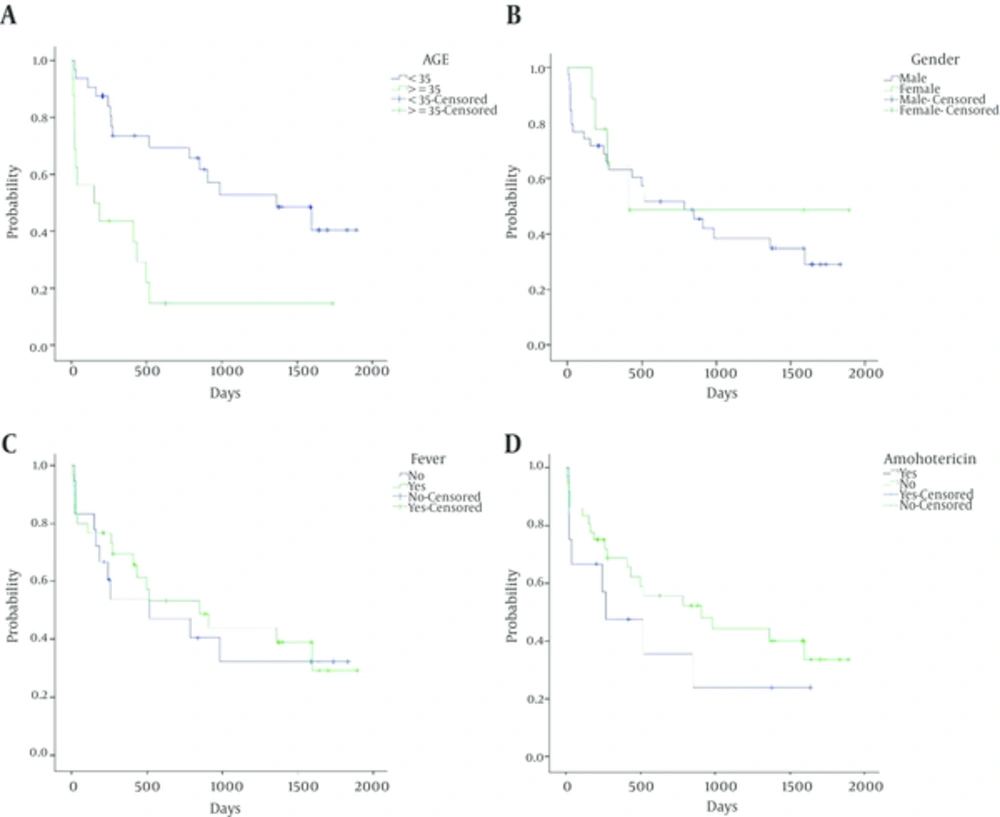
Figure 1.
The Kaplan-Meier Survival Curve Based on Risk Factors
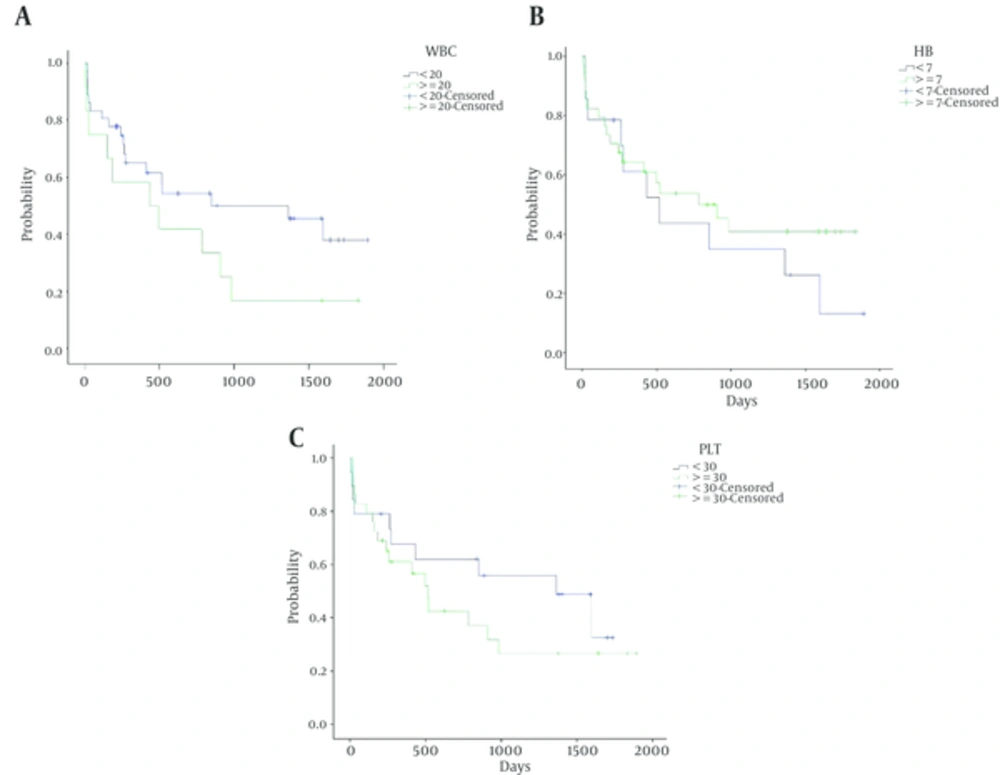
Figure 2.
The Kaplan-Meier Survival Curve Based on Risk Factors
5. Discussion
An analysis of the surveillance, epidemiology, and end results database showed an improvement in survival in adult ALL patients over the last two decades, with the greatest significant improvement being in the adolescent and young adult (AYA) groups (9). Although the median age for adults with ALL is older than 60 years, relatively few of these patients have been enrolled at prospective clinical trials (10). One study (11) on 55 previously untreated adults with ALL showed that the median age was 38 years (range, 15 - 73 years). In another study (12), the median age was 30 years with the range of 16 to 67 years. In an Iranian study (13), sixty-six adult patients entered. The Mean age was 33 years (range, 16 - 68), where 53 cases (80.3%) were male. In this study, the mean age of the patients was 32.3 years (range, 15 - 71) with 81.3% male. Therefore, based on these results, the mean age in a lot of studies is between 30 to 40 years and also more ALL patients are male. Pulte at al. (3) reported that men had a higher 5-year relative survival in Germany, but in this study, there was no difference between male compared to female.
Gokbuget in 2013 (14) reported that OS for older ALL patients was 33 months. Mashhadi et al. (13) showed that 1-, 2- and 3-year survival were 53% and 44.8%, 44.8%, respectively. Thomas et al. (15) analyzed 351 patients treated over standard chemotherapy where 3-, 5-and 8-year OS was 32%, 24%, and 22%, respectively. Our study showed that 1-, 2-, 3-, 4-, 5-year survival rates were 62.2%, 52.7%, 40.6%, 39.1%, 22.2%, respectively. Our patients had better survival compared to other studies.
A research (16), reported that the most common prognostic factors in ALL patients were: age, and WBC count. In another article, (13) the most common clinical manifestation was fever (62.1%). Also, the correlation between platelet and WBC levels and age with outcome were statistically significant. In our study, age had a significant correlation with survival and in the patients with WBC < 20 × 103/μL compared to WBC ≥ 20 × 103/μL was better but it was not significant. The patients with age > 35 years had poor survival. Therefore, age and then WBC count are the major risk factors in ALL patients which is confirmed by Marcus et al. (17) study. Also, Ayremlou et al. (18) reported that age, fever and WBC were significant prognostic factors in acute leukemias.
Invasive fungal infections (IFI) are a major cause of infection-related mortality during induction chemotherapy of acute leukemia patients (19). Amphotericin B (intravenous antifungal therapy) effectively reduces the duration of neutropenia by reducing the duration of fever (20). Amphotericin B is proven to be effective but toxic. This drug has a lot of severe adverse events including nephrotoxicity and infusion-related side effects (21). In our study, treated patients with amphotericin B (25%) had poor survival compared with non-treated.
5.1. Conclusions
Based on the results, age > 35 years is the major prognostic factor in ALL patients. Also, amphotericin B has severe side effects in ALL patients that could reduce survival. Patients who received amphotericin B had lower life expectancy because these patients were suffering from fungal infection or due to lack of response to antibacterial drugs have been treated with amphotericin B.