
1. Background
Among visceral cancers, breast cancer is the most prevalent cancer and accounts for 25% of all cancers in women and 16% of cancer deaths are due to breast cancer in the world (1).
In Iran the same as the world it comprises 25% of all new women’s cancer with 10,000 new cases annually based on the Cancer Registry. The incidence rate is 32 in 100,000 in Iranian women annually. Breast cancer in Iranian women was seen in the ages of 40 to 49 years old. Therefore, breast cancer is known as a major health problem in Iran (2).
Locally advanced breast cancer (LABC) is a subset of breast cancer tumors that is known, tumors more than 5 cm or tumors with direct extension to skin chest wall, or both, or tumors of any size with lymph node involvement (N2 or N3) without presence of distant metastasis (3).
Usually, LABC can be cured by surgery, radiation therapy, chemotherapy, hormone therapy and immunotherapy. The treatment sequence usually starts with neoadjuvant chemotherapy (NAC) or preoperative chemotherapy to down stage the tumors in the breast and lymph nodes (4).
There is some concern that NAC may be less effective in bulky tumors and some surgeons would rather operate first with the aim of debulking the tumor before chemotherapy, hormone therapy or radiotherapy. One of the potential advantages of NAC is that it treats the systemic micro- metastatic disease from the beginning (5).
There are some important studies such as European organization for research and treatment of cancer (EORTC) 10902 and the national surgical adjuvant breast and bowel project (NSABP) B-18 that NAC and adjuvant chemotherapy were compared, were shown that disease free survivals (DFS) and overall survival (OS) were equal in both groups. But, there are not any large studies in Iran which can compare these factors (6, 7).
2. Objectives
In the current study, we determined retrospectively clinical pathological profile, local recurrence, distant recurrence, breast cancer mortality, 5 years DFS, 5 years OS in patients with breast cancer after neoadjuvant chemotherapy and comparing these factors with patients who received adjuvant chemotherapy at cancer research center’s (CRC) Shahid Beheshti University of Medical Sciences (SBMU).
3. Methods
In this retrospective study, information on patients with breast cancer was extracted from the data base of CRC, a referral breast clinic in Tehran, Iran. Based on a time-stratified 2:1 approach, among cancer data of 1910 breast cancer patients, 564 patients with breast cancer were selected (patients with complete data) and finally, 188 patients of breast cancer who received NAC (group A) and 376 patients of breast cancer who received adjuvant chemotherapy (group B) were compared between October, 2002 and December, 2014. Patients with stage I to III without distant metastasis was collected and reviewed for clinical pathological profile and survival study.
Diagnosis of breast cancer was performed by biopsy or surgery. Information of breast cancer patients such as age, stage, type of the tumor, tumor grade, lymphovascular invasion (LVI), lymph node positive or negative, number of positive nodes, pathologic tumor size, type of surgery (modified radical mastectomy (MRM) or breast conserving surgery (BCS)), chemotherapy, radiation therapy, duration of the follow up, any location of recurrence (if present), and OS was considered.
Once all the treatments (surgery, chemotherapy, radiation therapy and hormone therapy) were over, for five years, every patient was visited in interval three to six months and annually afterwards. Breast cancer patients who had not follow up after initial diagnosis were excluded from the study. We made imaging, lab tests and biopsy to identify recurrence of any clinical suspicion or detection of signs or symptoms.
The two groups of Patients were compared in terms of age, tumor size, tumor histology, tumor grade, status of hormone receptors and Her2neu, type of surgery, location of recurrence (if present), and overall survival.
Until May, 2015, 564 patients with breast cancer were followed. DFS was known as the time of recurrence and the time of breast cancer diagnosis. OS was known as the time of death and the time of breast cancer diagnosis. The ethical regulations dictated in the act provided by SBMU were strictly observed and they approved the retrospective review of the medical records for the study (ethical code: IR.SBMU.MSP.REC.1369.9).
By SPSS version 22 (IBM Corp., Armonk, N.Y., USA), all data of patients were analyzed. By log-rank test analysis, the effects of variables on recurrence and death were analyzed. By Kaplan-Meier analysis, five years OS and five years PFS were estimated and they have been compared by Log-rank test. We considered P value < 0.05 significantly.
4. Results
The median age at diagnosis was 48.23 years (range 22 - 81 years) in group A and 48.76 years (range 17 - 86 years) in group B. In group A, infiltrating ductal carcinoma was seen in one hundred and sixty two patients (86%), other pathology except infiltrating ductal carcinoma was seen in twenty patients (11%) and unknown pathology reports was seen in six patients (3%). Infiltrating ductal carcinoma, other pathology except infiltrating ductal carcinoma and unknown pathology reports was seen in 320 patients (85%), 47 patients (12.5%) and nine patients (2.5%) in group B, respectively.
Patients with tumor grade III, grade II, grade I and unknown grade was found in seventy five cases (40%), 77 patients (41%), 13 cases (7%) and 23 cases (12%) in group A, respectively. In group B, there were, one hundred and five cases (28%) with grade III of tumor, 203 cases (54%) with grade II, 30 cases (8%) with grade I of tumor and 38 cases (10%) with unknown grade. In group A and B, LVI was detected in 39% of cases (73 patients) and 38% of cases (143 patients) respectively.
There were in group A, 41 patients (22%) with pathologic negative lymph nodes, 83 patients (44%) with one, two or three lymph nodes with pathological involvement, 58 patients (31%) with ≥ 4 lymph nodes with pathological involvement and 6 patients (3%) with unknown lymph nodes involvement. In group B, patients with pathologic negative lymph nodes, one, two or three lymph nodes with pathological involvement, patients with ≥ 4 lymph nodes with pathological involvement and unknown lymph nodes involvement was found in 113 patients (30%), 143 patients (38%), 83 patients (22%) and 37 patients (10%) respectively.
For tumor size in centimeters (cm), we found 117 patients (62%) with tumor size ≤ 5 cm and 260 patients (69%) with tumor size ≤ 5 cm, in group A and B respectively. Thirty patients (16%) with tumor size more than 5 cm and 44 patients (22%) with unknown tumor size were shown in group A. In group B, tumor size more than 5 cm was seen in thirty patients (8%) and 86 patients (23%) were with unknown tumor size.
Based on staging, in group A, 5% of cases (nine patients) were stage I, 28% of cases (53 patients) were stage II, 57% of cases (107 patients) were stage III , and 19 patients (10%) were with unknown stage. There were in group B, 34 patients (9%), 184 patients (49%), 124 (33%), and 34 patients (9%) with stage I, stage II, stage III and unknown stage respectively.
In group A, 84 patients (45%) underwent BCS, 89 patients (47%) underwent MRM and 15 patients (8%) were with unknown surgery. In group B, 218 patients (58%) underwent BCS, 139 patients (37%) underwent MRM and 19 patients (5%) were with unknown surgery.
For ER status, in group A: 115 patients (61%), 58 cases (31%) and 15 cases (8%) were ER positive, ER negative and with unknown ER receptor status respectively. In group B, there were, 245 cases (65%), 90 cases (24%) and 41 patients (11%) were ER positive, ER negative and with unknown ER receptor respectively.
We found in group A, 52% of our cases (98 patients), 36% of cases (68 patients) and 22 cases (12%) with PR positive, PR negative and unknown PR respectively. We also found in group B, 226 cases (60%), 105 patients (28%) and 45 cases (12%) with PR positive, PR negative and unknown PR respectively.
For HER2 status, there were in group A, 43 patients (23%), 113 patients (60%) and 32 patients (17%) with HER 2 positive, HER 2 negative and unknown HER 2 status respectively. In group B, there were 86 patients (22%), 229 patients (61%) and 64 patients (17%) with HER 2 positive, HER 2 negative and unknown HER 2 status respectively. Table 1 indicated clinical and the pathologic features of 564 breast cancer patients.
Table 1.
Baseline Characteristics and the Clinical-Pathological Features of 564 Adult Patients with Breast Cancera
| Characteristics | Group A, NAC (N = 188) | Group B, AC (N = 376) |
|---|---|---|
| Age, median (range), y | 48.23 (22 - 81) | 48.76 (17 - 86) |
| Tumor histology | ||
| IDC | 162 (86) | 320 (85) |
| Others | 20 (11) | 47 (12.5) |
| Unknown | 6 (3) | 9 (2.5) |
| Surgery type | ||
| BCS | 84 (45) | 218 (58) |
| MRM | 89 (47) | 139 (37) |
| Unknown | 15 (8) | 19 (5) |
| Tumor size, cm | ||
| ≤ 5 | 117(62) | 260 (69) |
| > 5 | 30 (16) | 30 (8) |
| Unknown | 41 (22) | 86 (23) |
| Nodal status | ||
| Node-negative | 41 (22) | 113 (30) |
| 1 - 3 positive nodes | 83 (44) | 143 (38) |
| ≥ 4 positive nodes | 58 (31) | 83 (22) |
| Unknown | 6 (3) | 37 (10) |
| Tumor stage | ||
| I | 9 (5) | 34 (9) |
| II | 53 (28) | 184 (49) |
| III | 107 (57) | 124 (33) |
| Unknown | 19 (10) | 34 (9) |
| Tumor grade | ||
| Well differentiated | 13 (7) | 30 (8) |
| Moderately differentiated | 77 (41) | 203 (54) |
| Poorly differentiated | 75 (40) | 105 (28) |
| Unknown | 23 (12) | 38 (10) |
| LVI | ||
| Positive | 73 (39) | 143 (38) |
| Negative | 83 (44) | 180 (48) |
| Unknown | 32 (17) | 53 (14) |
| Receptor status | ||
| ER positive | 115 (61) | 245 (65) |
| ER negative | 58 (31) | 90 (24) |
| Unknown | 15 (8) | 41 (11) |
| PR positive | 98 (52) | 226 (60) |
| PR negative | 68 (36) | 105 (28) |
| Unknown | 22 (12) | 45 (12) |
| HER2 positive | 43 (23) | 83 (22) |
| HER2 negative | 113 (60) | 229 (61) |
| Unknown | 32 (17) | 64 (17) |
Abbreviations: AC, Adjuvant Chemotherapy; NAC, Neoadjuvant Chemotherapy.
aValues are expressed as No. (%).
In group A, more tumors were shown with tumor size > 5 cm than group B (18% versus 10.3%) (P < 0.001). In group A, we showed more tumors with grade III than group B (45.4% versus 31%) (P = 0.001). In group A, there was more tumors with stage III (63.3% versus 36.5%) than group B (P < 0.001), more positive nodes (87% versus 66.6%) (P < 0.001) and more nodal status ≥ 4 positive nodes (35.8% versus 24.4%) (P = 0.025). Table 2 summarizes a statistical comparison of clinical and pathological features between two groups.
Table 2.
Comparison of Clinical Features Between Group A and Group B Breast Cancer (Patients with Unknown Prognostic Factors Were Deleted In Both Groups)a
| Candidate Prognostic Factor | Group A, NAC (N = 188) | Group B, AC (N = 376) | P Value |
|---|---|---|---|
| IDC histology | 162/182 (89) | 320/369 (86.7) | 0.61 |
| Tumor size > 5 cm | 30/166 (18) | 30/290 (10.3) | < 0.001 |
| positive nodes | 141/162 (87) | 226/339 (66.6) | < 0.001 |
| ≥ 4 positive nodes | 58/162 (35.8) | 83/339 (24.4) | 0.025 |
| Stage III | 107/169 (63.3) | 124/339 (36.5) | < 0.001 |
| Grade III | 75/165 (45.4) | 105/338 (31) | 0.001 |
| LVI positive | 73/156 (46.8) | 143/323 (44.2) | 0.544 |
| ER positive | 115/173 (66.4) | 245/335 (73.1) | 0.042 |
| PR positive | 98/166 (59) | 226/331 (68.2) | 0.022 |
| Her2 positive | 43/156 (27.5) | 83/312 (26.6) | 0.755 |
Abbreviations: AC, Adjuvant Chemotherapy; NAC, Neoadjuvant Chemotherapy.
aValues are expressed as No. (%).
For ER and PR status, patients in group A showed lower ER positive (66.4% versus 73.1%) than patients in group B (P = 0.042) and lower PR positive (59% versus 68.2%, respectively) (P = 0.022).
As HER2 positive, invasive ductal histology and LVI positive, there were not any significant differences between two groups statistically (Table 2).
Our median follow-up time (range 14 - 244 months) was 52 months. In group A, 13.1% of patients were with local recurrence during the five years of follow up and in group B, 7.7% of cases had local recurrence during the five years of follow up. There was a significant local recurrence during five years in group A than group B (P < 0.001, RR = 1.35, 95% CI = 1.15 - 1.59) based on the log-rank test analysis (Table 3).
Table 3.
Comparison of Local Recurrence, Distant Recurrence and Breast Cancer Mortality During 5-Years, Between Group A and Group B Breast Cancer (Patients with Unknown Prognostic Factors Were Deleted in Both Groups)
| Included Patients, No. | Local Recurrence During 5-Years, No. (%) | RR 95% CI | P value (Log-Rank Test) | |
|---|---|---|---|---|
| Group A | 137 | 18 (13.1) | 1.35 (1.15 - 1.59) | < 0.001 |
| Group B | 270 | 21 (7.7) | ||
| Distant recurrence during 5-years, No. (%) | ||||
| Group A | 137 | 35 (25.5) | 1.03 (0.89 - 1.11) | 0.65 |
| Group B | 270 | 68 (25.2) | ||
| Breast cancer mortality during 5-years, No. (%) | ||||
| Group A | 137 | 25 (18.2) | 1.07 (0.92 - 1.15) | 0.29 |
| Group B | 270 | 47 (17.4) |
Abbreviations: CI, Confidence Interval; RR, Relative Risk.
In group A, 25.5% of cases were with distant recurrence during the five years of follow up and 25.2% of cases in group B were with distant recurrence during the five years of follow up. Based on the log-rank test five year distant recurrence analysis, there was no significant difference between two groups as distant recurrence (P < 0.65, RR = 1.03, 95% CI = 0.89 - 1.11) (Table 3).
Breast cancer mortality during 5-years was 18.2% and 17.4% in group A and group B respectively. Based on the log-rank test breast cancer mortality during 5-year analysis, there was no significant difference between two groups as breast cancer mortality (P < 0.29 RR = 1.07, 95% CI = 0.92 - 1.15) (Table 3).
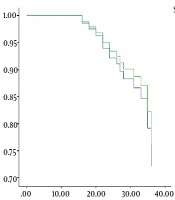
The five years PFS (include local recurrence distant recurrence) rate was 66% and 70% in group A and group B respectively. There was no significant difference between two groups as the five years PFS (P = 0.058) based on the log-rank test analysis, significantly (Table 4).
Table 4.
Comparison of the Five Year Progression Free Survival (PFS) Rate and Five Year Overall Survival Rate, Between Group A and Group B Breast Cancer (Patients with Unknown Prognostic Factors Were Deleted in Both Groups)
| Included Patients, No. | 5-Year PFS Rate, % | P Value (Log-Rank Test) | |
|---|---|---|---|
| Group A | 137 | 66 | 0.058 |
| Group B | 270 | 70 | |
| 5-year OS rate, % | |||
| Group A | 137 | 81.8 | 0.98 |
| Group B | 270 | 82.6 |
Abbreviation: 5-year PFS: Five Year Progression Free Survival.
The five years OS rate was 81.8% and 82.6% in group A and group B respectively. We did not find any significant differences between two groups as the five years OS (P = 0.98) based on the log-rank test analysis, significantly (Table 4). The patients in neoadjuvant group did not show worse outcome than adjuvant group.
5. Discussion
In the current study, with has been conducted at SBMU, we compared clinical pathological profile, local recurrence, distant recurrence, breast cancer mortality, 5 years DFS, 5 years OS in 188 patients with breast cancer after neoadjuvant chemotherapy with 376 patients who received adjuvant chemotherapy after surgery and is the largest series in Iran based on our knowledge.
The mean age was 48.23 and 48.76 years, in two groups respectively. The two groups did not have any differences in terms of age, indicating that age is not a determining factor for predicting local and distant recurrence in both groups. This result is in agreement with most studies (8, 9).
In the present study, in group A, 86% of the patients had infiltrating ductal carcinoma and in group B, 85% of the patients had infiltrating ductal carcinoma. The two groups did not show any differences in tumor histology, most studies have demonstrated similar results (10).
Colleoni et al. (10), found that tumor size more than 5 cm was associated with higher local recurrence, distant recurrence and breast cancer mortality. These findings were consistent with our study which showed in group A 16% of the patients had tumor size more than 5 cm and in group B, 8% of the patients had tumor size more than 5 cm and there was a higher local recurrence in group A, but inconsistent with our study that showed, there is not significant increase in distant recurrence or breast cancer mortality (10).
In the present study, in group A, 40% of the patients had grade III and in group B, 25% of the patients had grade III. The two groups showed difference in tumor grade, but difference in tumor grade was not associated with any significant increase in distant recurrence or breast cancer mortality. These findings were inconsistent with von Minckwitz et al. study that showed the higher tumor grade was associated with higher distant recurrence or breast cancer mortality (11).
Yoo et al. revealed estrogen receptors, progesterone receptors and HER 2 were the same in neoadjuvant and adjuvant group (12, 13). These findings were consistent with our study that showed ER positive 61% and 65%, PR positive 52% and 60% and HER 23% and 22% in neoadjuvant and adjuvant group, respectively.
Yuan et al. (14) found that NAC group had better recurrence control, 5 years DFS and 5 years OS than adjuvant chemotherapy in stage III breast cancer; These findings were inconsistent with our study with showed 5 years DFS and 5 years OS in NAC group and adjuvant chemotherapy group were compatible and was in contrast to our study that indicated that NAC group had worse local recurrence control than adjuvant chemotherapy group in stage III (15).
In the present study, in group A, 45% and 47% of the patients underwent BCS and MRM respectively and in group B, 58% and 37% of the patients had underwent BCS and MRM respectively. The two groups showed difference in BCS rate, but difference in BCS rate was not associated with any significant increase local recurrence in group B. In contrast, local recurrence was higher in group A than group B. These findings were inconsistent with Veronesi et al. study who showed higher risk of local recurrence associated with BCS than MRM (16).
The national surgical adjuvant breast and bowel project (NSABP) B-18 and NSABP B-27 trials have been shown NAC for LABC and operable breast cancer are non-inferior to adjuvant chemotherapy (17 - 19) These findings are consistent with our study with showed 5 years DFS and 5 years OS in NAC group and adjuvant chemotherapy group were compatible. These two trials excluded breast cancer patients with T4 or N3 disease, but in our study those patients were included. These two trials showed that the pathological complete response were a significant predictor of 5 years DFS and 5 years OS. But we did not evaluate PCR in our study.
The limitations of this study included the small sample size, the missing data of some patients’ information and tumor characteristics such as tumor size, stage of tumor and loss to follow up.
5.1. Conclusion
The findings of this study showed that higher frequency of local recurrence in neoadjuvant chemotherapy group than adjuvant chemotherapy group, but the increase in local recurrence was not associated with any significant increase in distant recurrence or breast cancer mortality. Longer follow up time of the patients to compare survival between two groups is recommended.