
1. Background
The consumption of cannabis is common in patients with severe diseases such as cancer with the aim of reducing pain (1). Traditional cannabis of Tetrahydrocannabinol (THC) or Gul is a kind of THC, and the use of Gul has seen a significant prevalence in Iran in recent years. Acute and chronic use of cannabis is potentially harmful for psychological health (2).
Cannabis is commonly used by patients with cancer to reduce pain (1). In recent years, the use of High-potency Cannabis (HPC) has been high in Iran. The use of HPC is associated with some physical and psychological damages (2).
On the other hand, HPC has the therapeutic effect through the activation of CB1-receptors. Some effects such as pain relief, appetite stimulation and inhibition of nausea and vomiting, which are caused by chemotherapy, can make this substance popular among patients with cancer (3). The negative effects of cannabis on cognition and brain function have been identified (4).
A part of the negative effects of cannabis in parents is on the body and mentality of children. These negative effects can have devastating behavioral and psychological consequences on children with a parent, who uses HPC. Children can be exposed to cannabis smoke and suffer from poisoning (5). Also, HPC abuse by parents can be associated with behavioral and educational problems that can lead to harm to parent-child interaction.
Patients with cancer and their families usually experience anxiety, fear, anger, and sadness in responding to a disease and its poor prognosis (6). Existence of anxiety and depression syndrome in children would be associated with extraversion problems such as disruption in family functioning, school absenteeism, difficulty in academic performance, and social relationships in youth and aggression (7).
On the other hand, stressors stimuli increase the cortisol secretion. Studies have shown that there is a correlation between the level of cortisol and mood and behavioral indices, and it is possible to use cortisol as a biomarker in evaluating psychological indices (8).
Parent-child interaction therapy (PCIT) is evidence-based, short-term, and based on social learning theory that is used in children aged between 2 and 8 years with a history of disruptive behavior disorders. This therapy can be effective in promoting interactions between child and parents through active listening, eye contact, empathy, refinement, and summarizing rather than criticism and prohibiting from discontinuing others words (9). Several studies on the effectiveness of PCIT have shown the reduction of the extraversion problems (10-12).
2. Objectives
According to the rich background research on the use of PCIT in the problems of children's extraversion and the lack of a study in the sample of THC users, we intend to study the effectiveness of PCIT on aggression and the level of cortisol in children of dependent cannabis caregiver with cancer.
3. Methods
3.1. Patients and Design
The present study was a double-blind randomized controlled trial (RCT) with parallel group design with a 6-month follow-up that was carried out during March 2015 to October 2016. During the enrolment phase, 54 caregivers were registered; finally, 50 Iranian caregivers, who were selected through respondent-driven sampling (RDS) method (13) and by block randomization, were assigned to the experimental group (n = 22) of PCIT (main protocol) and control group (n = 28).
RDS method was used that it is a combination of chain sampling and a mathematical model (Markov chain theory and networks bias) and is being considered today in the world’s major health organizations (14). The research sample selection phase lasted 9 months, 1 month of initial assessment, 3 months of treatment, and 6 months assigned for follow-up.
3.2. Sample Size
The sample size was calculated to be 50 subjects. This study was perform with regard to the assumption of Z = 1.96, d = 0.25, a = 0.05 and also power of test 1-B = 0.84 and possible of sample fall (7).
3.3. Intervention
The inclusion criteria were: (1) age range of 5 to 7 years in children; (2) the diagnosis of metastatic cancer stage 4 in at least 1 parent or caregiver; (3) the diagnosis of dependence to cannabis with a given dose by caregiver; and (4) the diagnosis of aggression syndrome in 2 clinical domains and evaluation of questionnaires; The exclusion criteria for mothers and children were as follow: (1) lack of natural intelligence with a criterion of less than 70; and (2) the use of psychiatric medications due to the possible effect on the psychological syndrome.
PCIT Protocol (UC Davis PCIT Training Center, Sacramento) was conducted in 2 phases of child-directed interaction (to improve communication) and parent-directed interaction (to practice interactive discipline) in 12 sessions. In the control group, a combination of motivational enhancement therapy (MET) and cognitive-behavioral therapy (CBT) was presented, so that there was no difference between the groups. Teachers did not have any intervention in data analysis, and the process of data analysis was carried out by a psychometric analyzer. The coaches of the course were distinguished from collectors and data analysts, so that awareness of the allocation of subjects to groups could not lead to bias in the results.
Two milliliters of saliva sample was collected at 3 intervals by a synthetic cotton swab that was placed in the baby’s mouth for 60 seconds and were stored at -80ºC and were centrifuged for 15 minutes at a rate of 3 000 rpm.
In this study, a structured clinical interview for DSM-5 (SCID-5), a researcher-made demographic checklist, aggression scale, and ELISA kits were used. The demographic checklist was developed and used by the researcher to collect personal information such as the age of children and parents, parent’s educational degree, marital status, and occupation (15). The aggression scale is made by Shahim and its reliability and validity are evaluated in children of Shiraz and has 21 items scored in Likert form. Cronbach’s alpha coefficient for the whole questionnaire was 0.91 that was desirable (15). Cortisol levels were also measured, using a salivary sample and analyzed using an enzyme-linked immunosorbent assay (ELISA) kits (16). ELISA is a technique used to detect the presence of an antibody or antigen in samples.
To gather self-report adherence data, structured interviews with caregiver and children were conducted monthly throughout the study by telephone, and adherence was calculated as the percentage of attendance at therapy sessions over the previous 3 days. The data were analyzed by repeated measures correlation (rmcorr) and generalized estimation equation (GEE) through IBM SPSS 22 software (SPSS, Inc., Chicago, IL, USA). Statistical significance was accepted at the level of P < 0.01.
All stages of the research were performed after obtaining informed written consent from the parents and the verbal consent of the child and based on the latest version of Helsinki Declaration (17).
4. Results
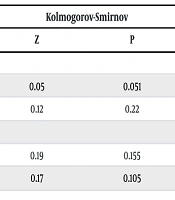
The assumption of normal distribution was evaluated by Kolmogorov-Smirnov (K-S) test. The results showed that the distribution of aggression scores and the cortisol level is not normal (P > 0.05). Regarding the lack of assumption of normality and the nature of repeated measurements in this study, a semi-parametric test of generalized estimation equation was used. The data were analyzed, using generalized estimation equation and repeated measures correlation method through IBM SPSS 22 software (SPSS, Inc., Chicago, IL, USA).
GEE is a general statistical approach to fit a marginal model for longitudinal/clustered data analysis, and it has been popularly applied into clinical trials and biomedical studies. Rmcorr is a statistical technique for determining the common within-individual association for paired measures assessed on 2 or more occasions for multiple individuals. Statistical significance was accepted at the level of P < 0.01.
The average age of children was 5.8 (SD = 1.1) and the average age of caregivers was 44.2 (SD = 5.3). A total of 67% of the children were boys and 56% of the caregivers were female; 81% were parent caregivers, 8% were foster mother, 5% were grandparents and grandmothers, 4%were aunts, and 3% were kinship careers.
The results of the chi-square test in assessing the demographic characteristics of the participants in the research showed that there was no relationship between the age of children and parents, parental education degree, and the drug use of parents and therapeutic results.
In order to investigate the changes in the aggression and cortisol levels of children, the GEE test was used and the results are presented in the Tables 1 and 2, and Figures 1 and 2. As it can be seen, changes in the two indices are significant (all < 0.01).
Table 1.
The Results of Generalized Estimating Equation in in the Salivary Cortisol Level Variable
| Course | Cortisol | Pairwise Comparisons | |
|---|---|---|---|
| Exp. Group | Non Exp. Group | ||
| Base Line | |||
| Base Line 1 | 179 (41) | 178 (32) | NS |
| Base Line 2 | 178 (54) | 179 (57) | NS |
| Base Line 3 | 181 (42) | 180 (53) | NS |
| Treatment | |||
| Week 1 | 180 (41) | 182 (58) | NS |
| Week 2 | 179 (64) | 178 (49) | NS |
| Week 3 | 178 (47) | 179 (59) | NS |
| Week 4 | 179 (64) | 181 (51) | NS |
| Week 5 | 177 (56) | 180 (72) | 0.048a |
| Week 6 | 178 (47) | 181 (59) | 0.048a |
| Week 7 | 179 (43) | 182 (65) | 0.047a |
| Week 8 | 177 (48) | 180 (61) | 0.048a |
| Weeks 9 | 176 (52) | 179 (47) | 0.047a |
| Weeks 10 | 175 (62) | 180 (69) | 0.042b |
| Weeks 11 | 176 (48) | 181 (71) | 0.045b |
| Weeks 12 | 176 (56) | 180 (48) | 0.040b |
aP < 0.05.
bP < 0.01.
Table 2.
The Results of Generalized Estimating Equation (GEE) (GEE) in the Variable of Aggression
| Course | Aggression | Pairwise Comparisons | |
|---|---|---|---|
| Exp. Group | Non Exp. Group | ||
| Base Line | |||
| Base Line 1 | 52 (18) | 53 (16) | NS |
| Base Line 2 | 54 (21) | 54 (19) | NS |
| Base Line 3 | 53 (16) | 52 (17) | NS |
| Treatment | |||
| Week 1 | 52 (20) | 53 (21) | NS |
| Week 2 | 53 (21) | 51 (15) | NS |
| Week 3 | 46 (20) | 50 (19) | 0.048a |
| Week 4 | 48 (24) | 51 (27) | 0.048a |
| Week 5 | 49 (22) | 52 (26) | 0.046a |
| Week 6 | 47 (20) | 50 (24) | 0.048a |
| Week 7 | 47 (19) | 50 (21) | 0.046a |
| Week 8 | 46 (22) | 49 (25) | 0.047a |
| Weeks 9 | 45 (18) | 48 (21) | 0.046a |
| Weeks 10 | 45 (27) | 49 (26) | 0.007b |
| Weeks 11 | 44 (16) | 48 (22) | 0.007b |
| Weeks 12 | 43 (19) | 47 (21) | 0.007b |
aP < 0.05.
bP < 0.01.
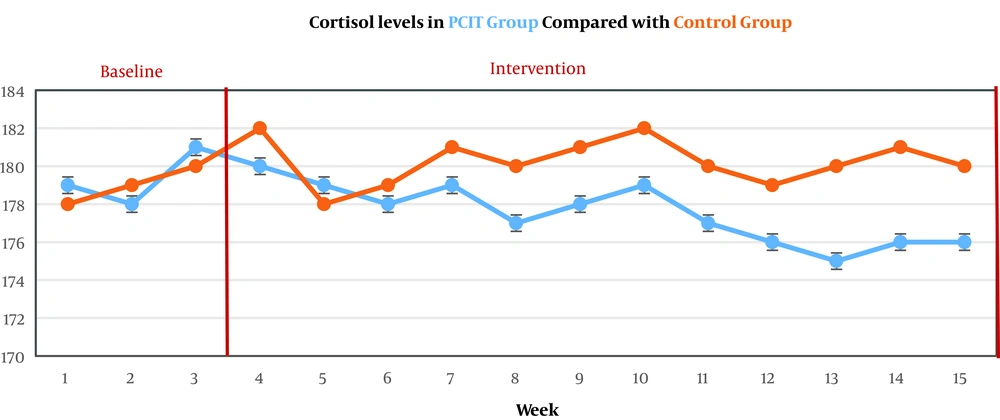
Figure 1.
Cortisol levels in PCIT and control group (N = 50)
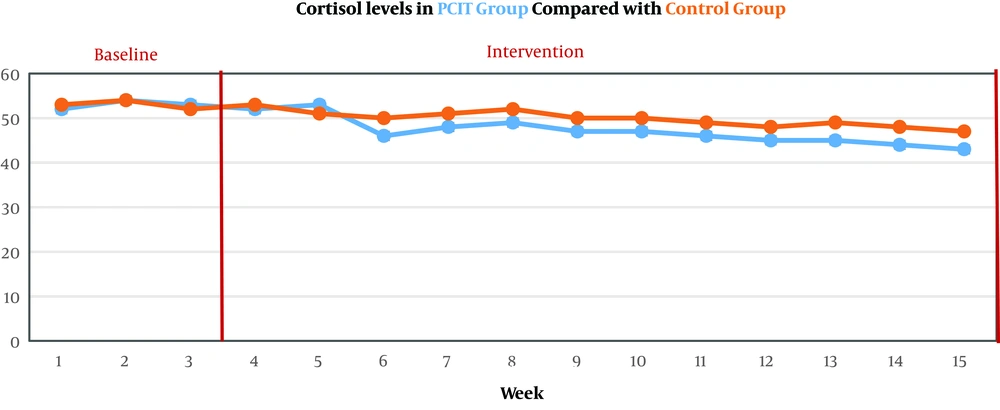
Figure 2.
Aggression levels in PCIT and control group (N = 50)
Rmcorr was used to determine the relationship between aggression and cortisol level. The results showed that there is a significant relationship between aggression index and cortisol level (P < 0.01).
5. Discussion
The results showed that this therapy had a decreasing effect on both aggression and cortisol indices. However, the changes did not remain constant until the follow-up phase.
This study was conducted for the first time in the community of patients with cancer, so there is no similar study. However, studies have been conducted on the effectiveness of parent-child interaction therapy.
In this regard and in line with our results, the study conducted by by Pirnia et al. (9) investigated the effectiveness of parent-child interaction therapy on the anxiety of pre-school children and the results showed that interaction therapy was effective in improving the anxiety index. Also, the results of the study performed by Thomas et al. (11) showed that parent-child interaction therapy had a significant effect on reducing the externalizing children's behaviors. The results of a study carried out by Herschell et al. (12) showed that parent-child interaction therapy was effective on the variables of improving child maladaptive behaviors, parenting style, and psychological syndrome.
A part of the results of this study showed that the effectiveness of this therapy on both anxiety and cortisol levels indices was not maintained until the follow-up phase. Contrary to our results, in a study performed Graziano et al. (10), the effectiveness of parent-child interaction therapy was maintained in 6 to 9 months follow-up.
A part of the results of this study showed that there is a direct relationship between the cortisol level and aggression. Consistent with the results of Pirnia et al. (8), these results showed that there is a significant relationship between the cortisol level and mood index. Contrary to our results, the results of Pirnia et al.’s research (18) showed that there is no significant relationship between the cortisol level and psychological indices.
This study was accompanied by some limitations. The most important limitation of this study was the inability to evaluate the dose and concentration of the consumed THC. It is suggested that in future studies, the relationship between the concentration of cannabis and the cortisol level should be investigated. Also, the study of the mediating role of mother’s cortisol on the relationship between the psychological problems of mothers and the child can be a suitable route for future studies.
5.1. Conclusions
The results of this study showed that parent-child interaction therapy is effective in families of caregivers with metastatic cancers consuming cannabis on children’s aggression and cortisol level. These results reflect the role of interpersonal interactions in psychopathology of behavioral problems and biological function. The findings of this study can have clinical applications in designing of therapeutic interventions in patients with cancer.