



1. Background
According to studies by the World Health Organization (WHO), cancer is one of the leading causes of mortality and morbidity worldwide and its growing trend has become a threat for both developed and developing countries (1). Skin cancer is a type of cancer that is considered as a major public health problem. Studies conducted in many countries indicate that the incidence of skin cancer is high and rising (2). According to the WHO, two to three million new cases of skin cancer occur worldwide annually (3). In Iran, the epidemiological transition will be accompanied by an increase in noncommunicable diseases, including cancers. In addition, cancer is the third most common cause of death in Iran. Studies have shown that skin cancer alone accounts for 32.7% of all cases of cancers (4). Further, Iranian people are exposed to the intense sunlight in most seasons and they usually do not use appropriate protectors such as hats and clothing in the open environment so a high incidence of skin cancer is expected in Iran (5). The incidence of skin cancer is 16.5% in Iran (3). In addition to life threats, cancer also causes anxiety and depression in more than a third of the patients and has a devastating effect on the economic status of household. Furthermore, a large part of the health budgets is spent on clinical care for cancer patients (6). According to studies, skin cancer has the highest control cost among all types of cancers (7).
The most important risk factor for skin cancer is exposure to sunlight and ultraviolet radiation; moreover, heredity and the environment are also effective in the incidence of this type of cancer (3). In the one hand, skin cancer is one of the most common cancers and, on the other hand, it is also one of the most preventable cancers (8). Some factors such as race and genetic background cannot be changed, but there are some preventable factors against skin cancer such as prevention of exposure to ultraviolet radiation and the use of protective agents against sunlight (9). There are several simple strategies for protecting against sunlight such as limiting outdoors activities by stopping these activities or by avoiding exposure to sunlight from 10 am to 4 pm, using protective clothing like wide hat and long-sleeved shirt, using a sunscreen with a protective factor of sun protection factor 15 (SPF15) and above, and avoiding exposure to sources of ultraviolet radiation. Raising community awareness and modifying life style factors can help to reduce the risk of the incidence of skin cancer (8). One of the most important factors in controlling and preventing the disease similar skin cancer is an educational program community and groups at-risk (10).
Farmers are one of the main population groups who are at risk of the skin cancer because they are exposed to sunlight for a long time due to their type of occupation; hence, in the absence of adequate protection against sunlight, they are susceptible to this type of cancer (3). Moeini et al. conducted a study on 280 farmers in Eslamabad-e Gharb to investigate the skin cancer preventive behaviors in Iranian farmers with applying protection motivation theory. The results of their study indicated that of all farmers, 8.6%, 3.2%, 3.9%, and 15.4% respectively, used sunscreen, hats, gloves, and full clothing; however, 95.4% of the farmers did not use glasses at all (10). It is necessary to educate farmer about skin cancer because they have a major role in preventing skin cancer. The effectiveness of an educational program depends on the appropriate use of models and theories of behavior (11). For this regard, researcher have utilized different models and theories to change the behavior. Protection motivation theory is one of the theories that have been used in various studies, including this study, to predict and interfere the behavior. This theory, which is based on expectancy-value theory, was proposed by Rogers in 1975 to explain the effects of fear on attitudes in health behaviors (12) also he argued that fear could affect the protection motivation through the constructs of self-efficacy, response efficiency, response costs, perceived vulnerability, and perceived severity (13).
This model explains protection motivation via introducing threat and coping appraisal. In order to provoke for protection motivation, perceived severity and vulnerability must overcome the maladaptive response rewards (lack of self-protection), and the perceived self and response efficacy must overcome adaptive response costs (self-protection). Protection motivation is an intermediate variable between the stages of threat appraisal, coping appraisal, and prevention behavior (protection behavior). Studies have shown that the constructs of this theory are very important in predicting cancer prevention behaviors (Figure 1) (14).
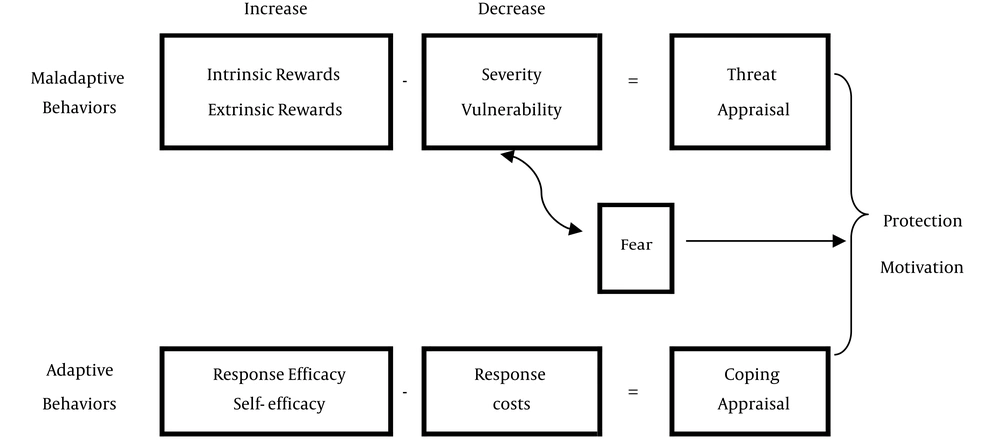
Figure 1.
Cognitive mediation process of protection motivation theory
2. Objectives
In regard to the high prevalence of skin cancer and subsequent mortality among farmers, it seemed necessary to conduct this study. Therefore, this study was conducted to determine the effects of an educational program designed on the basis of protection motivation theory on preventive behaviors of skin cancer among rural farmers. As a step towards improving the health of the community, the results of this study are expected to be used for developing educational programs with appropriate strategies to promote protection behaviors against sunlight.
3. Methods
3.1. Participants
This interventional study was conducted on rural farmers in Kashan in 2018. The samples were selected via simple random sampling method. First, from 40 rural primary health care centers, which were listed in a checklist, 2 rural primary health care centers were randomly selected and the members for the intervention group were selected from one center and the members for the control group were chosen from another.
Based on the sample size formula used in Baghianimoghaddam et al.’s study (14), with a confidence level of 95%, a test power of 80%, and a probability of sample loss of 10%, 120 participants were selected through random sampling from household profiles, which were available in the selected rural primary health care centers. Among the research sample, 60 persons were assigned for the intervention group and 60 for the control group. The subjects were briefed about the procedure of the research and the confidentiality of data, as well as the objective of the project. All the participants were enrolled into the study after obtaining informed consent.
3.2. Data Collection Instruments
The required data were collected through a questionnaire that contained items on demographic information and questions, which were related to the protection motivation theory such as perceived vulnerability, perceived severity, fear, self-efficacy, perceived response efficiency, perceived response costs, perceived rewards, protection motivation, and skin cancer prevention behaviors. It is worth noting that this study was conducted using the standard questionnaire designed based on the protection motivation theory for skin cancer prevention, which had been designed by Afshari et al. (3). Validity and reliability of the questionnaire were verified through content validity test that was performed through collecting the ideas of 4 health education program and health promotion experts. The internal consistency of this questionnaire was determined by calculating’s the alpha coefficient of Cronbach for perceived susceptibility (α = 72), perceived severity (α = 75), perceived efficiency of response (α = 74), self-efficacy (α = 85), perceived response costs (α = 82), perceived reward (α = 78), fear (α = 76), and protection motivation (α = 80).
The inclusion criteria were included: being a rural farmer with a minimum reading and writing literacy, being aged between 18 and 65 years old, and working as a farmer in the spring and summer. The exclusion criteria were contained: being absent in more than one educational session, not answering more than 20% of items of the questionnaire, and history of skin cancer among the family members of farmers. In this study, the required data were collected using a self-report questionnaire. The questionnaire consisted of 47 items which collected data about demographic variables (10 items were included: age, marital status, level of education, history of agricultural work, working hours per day, and history of sunburn), information about skin cancer, and the sources of information. The items, which were related to the constructs of protection motivation theory (21 questions) and preventive behaviors of skin cancer (8 questions) were designed based on the Likert scale, and some of the phrases were expressed negatively to prevent its inductive effect. The numbers of items that be used to assess the constructs of protection motivation theory were contained the perceived vulnerability, perceived severity, and self-efficacy (n = 4); perceived response efficiency (n = 2); and perceived reward (n = 3). A five-point Likert scale was used to score the items (from fully disagree to fully agree). The constructs of fear (n = 3), perceived costs (n = 4), and protection motivation (n = 5) were scored by using a four-point Likert scale (from at all to very much). Finally, preventive behaviors of skin cancer were measured by using a four-point Likert scale (from never to always).
3.3. Intervention Program
The status of preventive behaviors of skin cancer and other variables in the two intervention and control groups were investigated in the pre-intervention stage and their data were analyzed. According to the results, an educational program was developed based on the protection motivation theory for the intervention group and focused on constructs of protection motivation theory with a lower mean score.
Educational program for the intervention group included three 45-minute educational program sessions through presenting lectures, questions and answers, role play, and practical presentation. In addition, posters, pamphlets, and instructional manuals on skin cancer were used for educational program (15-17). The educational sessions were held in educational room of the rural primary health care centers. At the first educational session, 60 farmers in the intervention group were trained about variety of skin cancers and a high risk for skin cancer, as well as the importance of the incidence, complications of skin cancers and the seriousness of the risk of skin cancer in farmers for 45 minutes in an educational room. The second session focused on perceived cost estimates for skin cancer prevention as well as perceived rewards for conducting skin cancer prevention interventions in farmers. Finally, the ability to prevent skin cancer and protective measures against the factors affecting the occurrence of this type of cancer, taking preventive measures and measures to protect against the rays of the sun and proper methods of using sunscreen and other skin cancer preventive products were trained.
It is worth noting that according to the farmers’ daily plan, the curriculum was arranged, in line with the participants’ situation in the study, at night in order to overcome the interference of the classes. As well as at the end of each educational session to encourage farmers to attend the next educational sessions, through the question and answer of the materials provided at that meeting, protective equipment was distributed among them.
To determine the effect of the educational program, the questionnaire was completed again by the members in the intervention and the control groups 2 months after the intervention. After completing the questionnaires, the data were analyzed by independent t-test, chi-square test, and covariance analysis with SPSS version 20 software. At the end of the study, the educational content was also presented to the control group.
4. Results
This study was conducted on 120 farmers who were living in Kashan city. The subjects, were divided into the 2 groups of intervention and control (with 60 farmers in each group). The mean age of participants was 51.25 ± 8.39 in the intervention group and 52.66 ± 7.44 in the control group. Most of the farmers, namely 34 individuals (56.7%) in the intervention group and 45 individuals (75%) in the control group had a primary school education level. Concerning the marital status, 58 individuals (96.7%) in the intervention group and 55 individuals (91.7%) in the control group were married. The mean and standard deviation of history of agricultural work were 28.45 ± 11.76 in the intervention group and 29.43 ± 11.85 in the control group. Most of the farmers were exposed to sunlight from 4 to 8 hours each day (6.26 ± 1.97 in the intervention group and 5.75 ± 1.90 in the control group). The majority of the subjects were suffering from sunburn and 45 individuals (75%) in the intervention group and 47 individuals (78.3%) in the control group had a history of sunburn. Of all the farmers, 45 individuals (75%) in the intervention group and 40 individuals (66.6%) in the control group had searched and collected information about the dangers of sunlight and skin cancer. The main sources of information about the risks of sunlight and skin cancer that had been used by the farmers were: Television (TV) programs (intervention group: n = 27, 45%; control group: n = 24, 40%), physicians or health workers (intervention group: n = 13, 21.7%; control group: n = 9, 15%), and book and booklet (intervention group: n = 3, 5%; control group: n = 3, 5%). Based on the finding there is no significant difference between the 2 groups in terms of demographic variables (P > 0.05).
Table 1 presents the mean and standard deviation of the studied variables in the intervention and control groups before the intervention. Based on the results of independent t-test, before the intervention there was no significant difference between the 2 groups in terms of all the studied constructs (perceived vulnerability, perceived severity, fear, self-efficacy, response efficiency, response cost, protection motivation, and cancer prevention behaviors) (P > 0.05).
Table 1.Comparison of the Mean and Standard Deviation of the Constructs of Protection Motivation Theory Between the 2 Groups of Intervention and Controls Before the Educational Program
| Variables/Group | Mean ± SD | P Value |
|---|---|---|
| Perceived susceptibility | 0.11 | |
| Intervention | 47.91 ± 10.58 | |
| Control | 50.58 ± 9.43 | |
| Perceived severity | 0.23 | |
| Intervention | 47.5 ± 7.83 | |
| Control | 48.83 ± 9.58 | |
| Fear | 0.20 | |
| Intervention | 54.72 ± 17.98 | |
| Control | 60.83 ± 21.22 | |
| Self-efficacy | 0.13 | |
| Intervention | 71.58 ± 4.64 | |
| Control | 62.83 ± 6.06 | |
| Perceived costs | 0.25 | |
| Intervention | 65.52 ± 21.51 | |
| Control | 61.35 ± 24.06 | |
| Perceived response efficacy | 0.33 | |
| Intervention | 37.66 ± 15.22 | |
| Control | 45.5 ± 13.58 | |
| Perceived rewards | 0.23 | |
| Intervention | 57 ± 6.96 | |
| Control | 43.16 ± 7.64 | |
| Protection motivation | 0.08 | |
| Intervention | 50.50 ± 11.99 | |
| Control | 55.66 ± 14.45 | |
| Behavior | 0.71 | |
| Intervention | 71.35 ± 8.09 | |
| Control | 65.15 ± 7.60 |
The results indicated a significant difference between the 2 groups after the intervention, and the scores of all the constructs of the protection motivation theory in the intervention group were significantly higher than those in the control group (P < 0.05) (Table 2).
Table 2.Comparison of the Mean and Standard Deviation of the Constructs of Protection Motivation Theory Between the 2 Groups of Intervention and Controls After the Educational Program
| Variables/Group | Mean ± SD | P Value |
|---|---|---|
| Perceived susceptibility | 0.001 | |
| Intervention | 86.66 ± 11.56 | |
| Control | 46.66 ± 8.24 | |
| Perceived severity | < 0.001 | |
| Intervention | 59.41 ± 4.51 | |
| Control | 46.58 ± 9.58 | |
| Fear | 0.001 | |
| Intervention | 64.30 ± 12.28 | |
| Control | 61.52 ± 18.92 | |
| Self-efficacy | 0.003 | |
| Intervention | 97.50 ± 4.64 | |
| Control | 69.16 ± 8.74 | |
| Perceived costs | 0.001 | |
| Intervention | 54.37 ± 22.58 | |
| Control | 65.20 ± 15.66 | |
| Perceived response efficacy | 0.025 | |
| Intervention | 74.00 ± 21.72 | |
| Control | 56.08 ± 10.18 | |
| Perceived rewards | < 0.001 | |
| Intervention | 55.33 ± 14.99 | |
| Control | 46.33 ± 10.30 | |
| Protection motivation | 0.025 | |
| Intervention | 66.83 ± 6.76 | |
| Control | 56.08 ± 10.18 | |
| Behavior | < 0. 001 | |
| Intervention | 80.46 ± 12.02 | |
| Control | 65.57 ± 6.04 |
To measure the exact effect of educational program by adjusting for the effect of confounding variables before the educational program, the covariance analysis was used to control the effect of the initial values of the constructs of the protection motivation theory. This test indicated that the educational program led to a significant increase in the scores of the constructs of the protection motivation theory in the intervention group (P < 0.001) (Table 3).
Table 3.Results of the Covariance Analysis to Investigate the Effect of Educational Program Based on the Constructs of Protection Motivation Theory
| Variables/Source of Change | Sum of Squares | Degree of Freedom | Mean of Squares | F | P Value | Effect Size |
|---|---|---|---|---|---|---|
| Perceived susceptibility | 0.79 | |||||
| Intercept | 13420.03 | 1 | 13420.03 | 138.41 | < 0.001 | |
| Group | 44785.73 | 2 | 2392.86 | 4541.37 | < 0.001 | |
| Error | 11343.46 | 117 | 96.95 | |||
| Total modified | 55396.66 | 119 | ||||
| Perceived severity | 0.52 | |||||
| Intercept | 3826.68 | 1 | 3826.68 | 91.68 | < 0.001 | |
| Group | 7116.27 | 2 | 3558.13 | 128.67 | < 0.001 | |
| Error | 4883.41 | 117 | 41.73 | |||
| Total modified | 11570 | 119 | ||||
| Fear | 0.17 | |||||
| Intercept | 16496.52 | 1 | 16496.52 | 93.70 | < 0.001 | |
| Group | 10331.57 | 2 | 5165.78 | 5.13 | 0.02 | |
| Error | 20597.47 | 117 | 176.04 | |||
| Total modified | 30256.94 | 119 | ||||
| Self-efficacy | 0.74 | |||||
| Intercept | 7275.70 | 1 | 7275.70 | 151.80 | < 0.001 | |
| Group | 16640.73 | 2 | 8320.36 | 344.09 | < 0.001 | |
| Error | 5593.87 | 117 | 47.81 | |||
| Total modified | 29866.66 | 119 | ||||
| Perceived costs | 0.10 | |||||
| Intercept | 20248.56 | 1 | 20248.56 | 62.74 | < 0.001 | |
| Group | 11270 | 2 | 5635 | 13.76 | < 0.001 | |
| Error | 37756.79 | 117 | 322.70 | |||
| Total modified | 48104.16 | 119 | ||||
| Perceived response efficacy | 0.09 | |||||
| Intercept | 58672.48 | 1 | 58672.48 | 162.93 | 0.001 | |
| Group | 4438.5 | 2 | 2219.25 | 12.32 | < 0.001 | |
| Error | 42132.01 | 117 | 360.10 | |||
| Total modified | 46946.66 | 119 | ||||
| Perceived rewards | 0.03 | |||||
| Intercept | 4775.93 | 1 | 4775.93 | 28.78 | 0.001 | |
| Group | 912.88 | 2 | 456.44 | 4.80 | < 0.001 | |
| Error | 19414.77 | 117 | 165.93 | |||
| Total modified | 01961.11 | 119 | ||||
| Protection motivation | 0.08 | |||||
| Intercept | 19517.85 | 1 | 19517.85 | 301.38 | < 0.001 | |
| Group | 12485.14 | 2 | 62425.73 | 4.05 | 0.04 | |
| Error | 7577.01 | 117 | 64.76 | |||
| Total modified | 8914.79 | 119 | ||||
| Behavior | 0.29 | |||||
| Intercept | 2555.75 | 1 | 2555.75 | 33.03 | < 0.001 | |
| Group | 5339.64 | 2 | 2669.82 | 47.89 | < 0.001 | |
| Error | 9051.38 | 117 | 77.36 | |||
| Total modified | 17342.44 | 119 |
5. Discussion
The findings of the present study indicated that the application of the protection motivation theory in the educational program for farmers leads to an increase in the scores of the constructs of the theory in the intervention group, as compared with the control group. Farmers are exposed to ultraviolet rays and are prone to skin cancer because of their job type (18). Therefore, in order to control this important problem, this study assessed skin cancer prevention educational on the basis of the constructs of the protection motivation theory.
The results showed that the mean score of the constructs of the protection motivation theory increased significantly after the intervention, and this increase was higher in the intervention group than in the control group, which indicates the effectiveness of the educational program. The findings indicated that when a person considers himself to be in danger of a health hazard and feels a threat, he/she feels fear, looks for a reward obtained through practicing an adaptive behavior (protective measures), and empowers himself/herself for practicing the recommended behavior; as a result, his/her motivation (intention) for practicing the behavior increases (19).
In this study, there was a significant increase in the mean score of perceived vulnerability of farmers in the intervention group, as compared with the control group after the intervention. The results of a study by Maseudi et al. showed a significant difference between the scores of the construct of perceived vulnerability in the intervention group that was measured before and 2 months after the intervention (19). Our findings are also consistent with the results of a study by Jeihooni and Rakhshani entitled “the effect of educational intervention based on health belief model and social support on promoting skin cancer preventive behaviors in a sample of Iranian farmers” (20). This is probably due to the increase in the farmers’ sensitivity to the risk of exposure to sunlight after educational program; because of the intervention, they might have found themselves at risk for diseases caused by sunlight, including skin cancer, which occurs due to climate change such as changes in the thickness of the ozone layer.
In the present study, the mean score of perceived severity increased in the group intervention after the intervention and this change was statistically significant. In the control group, the mean score of perceived severity decreased after intervention, however, this difference was not significant. The results of studies by Baghianimoghaddam et al. (14) and Ch’ng and Glendon (21) showed that the perceived severity was an effective construct in prevention interventions. The intervention helped the farmers to understand the severity of the risk of skin cancer. Skin cancer has a high mortality rate, affects the person’s appearance and beauty, and disturbs a persons’ relationship with both the family and the community; hence, it is necessary to adopt protection behaviors.
The findings indicated that the mean score of the fear construct in the intervention group increased after the intervention and this change was statistically significant, while the change in the mean score of fear in the control group was not statistically significant. In Afshari et al.’s study, there was a significant correlation between the skin cancer prevention behaviors and the mean score of fear construct (3). The results of Babazadeh et al. are also in line with the results of this study (22). Therefore, in this educational program, fear of illness and other related problems, including fear of loss of appearances, rejection by the community, and anxiety and depression on the one hand, and the fear of the destructive impact of cancer on the economic status of the family and its own life, on the other hand, affected the farmers’ motivation for practicing prevention behaviors against sunlight.
The results of this study also showed that the mean score of the perceived cost was decreased in the intervention group and this change was statistically significant. Nevertheless, the mean score increased in the control group. In a study by Kaviani et al. the results showed that the increase in the cost of adaptive behavior can act as an obstacle. Therefore, identification of behavioral barriers and their elimination are effective in increasing adaptive behaviors (15). The farmers participating in the study found that the protection behaviors against sunlight, which prevent skin diseases and skin cancer, have a negligible cost. They also realized that spending short-term cost (monetary and non-monetary) spent on protective tools could help them to escape long-term costs spent on cancer diagnosis and treatment, and safeguard them against long treatment periods and non-definitive cancer treatments.
In the present study, the mean score of self-efficacy increased in the intervention group after the intervention. Tazval et al. studied the prediction of sunlight protection and skin cancer prevention behaviors in farmers, and their results indicated that self-efficacy was the most important predictor of protection motivation (23). Self-efficacy is the ability of rural farmers to perform sunlight prevention behaviors; thus, an educational program can help farmers to recognize and apply their ability to use sunlight protection products.
In this study, after the intervention, there was a significant difference between the intervention and control groups in terms of the mean score of perceived response. In other studies by Maseudi et al. (19) and Ch’ng and Glendon (21), the scores of the construct of perceived response in the intervention group increased 2 months after the educational program. Therefore, intervention can enable farmers to respond appropriately and practice protection behaviors on the bases of recommended responses to eliminate skin cancer threats. Their findings showed that, after the intervention, the mean score of perceived reward was reduced and this change was statistically significant. In another studies by Babazadeh et al. (18) and Afshari et al. (3), the results indicated that there are significant differences between the mean scores of the perceived reward in the intervention group before the intervention and 2 months after the educational program. The higher the internal and external rewards of the maladaptive behavior (lack of self-protection), the greater is the likelihood of protection behaviors; thus, the educational program is effective in clarifying the advantages of prevention behaviors and the disadvantages of maladaptive behaviors.
The findings indicated that the mean score of farmers’ protection motivation in the intervention group significantly increased after the intervention. The results of Prentice-Dunn et al.’s study showed that intervention increased the intention to protect against skin cancer in the intervention group, as compared with the control group (24). Inaddition, the results of this study were consistent with the results of a study by Kaviani et al. (15). The educational program increased farmers’ sensitivity and informed them about the severity and costs of the disease; they also found that many therapeutic approaches were not good responses and treatments for the disease. Hence, the intervention increased farmers’ protection motivation to practice preventive and self-care behaviors.
In the present study, the mean score of protection behaviors against the harmful effects of sunlight did not show a significant difference between the 2 groups before the intervention, but this difference was significant after the intervention. In addition, the mean score of behavior in the intervention group after the intervention was significantly higher than before the intervention. In other studies by Sumen and Oncel (25) and McClendon and Prentice-Dunn (2), after the educational program, the target groups protected themselves better against sunlight and the educational program reduced sunburn in the intervention group, as compared with the control group. The results of studies by Khani Jeihooni and Moradi (26) and Stankeviciute et al. (27) were also consistent with the results of this study. The results of present study showed that protection motivation theory was effective in increasing sunlight protection in the intervention group.
One of the strength of this study is that it designed based on the protection motivation theory in order to assess skin protection behaviors. In addition it helped to design the educational program based on the actual needs of the studied groups, which increased the effectiveness of the educational program. The use of the constructs of protection motivation theory in designing an educational program helped to promote the sustainability of the sun protection behavior. Another strength of this study was the full participation of rural farmers in the program, which led to in a response rate of 100%; apparently, the high participation of farmers was due to their interest in preventing skin cancer.
In general, due to the complex nature of health behaviors, alone no theory and model cannot predict and describe all aspects of these behaviors. Therefore, it is recommended to analyze the factors affecting the protection motivation and compare them with other models and theories of health education program and health promotion and assess the results.
5.1. Conclusions
The results of this study confirmed the effectiveness of the intervention based on the protection motivation theory in changing perceptions and behaviors related to skin cancer prevention; thus, this theory can be considered as a basis for the educational program. Therefore, in order to promote protective behaviors against sunlight and ultimately prevent skin cancer, it is recommended to utilize the educational program which was designed and used in this study as a model.
5.2. Limitations
This study had some limitations; for instance, the required data were collected via a self-reporting tool. In addition, this study was conducted only on male farmers. In order to compare gender differences in the use of skin cancer prevention tools, it is necessary to assess this issue in female farmers as well.