
1. Background
Breast cancer (BC) is the most frequent malignancy among women (1) that is the second leading cause in low and middle income countries (2). Inherited genetic risk factors contribute toward BC onset and the discovery of new BC susceptibility genes is critical for improved risk assessment and to provide insight toward disease mechanisms for the development of more effective therapies (3). As in Iran, since the onset of the disease is at low age, in spite of the relatively high survival rate as compared to other cancers, prevention and screening programs at early age for early stage diagnosis seem necessary (4). A combination of family- and population-based approaches indicated that genes involved in DNA repair are associated with moderate BC risk (5). The genetic factors known to be involved in BC risk comprise about 30 genes (6), the risk of some of them has been reported in Iranian people with BC (7-9). Vitamin D (1, 25-dihydroxyVitamin D3) has been shown experimentally to have anti-carcinogenic effects and is thought to inhibit BC (10). Vitamin D is hypothesized to lower the risk of BC by inhibiting cell proliferation via the nuclear vitamin D receptor (VDR) (11). Therefore, the actions of Vitamin D are mediated via the VDR, and the polymorphisms at 3'UTR region (four important single nucleotide polymorphisms (SNPs) in exon 2 including VDR-Fok1 (rs 2228570), VDR-Bsm1 (rs 1544410), VDR-Taq1 (rs 731236) and VDR-Apa1 (rs 7975232) (12) of this gene are associated with the risk and progression of breast carcinoma (10). Also, the VDR is a key nuclear receptor that binds nutritionally derived ligands and exerts bio-effects that contribute to bone mineral homeostasis, detoxification of exogenous and endogenous compounds, cancer prevention, and mammalian hair cycling (13). VDR-Cdx2 is another polymorphism of the VDR. There are limited studies on the relationship between it and BC's unfavorable biopathological characteristics (14). Therefore, these polymorphisms change the codons that alter the function of VDR protein.
2. Objectives
In the present study, we investigated the Fok1, Bsm1, Taq1 and Cdx2 polymorphisms in the VDR gene and susceptibility to BC in a sample of Southeastern Iranian population.
3. Methods
3.1. Patients
This study was approved by the ethical committee of Zahedan University of Medical Sciences (Grant number: 6796 and Ethical Code: IR.ZAUMS.REC1393.6796). In a cross-control study, 180 BC and 178 control women (age-matched) who referred to Ali-ibn Abi Talib hospital and private centers, Zahedan, Iran were chosen. The controls did not have any relationship with patients and had no history of cancer.
3.2. Immunohistochemical (IHC) Analysis
Estrogen receptor (ER) and progesterone receptor (PR) positivity, defined as ≥ 10% positive tumor cells with nuclear staining (15). Also, for HER2 2+ based on IHC, chromogenic in situ hybridization (CISH) identified HER2 gene amplification for determination of HER2 status.
3.3. VDR Genotype Analysis
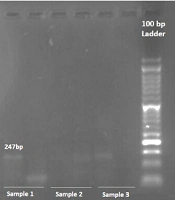
Blood samples of the controls and patients were gathered in tubes with EDTA, and DNA was extracted with salting out method (16). RFLP-PCR method was used for analysis of rs 1544410, rs 7975232, rs 2228570, and rs 731236 while TETRA-ARMS method was used for rs11568820. Primer sequence and reaction conditions have been shown in Table 1. The amplified PCR products were digested with Taq1, Apa1, Bsm1 and Fok1 restriction endonuclease enzymes (Thermo Scientific Company, USA) overnight (16 hours) at temperatures 65°C, 37°C, 37°C and 55°C respectively. The PCR conditions for VDR polymorphisms (Taq1, Fok1, Apa1 and Bsm1) were: The initial denaturation in 95°C for 5 minutes and after that, thirty cycles in 95°C for 30 seconds, 68°C for 30 seconds, 72°C for 30 seconds and at last, 72°C for 5 minutes. Then, products of PCR with 2% agarose gel and 0.5 µg/mL Ethidium bromide were loaded and observed under UV light. At last, each site was digested with specific enzyme. The PCR conditions for Cdx2 was: The initial denaturation in 95°C for 5 minutes and after that, thirty cycles in 95°C for 30 seconds, 58°C for 30 seconds, 72°C for 30 seconds and at last, 72°C for 5 minutes.
Table 1.
Primer Sequence and Reaction Conditions
| SNP | Primer sequence | Restriction enzyme | Product size (bp) | Annealing |
|---|---|---|---|---|
| rs 1544410 | Forward: 5-AACCAAGACTACAAGTACCGCGTCAGTGA-3 (30bp) | Bsm1 | GG 650 + 175 | 68°C |
| AG 825 + 650 + 175 | ||||
| Reverse: 5-AACCAGCGGAAGAGGTCAAGGG-3 (22bp) | AA 825 | |||
| rs 7975232 | Forward: 5-GCAACTCCTCATGGCTGAGGTCTCA-3 (25bp) | Apa1 | TT 745 | 68°C |
| Reverse: 5-AGAGCATGGACAGGGAGCAAG-3 (21bp) | GT 745 + 528 + 217 | |||
| GG 528 + 217 | ||||
| rs 2228570 | Forward:5-ATGGAAACACCTTGCTTCTTCTCCCTC-3 (27bp) | Fok1 | FF 272 | 68°C |
| Ff 272 + 198 + 74 | ||||
| Reverse: 5-ATGCCAGCTGGCCCTGGCACTG-3 (22bp) | Ff 198 + 74 | |||
| rs 731236 | Forward: 5-GCAACTCCTCATGGCTGAGGTCTCA-3 (25bp) | Taq1 | CC 294 + 251 + 201 | 68°C |
| TC 493 + 294 + 251 + 201 | ||||
| Reverse: 5-AGAGCATGGACAGGGAGCAAG-3 (21bp) | TT 493 + 251 | |||
| rs 11568820 | F1: 5‘-AGGATAGAGAAAATAATAGAAAACATT-’3 (27bp) | Cdx2 | GG 297 + 110 | 58°C |
| R1: 5‘-AACCCATAATAAGAAATAAGTTTTTAC-’3 (27bp) | AG 297 + 235 + 110 | |||
| F2: 5‘-TCCTGAGTAAACTAGGTCACAA-’3 (22bp) | AA 297 + 235 | |||
| R2: 5‘-ACGTTAAGTTCAGAAAGATTAATTC-’3 (25bp) |
3.4. Statistical Analysis
The analysis was done using SPSS 22 software (IBM, SPSS Inc., Chicago, IL, USA). The logistic regression analyses were assessed by computing the odds ratio (OR) and 95% confidence intervals (CI) for association between genotypes and BC. Also, a p-value < 0.05 was considered to be statistically significant.
4. Results
The mean age of the case and control groups were 47.93 years and 48.28 years, respectively. Table 2 shows a number of variables in the patients. The prevalence of genotypes in two groups has been shown in Table 3. There was no significant correlation between polymorphisms of Taq1, Fok1 and Apa1 with BC, but there was for Bsm1 (OR = 3.452, 95% CI 1.769 - 6.738; P < 0.001). Also, there was a significant correlation between the case and control groups for Cdx2 (OR = 3.720, 95% CI 2.224 - 6.225; P < 0.001) and allele A in Cdx2 had just significant correlation with BC.
Table 2.
Demographic Variables in Breast Cancer Patients (n = 180)a
| Variable | Patients group |
|---|---|
| Age | |
| ≥ 50 | 67 (39.4) |
| > 50 | 103 (60.6) |
| TNM Stage | |
| I | 25 (14) |
| II | 75 (41.9) |
| III | 50 (27.9) |
| IV | 29 (16.2) |
| Grade | |
| I | 28 (19) |
| II | 92 (62.6) |
| III | 27 (18.4) |
| ER status | |
| Positive | 105 (61) |
| Negative | 67 (39) |
| HER2 status | |
| Positive | 88 (49.4) |
| Negative | 90 (50.6) |
| PR status | |
| Positive | 97 (56.7) |
| Negative | 74 (43.3) |
aValues are expressed as N. (%).
Table 3.
The Exact Prevalence of Genotypes in Two Groups
| Variabes | Case Groupa | Control Groupa | OR | P Value |
|---|---|---|---|---|
| Rs1544410-Bsm1 | ||||
| GG | 14 (7.8) | 35 (19.7) | 1 | < 0.001 |
| AG | 145 (80.6) | 105 (59) | 3.452 (1.769 - 6.738) | < 0.001 |
| AA | 21 (11.6) | 38 (21.3) | 1.382 (0.610 - 3.129) | 0.438 |
| Allele | ||||
| G | 157 (45.63) | 175 (49.15) | 1 | - |
| A | 187 (54.36) | 181 (50.85) | 1.15 (0.86 - 1.55) | 0.364 |
| Rs7975232-Apa1 | ||||
| TT | 45 (25) | 52 (29.2) | 1 | 0.263 |
| GT | 124 (68.9) | 121 (68) | 0.393 (0.127 - 1.218) | 0.106 |
| GG | 11 (6.1) | 5 (2.8) | 0,466 (0.157 - 1.380) | 0.168 |
| Allele | ||||
| T | 214 (59.45) | 225 (63.21) | 1 | - |
| G | 146 (40.55) | 131 (36.79) | 1.17 (0.87 - 1.58) | 0.319 |
| Rs2228570-Fok1 | ||||
| FF | 98 (54.4) | 88 (49.4) | 1 | 0.297 |
| Ff | 72 (40) | 84 (47.2) | 0.668 (0.233 - 1.914) | 0.453 |
| Ff | 10 (5.6) | 6 (3.4) | 0.514 (0.178 - 1.484) | 0.219 |
| Allele | ||||
| F | 268 (74.45) | 260 (73.04) | 1 | - |
| F | 92 (25.55) | 96 (26.96) | 0.93 (0.67 - 1.29) | 0.672 |
| Rs731236-Taq1 | ||||
| TT | 79 (43.9) | 83 (46.6) | 1 | 0.253 |
| TC | 90 (50) | 77 (43.3) | 1.558 (0.692 - 3.504) | 0.284 |
| CC | 11 (6.1) | 18 (10.1) | 1.913 (0.851 - 4.297) | 0.116 |
| Allele | ||||
| T | 248 (68.88) | 243 (68.25) | 1 | - |
| C | 112 (31.12) | 113 (31.75) | 0.97 (0.71 - 1.33) | 0.872 |
| Rs11568820-Cdx2 | ||||
| GG | 26 (14.4) | 69 (38.8) | 1 | < 0.001 |
| AG | 150 (83.4) | 107 (60.1) | 3.720 (2.224 - 6.225) | < 0.001 |
| AA | 4 (2.2) | 2 (1.1) | 5.308 (0.917 - 30.736) | 0.06 |
| Allele | ||||
| G | 202 (56.12) | 245 (68.82) | 1 | - |
| A | 158 (43.88) | 111 (31.18) | 1.73 (1.27 - 2.34) | < 0.001 |
aValues are expressed as N. (%).
The correlation between five genotypes and three receptors in BC patients have been shown in Table 4. There was just a significant correlation between Fok1 and HER2 status (P = 0.025).
Table 4.
The Correlation Between Genotypes and Receptors in Breast Cancer Patients
| Variables | Bsm1 | P Value | ||
|---|---|---|---|---|
| GG, N = 14 | AG, N = 137 | AA, N = 21 | ||
| ER, Positive | 8 ( 57.1) | 87 ( 63.5) | 10 ( 47.6) | 0.362 |
| PR, Positive | 9 ( 64.3) | 77 ( 56.6) | 11 ( 52.4) | 0.783 |
| HER2, Positive | 7 ( 50) | 68 ( 47.6) | 13 ( 61.9) | 0.470 |
| Cdx2 | ||||
| GG, N = 26 | AG, N = 148 | AA, N = 4 | ||
| ER, Positive | 13 ( 50) | 73 ( 49.3) | 2 ( 50) | 0.998 |
| PR, Positive | 13 ( 54.2) | 83 ( 58) | 1 ( 25) | 0.406 |
| HER2, Positive | 16 ( 64) | 86 ( 60.1) | 3 ( 75) | 0.791 |
| Fok1 | ||||
| FF, N = 93 | Ff, N = 69 | ff, N = 10 | ||
| ER, Positive | 55 ( 59.1) | 43 ( 62.3) | 7 ( 70) | 0.796 |
| PR, Positive | 53 ( 57.6) | 39 ( 56.5) | 5 ( 50) | 0.898 |
| HER2, Positive | 53 ( 54.6) | 34 ( 47.9) | 1 ( 10) | 0.025 |
| Taq1 | ||||
| TT, N = 78 | TC, N = 89 | CC, N = 11 | ||
| ER, Positive | 43 ( 55.1) | 55 ( 66.3) | 7 ( 63.6) | 0.345 |
| PR, Positive | 45 ( 58.4) | 46 ( 55.4) | 6 ( 54.5) | 0.918 |
| HER2, Positive | 34 ( 43.6) | 50 ( 56.2) | 4 ( 36.4) | 0.179 |
| Apa1 | ||||
| TT, N = 44 | GT, N = 117 | GG, N = 11 | ||
| ER, Positive | 28 ( 63.6) | 71 ( 60.7) | 6 ( 54.5) | 0.850 |
| PR, Positive | 21 ( 47.7) | 70 ( 60.3) | 6 ( 54.5) | 0.351 |
| HER2, Positive | 23 ( 51.1) | 53 ( 51.6) | 2 ( 18.2) | 0.101 |
5. Discussion
This study showed that there were significant correlations between polymorphisms of VDR, such as Bsm1 and Cdx2, and risk of BC in women of Sistan and Baluchestan province (southeastern Itan). These polymorphisms, based on their position at the beginning of VDR gene, impacted translation and ultimately levels of expression of these protein. The OR for BC in association with Bsm1 and Cdx2 was (OR = 0.4, 95% CI 0.222 - 0.721; P < 0.05) and (OR = 0.29, 95% CI 0.148 - 0.565; P < 0.05), respectively. Guy et al. (17) reported that VDR polymorphisms are associated with BC risk and may be associated with disease progression in United Kingdom Caucasian population and Chandler et al. (3) showed that they are associated with BC in African-Americans, but not in Hispanic/Latinas and that the Fok1FF genotype is linked with poor prognosis in African-American women with BC. The results of one study (18) suggested that Cdx2 polymorphism was a potential biomarker for vitamin D treatment in BC, independent of the VDR receptor expression, and another study reported the Bsm1 associated with BC risk, with a trend for increasing risk with increasing number of Bsm1 B alleles in Latina women (19) and the b allele in Pakistani women (20). In addition, Bsm1 genotype significantly modified the association between dietary vitamin D and BC overall (21). The Pakistani authors (22) offered that the GG genotype of Cdx2-VDR gene polymorphism may increase the risk of developing BC in young female patients in South Pakistan. The authors of one research concluded that the common genetic variants in vitamin D genes (Bsm1, Apo1, Fok1 and Taq1) were not risk factors for BC in Chinese women (23). Also, the current analysis suggested that they may not be associated with BC risk in Caucasian women (24) and a meta-analysis study confirmed this result in Caucasian population (25). The results of Tang et al. (26) showed that there were not significant associations between the Bsm1, Apa1 and Taq1 variants and risk of BC. Apa1 and Taq1 and Fok1 were tested for association with BC risk in 135 females with sporadic BC and 110 cancer-free female controls (27) where allele frequencies of Apa1 polymorphism showed a significant association, while the Taq1 showed a similar trend, but the Fok1 polymorphism were not significantly different in the study population. Chen et al. (28) observed a significantly increased risk of BC among carriers of the ff genotype of Fok1 compared with those with FF, but did not observe an association between polymorphisms in BsmI and BC risk for BB versus bb. Therefore, the results suggested that the VDR may be a mediator of BC risk and could represent a target for cancer prevention efforts. Shahbazi et al. (29) concluded that statistically significant association between Fok1 genotypes and BC risk was not observed, but there was an increased risk of BC associated with the BsmI polymorphism (Bsm1 bb or even Bb genotype) in Tehran (Central Iran).
In conclusion, the present study findings showed that there were significant correlations between Bsm1 and Cdx2 polymorphisms, and BC in women of Sistan and Baluchestan province (southeastern Itan). Also, signals of Rs1544410-Bsm1 and Rs11568820-Cdx2 positions were different with routes of ER and PR per person and they probably act independently. Therefore, studies with more sample sizes and in different ethnicities and long-term follow-up are required to confirm our finding.