
1. Background
Leukemia is the most common type of childhood cancer (1) which accounts for about 30 to 40 percent of all cancer diagnoses among children (2). Acute lymphoblastic leukemia (ALL) is also the most common type of leukemia (includes 75% of childhood Leukemia) (3). Cancer and adverse side effects of medical treatment may severely affect the psychological functioning of children in the long run (4). Previous studies have shown that emotional disorders such as anxiety disorders are prevalent in childhood cancer (5). According to the past studies, behavioral disorders are more diagnosed in children with leukemia compared to healthy children. Children with leukemia have also severe problems in emotion regulation because of cognitive impairments. They commonly use emotional inhibition more than other emotion regulation strategies. Social withdrawal and lack of engagement in age-related- activities may further exacerbate cognitive impairments (6). Long-term effects of chemotherapy on brain function and development have been confirmed in various studies. Age, type, and intensity of treatment (radiotherapy or chemotherapy) are important components. It seems that these mechanisms may affect academic achievement, adaptive functioning and psychological adjustment (7).
Working memory refers to the ability to retain information in the short term memory so that other information processing or cognitive operations can be carried out simultaneously (8). Studies have demonstrated the intensity of working memory dysfunction in children with the brain tumor is associated to radiotherapy, tumor type and tumors’ location (9). Some other studies suggest that childhood cancer survivors suffer from difficulties in working memory (10). According to the previous research, it can be expected that children with leukemia for various reasons are at risk of working memory dysfunction which we will investigate in the current study.
Attention is a mental process of selectively concentrating on a stimulus while ignoring other perceivable information. Attention problems in children with cancer have been studied from various aspects. For example, research findings indicated that childhood cancer survivors have more problems in attention and academic performance compared to the control group (11). The white matter of the brain determines attention maintenance, intelligence quotient (IQ) and academic achievement (12). Results indicated significantly reduced white matter volumes in survivors of ALL compared to healthy children (13). Chemotherapy doses, early onset of chemotherapy and child’s age in the first infusion are influential factors in attention problems (14). This study attempted to examine the attention disorder during the medical treatment and the resulted stress.
Executive functions include the ability to control one’s thoughts in response to targets. Studies have shown that executive functioning includes maintenance and flexible changes of goals are controlled by the prefrontal cortex (15). Also executive function significantly affect emotional regulation and coping strategies in survivors. Task-based functional MRI (fMRI) have demonstrated childhood cancer survivors have less blood flow in the frontal lobe compared to healthy subjects (16). One of the reasons for executive function vulnerability in children with ALL is oxidative stress due to chemotherapy. Previous studies focused on survivorship. This study attempted to examine the cognitive problems in coordination with routine medical visits and also to compare the vulnerability of children with ALL and the healthy control group.
2. Methods
Participants were recruited from inpatient clinics at Mofid children’s hospital in Tehran. Using the Cochrane method, 50 children with ALL and 50 healthy children participated in the study. The participants were selected using convenience sampling method. Siblings’ cancer group were recruited as healthy children. Of course, parents filled out the consent form. Entrance criteria included: 1) being a boy, 2) between 7 - 12 years old, 3) diagnosis of ALL, 4) being treated with chemotherapy, 5) being at least one month from diagnosis, and 5) parents’ willingness to participate. Exclusion criteria included: 1) having other diseases at the same time, 2) having a history of psychiatric disorders (by report of mothers), 3) previous participation in psychological courses, and 4) not having any significant cognitive or sensory deficit. Working memory test software (N-Back), Continuous performance test (CPT) and Wisconsin card sorting test (WCST) were used for evaluation of cognitive disorders in the current study. The data were analyzed by SPSS22. Independent T-test and Mann-Whitney test were used to analyze the findings. This study was approved by ethics committee of Shahid Beheshti University of Medical Science.
2.1. N-Back Working Memory Test (N-Back)
The n-back task is a measurement task of cognitive performance related to the executive function that is commonly used in functional neuroimaging studies to stimulate subjects’ brain function. It was first introduced by Wayne Kirchner in 1958. Reliability coefficients ranged between 0.54 to 0.84 showed the high validity of the test. The validity of this test is acceptable as an index to measure working memory performance.
2.2. Continuous Performance Test (CPT)
The continuous performance task (CPT) was developed by Rosvold and colleagues in 1956 and applied as the most common laboratory method for evaluation of children with attention deficit/hyperactivity disorder (ADHD) in the 1990s. Assessment of sustained attention, vigilance and focused attention are the test objectives. In this experiment, subjects must maintain their focus over a period of time in order to respond to the relatively simple, visual or auditory stimuli. When the target stimulus appeared, they must press a button to give the answer. In this test, omission errors and commission errors are scored by computer. Omission errors indicate the number of times the target was presented, but the subject did not respond and commission errors refer to difficulties with impulsivity or reflect a weakness in inhibition control. Test-retest reliability has been reported 0.72 to 0.93 and it also showed acceptable validity by comparing the performance of normal and ADHD children. Test-retest reliability coefficient was reported 0.93 to0.95 between different parts of the test and all calculated coefficients.
2.3. Wisconsin Card Sorting Test (WCST)
The Wisconsin card sorting test (WCST) was first developed by Berg and Grant (1948) and it can be considered as a useful tool for studying cognitive deficits after brain injuries. WCST has been widely used as a neuropsychological test of “set-shifting”, i.e. the ability to display cognitive flexibility and abstract reasoning. Participants must maintain a concept that has found at the stage of testing in sequential conditions. When the classification rules change, they must change the previous concepts. Scores obtained from this test are the number of incorrect response, perseverative errors, and percentiles of achieved categories. The validity of this test has been reported 0.86 for measurement of cognitive deficits after brain injury. Reliability based on the agreement between the raters was equivalent to 0.83 in the study of Strauss.
3. Results
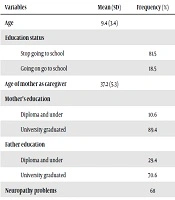
The demographic and medical characteristics of the 50 children with ALL and 50 sibling controls are listed in Table 1.
Table 1.
Demographic and Medical Characteristics of Children with Cancer
| Variable | M (SD) | Frequency, % |
|---|---|---|
| Age of child | 9.4 (2.2) | |
| Child’s education status | ||
| Stop going school | 76.2 | |
| Going on go to school | 23.8 | |
| Age of mother as caregiver | 34.7 (4.1) | |
| Mother’s education | ||
| Diploma and under | 18.7 | |
| University graduated | 81.3 | |
| Father’s education | ||
| Diploma and under | 26.1 | |
| University graduated | 73.9 | |
| SES (father) | ||
| House Holding | 4.2 | |
| Unemployed | 21.8 | |
| Employed | 74 | |
| Time diagnosis (in month) | 26.1 (3.3) |
The Kolmogorov-Smirnov test was applied to test normal distribution. It indicated normal distribution of reaction time scores in N-Back test, commission errors and reaction time scores in CPT and incorrect response scores in WCST. Other variables were not normal. Therefore, independent T-test was used to analyze the findings of mentioned variables and other variables were analyzed by The Mann-Whitney test.
According to Table 1, the comparison of two groups in three cognitive tests shows that the reaction time variable of n-back test has no significant differences between children with ALL and healthy children (P = 0.099). Also there are no significant differences between two groups in commission errors and reaction time variables of CPT (P > 0.01). The results showed that there is a statistically significant difference in incorrect response variable of WCST between two groups (P < 0.01).
As shown in Table 2, average scores of children with ALL in correct response variable of n-back test are significantly lower than normal children and the average scores of unanswered variables in children with ALL is significantly higher (P < 0.01). Average scores of children with ALL in correct detection variable of CPT is also significantly lower than healthy children (P < 0.01). While there is no significant difference in average scores of omission errors variable between two groups (P = 0.111). Results obtained from WSCT shows percentiles of achieved categories in children with ALL is significantly lower than healthy children and average scores of preservation error variable is significantly higher in children with ALL (P < 0.05).
Table 2.
Comparison of Reaction Time Scores in N-Back Test, Commission Errors and Reaction Time Scores in CPT and Incorrect response scores in WCST in Children with ALL and Healthy Children
| Test | Variables | Children with ALL | Healthy Children | T | P Value | ||
|---|---|---|---|---|---|---|---|
| M | SD | M | SD | ||||
| N-back | Reaction times | 594 | 211 | 673 | 189 | 1.67 | 0.099 |
| CPT | Commission errors | 4.38 | 4.03 | 6.93 | 7.3 | 1.76 | o.o86 |
| Reaction time | 550 | 58.71 | 567 | 86.1 | 0.95 | 0.347 | |
| WCST | % Correct | 15.1 | 4.55 | 19.43 | 8.09 | 2.67 | 0.01 |
| % Errors | 14.8 | 5.31 | 18.2 | 6.99 | 2.43 | 0.03 | |
Table 3.
Mann-Whitney test to Compare the Correct Response and Unanswered Variables of N-Back Tests, Correct Detection and Omission Errors Variables of CPT and Perseverative Errors Variable of WCST in Children with ALL and Healthy Children
| Test | Variables | Children with ALL | Healthy Children | Mann Whitney U | P Value | ||
|---|---|---|---|---|---|---|---|
| M | SD | M | SD | ||||
| N-back | Correct response | 86.6 | 15.43 | 72.6 | 24.13 | 483.5 | 0.008 |
| Unanswered | 5.38 | 6.5 | 21.77 | 21.75 | 396.5 | 0.001 | |
| CPT | Correct detection | 1.32 | 1.92 | 4.3 | 4.9 | 596 | 0.111 |
| Omission errors | 144 | 5.33 | 139 | 10.36 | 530.5 | 0.029 | |
| WCST | Categories achieved | 5.16 | 0.93 | 4.5 | 1.25 | 524 | 0.017 |
| Failures to maintain set | 2.68 | 2.4 | 5.37 | 4.04 | 415.5 | 0.001 | |
4. Discussion
The N-back task is a continuous performance task to measure a part of working memory and working memory capacity. Two main scores in N-back are accuracy and reaction time. The current results indicate that children with ALL, compared to healthy children, had weak performance in correct response and left unanswered tests (weak in accuracy), but there was no significant difference between two groups in reaction times (no slower than healthy group). Our results showed greater risk of accuracy in working memory of patients. Previous studies by fMRI showed that cortical regions were involved in attention control (17). In addition, when participants revealed difficulties in accuracy, the anterior cingulate cortex that improve attention activities, could manage error detection and response correction (18). The working memory studies recruit the N-Back task and fMRI demonstrates subcortical attention system related to the reaction time on the N-back task (18, 19).
According to another study (16), childhood leukemia survivors have deficits in working memory performance. The findings of the current study were consistent with research findings in recent years due to the weak performance of children with ALL in accuracy. Pathological intensity is not the same in all sections and there are not equal deficits in all cognitive activities. There is not a considerable attention maintenance deficit in children with ALL compared to control group. Another study (6) also showed children with acute leukemia have no significance differences in speed, attention maintenance, response inhibition and organizing the responses with healthy children that is consistent with the present study. The differences may be related to the chemotherapy dose. Studies have shown that chemotherapy dose intensity determines the cognitive impairment in children with cancer (14).
In this study, sustained attention was investigated by continuous performance task (CPT). The test concludes four main scores, correct detection, reaction time, omission errors and commission errors. Comparison of executive functions in two groups showed that patients revealed slightly dysfunction in correct detection, compared to healthy children. Omission errors and commission errors were not significantly different between the two groups. Correct detection scores in ALL group indicates the limitation in attentional capacity. The limbic system is seen as more important to attention abilities and is viewed as having a stronger impact on vigilance (15). It is possible, brain damages and psychological factors effect on attention deficit in cancer group. The Wisconsin card sorting test (WCST) as a neuropsychological test apply for display frontal lobe functioning and cognitive flexibility (for assessment of executive functions, behavioral regulation, and social discourse). Campbell et al. (15) showed children with ALL have problem in executive function and cognitive flexibility. In this paper, the results were the same. Most neuroimaging studies on WCST performance report a significant increase in metabolic or neural activity within frontal or prefrontal cortical regions (20). It seems frontal or prefrontal lesions in boys with ALL is serious and needs more cognitive re-habituation in this area.
4.1. Conclusion
As results show, children with ALL have more cognitive problems than healthy children. According to research, several factors are involved in sustained cognitive dysfunction of childhood cancer that persists into adulthood. For example, sleep problems and chronic fatigue (21) has a high prevalence in children with leukemia which may underlie cognitive disorders. Studies have shown sleep duration creates serious disturbances in cognitive skills development, especially executive function and children performance under multiple cognitive tasks. Educational deprivation, loneliness, and isolation at a time when children need high social support can reduce children’s abilities how to apply their cognitive skills. Acquisition of many cognitive abilities occurs in school and by peer interaction.
Cognitive and social deprivation may prevent the brain cortical thickness and it causes reduced cognitive functioning.
Cancer and its treatment are associated with a variety of uncontrolled stressors. Diagnosis, painful treatment, and economic pressures are just some of psychological pressure that affect a child’s life. Studies have shown that children with chronic diseases experience sustained cognitive deficits. These findings suggest that cognitive problems are not related to a specific treatment, although treatment will exacerbate problems. Children with cancer apply more avoidance behaviors. Avoidance mechanisms, as an emotion regulation mechanism, decrease attention in children with cancer and cause reduced cognitive skills (4). Avoidance leads to the reduced sense of curiosity and searching in the environment and is considered as a base for cognitive problems. Treatment and disease-related factors have also a strong role in the development of cognitive problems. For example, anemia and bleeding risk are consequences of leukemia. Results showed iron deficiency anemia cause cognitive dysfunction in children suffering from diseases such as hemophilia and Malaria (8). Pain resulting from invasive therapies can reduce IQ in children. Despite the above factors, Air and colleagues (4) have emphasized that chemotherapy increased the behavioral problems incidence and this consequence persists for many years afterwards. Briefly, children with cancer are involved with cognitive problems due to various reasons. Early diagnosis and intervention can prevent these problems.
Future studies should focus on biochemical and social factors related to cognitive impairments. Also, it seems that executive function is more vulnerable and interventions priority should be designing prevention and rehabilitation of this brain function.