
1. Background
Thyroid cancer is the most common endocrine malignancy that includes about 1 - 3% of all cancers (1, 2). Non-medullary differentiated thyroid cancers (papillary and follicular thyroid cancer) are the most frequent types of thyroid cancer and the third most common cancers in women in the USA (1-3). The female to male ratio ranges from 3 to 1 in different reports (2). History of radiation exposure and familial history of NMTC are two major factors predisposing to thyroid carcinoma. Although most thyroid carcinomas are sporadic, about 3 - 9% of all non-medullary thyroid cancers have been reported to be familial (4-6). Familial Non-medullary Thyroid Cancer (FNMTC) is defined as NMTC in two or more than two first-degree relatives who cannot be categorized in other familial syndromes (7). Some researchers suggested that familial NMTCs are more aggressive at first presentation and have more recurrences in long-term follow-up. Confirming these theories would suggest the necessity of screening and more aggressive treatment in patients with FNMTC (4, 5, 7-9). On the other hand, there is much-published research in which a similar behavior and prognosis have been confirmed for sporadic and familial non-medullary thyroid cancers (10-13). Considering these controversies (14), we looked at our cancer registry to evaluate response to treatment and disease recurrence in familial NMTC patients compared to age, sex, and TNM stage-matched sporadic thyroid cancer patients.
2. Methods
We reviewed the medical files of all patients with NMTC who were referred to our institute in the last 21 years (1997 - 2018). We included all patients with familial NMTC (defined by NMTC in at least two first-degree relatives) and no evidence of any hereditary syndromes (15). Patients with poorly differentiated carcinoma, medullary carcinoma, or anaplastic thyroid cancer were excluded. All patients had been treated uniformly with a standard protocol, including near-total or total thyroidectomy with central and/or lateral lymphadenectomy (if physical exam or preoperative ultrasonography showed enlarged lymph node), followed by RIA (if indicated) and suppressive therapy without considering its familial nature. In persistent or metastatic diseases, repeated radio-iodine therapy was applied. In the case of structural disease with no iodine uptake, surgery and/or external beam radiotherapy was performed. Response to treatment was assessed one and two years after treatment in the off-T4 state by physical examination, neck ultrasonography, whole-body iodine scan, as well as the measurement of thyroglobulin (Tg) and anti-thyroglobulin antibody (anti-Tg Ab) levels. Nearly all laboratory tests were done in a single laboratory. Thyroglobulin was measured using immune-radiometric assay (IRMA) with a functional sensitivity of 0.35 ng/mL (BIOCODE S.A- Liege, Belgium), intra-assay coefficient of variation of 4.8%, and inter-assay coefficient of variation of 6.1%. Then, TSH was measured using the IRMA method (Padyab, Inc., Iran) with a functional sensitivity of 0.02 uIU/mL and inter-assay and intra-assay variance of 3.5 and 2.9%, respectively. Anti-thyroglobulin antibody was measured using ECLIA (Roche, Inc., Germany) with a functional sensitivity of 10 IU/mL and inter-assay and intra-assay variance of 5.1 and 5.9%, respectively. All ultrasonography studies were done at four centers by four radiologists who were experts in thyroid and cervical US. They used 10 - 12 MHz linear probes. The US systems used included Mediso, V10, South Korea, Affiniti 70, Philips, USA, LOGIQ P9, GE healthcare, USA.
The response to treatment was defined as an excellent response, indeterminate response, and incomplete response (either biochemical or structural) according to the ATA response criteria. According to these criteria, “excellent response” refers to “no clinical, biochemical, or structural evidence of disease”, while “biochemical incomplete response” is defined as abnormal Tg or rising anti-Tg antibody levels in the absence of localizable disease. Furthermore, “structural incomplete response” is referred to as “persistent or newly identified loco-regional or distant metastases”. Also, nonspecific biochemical or structural findings that could be confidently classified as either benign or malignant were considered as “indeterminate responses” (1).
We recorded all disease features of patients with familial NMTC, including TNM stage, the dose of iodine therapy, laboratory tests (TSH, thyroglobulin, and anti-thyroglobulin) at the first visit one and two years after iodine therapy, and at the last visit. Comparing familial and sporadic NMTC, we searched our data and included sporadic NMTC patients (control group) who were matched for age, sex, and TNM stage with NMTC patients. All demographic data, disease features, and response to treatment were also recorded for the control group. Any additional treatment, accumulative iodine dose, time to an excellent response, disease recurrence, and patient’s death were also recorded for both groups. Response to treatment and time to excellent response were compared between 66 FNMTC patients (cases) and 66 age, sex, and TNM stage-matched sporadic NMTC (controls) who had been followed up for at least one year. All data were analyzed using SPSS software, version 22.
The study was approved by the local Ethics Committee (MUMS, 941547). All patients had signed a written consent form in initial admission to our department. As this was a retrospective study, a new consent form was waived by the ethics committee. All authors declare no conflict of interest or funding.
2.1. Statistical Analysis
Descriptive analysis was done using univariate analysis and presented as means with standard deviations. Frequency tables and crosstabs were used for the depiction of qualitative variables. Statistical comparison between groups was done using an independent sample t-test for numeric variables. Nominal variables were compared using the chi-square test between the groups. The SPSS software (V. 11.5, SPSS Inc., USA) was used for data analysis. A P-value of less than 0.05 was considered significant in all comparisons.
3. Results
Reviewing data of 2,944 patients with a history of differentiated thyroid cancer who had been referred to our institute between 1997 and 2018, 81 (2.75%) patients with familial NMTC were found (58 females, 23 males) in 37 families who had at least two involved family members with NMTC in the first-degree relatives. One family had four involved members, and five families had three involved members. The majority of the patients (77 patients, 95.1%) had papillary thyroid carcinoma, and four (4.9%) patients had follicular carcinoma. Classic subtypes included 87% of patients with PTC, while 50% of patients with follicular carcinoma were categorized as a widely invasive subtype. Furthermore, microcarcinoma was observed in 11 patients.
In four patients, consanguinity was noted in the parents. The number of involved sisters or daughters was 54/243 (22.3%), while the number of involved brothers or sons was 22/277 (8%). The number of involved female relatives was 2.79 times more than the number of involved male relatives. There were three identical pairs of twins with a diagnosis of familial PTC (diagnosed in less than one year). None of them had a history of NMTC in other first-degree relatives, but another case of NMTC was found in the second-degree family of one of these twins.
The mean age of the patients was 37.9 ± 13.4 years (5 - 70 years). General characteristics and TNM staging of the patients are shown in Table 1. The TNM staging was available in 78 patients and was done according to the TNM stage (seventh version). All data from pathology, post-ablation whole body iodine scan, and ultrasonography/radiology examinations were used for staging. Three patients with familial PTC did not receive any iodine treatment and were followed with suppressive therapy due to the low risk of recurrence.
Table 1.
| Variables | Results |
|---|---|
| Age (y) [range of age] | 37.9 ± 13.4 [5 -70] |
| Female/male ratio | 58/23 |
| Involved family members | |
| 2 | 31 (family) |
| > 2 | 6 (family) |
| T staging | |
| Tx | 1 |
| T1 | 40 |
| T2 | 25 |
| T3 | 9 |
| T4 | 3 |
| N staging | |
| Nx | 2 |
| N0 | 29 |
| N1 | 47 |
| M staging | |
| M0 | 75 |
| M1 | 3 |
| First TSH (mIU/L) | 84.1 ± 48.03 |
| First Tg (ng/mL) | 64.3 ± 270.3 |
| First Anti-Tg Ab (IU/mL) | 401 ± 894.5 |
Abbreviations: Tg, thyroglobulin; TSH, thyroid stimulating hormone.
a Values are expressed as mean ± SD unless otherwise indicated.
b TNM staging was not available in three patients.
c Normal range of Anti-Tg Ab was up to 115 IU/mL.
3.1. Comparison of FNMTC with Sporadic NMTC
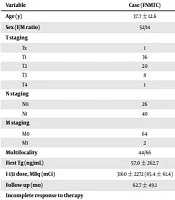
From the studied cohort, 66 patients (52 females and 14 males) had been followed up for a minimum of one year after radio-iodine therapy and were compared with 66 age, sex, and TNM stage-matched controls who had PTC with no family history and had been followed up for at least one year. The mean age of the patients was 37.76 ± 12.64 and 37.86 ± 12.39 years in the case and control groups, respectively (P = 0.96). Comparison of general characteristics and responses to therapy between the case and control groups is shown in Table 2. There was no significant difference in the first Tg level, initial iodine dose, and accumulated radio-iodine dose between patients and controls. The incomplete response was noted in 29% of patients and 24% of controls one year after I-131 therapy (P = 0.4). Two years after radio-iodine therapy, the incomplete response was seen in 24% of cases versus 13% of controls (P = 0.2). Although the rate of incomplete response was not significantly different between cases and controls in our study, the effect size should not be ignored. Interestingly, the time to excellent response was significantly longer in patients with FNMTC compared to controls (26.7 ± 24.9 versus 15.9 ± 9.0, P= 0.01).
Table 2.
Comparison of Different Variables Between Familial Non-medullary Thyroid Cancer (FNMTC) Patients and Controls (66 patients) a
| Variable | Case (FNMTC) | Control (NMTC) | P-Value |
|---|---|---|---|
| Age (y) | 37.7 ± 12.6 | 37.8 ± 12.4 | 0.96 |
| Sex (F/M ratio) | 52/14 | 52/14 | 1 |
| T staging | 0.38 | ||
| Tx | 1 | 0 | |
| T1 | 36 | 32 | |
| T2 | 20 | 24 | |
| T3 | 8 | 8 | |
| T4 | 1 | 2 | |
| N staging | 1 | ||
| N0 | 26 | 26 | |
| N1 | 40 | 40 | |
| M staging | 1 | ||
| M0 | 64 | 64 | |
| M1 | 2 | 2 | |
| Multifocality | 44/66 | 45/66 | 0.85 |
| First Tg (ng/mL) | 57.0 ± 262.7 | 22.0 ± 66.2 | 0.31 |
| I-131 dose, MBq (mCi) | 3160 ± 2272 (85.4 ± 61.4) | 2627 ± 2061 (71.0 ± 55.7) | 0.16 |
| Follow-up (mo) | 62.7 ± 49.1 | 60.9 ± 30.0 | 0.8 |
| Incomplete response to therapy | |||
| at 1 year | 18/63 (29) | 15/64 (23) | 0.4 |
| at 2 years | 13/54 (24) | 8/63 (13) | 0.27 |
| Time to excellent response (mo) | 26.7 ± 24.9 | 15.9 ± 9.0 | 0.01 |
| Accumulated dose of I-131 MBq (mCi) | 5202 ± 7211 (140.6 ± 194.9) | 4111 ± 5206 (111.1 ± 140.7) | 0.32 |
| External radiotherapy | 6/66 (9.1) | 2/66 (3) | 0.27 |
| Additional surgery | 8/66 (12.1) | 5/66 (7.5) | 0.56 |
Abbreviation: Tg, thyroglobulin.
a Values are expressed as mean ± SD and No. (%) unless otherwise indicated.
The mean follow-up time was 62.6 months in familial patients and 60.9 months in non-familial cancer patients. Three patients with familial NMTC died during follow-up, including two cancer deaths, while no cancer death was noted in the control group. Cancer death was defined as death directly related to thyroid cancer. One of our patients with lung metastasis died with hemoptysis and respiratory distress, and another patient with widespread bone metastasis died with bone marrow involvement and aplastic anemia. One patient in each group had a recurrence of disease after achieving an excellent response. Multifocality of carcinoma in pathologic examination was noted in 44 patients with familial NMTC and 45 control subjects (P = 0.85).
3.2. Influence of Number of Involved Members
Of 37 families with FNMTC, 31 patients had two involved first-degree family members (group 1) while six families had more than two involved first-degree family members (group 2). We compared patients in group 1 and group 2 in terms of age, sex, first Tg level, radio-iodine dose, response to treatment at one and two years, and time to excellent response (Table 3). Overall, we could not find any difference in response to treatment between patients in group 1 and group 2, suggesting that the involvement of more than one first-degree family member does not increase the risk of disease.
Table 3.
Comparison of Non-medullary Thyroid Cancer Patients with Two and More Than Two Involved First-Degree Family Members (81 patients) a
| Variables | 2 Involved Members | > 2 Involved Members | P-Value |
|---|---|---|---|
| Age (y) | 36.5 ± 13.7 | 39.7 ± 11.3 | 0.34 |
| First Tg (ng/mL) | 81.2 ± 311.9 | 15.7 ± 37.5 | 0.38 |
| I-131 dose in MBq (mCi) | 3134 ± 3452 (84.7 ± 63.3) | 3274.5 ± 2249.6 (88.5 ± 60.8) | 0.81 |
| Follow-up (mo) | 53.7 ± 45.1 | 67.4 ± 60.4 | 0.29 |
| Incomplete response to therapy | |||
| At 1 year | 16/50 (32) | 5/18 (28) | 0.83 |
| At 2 years | 8/38 (21.1) | 5/14 (35.7) | 0.51 |
| Time to excellent response (mo) | 29.6 ± 28.4 | 21.9 ± 14.8 | 0.42 |
Abbreviation: Tg, thyroglobulin.
a Values are expressed as mean ± SD and No. (%) unless otherwise indicated.
4. Discussion
This retrospective case-control study showed that although the response to treatment at one and two years was not different between the case and control groups, time to reach excellent response was significantly longer in patients with familial NMTCs than in non-familial patients while they had received similar treatments and were age, sex, and TNM stage-matched. These findings were also correct when we compared two sub-groups of familial NMTCs (families with two involved NMTC first-degree relatives and families with three or more NMTC patients). Our results support those reports showing that familial NMTCs are more aggressive and may require additional treatments to achieve an excellent response.
Familial NMTCs account for about 3 - 9% of all differentiated thyroid cancers and seem to follow an inherited feature (8, 12, 16). Although a large number of researchers advocate more aggressiveness of familial disease and suggest more aggressive treatments for them (7, 9, 17), others believe that familial and sporadic NMTCs are not different in terms of clinical and pathological presentations from sporadic NMTC and have a similar prognosis (11, 18). One of the main reasons behind these controversies is the low incidence of familial NMTCs and limited literature on their genetic mutations (14, 19). Other variables that may be effective include different follow-up durations, different definitions of response to treatment, and different inclusion criteria.
In this study, 95.1% of the patients had papillary thyroid cancer, and 87% had a classic subtype. These findings are concordant with other studies that reported papillary thyroid cancer as the most frequent pathologic type of differentiated thyroid cancers (7, 10, 11, 17). Many reports confirm that familial NMTCs are more frequent in women than in men, and no gender difference is noted between familial and sporadic NMTCs (7, 10, 11, 16, 17). Our results supported this finding and showed that the female to male ratio was about 2.79 in familial NMTC patients. This result suggests more careful screening in female first-degree relatives of NMTC patients.
In this study, 2.75% of thyroid cancer patients had familial NMTC, which is concordant with reports from other parts of the world. Overall, familial NMTC was reported in 3 - 9% of patients with thyroid cancer (8, 12, 16), and it was 4% in Japan (20), 10% in the USA (17), 6.4% in Italy (16), 5.3% in Israel (11), and 4.4% in Canada (18).
We found differences in time to reach excellent response to treatment between familial and sporadic NMTCs. Macdonald et al. reported more aggressiveness of familial NMTCs at first diagnosis, more deaths, more required reoperation, and more iodine therapy in familial NMTC (7). In our study, five cancer deaths happened in the FNMTC group, while no cancer death was reported in the control group. However, the difference was not statistically significant. Furthermore, additional treatments like second surgery or additional radio-iodine therapy were not more frequent in patients in our study. The advantage of our study was that we matched familial and sporadic patients for age, sex, and TNM stage. Moreover, we excluded more aggressive histologies like anaplastic cancer, which could have more effects on prognosis in a group of patients. Our study, however, indicates the importance of long-term follow-up in any research involving NMTC, as cancer death was more common in patients with familial NMTC than in sporadic cases. Furthermore, our study showed a similar response to treatments one and two years after therapy in sporadic and familial NMTC. Some comparative studies (7, 11, 17) compared familial and sporadic NMTC patients without matching for age, sex, or TNM stage. To the extent of our search in the literature, there was no study in which response to treatment and time to excellent response was compared between two groups.
In another study, Uchino et al. showed that familial NMTCs were more aggressive, and disease recurrence was significantly more common in familial NMTCs (20). The high number of familial NMTCs (258 familial versus 6200 non-familial cancer cases) in that study was a big advantage. They concluded that although overall survival was not different between the two groups, cancer-free survival was shorter in familial NMTC patients. This conclusion seems to be concordant with our findings of the longer time required to achieve excellent response despite no difference in categorized response to treatment after one and two years. One study compared 321 non-familial NMTCs with 37 familial NMTCs, and familial NMTCs were found to be more aggressive in pathology and included more disease recurrence in long-term follow-up (17). Again, this study included all NMTC patients without matching and did not evaluate response to treatment. We had one recurrence in each group.
Only two studies had exactly matched familial and non-familial patients in terms of age, sex, and TNM stage and had been performed by Pinto et al. (10) and Evelyn Linda Maxwell et al. (18). They concluded that familial and sporadic NMTCs were similar in clinical behavior and prognosis, except for multifocality that was more frequent in familial patients (Table 4). Our study showed a similar response to treatment one and two years after therapy between the case and control groups. Also, they compared disease-free survival (DFS) and overall survival (OS) as prognostic criteria, which was not different between familial and non-familial patients. Moreover, the mortality rate was calculated to be higher in the control group in one of these studies (although statistically insignificant) (10). Multifocality was not more prevalent in FNMTC patients in our study. The difference between our study and others may reflect different selection criteria and methodology in our study. Most of the previous studies did not match familial NMTC patients with their non-familial counterparts. From the studies that matched the two groups, one had 24 patients with FNMTC and found no difference in any variable that could be due to the limited number of patients in that investigation (18). The second study found that only multifocality was more common in FNMTC patients; however, it did not compare time to reach excellent response between the two groups (10). Multifocality was not different in our study that may be due to the exclusion of high-risk histologic variants in our study.
Table 4.
Comparison of Different Published Studies Comparing Familial and Sporadic Differentiated Thyroid Cancer a
| References | Age (y) | F/M | Incidence of FNMTC | PTC (%) | > 2 Member | Matched | Multifocality | Follow-up Time (mo) | Cancer Death | Significant Difference |
|---|---|---|---|---|---|---|---|---|---|---|
| Current study | 37.7 ± 12.6 | 52/14 (78.8) | 81/2944 (2.75) | 95.1 | 22/66 (33.3) | Age, sex, TNM | 44/66 (66.7) | 62.7 ± 49.1 | 2/66 (3) | TTER |
| Mc. Donald et al. (7) | 41.66 ± 1.9 | 72/19 (79.1) | 91/698 (13) | 95.1 | 41/91 (45) | No match | 54/91 (59.3) | 57.96 ± 8.28 | 3/91 (3.3) | Death, distant metastasis, persistent disease, additional surgery, additional RIT |
| Uchino et al. (20) | 49.1 ± 13.9 | 227/31 (88) | 258/6458 (4) | NA | 43/258 (16.6) | No match | 105/258 (15.9) | 142.5 ± 123.1 | 7/258 (2.7) | Recurrence, DFS, multifocality |
| Mazeh H et al. (17) | 43 ± 3 | 29/8 (78.4) | 37/358 (10) | 90 | 19/37 (51.3) | No match | 18/37 (48) | NA | NA | Age, multifocality, N stage, recurrence |
| Pinto et al. (10) | 46.1 | 82/25 (76.6) | NA | 77.6 | 32/107 (29.9) | Age, sex, pTNM, approximate follow-up time | 52/107 (49.1) | 92.7 | 0/107 | Multifocality |
| Maxwell et al. (18) | 54.6 ± 18.5 | 19/5 (79.2) | 24/543 (4.4) | 92 | NA | Age, sex, stage at presentation, tumor size | 12/24 (50) | ≥ 24 | 0/24 | Nothing |
Abbreviations: TTER, time to reach excellent response; DFS, disease-free survival.
a Values are expressed as mean ± SD and No. (%) unless otherwise indicated.
In another study, 67 familial NMTC patients were compared with 375 patients with non-familial NMTC, and it found no significant difference in age, gender, TNM stage, pathology aggressiveness, prognosis, persistent/recurrent disease, and disease-free survival between the two groups (11). Our study also showed no difference in response to treatment one and two years after surgery, but time to excellent response was longer in patients with familial NMTC. These findings suggest that although familial NMTCs are not significantly more aggressive and their one and two years’ response to therapy are not statistically different, they may require more careful follow-up to achieve an excellent response.
Furthermore, we looked at the number of involved family members and compared two subgroups of patients with two involved members and more than two involved members. There was no significant difference between the two groups in terms of response to therapy, similar to other reports that found no significant difference (10, 11, 17, 21). These findings suggest that the number of involved family members did not change the prognosis in familial NMTC. Anyhow, a recent screening study of family members of FNMTC patients showed that thyroid carcinoma was more commonly seen (22.7 versus 4.6%) in family members of patients with three or more involved relatives compared to patients with two involved relatives and recommend that screening in this group may be justified (22).
The strength of our study was that we compared two uniform groups that were matched for age, sex, and TNM stage, and we excluded aggressive histology. However, our main limitations were a relatively limited number of patients and the retrospective nature of the study.
4.1. Conclusion
Our studies showed that the majority of the patients with FNMTC had only one involved first-degree relative. The chance of the involvement of a female relative was 2.79 times higher than that of the involvement of a male relative. Furthermore, the time to excellent response was longer in patients with FNMTC than in controls, and the involvement of more than one family relative would not increase the chance of incomplete response.