
1. Context
There are 463 million people with diabetes mellitus (DM) in the world, and there is an increasing trend of DM incidence around the world and in Iran (1). The two main lifestyle risk factors for DM are, first, inappropriate diets rich in sugar and fat and poor in fibers, and second, lack of enough physical activity (2). Physical activity (PA) is an important part of diabetes prevention and management. Cardiovascular risk factors and obesity play a great role in type 2 diabetes mellitus (T2DM) progression and complications; however, they can be prevented with simple interventions such as a healthy diet and exercise (3). Also, it has been shown that PA could be useful in glycemic control, and all together, decreases mortality in T2DM patients (4, 5). Although there is not as much evidence as for T2DM, yet PA is recommended for type 1 diabetes mellitus (T1DM) either through either decreasing cardiovascular risk factors or increasing insulin sensitivity, leading to general well-being (6). Therefore, the type of activity and its intensity, duration, and frequency are all aspects of PA as an intervention for DM prevention and management. Physical activity includes a wide range of activities from regular daily walking to aerobic, strength (resistance), and flexibility exercises, all of which have been reported to be beneficial in the prevention and management of DM (7).
Although the benefits of PA are well studied and established, guidelines are needed to indicate personalized regular PA for the general population to prevent diabetes and T2DM patients to manage diabetes. The role of PA in recent DM research has led to its credit as an important component of personalized diabetes management in guidelines; however, it seems that it has not translated well into the community (8), and therefore, the evidence gap of PA for subgroups such as the elderly, pregnant women, and other groups with specific needs that will benefit from PA should be considered in personalized DM research. Also, the current litterateur lacks enough evidence on a variety of physical activities and, more importantly, the complicated network between its benefits and other aspects of DM research that had gained more interest in the past years, such as psychosocial, economical, and virtual interventions in DM management (9). Therefore, since there are lots of gaps and questions for DM researchers when it comes to the importance and novelty of PA, it could be an opportunity for Iranian researchers to establish specific national guidelines for PA in the context of DM prevention and management, and also to improve the scientific potentials and capabilities with research in new horizons of DM investigation. There have been efforts for national guidelines adaptation, and the Iran diabetes research roadmap (IDRR) study was successful to draw a picture of the diabetes research gap in Iran in 2015 (8, 9).
This study aimed to review the current situation of PA practice and research for the prevention and management of diabetes in Iran in 2015 - 2019 to find research gaps and establish research priorities.
2. Evidence Acquisition
This scoping review was conducted to assess the diabetes research activities performed by Iranian authors from 2015 to the end of 2019, following the previous IDRR study that covered publications until 2015. The Arksey and O'Malley method (10) was used for this scoping review, which consisted of six stages: (1) Identifying the research question, (2) Identifying relevant studies, (3) Selecting studies, (4) Charting the data, (5) Collating, summarizing, and reporting the results, and (6) Expert consultation. The SPSS software (version 20) was used for the descriptive analysis. Additionally, VOSveiwer 1.6.15 was used to draw the network of researchers and keywords of PA research in Iran in the field of DM.
Stage 1: Identifying the research question: The main question of this study was that what are the gaps in the field of PA research in DM investigation during 2015 - 2019 in Iran?
Stage 2: Identifying relevant studies: To identify the associated studies, the databases consisting of Scopus, PubMed, and Web of Science were searched using the following keywords: (diabetes OR diabetic) AND Iran. The search was limited to the time between the beginning of 2015 and the end of 2019. There was no other restriction on the search in databases.
Stage 3: Selecting studies: After excluding duplicates, the titles and abstracts of the studies were screened based on the eligibility criteria by two members of the research team. Some criteria were used in this study to select the relevant studies. Only original and secondary studies were included. Commentaries, letters to editors, books, protocols, news, theses, notes, short surveys, and conference abstracts were removed. An interactive team approach was used to confirm the selected studies. The research studies associated with Iranian populations were assessed. The investigations associated with non-Iranian populations were excluded. All studies published in 2015-2019 were included. Only English and Persian documents were eligible.
Stage 4: Charting the data: The included manuscripts were categorized in different subject areas, including basic sciences, complications, comorbidities, prevention, psychology, nutrition, PA, education, epidemiology, treatment, and gestational diabetes mellitus (GDM). A team member with multiple areas of expertise worked together on the appraisal of the included articles and data extraction. Only articles in the PA category are presented in this study.
Stage 5: Collating, summarizing, and reporting the results: The multidisciplinary working team synthesized and interpreted the results to find the research gap. The selected articles were summarized into a table by two investigators. The table contains the following data:
1- The population in this study included healthy, T2DM, and T1DM people and animals.
2- Types of research encompassed animal studies, clinical studies, epidemiological studies, and secondary research as reviews.
3- Design and Level of Evidence (LOE) included level (1) Systematic reviews and meta-analyses, level (2) RCTs, quasi RCTs, and clinical trials, level (3) Cohort studies, level (4) Case-control and cross-sectional studies, level (5) Case series and case reports, level (6) Expert opinions, narrative reviews, and editorials, and level (7) Animal studies.
4- Gender and age included male/female and children, adolescents, adults, and the elderly (animal studies were not considered for this part).
5- Type of PA involved aerobic, resistance, flexibility, swimming, and relaxation exercises. Some articles may have reported more than one type, which was defined as combined. The exercise was used for those studies that did not elaborate on the type of it (especially in animal studies), and PA was considered as a wide type of activities including both exercises and regular daily activities such as walking. If these regular daily activities were reported exclusively, they were considered an individual type.
6- Main complications were DM, T2DM, T1DM, GDM, prediabetes, and prevention. Each article may have reported one or more outcomes such as metabolic syndrome, glycemic control, etc.
Stage 6: Expert consultation: After finalizing the initial manuscript of this study, the manuscript was presented to active DM researchers, especially in the field of PA, and other stakeholders to have their feedback for improving the scoping review.
3. Results
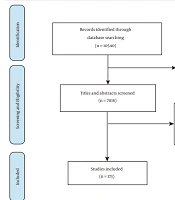
After screening, 169 publications (2.4% of screened titles and abstracts) were included, as tabulated in Supplementary file 1 and summarized in Table 1. In Appendix 1, the flow diagram of study selection is shown.
3.1. Co-author and Keywords Analysis and Network Visualization:
Figure 1 shows the network visualization of co-authorship for 71 items that had the largest set of connected items (eight clusters). The most co-authorship relations and strongest links were for Mohaddes, G, followed by Mohammadi, M and Alipour M.R.
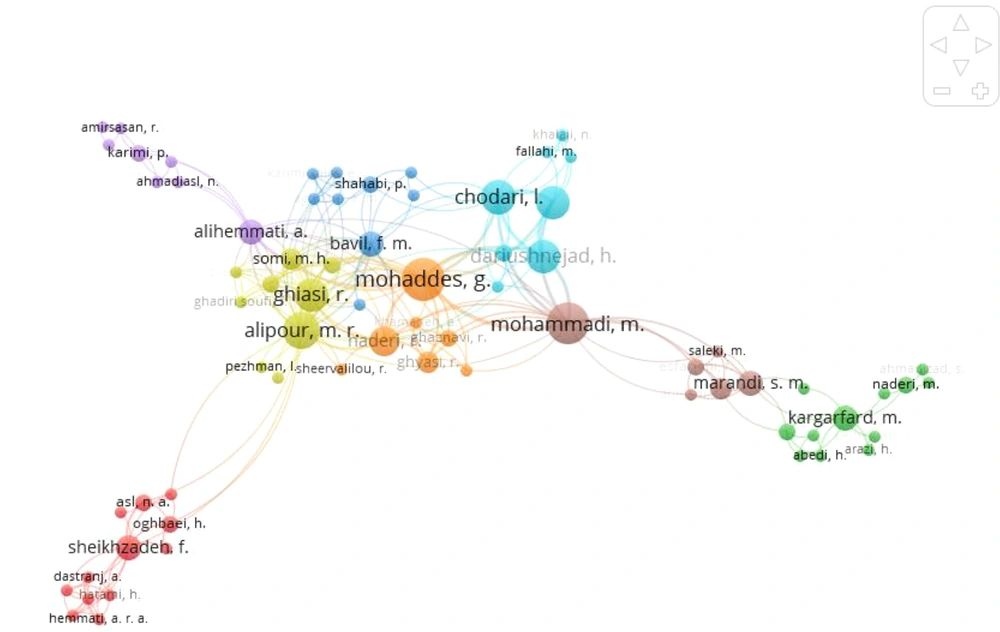
Figure 1.
Network visualization of co-authorship for 71 items that had the largest set of connected items (eight clusters).
Figure 2 represents the network visualization of the top 49 keywords that were repeated at least 15 times in publications (two clusters). "Controlled study", "male", "rat", "nonhuman", "glucose blood level", "animal model", and "animal experiment" were the top keywords that were applied in these documents.
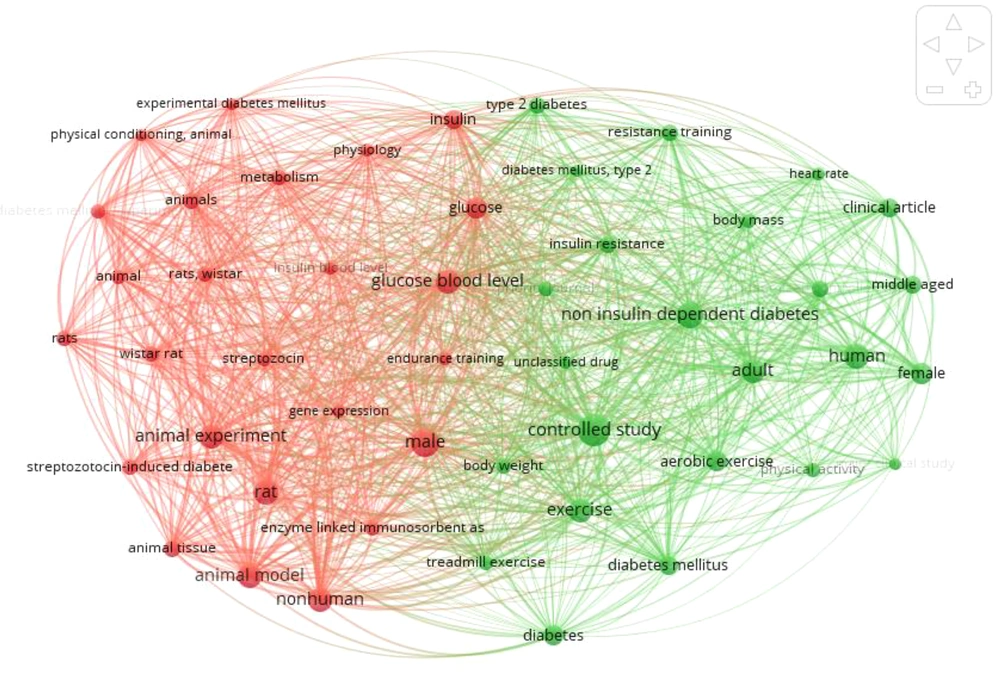
Figure 2.
Network visualization of top 49 keywords that were repeated at least 15 times in publications (two clusters).
3.2. The Trend of Publication and Population
Most of the articles were published in 2019, and the trend of publications is presented in Appendix 2. Almost half (85 articles, 50.3%) of them were animal studies, and 45.6% (77 articles) were on patients with diabetes. Research on a healthy population and together with diabetics was reported only in six articles and one article, respectively. The majority of the publications on clinical topics were focused on females (42 articles) rather than males or combined (5 and 37 articles, respectively). The elderly were studied only in six articles, and other publications that were not animal studies were focused on adults (78 publications, 46.2%). The main topic of the included studies was T2DM in 134 articles. In six articles, T1DM was investigated, and 19 articles investigated both types of diabetes. Gestational diabetes mellitus was reported in four articles, and prediabetes and prevention were the main topics in two and four articles, respectively.
3.3. Type of Research, Study Design, and LOE
The type of research was basic in most publications (89 articles, 50.9%), followed by clinical studies (69 articles, 40.8%). Epidemiological and secondary studies were the types of research in eight and six articles, respectively. Most of the studies were RCTs (51, 30.2%) second to animal studies. Also, quasi-randomized trials and non-randomized clinical trials consisted of 17 publications. Other study designs are shown in Table 1. Due to the utmost number of animal studies, the majority (50.9%) of the articles were in LOE 7; however, 40.2% of the publications were rated as LOE 2.
| Foot Care | Pregnancy | Behavior | Cardiovascular | Metabolism | Cognitive | Glycemic Control | Inflammation | Insulin Sensitivity | Metabolic Syndrome | HTN | Reproductive | Neuropathy | Nephropathy | Prevention | QOL | Skeletal Muscle | Hypoglycemia | Platelet Function | |
|---|---|---|---|---|---|---|---|---|---|---|---|---|---|---|---|---|---|---|---|
| Population | |||||||||||||||||||
| Patients | 1 | 8 | 6 | 15 | 1 | 10 | 5 | 13 | 13 | 2 | 8 | 1 | 4 | 3 | 2 | ||||
| Healthy | 1 | 1 | 1 | 1 | 1 | 1 | 1 | ||||||||||||
| Both | 1 | ||||||||||||||||||
| Animal | 19 | 17 | 4 | 11 | 8 | 10 | 5 | 8 | 3 | 7 | 1 | ||||||||
| Design | |||||||||||||||||||
| RCT | 1 | 4 | 8 | 1 | 7 | 3 | 10 | 10 | 1 | 7 | 4 | 3 | 1 | ||||||
| Quasi | 2 | 7 | 3 | 2 | 3 | 3 | 1 | 1 | 1 | 1 | |||||||||
| Meta-systematic review | 1 | 2 | |||||||||||||||||
| Case-control | 1 | ||||||||||||||||||
| Cross-sectional | 8 | ||||||||||||||||||
| Expert | 1 | 1 | 1 | 1 | |||||||||||||||
| Expert | 19 | 17 | 4 | 11 | 8 | 10 | 5 | 8 | 3 | 7 | 1 | ||||||||
| LOE | |||||||||||||||||||
| 1 | 1 | 2 | |||||||||||||||||
| 2 | 1 | 6 | 15 | 1 | 10 | 5 | 13 | 13 | 2 | 8 | 5 | 3 | 2 | ||||||
| 4 | 9 | ||||||||||||||||||
| 6 | 1 | 1 | 1 | ||||||||||||||||
| 7 | 19 | 18 | 4 | 11 | 8 | 10 | 5 | 8 | 3 | 7 | 1 | ||||||||
| Type of research | |||||||||||||||||||
| Clinical | 1 | 1 | 6 | 15 | 1 | 10 | 5 | 13 | 13 | 2 | 8 | 5 | 3 | 2 | |||||
| Epidemiology | 8 | ||||||||||||||||||
| Secondary | 1 | 1 | 1 | 1 | 2 | ||||||||||||||
| Basic | 19 | 18 | 4 | 11 | 8 | 10 | 5 | 8 | 3 | 7 | 1 | ||||||||
| Type of PA | |||||||||||||||||||
| Exercise | 1 | 1 | 1 | 15 | 10 | 1 | 2 | 3 | 5 | 2 | 1 | 3 | 1 | 1 | 2 | 5 | |||
| Aerobic | 7 | 18 | 3 | 3 | 4 | 12 | 3 | 1 | 9 | 1 | 2 | ||||||||
| Resistance | 1 | 2 | 1 | 9 | 1 | 3 | 4 | 1 | 1 | 2 | |||||||||
| Swimming | 1 | 2 | 5 | 4 | 1 | 1 | 2 | 1 | |||||||||||
| Combined | 1 | 1 | 2 | 1 | 3 | 3 | 1 | 2 | 2 | 2 | |||||||||
| Flexibility | 2 | ||||||||||||||||||
| PA | 7 | 2 | 2 | ||||||||||||||||
| Walking | 1 | ||||||||||||||||||
| Relaxation | 1 | 1 | |||||||||||||||||
| Total | 1 | 1 | 9 | 25 | 33 | 5 | 22 | 13 | 24 | 14 | 2 | 5 | 16 | 3 | 2 | 5 | 10 | 1 | 2 |
Abbreviations: PA, physical activity; QOL, quality of life; RCT, randomized clinical trial; LOE, level of evidence
3.4. Type of Activity
Aerobic exercises were reported in 54 articles while it was 21 for resistance exercises. Other types of PA were swimming (n = 15), flexibility (n = 2), relaxation (n = 1), and walking (n = 1). In 14 articles, PA was a combination of different exercises and activities. Most animal studies just used exercises with no elaboration on the type of it (n = 50) and in 11 studies, PA was used in a wide meaning, from daily activities like walking to high-intensity exercises. The type of PA in the included studies is presented in Figure 3.
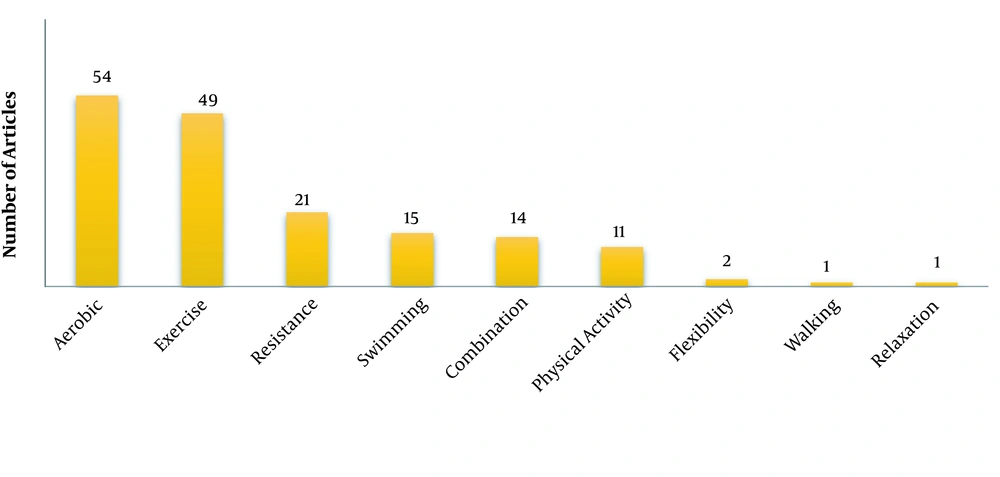
Figure 3.
Type of activity in publications of physical activity in diabetes during 2015-2019
3.5. Outcomes
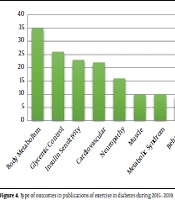
Outcomes of the included studies were mainly focused on metabolism, metabolic syndrome, cardiovascular health, insulin sensitivity, and glycemic control. There were also other outcomes with less frequent publications including inflammation, behavior, neuropathy, and skeletal muscle health. Finally, there were limited publications with outcomes such as pregnancy, foot care, cognitive, hypertension, reproductive health, nephropathy, prevention, quality of life (QOL), platelet function, and hypoglycemia. Figure 4 represents these topics.
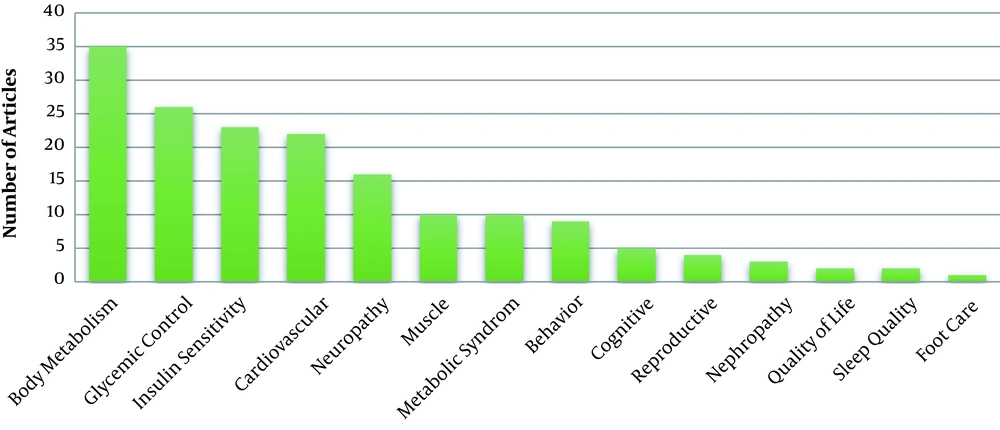
Figure 4.
Type of outcomes in publications of physical activity in diabetes during 2015 - 2019
4. Discussion
In the previously published scoping review on exercise research in IDRR, there were 180 publications until 2015 with an increasing trend (9). In this study, 169 publications were obtained from 2015 to the end of 2019, which had an increasing trend too, and compared to the previous study, it seems to have been an overall increase in publications in this field.
Almost half of the publications were animal studies, and of the remaining clinical studies, the majority of them were original articles and specifically RCTs. Although this is a strong point of PA research in the DM field in Iran that there have been published original RCTs, there are opportunities for epidemiology and secondary research, as well. The previous study recommended more efforts for publishing systematic reviews and meta-analyses too (11); however, it has not been done in the past years.
Investigation on a healthy population was limited and this may indicate the importance of DM prevention and establishing PA as a health behavior in the Iranian population, more importantly children, adolescents, and young adults. The lower number of publications in prediabetes and prevention is consistent with this possibility. Also, there was no publication on children and adolescents, which highlights this topic for future research.
Based on the included publications, there has been more interest in women than men and adults than the elderly. In Iran, the prevalence of DM is more in women than in men (12, 13), and it makes sense that there are more publications on women; however, it is important to have well-designed research on PA for men in the context of diabetes and metabolic syndrome. The publications on the elderly were limited, and this shows the need for more research on this population. With the aging of the Iranian population on the one hand and the numerous benefits of PA in the elderly, which are at greater risk of different chronic diseases on the other, there should be more studies in this field in the future (11, 14).
Since most of the included clinical studies were RCTs, the LOE for the majority of the original clinical articles was at level 2, which is considered a good evidence level. However, publishing more systematic reviews and meta-analyses on PA in DM research may help improve evidence-based medicine and health decision-making in Iran since these types of research are considered to be at the highest evidence level. Also, it should be noted that there was no cohort study in the search result, and this is despite recent achievements of Iranian researchers in this field, as there have been some well-designed cohort studies, especially focusing on metabolic syndrome, DM, and other chronic diseases (15, 16). The previous study suggested that quality assessment for articles should be performed in the future (11), and although LOE is a useful tool for evaluating the evidence level of research, in the future scoping reviews, other tools for quality assessment could be used that will bring a more adequate understanding of the research quality in the field of PA in Iran.
Similar to a previous study (9), most clinical studies investigated aerobic exercise, which was expectable since this is a common form of PA that is recommended for DM patients and has beneficial results for both DM and its related aspects such as cardiovascular health (17, 18). Only one study exclusively investigated walking as a PA, and therefore, it would be worth full if future research focuses more on walking and other similar types of PA since these are easy and regular daily activities that are still reported to have good results for the management of DM patients (19).
There were different outcomes reported in publications, and they mostly were focused on metabolism, metabolic syndrome, glycemic control, insulin sensitivity, and cardiovascular health, which are the main effects of PA in DM patients (7, 17). However, some other outcomes would be important in the context of PA in diabetes, such as hypoglycemia. Hypoglycemia is a serious complication of DM that could be initiated following excessive insulin intake or not decreasing regular insulin and medications while exercising (15). Only one study assessed hypoglycemia, and it was on an animal model. The other outcome with limited publications was prevention. The role of diet and PA in preventing diabetes is well studied worldwide (2), and it seems that there should be more studies (both clinical and epidemiological) in this field in Iran. In future research, RCTs should be directed more toward these neglected outcomes, including hypoglycemia and DM chronic complications such as diabetic foot, retinopathy, neuropathy, and musculoskeletal morbidities.
Compared to other scoping reviews in this field, Iranian researchers have neglected the massaging of the PA benefits into the public community; therefore, the need for studies that investigate factors facilitating or obstacles to the translation of PA guidelines into public awareness is crucial since cultural and social factors affect this process (16). The other new concept of PA in DM management is the role of electronic health and virtual interventions. There have been successful experiences for electronic coaching for diabetics regarding lifestyle changes, including physical training; however, this field has not been widely studied yet in Iran (16). Taking into account the COVID-19 pandemic and its numerous economic and psychosocial problems, the quarantine in different countries and the fear of virus transmission may have adverse effects on the daily and long-time PA habits of both healthy individuals and diabetics. Therefore, investigating the effects of this pandemic on PA status and finding practical solutions for this issue could be another interesting and new topic for Iranian researchers.
Compared to recently published systematic reviews, this study shows that there are some other topics that, despite a significant number of original publications worldwide, still have gained less attention from Iranian researchers. Electronic health, behavior change interventions, and health economic benefits of PA will be quite new topics in Iran since there are still limited publications about these topics (20-22). With an increasing number of publications in the field of PA interventions for chronic diseases, including DM, there has been an interest in recent years to draw a bigger picture of PA benefits in multiple chronic diseases and the additional effects that result in. Although some studies intended to evaluate different benefits of PA such as cardiovascular, metabolic, or glycemic control, it seems that this bigger picture should be encouraged between Iranian researchers to fill evidence gaps regarding the PA benefits in multiple chronic diseases (23, 24). Some DM complications have been the title of many systematic reviews in the past years because of accumulated evidence; however, there were limited publications in Iran; for example, the importance of PA for the prevention and management of diabetic foot, neuropathic pain, and retinopathy was presented in a very small number of clinical articles in Iran (25-27). One of the evidence gaps in Iran is the lack of high-quality publications in specific populations such as children, adolescents, pregnant women, and the elderly, and this makes difficulties when it comes to recommending PA for control of DM, specifically T1DM and GDM in guidelines (28, 29). So altogether, compared to recent systematic reviews, different evidence gaps need the attention of policymakers, institutes, and researchers in Iran.
The main limitation of this study was that although the search was systematic in databases with a high number of indexed articles, still there may be some publications that have been missed in our search. Also, publications in Persian were not searched in national databases, and the number of publications of PA in DM research may be underestimated.
4.1. Conclusions
There have been some improvements in the field of PA research in Iran, especially in the field of understanding the exercise mechanisms affecting diabetics, which have been recognized as a research gap of evidence in the previous study of IDRR. In response to gaps mentioned in the previous IDRR, there has been an increase in animal studies during 2015 - 2019, but cohort studies still have remained as an evidence gap in Iran. However, new concepts and topics should be investigated in the future. Regarding the COVID-19 pandemic situation, meta-analyses (RCT, animal study) and cohort studies on registry data would be recommended. Also, according to the population of the assessed studies, further research on children and elder people is recommended.
Also, concerning the pandemic situation, there is the same need for future research on brisk walking as an inexpensive activity with major benefits and also Tai Chi and Yoga that can be done at home to reduce stress for blood sugar control. Additionally, the effects of PA in the public community for weight loss and prevention and management of DM should be emphasized more in further research.