
1. Context
In general, diabetes is divided into five groups: diabetes mellitus type 1, type 2, gestational diabetes, prediabetes, and diabetes insipidus. The number of patients with diabetes mellitus is increasing worldwide, and an estimated 463 million adults are diagnosed with diabetes. It is predicted that this number will exceed 700 million people by 2045 (1). Diabetes mellitus is a set of metabolic abnormalities characterized by high blood sugar due to defects in insulin secretion, insulin action or both, and is classified into two main categories, type 1 and type 2, type 2 diabetes covers more than 90% of diabetes cases and is related to metabolic disorders including fat and carbohydrates (2). Diabetic ketoacidosis and hyperosmolar hyperglycemic syndrome are acute complications of diabetes mellitus. Chronic complications of diabetes include micro vascular complications, including retinopathy (blindness), nephropathy (glomerular damage and albumin excretion), neuropathy (decrease or loss of pain sensation), and macro vascular complications (coronary artery disease, cerebral vascular accident, peripheral vascular disease) (3) and if diabetic foot ulcer is not properly treated and amputation of the lower limbs may occur as a result of diabetes (4).
Insulin resistance is usually defined as a decrease in sensitivity and response to insulin-mediated glucose excretion and inhibition of hepatic glucose production, and it plays a major pathophysiological role in type 2 diabetes mellitus. Insulin resistance significantly increases the incidence and prevalence of cardiovascular diseases in people with type 2 diabetes mellitus, diabetes is usually associated with obesity, increased lipid profiles, blood sugar, blood pressure and arteriosclerosis (5). Each of these cases can potentially increase cardiovascular diseases in diabetics. In obese diabetic people, there is a risk of cardiovascular diseases due to the presence of low-grade inflammation, in these patients, an increase in the absorption of low-density lipoprotein in the vessel wall and as a result, fat deposition and arteriosclerosis are seen (6), hypertension is common among diabetic patients, this rate is 30% in type 1 diabetic patients and 60% in type 2 diabetic patients, this issue can increase the occurrence of heart failure, stroke and kidney failure (caused by diabetic nephropathy) (7)
Blood lipid disorders are also seen in many diabetes mellitus patients, the cause can be due to the presence of free fatty acids in insulin-resistant fat cells, which leads to an increase in triglycerides and cardiovascular diseases (8). Cardiac autonomic neuropathy is also a common complication of diabetes and exposes these patients to an increased risk of contracting and dying from cardiovascular diseases. This disorder in diabetic patients is associated with a high risk of cardiac arrhythmia, sudden death, myocardial ischemia, diabetic cardiomyopathy, stroke, and cardiovascular instability during and after surgery. Heart rate changes, resting tachycardia, exercise intolerance, orthostatic hypotension, and abnormal blood pressure regulation are also seen with high prevalence (9). With various methods of drug therapy, surgery, following a diet, quitting smoking and alcohol and performing minimal daily activities, the spread and occurrence of diabetes can be prevented. Exercise and physical activity are the basic principles of type 2 diabetes prevention and treatment. According to the diabetes prevention program, 30 minutes of moderate activity per day is recommended for the prevention and delay of type 2 diabetes mellitus (10), the American Diabetes Association recommends patients to walk or ride a bicycle for at least 150 minutes a week with a intensity of moderate to severe (4).
In addition to controlling blood sugar, exercise has many benefits, such as reducing cardiovascular risk factors, reducing insulin resistance, and increasing functional capacity. It has been specifically mentioned in studies that both aerobic training and resistance training improve metabolic characteristics and insulin sensitivity and reduce abdominal fat in type 2 diabetic patients. Post-exercise changes in VO2 peak and body fat may be the main factors of training -induced metabolic improvement (11). During aerobic training, the intensity of the training gradually increases, the rate of fat oxidation increases with a certain intensity to the peak and then starts to decrease. And from this intensity onwards, carbohydrate oxidation is preferable, this process can balance the consumption of fat and carbohydrates in the body, the improvement of laboratory variables and daily physical capacity are expected results (4). In the last decade, attention has been paid to the use of resistance training in diabetic patients. Resistance training is considered a basic and first-line intervention for the treatment and management of diabetic patients. In addition to controlling blood sugar, it causes physical fitness, reduces cardiovascular complications, improves the function of the heart and respiratory system, improves body composition and laboratory variables in these patients. Therefore, it can be said that its beneficial effects are comparable to the effects of aerobic training. The use of these training depends on the limitations and preferences of patients (12). This systematic review and meta-analysis examines the effect of training programs (aerobic and resistance training) on insulin resistance and some cardiovascular disease risk factors in patients with type 2 diabetes for further analysis of specific training characteristics.
2. Methods
In the current research, as a review of studies, we searched articles related to the effect of exercise training on cardiovascular diseases and insulin resistance in diabetes mellitus patients published in English and Farsi in Springer, Hindawi, PubMed, Google Scholar, Scopus, SID and ISC until July 2022 using the keywords diabetes, insulin resistance, cardiovascular disease training, exercise, aerobic training, and resistance training. Between 1999 and 2022, 68 studies and 14 systematic review and meta-analysis articles were examined.
3. Results
In the review of 14 review studies and 68 studies, the following findings were obtained regarding the effect of training programs (aerobic and resistance training) on insulin resistance and some risk factors of cardiovascular diseases in patients with type 2 diabetes mellitus.
3.1. Training and Insulin Resistance in Patients with Type 2 Diabetes
Insulin resistance can be defined as an abnormally high level of insulin required to maintain normal metabolic homeostasis. Insulin resistance is associated with impaired biological response to insulin stimulation of key target tissues, especially liver, muscle and adipose tissue. Insulin resistance affects the use of glucose and leads to a compensatory increase in insulin production of beta cells and hyperinsulinemia. The development of insulin resistance can lead to metabolic syndrome and type 2 diabetes mellitus patients (13).
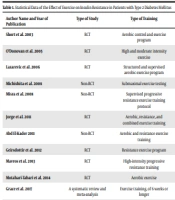
During a period of active training in insulin-resistant individuals, due to transient insulin-independent activation of the glucose absorption pathway, glucose absorption returns to almost normal state (14). It seems that its greatest effect is 3 to 4 hours after training and may be evident up to 72 hours after training, this effect disappears within 5 days after the last training session (15, 16). In several studies, the effect of aerobic and resistance training on insulin resistance in type 2 diabetes mellitus patients has been evaluated (17, 18). In Motahari-Tabari et al.’s study, there was no significant difference in insulin resistance between the groups at the beginning of the study and after the first and second months, but it was significantly lower in the training group after 2 months (P = 0.007) (19) (Table 1).
Table 1.
Statistical Data of the Effect of Exercise on Insulin Resistance in Patients with Type 2 Diabetes Mellitus
| Author Name and Year of Publication | Type of Study | Type of Training | Number of Subjects | Result Observed | References |
|---|---|---|---|---|---|
| Short et al. 2003 | RCT | Aerobic control and exercise program | 90 | P < 0.001 | (32) |
| O’Donovan et al. 2005 | RCT | High and moderate intensity exercise | 67 | P < 0.05 | (33) |
| Lazarevic et al. 2006 | RCT | Structured and supervised aerobic exercise program | 30 | P < 0.001 | (34) |
| Michishita et al. 2008 | Non-RCT | Submaximal exercise testing | 30 | P < 0.05 | (35) |
| Misra et al. 2008 | Non-RCT | Supervised progressive resistance exercise training protocol | 30 | P < 0.001 | (36) |
| Jorge et al. 2011 | RCT | Aerobic, resistance, and combined exercise training | 48 | P < 0.05 | (20) |
| Abd El-Kader 2011 | Non-RCT | Aerobic and resistance exercise training | 40 | P < 0.05 | (37) |
| Geirsdottir et al. 2012 | RCT | Resistance exercise program | 237 | P < 0.05 | (38) |
| Mavros et al. 2013 | RCT | High-intensity progressive resistance training | 103 | P = 0.04 | (39) |
| Motahari-Tabari et al. 2014 | RCT | Aerobic exercise | 53 | P = 0.007 | (19) |
| Grace et al. 2017 | A systematic review and meta-analysis | Exercise training, of 6 weeks or longer | 2008 | P = 0.007 | (21) |
| Sampath Kumar et al. 2019 | A systematic review and meta-analysis | 843 | P < 0.05 | (17) | |
| Mohammad Rahimi et al. 2021 | A systematic review and meta-analysis | 123 | P < 0.05 | (40) |
Jorge et al. studied 48 diabetic patients in 4 aerobic (12 people), resistance (12 people), combined (12 people) and control (12 people) groups, three times a week and each session lasted 60 minutes (20). After exercise, the expression of insulin receptor substrate (IRS) increased by 65% in the resistance group and 90% in the combination group (20). In the review study by Sampath Kumar et al., four studies have been examined in detail, a total of 83 people were in the intervention group compared to 92 people in the control group, and the average difference was 0.14 with a confidence level of 95% (17). In a review study, Grace et al. examined the data of 27 studies (38 intervention groups, 1372 subjects and 635 people from the control group) (21). These studies include data on 39,435 hours of exercise training for participants. Data analysis has shown that the improvement with training in evaluating the homeostatic model of insulin resistance with training was significant (P = 0.007) (21).
3.2. Training and Blood Pressure in Patients with Type 2 Diabetes Mellitus
Due to its many complications, hypertension should be controlled early with drug therapy, lifestyle changes and physical activity. Not only is high blood pressure more common in diabetic patients, but diabetes is also more common in people with high blood pressure than in the general population. Therefore, there is a chicken-and-egg relationship between high blood pressure and diabetes. High blood pressure occurs in 50 to 80 percent of patients with type 2 diabetes mellitus, as opposed to 30 percent of patients with type 1 diabetes who have high blood pressure. The fact that high blood pressure is especially common in type 2 diabetes mellitus indicates that insulin resistance may play an important role in the pathogenesis of high blood pressure (22). Current national and international guidelines recommend regular physical activity and exercise as part of first-line treatment for the primary and secondary prevention of hypertension. A great number of evidence support participation in at least 30 minutes of aerobic exercise (walking, jogging, cycling, or swimming) with moderate intensity, 5 to 7 days per week for all prehypertensive patients. Resistance training 2 to 3 days per week is also recommended as an adjunctive treatment for lowering blood pressure. These exercise guidelines, which are uniform among different ethnic groups, are largely based on researches showing clinically significant reductions in systolic and diastolic blood pressure following aerobic training or dynamic resistance training (23).
The importance of the issue is that a decrease of 2 mmHg in systolic blood pressure leads to a 6% decrease in death due to stroke and a 4% decrease in death due to coronary heart disease, and a decrease of 5 mmHg reduces the mortality of these diseases by 14% and 9%, respectively (24). In a review study, Yang et al. have examined the data of ten clinical trials with a total of 422 subjects, intra-group systolic blood pressure changes before and after the test in resistance and aerobic groups, respectively -7.02 mmHg (-11.03, -3.01) and -8.69 mmHg (-11.14 and -6.23) and corresponding values for diastolic blood pressure -4.40 mmHg (6.53 -, -2.28) and -4.98 mmHg (-8.89, -1.08) (25). In the study of Schroeder et al., 69 subjects underwent aerobic, resistance and combined exercise for 8 weeks (26). According to the data, there was no significant reduction in systolic blood pressure in all three aerobic, resistance and combined groups (26) (Table 2).
Table 2.
Statistical Data of the Effect of Training on Blood Pressure in Patients with Type 2 Diabetes Mellitus
| Author Name and Year of Publication | Type of Study | Type of Training | Number of Subjects | Observer Result | References | |
|---|---|---|---|---|---|---|
| Systolic Blood Pressure | Diastolic Blood Pressure | |||||
| Sousa et al. 2013 | RCT | Aerobic training versus combined aerobic and resistance training. three days/week for 9-months | 48 | P = 0.008 | P = 0.005 | (41) |
| Carpio-Rivera et al. 2016 | A Meta-analytic investigation | Resistance - combination - aerobic | 1101 | P < 0.05 | P < 0.05 | (24) |
| Moraes et al. 2012 | RCT | 6-week resistance exercise | 15 | P < 0.01 | - | (42) |
| Lemes et al. 2016 | A systematic review and meta-analysis of randomized controlled trials | Resistance training | 519 | P < 0.01 | P = 0.08 | (43) |
| Corso et al. 2016 | A meta-analysis | - | 4110 | P < 0.05 | P < 0.05 | (44) |
| Ostman et al. 2017 | A systematic review and meta – analysis | Aerobic exercise studies versus control | 701 | P = 0.006 | P = 0.006 | (45) |
| van Namen et al. 2019 | A systematic review and meta-analysis | Supervised lifestyle intervention | 1160 | P < 0.05 | P < 0.05 | (46) |
| Schroeder et al. 2019 | RCT | 8-week exercise programs- 3 days/week (aerobic: 60 minutes/session vs. resistance: 60 minutes/session vs. combination: aerobic 30 minutes/session plus resistance 30 minutes/session) | 69 | P > 0.05 | P < 0.05 | (26) |
3.3. Training and Profile of Blood Lipids in Patients with Type 2 Diabetes Mellitus
Lipid disorders including disorders in serum cholesterol, triglycerides or both are usually observed clinically and often have consequences for cardiovascular risks and general health (27). Clinical studies have shown that lipid modification is clearly beneficial for secondary prevention of coronary heart disease and possibly for primary prevention. The cardiovascular benefits of lowering LDL cholesterol are well established. In addition, a sharp increase in triglycerides increases the risk of pancreatitis and should always be taken into consideration (28). Modern drug therapy, diet management, regular and dedicated physical activity can be used as treatment methods (27).
Currently, training therapy as a safe and effective method for the prevention and treatment of dyslipidemia has received more attention from domestic and foreign experts and researchers (29). Hayashino et al., in a meta-analysis study of randomized controlled trials, examined the effects of supervised exercise on lipid profile control in 42 clinical trials that included 2808 subjects with type 2 diabetes, the findings showed, significant changes in HDL and LDL (P < 0.05) (30). In the study by Aggarwala et al., the effect of aerobic training (4 weeks, 4 days a week, 30 minutes a day) on the glucose level and blood lipid profile in 20 type 2 diabetes mellitus patients was investigated. According to the data, the parameters of very low density lipoprotein (VLDL) and triglyceride (TG) in the lipid profile showed a significant decrease, the P values were less than (P < 0.001) and (P < 0.05), respectively, but the changes in other lipid profile parameters like chylomicron high-density lipoprotein (HDL), low-density lipoprotein (LDL) was not significant (31) (Table 3).
Table 3.
Statistical Data of the Effect of Training on Blood Lipid Profiles in Patients with Type 2 Diabetes Mellitus
| Author Name and Year of Publication | Type of Study | Type of Training | Number of Subjects | Observer Result TG | Observer Result TC | Observer Result LDL | Observer Result HDL | Observer Result VLDL | References |
|---|---|---|---|---|---|---|---|---|---|
| Hayashino et al. 2012 | A meta-analysis of randomized controlled trials | Supervised exercise | 2808 | - | - | - | P < 0.05 | P < 0.05 | (30) |
| Aggarwala et al. 2016 | RCT | Aerobic exercise | 20 | P < 0.05 | - | P > 0.05 | P > 0.05 | P < 0.001 | (31) |
| Silveira-Rodrigues et al. 2021 | RCT | Combined exercise | 31 | P > 0.05 | P < 0.05 | P > 0.05 | P < 0.05 | - | (47) |
| Zhang 2022 | RCT | Exercise intervention | 86 | P < 0.05 | P < 0.05 | P < 0.05 | P < 0.05 | - | (48) |
| Qadir et al. 2021 | A systematic review and meta-analysis | Resistance training | 668 | P = 0.001 | P = 0.012 | P = 0.039 | P = 0.011 | - | (49) |
| LeMura et al. 2000 | RCT | Resistance, aerobic and combination training | 48 | P < 0.05 | P > 0.05 | P < 0.05 | P < 0.05 | - | (50) |
| Pan et al. 2018 | A systematic review and network meta-analysis | Resistance, aerobic and combination training | 1323 | P < 0.05 | P < 0.05 | P < 0.05 | P < 0.05 | - | (51) |
| Misra et al. 2008 | Non-RCT | Supervised progressive resistance exercise training protocol | 30 | P < 0.001 | P = 0.003 | P = 0.210 | P = 0.331 | P = 0.003 | (36) |
| van Namen et al. 2019 | A systematic review and meta-analysis | Supervised lifestyle intervention | 797 | P < 0.05 | - | - | P > 0.05 | - | (46) |
| Ostman et al. 2017 | A systematic review and meta-analysis | Aerobic exercise versus control | 617 | P < 0.05 (308 people) | - | P < 0.05 (44 people) | P > 0.05 (265 people) | - | (45) |
| Ostman et al. 2017 | A systematic review and meta-analysis | Combined aerobic and resistance exercise versus control | 1951 | P = 0.050 (606 people) | - | P > 0.05 (722 people) | P < 0.05 (623 people) | - | (45) |
4. Discussion
4.1. Effect of Training on Insulin Resistance and Blood Glucose Levels
Based on the results of previous researches, it can be said that one of the ways to reduce insulin resistance is aerobic training. Insulin resistance is often potentially mediated by changes in the function of several peptide mediators secreted from adipocytes, including tumor necrosis factor alpha, leptin, and adiponectin. In non-inflammatory conditions, tumor necrosis factor alpha is derived from fat tissue and its plasma levels are related to body fat mass. Tumor necrosis factor alpha opposes signaling by insulin, which does this by reducing signaling through serine phosphorylation. Since adiponectin is secreted from adipocytes in inverse proportion to body mass index and is a potential tumor necrosis factor inhibitor, therefore, the serum level of adiponectin decreases with the possible reduction of fat mass due to aerobic training (52).
In addition to the regulatory role of training in insulin secretion through long-term weight loss, training also increases glucose uptake in the body’s muscles, and these changes are dependent on functional changes in insulin signals and associated with an increase in glucose transporter (GLUT)-protein content (53). During rest, glucose uptake by muscle is dependent on insulin and its main role is to restore muscle glycogen reserves. During exercise, muscle contractions increase blood glucose uptake to aid in muscle glycogenolysis. Because both pathways are separate from each other, uptake of blood glucose into working muscle is normal in type 2 diabetics whose insulin-dependent uptake is impaired. Glucose uptake into muscle is high even after exercise, because the pathways that stimulate glucose uptake remain active for hours after exercise (54).
Glucose transfer to skeletal muscle is done through glucose transporter proteins called glucose transporter 4 (GLUT4), which is the most important isoform in skeletal muscle and its activity is influenced by contraction and insulin. Insulin activates the translocation of GLUT4 from deep to the cell surface through complex signaling cascades. While muscle contraction through the activation of AMP-activated protein kinase (AMP-activated protein kinase) causes GLUT4 to move from the depth to the cell surface. Generally, in people with type 2 diabetes, the movement of GLUT4 from the depth to the surface of the cell, which is stimulated by insulin, is disturbed. Both aerobic and resistance training increase the frequency of GLUT4 and glucose uptake even in type 2 diabetic patients (55). Glucose uptake into skeletal muscle at rest is mainly driven by insulin stimulation, which is impaired in diabetes mellitus patients, while muscle contraction stimulates glucose transport through improved insulin sensitivity and separate dual mechanisms. Resistance training also improves insulin sensitivity by increasing the expression of GLUT4, glycogen synthase, adiponectin and decreasing TNF-α. Unlike aerobic training, higher intensities of resistance training (3 sets of 8 - 10 repetitions at 75 - 85% of 1 RM) can be tolerated by people with diabetes and have many benefits for them (56).
4.2. The Effect of Training on Blood Lipids
LDL-c accumulates mostly in the walls of blood vessels and causes disturbances in cardiovascular activity, while HDL-c causes the transfer of cholesterol from blood vessels to the liver and prevents the accumulation of fats in blood vessels (57). The mechanism that improves fat metabolism through exercise (aerobic and resistance) can be caused by changes in the activity of lipase enzymes, including lipoprotein lipase (LPL) and hormone-sensitive lipase (HL) (58). It seems that the benefits of exercise training on blood lipid profile are greater when it is combined with weight loss (59). In general, we can say that the response of blood lipids to training is not clear, but it may be associated with a gradual decrease in LDL-cholesterol and no change in HDL-cholesterol and triglycerides. But the combination of weight loss and physical activity is more effective than exercise alone in improving the blood lipid profile (56).
4.3. The Effect of Training on Hypertension
Both aerobic and resistance training reduce blood pressure by reducing vascular resistance (60, 61). On the other hand, hypoxia caused by exercise increases the blood-forming factors, including VEGF, and angiogenesis caused by adaptation to exercise increases the capacity of muscles for blood supply and ultimately causes a decrease in blood pressure. Most studies show that both training methods reduce systolic blood pressure in people, but have no significant effect on diastolic blood pressure. On the other hand, weight loss due to exercise is also effective in reducing both systolic and diastolic blood pressure (59).
4.4. Conclusions
By reducing body fat and improving the concentration of catecholamine hormones, training has a protective role against blood pressure disorders. Aerobic training improves oxygen consumption and improves glycemic parameters, which can be a reflection of the reduction of blood glucose and glycosylated hemoglobin A1C. Carrying out regular training and physical activities will reduce the resistance of blood vessels and causes angiogenesis and will be effective in reducing blood pressure. In general, it can be said that both aerobic and resistance training improve the lipid profile and reduce cardiovascular risk factors and can be used as a useful treatment and prevention method for cardiovascular diseases.