1. Background
Sphingolipids are a class of intracellular lipids, sphingosine kinase (SK) is a key enzyme of the sphingolipid metabolic pathway, in mammalian there are two SK isoforms: SK1 and SK2 (1). It has been reported that SK2 is involved in obesity, insulin resistance and diabetes (2, 3), but the mechanism remains elusive.
2. Objectives
In the present research, we aimed to further investigate the effect of SK2 knockout on high-fat diet (HFD)-induced obesity and metabolic regulation.
3. Methods
3.1. Ethics Approval
Institutional Animal Care and Use Committee (IACUC) of Wayne State University approved this study (Protocol ID: 17-08-309).
3.2. Animals and Care
All mice had free access to water and diet. Wild-type (WT) and SK2-/- mice were purchased from the Jackson Laboratories (Bar Harbor, ME, USA), the backgrounds of all mice were C57BL/6. Male WT and SK2−/− mice (8 weeks of age) were fed HFD (D12492 Research Diets, New Brunswick, NJ, USA) for 8 weeks.
3.3. Evaluation of Body Composition
Body composition was evaluated with an EchoMRI-100 analyzer (EchoMRI LLC).
3.4. Histological Analysis
Inguinal white adipose tissue (IWAT) of mice were fixed in 10% formaldehyde. The frozen sectioning was performed routinely. The frozen sections were stained with H&E.
3.5. Intraperitoneal Glucose Tolerance Test (IPGTT)
Mice were fed HFD for 8 weeks and were fasted for six hours, 2 g/ kg body glucose is injected intraperitoneally, glucose levels of tail-tip blood were obtained with a glucometer (Lifescan) at indicated time points.
3.6. Measurement of Metabolic Parameters
Food intake, physical activity, oxygen consumption (VO2), carbon dioxide production (VCO2), respiratory exchange ratio (RER) (VCO2/VO2) and energy expenditure was estimated by a PhenoMaster system (TSE Systems, Inc).
3.7. Real-time PCR
Total RNA was extracted with Trizol reagent (Life Technologies), and cDNA was prepared with a qScript cDNA SuperMix kit (Quanta Biosciences). Real-time PCR was performed by a Mastercycler instrument (Eppendorf) using SYBR Green qPCR Master Mix (Applied Biosystems).
3.8. Western Blot
IWAT extracts were prepared using a tissue homogenizer (Fisher Scientific). Western blot was performed routinely. All antibodies were purchased from Cell Signaling Technology. ECL detection reagent was from Amersham Biosciences.
3.9. Statistics
All data are analyzed with Student’s t test by Prism 70 (GraphPad).
4. Results
4.1. SK2−/− Mice Resist HFD-Induced Obesity
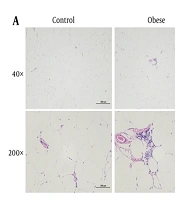
After male SK2−/− and WT control mice were challenged with HFD for 8 weeks, SK2−/− mice were about 30% lighter than WT counterparts (Figure 1A), and SK2−/− mice had significantly lower epididymal white adipose tissue (EWAT) and IWAT mass than WT mice (Figure 1B). Whole-body MRI analysis showed that SK2-/- mice had significantly lower fat/lean body mass ratios than WT mice (Figure 1C). Histological analyses of IWAT identified that SK2-/- adipocytes were smaller in size than WT adipocytes (Figure 1D). Consistent with the decreased adipose tissue, the mRNA expressions of leptin were obviously lower in IWAT from SK2−/− mice (Figure 2A). These results suggest that SK2-/- mice are resistant to HFD induced adipocyte hypertrophy and obesity.
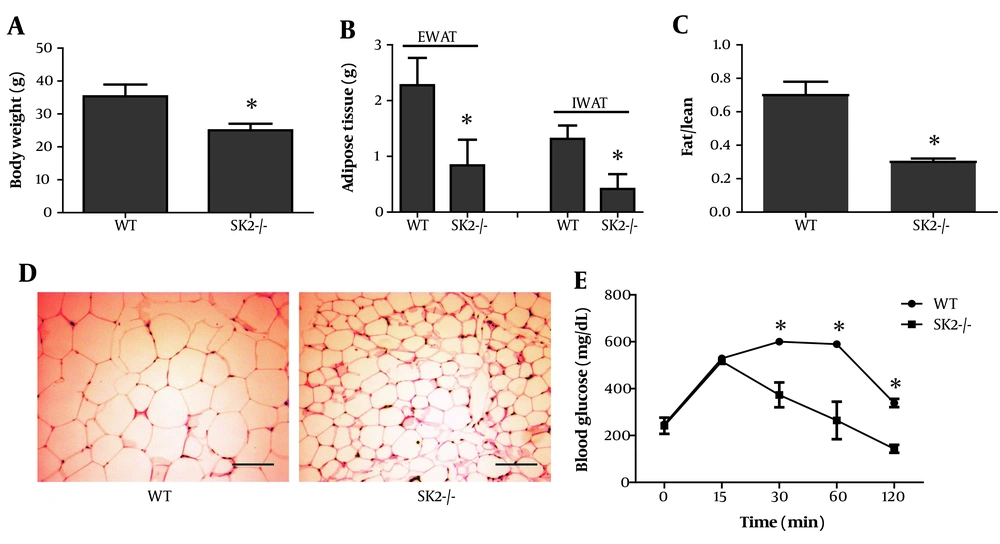
Figure 1.
Sphingosine kinase (SK) 2 knockout mice are resistant to high-fat diet (HFD)-induced obesity and glucose intolerance. SK2-/- and wild-type (WT) control mice were challenged with HFD for 8 weeks. A, Body weights in HFD-fed WT and SK2-/- mice. B, Epididymal white adipose tissue (EWAT) and inguinal white adipose tissue (IWAT) weights in HFD-fed WT and SK2-/- mice. C, fat/lean body mass ratio was determined by an EchoMRI-100 analyzer. D, H&E-stained IWAT sections, scale bars = 50 µm. E, Intraperitoneal glucose tolerance test (IPGTT) in WT and SK2-/- mice. *P < 005, n = 8 per group.
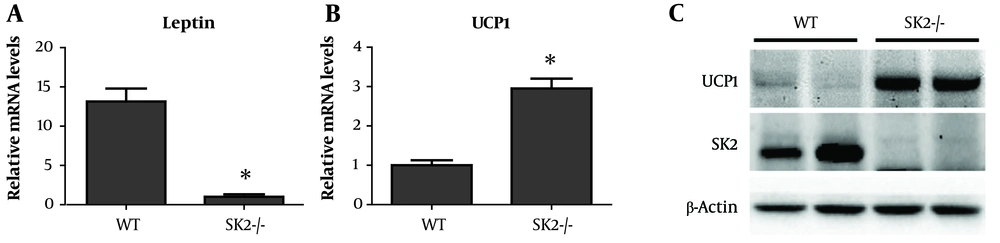
Figure 2.
High-fat diet (HFD)-fed sphingosine kinase (SK) 2 knockout mice have lower leptin and higher uncoupling protein 1 (UCP1) expressions in inguinal white adipose tissue (IWAT). Leptin (A) and UCP1 (B) mRNA expressions were examined by real-time PCR in IWAT from HFD-fed wild-type (WT) and SK2-/- mice. *P < 005, n = 8 per group. C, UCP1 and SK2 protein expressions were analyzed by Western blot in IWAT from HFD-fed WT and SK2-/- mice. Representative blot images (duplicate) are shown as insets.
4.2. SK2−/− Mice Have Improved Glucose Homeostasis
The IPGTT was performed on HFD-fed WT and SK2−/− mice. Result showed that SK2−/− mice had significantly lower glycemic excursions than their WT counterparts (Figure 1E). This result indicates that SK2-/- mice are protected against HFD-induced glucose intolerance/insulin resistance.
4.3. SK2−/− Mice Consume Significantly Higher Energy
To determine the role of SK2 in whole-body energy balance, the metabolic parameters were investigated. Results showed that the HFD-fed SK2-/- mice consumed a similar amount of food per day to HFD-fed WT mice (Figure 3A), and no significant differences in physical activity were observed between the SK2-/- and WT mice (Figure 3B), however, SK2-/- mice exhibited increased VO2 (Figure 3C) and VCO2 (Figure 3D), without a difference in RER (Figure 3E).
Consistent with the higher VO2 and VCO2, SK2-/- mice showed a marked increased energy expenditure (Figure 3F). These results indicate that HFD-fed SK2-/- mice consumed significantly higher amounts of energy than HFD-fed WT mice.
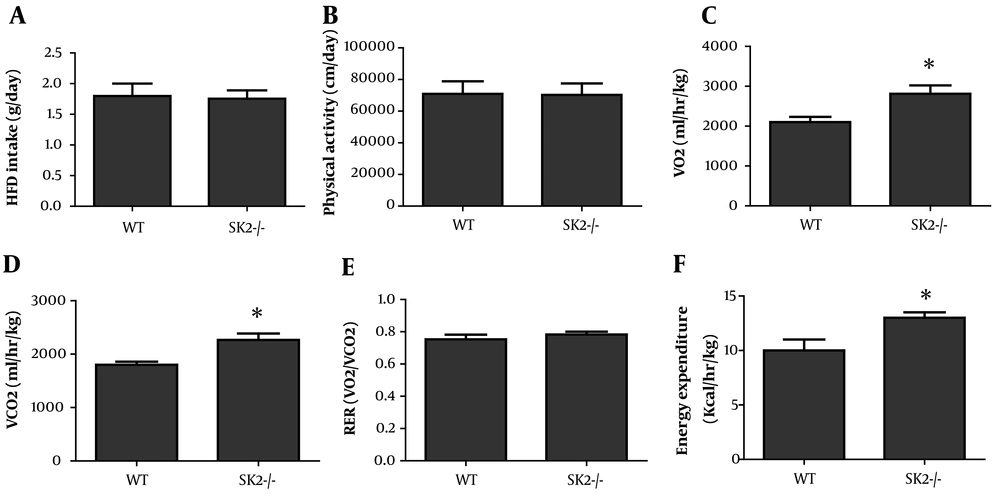
Figure 3.
High-fat diet (HFD)-fed sphingosine kinase (SK) 2 knockout mice have increased energy expenditure. Food intake (A), physical activity (B), oxygen consumption (VO2) (C), carbon dioxide production (VCO2) (D), respiratory exchange ratio (RER) (E) and energy expenditure (F) was determined using a PhenoMaster system in HFD-fed wild-type (WT) and SK2-/- mice. *P < 005, n = 12 per group.
4.4. SK2-/- Mice Have a Markedly Higher Uncoupling Protein 1 (UCP1) Expression in IWAT
UCP1 is a pivotal molecule in metabolic thermogenesis. To assess whether the increased energy expenditure in HFD-fed SK2-/- mice was associated with enhanced thermogenesis, we measured UCP1 mRNA transcripts and protein levels in IWAT, a representative beige adipose tissue in mice. Results showed that UCP1 mRNA was markedly increased in IWAT from HFD-fed SK2-/- mice compared to HFD-fed WT controls (Figure 2B). In alignment with this finding, UCP1 protein levels also were dramatically increased in IWAT from HFD-fed SK2-/- mice (Figures 2C). These results suggest that SK2 could crucially regulate UCP1 expression in IWAT; SK2 knockout may elevate UCP1 expressions and promote thermogenesis in IWAT of HFD-fed mice.
5. Discussion
Compared to HFD-fed WT mice, HFD-fed SK2-/- mice gained less weight (Figure 1A). EWAT and IWAT weight (Figure 1B), and fat/lean body mass ratio (Figure 1C) was significantly decreased in SK2-/- mice compared with WT mice. SK2-/- mice also exhibited smaller inguinal adipocyte size compared to WT mice (Figure 1D), increased adipocyte size (hypertrophy) is an important mechanism of fat gain in response to excess energy. Moreover, the expressions of leptin, a marker of obesity, were notably lower in IWAT from SK2−/− mice (Figure 2A). These results indicated that SK2−/− mice are thinner and may resist HFD-induced adipocyte hypertrophy and obesity. Consistent with reduced obesity, HFD-induced glucose intolerance is attenuated in SK2-/- mice (Figure 1E), this result suggests that HFD-fed SK2−/− mice have higher insulin sensitivity compared to HFD-fed WT mice, and SK2 knockout may reduce diet-induced insulin resistance in mice.
Whole-body energy expenditure was increased in HFD-fed SK2-/- mice (Figure 3F), however no differences were observed in food intake (Figure 3A) and physical activity (Figure 3B) between HFD-fed SK2-/- and WT mice. These results indicate that the decreased obesity in HFD-fed SK2-/- mice was due to an increase in energy expenditure, and SK2 may play a role in repressing energy expenditure.
UCP1 is an important regulator of thermogenesis and plays a critical role in adjusting energy homeostasis. To explore the mechanism of elevated energy expenditure in HFD-fed SK2-/- mice, we analyzed the UCP1 expressions in IWAT and brown adipose tissue (BAT) with real- time PCR and Western Blot; surprisingly, we found HFD-fed SK2−/− mice had significantly higher UCP1 mRNA (Figure 2B) and protein (Figure 2C) expressions in IWAT than their WT counterparts, however, we did not detect such changes in BAT (results not shown). These results suggest that SK2 may inhibit the expression of UCP1 in IWAT. It is generally accepted that IWAT is a representative beige adipose tissue, which can robustly shift to BAT-like phenotype (beige adipose tissue browning) in response to genetic, pharmacological, or environmental stimuli. UCP1 is responsible for BAT-mediated thermogenesis and is a key marker of thermogenesis (4). Increased UCP1 in adipose tissue is significantly correlated to resisting diet-induced obesity. Human obesity is associated with a reduced expression of UCP1 (4). In the current study, augmented UCP1 in the beige adipose tissue from HFD-fed SK2-/- mice indicates that SK2 knockout may alleviate HFD-induced obesity via increasing energy expenditure by enhancing thermogenesis in beige adipose tissue.
5.1. Conclusions
SK2-/- mice may increase energy expenditure through promoting thermogenesis in the beige adipose tissue, leading to alleviated obesity induced by HFD. SK2 is an inhibitor of thermogenesis and is a potential therapeutic target for obesity and type 2 diabetes.