
1. Background
COVID-19 is a viral disease caused by a coronavirus (SARS-CoV-2) that spread in late 2019 in Wuhan, China. The World Health Organization declared a public health emergency due to the rapid spread of the epidemic (1-3). At present (October 11, 2020), the global number of cases and deaths of COVID-19 in the world is 3,710,9851 and 1,070,355, respectively. At this time, on October 11, 48% of the total confirmed cases and 55% of the total confirmed cases to be reported in the region of the Americas. In the Eastern Mediterranean Region, the Islamic Republic of Iran is the worst affected country in the region, accounting for 20% of all new cases reported this week (4). There is currently no vaccine, or special antiviral treatment for it, and only preventative measures are effective. Hence, people want to know what to do to prevent and treat the disease (5).
The rapid advancement of technology and easy access to the internet has made it possible for many people to search online health information (6). Nowadays, not only health services but also health information is extensively applied by general users (7, 8). Common web search engines and social media are widely used to access health information (9-13). Mostly, women, younger adults, and those with higher family incomes and higher levels of education obtain health information through web and social media (9, 11, 14). Health information seeking behaviors (HISB) involves activities about searching and finding health problems, disease information, health risk factors information, and health promotion (15).
To promote effective health knowledge, behavior change must be carried out at the individual level. According to the US Department of Human Services and Health (16), a health message should have content accuracy, availability, balance in the transparency of health issues, stability, and consistency in content, along with cultural considerations, understandability, and appropriateness. Therefore, the identification of the most important sources of information related to COVID-19 will help politicians and public health planners. They can upgrade the content of communication channels so that people can use this information to prevent the disease.
2. Objectives
This study aimed to investigate HISB related to COVID-19 among 19-29-year-old people in Ilam province, Iran.
3. Materials and Methods
3.1. Study Strategy
This descriptive-analytical study was carried out on HISB related to COVID-19 among 19 to 29-year-old people who were members of the public telegram channels in Ilam Province, western Iran, from April to May 2020. It should be noted that due to the COVID-19 pandemic, data collection was done online through Telegram software. The inclusion criteria included the age of 19 - 29 years, access to the internet, and being a member of the public telegram channels of Ilam Province. At the time of the study, 115,000 people were the members of the two main public telegram channels in Ilam Province, of whom 12,480 were 19 to 29-years-old. Hence, the study sample was selected from these individuals by a convenience sampling method. The sample size (N = 385) was calculated using the Cochran formula (17).
3.2. Questionnaire Design
A questionnaire was used to investigate different ways people used to obtain health information related to COVID-19 (HISBC-19). This questionnaire was taken from Lee et al. (14) and Esmaeilzadeh et al. (18) studies. It was converted to an electronic version using the Porsline website, and the associated link (https://survey.porsline.ir/s/diKZkkY) was provided to the participants through Telegram software.
To assess the validity of the questionnaire, a panel of experts consisting of seven specialists in health education and health promotion examined the questionnaire for content validity. As a result, none of the items in the questionnaire changed, and the initial questionnaire was approved. The validity of the questionnaire was also evaluated through a pilot study on a sample of 53 young people, and Cranach’s alpha was 0.74.
The questionnaire consisted of demographic characteristics and HISBC-19 sections. The HISBC-19 questionnaire included 13 items. Items 1 to 10 were about the use of different methods of accessing health information related to COVID-19. Items of 11 and 13 were related to the primary source of information on the disease and the main reason for searching health information on the internet in the past month. Items 12 was about the evaluation of a person’s behavior change related to COVID-19 prevention after receiving information.
3.3. Data Analysis
The data were analyzed by SPSS version 19. The chi-square test was conducted to compare the frequency of using sources of health information by gender, marital status, education level, and job status. An alpha = 0.05 was considered as the significance level.
4. Results
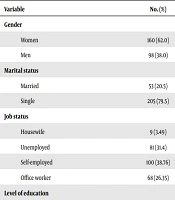
The number of visits to the questionnaire was 500, but 258 subjects completed it. The response rate was 51%. The mean age was 22.74 ± 3.09 years. Besides, 160 (62%) participants were females, and 98 (38%) were males. Demographic variables are given in Table 1.
Table 1.
Baseline Characteristics of Participants
| Variable | No. (%) |
|---|---|
| Gender | |
| Women | 160 (62.0) |
| Men | 98 (38.0) |
| Marital status | |
| Married | 53 (20.5) |
| Single | 205 (79.5) |
| Job status | |
| Housewife | 9 (3.49) |
| Unemployed | 81 (31.4) |
| Self-employed | 100 (38.76) |
| Office worker | 68 (26.35) |
| Level of education | |
| Elementary | 9 (3.5) |
| Secondary | 72 (27.9) |
| High school diploma | 13 (5.0) |
| Associate degree | 12 (4.7) |
| Bachelor degree | 150 (58.1) |
| Master degree | 2 (0.8) |
| Monthly family income | |
| Low income | 19 (7.4) |
| Moderate | 153 (59.3) |
| High income | 86 (33.3) |
The results showed that 105 (40.7%) people had very good internet search skills, 77 (29.8%) were good, and 76 (29.5%) were poor. Also, 171 (66.3%) people had access to mobile internet, 84 (32.6%) had access to the internet at home, and three (1.2%) had access to the internet at work.
According to the findings, the participants more frequently used virtual social media, watching TV, and searching the internet as the main resources for accessing information related to COVID-19. The chi-square test demonstrated a significant difference between men and women in receiving information from visiting the physician or other treatment staff, asking questions from family members, watching satellite channels, and attending workshops and meetings on health (P < 0.05) (Table 2). There was no significant difference between married and single people in the use of health information sources (P > 0.05).
Table 2.
Frequency and Percentage of Using Health Information Sources Related to COVID-19 by Gendera
| Sources of Health Information | Numbers | Low | Medium | High | P-Value |
|---|---|---|---|---|---|
| Visiting the physician or other treatment staff | 0.001 | ||||
| Women | 160 | 101 (63.1) | 30 (18.8) | 29 (18.1) | |
| Men | 98 | 47 (48) | 14 (14.3) | 37 (37.8) | |
| Watching TV (medical series, medical news, interviews with physicians) | 0.83 | ||||
| Women | 160 | 10 (6.3) | 51 (31.9) | 99 (61.9) | |
| Men | 98 | 5 (5.1) | 29 (29.6) | 64 (68.3) | |
| Asking questions from friends or classmates | 0.27 | ||||
| Women | 160 | 35 (21.9) | 54 (33.8) | 71 (44.4) | |
| Men | 98 | 14 (14.3) | 33 (33.7) | 51 (52) | |
| Searching the internet | 0.33 | ||||
| Women | 160 | 14 (8.8) | 50 (31.3) | 96 (60) | |
| Men | 98 | 4 (4.1) | 30 (30.6) | 64 (65.3) | |
| Using virtual social media such as Telegram, Instagram, Facebook, Twitter, etc. | 0.13 | ||||
| Women | 160 | 6 (3.8) | 41 (25.6) | 113 (70.6) | |
| Men | 98 | 3 (3.1) | 15 (15.3) | 80 (81.6) | |
| Using applications installed on the cellphone or tablet | 0.19 | ||||
| Women | 160 | 64 (40) | 28 (17.5) | 68 (42.5) | |
| Men | 98 | 32 (32.7) | 26 (26.5) | 40 (40.8) | |
| Asking questions from family members (father, mother, sisters, brothers, etc.) | 0.03 | ||||
| Women | 160 | 26 (16.3) | 52 (32.5) | 82 (51.2) | |
| Men | 98 | 21 (21.4) | 43 (43.9) | 34 (34.7) | |
| Watching satellite channels | 0.001 | ||||
| Women | 160 | 120 (75) | 6 (3.8) | 34 (21.3) | |
| Men | 98 | 65 (66.3) | 14 (14.3) | 19 (19.4) | |
| Attending workshops and meetings on health | 0.001 | ||||
| Women | 160 | 127 (79.4) | 6 (3.8) | 27 (16.9) | |
| Men | 98 | 55 (56.1) | 8 (8.2) | 35 (35.7) |
aValues are expressed as No (%).
According to the chi-square test, a significant difference was found between various occupational groups in using the television as the source of health information (P < 0.05). But, no significant difference was found in the use of other information sources (P > 0.05). The participants with academic education more frequently searched on the internet than participants with lower education (P < 0.05).
The users started searching for health information on the internet as follows. Out of 258 people, 100 (38.8%) used search engines, 94 (36.4%) used virtual social media, 35 (13.6%) used health-related websites, 22 (5.8%) used healthcare websites, and seven (2.7%) used online group discussions.
According to the findings, 243 (94.2%) people reported behavioral improvement after achieving health information. Table 3 shows the primary reason for asking or searching for health information in the past month. More details are given in Table 3.
Table 3.
Primary Reasons for Asking or Looking for Health Information in the Last Month
| Primary Reason | No. (%) |
|---|---|
| Managing health | 58 (22.49) |
| Diagnosing a health problem | 12 (4.65) |
| Gaining information about COVID-19 prevention | 112 (43.42) |
| Identifying symptoms of COVID-19 | 34 (13.17) |
| Answering a specific question related to COVID-19 | 8 (3.1) |
| Health knowledge related to COVID-19 as being acute or chronic | 3 (1.16) |
| Lifestyle changes related to COVID-19 | 31 (12.01) |
| Total | 258 (100.0) |
5. Discussion
This study aimed to investigate HISB related to COVID-19 among young people. The results showed the significant role of internet search in obtaining health information. The information obtained from social media in 94.2% of the subjects led to behavioral changes related to COVID-19. According to the previous studies, young people were the main audiences of new mass communication technologies, including social media such as YouTube, Facebook, Instagram, WhatsApp, and Telegram (11). Based on the results, virtual social media were the most important sources of COVID-19 information. In contrast, direct referral to physicians and health care centers had a small proportion in obtaining information related to COVID-19. Several studies showed that social media had the largest proportion of health information related to COVID-19 (19, 20).
Although social media have enabled quick access to information around the world, people with poor e-health literacy may be exposed to inaccurate information (21, 22). A list of misconceptions related to COVID-19 has been published on the website of the World Health Organization. With the increasing prevalence of COVID-19 in different countries, these misconceptions have also been enhanced (19). If people have sufficient e-health literacy, first, they are not affected by misconceptions, and second, they do not share incorrect information on social media (23, 24). According to a study by Pennycook et al. (23), people who easily disseminate incorrect information in social media had low analytical thinking and low scientific knowledge. Stellefson et al. (17) expressed that despite the high tendency of young people to use the internet, they did not have sufficient e-health literacy to obtain health information. Therefore, it is necessary to improve the e-health literacy of the public, especially the youth, in a desirable way.
According to the findings, a significant proportion of young people obtained health information by searching websites. Reputable international websites such as WHO and CDC provide useful information about COVID-19 to users (21, 25). At the national level, the Health Ministry of Iran and other related organizations provide up-to-date instructions about COVID-19 to users (26). However, the information provided on websites should be understandable to everyone. For example, the use of multimedia educational content can increase the knowledge and behaviors of people with low health literacy (22, 27). In addition, given the proliferation of smartphones among young people, providing educational content via social media can greatly help in COVID-19 protective behaviors (28).
Women more frequently used the internet as the source of seeking information related to COVID-19 than men although there was no significant difference between women and men in searching on the internet. A health on the net (HON) survey (29) found that women searched health websites more often than men. A study by Cline et al. (10) also reported that men used the internet more than did women. The discrepancy can be due to that HISB may vary depending on the search fields for men and women. In the present study, only HISB related to COVID-19 was investigated. However, other studies did not limit HISB to a specific issue. For example, Kalankesh et al.’s (15) study reported that women were more likely to seek health information, physical activity, lifestyle, nutrition, and pharmacological information. Based on the results of this study, there was no significant difference between individuals with different job status in terms of information sources related to COVID-19. Only the use of television in the unemployed and housewives was significantly higher than others. It seems that the youth of the study sample as well as the high level of education of most of them can be one of the reasons for the lack of significant difference between searching for information resources, especially the Internet and virtual social networks in people with different employment conditions. However, unemployed people and housewives are more likely to watch TV for information about COVID-19 due to spending more time at home (15, 30).
The results also showed that people with university education more significantly followed information on the internet and social media than others. Our findings are consistent with the Mirzaei et al. (30) study on the prediction of preventive behaviors among a sample of the Iranian adult population, which reported that young academic people had more access to smartphones and had a high tendency to receive health information related to COVID-19 via the internet. Therefore, it is necessary to promote media literacy in the youth to properly use the internet and social media for correct information related to COVID-19.
Our study had some limitations. One of the problems with online surveys is the low rate of participation from the study population. Because of the prevalence of COVID-19, data were collected online, and the participation of the target population was less than the estimated sample size. In addition, due to financial constraints, we were unable to provide gifts to study participants, and they had a low tendency to participate in the survey.
5.1. Conclusions
The results of the present study showed that internet-based information is the most important source of health information related to COVID-19 in young people. Although social media provides quick access to information in the community, it can be a platform for disseminating inaccurate and invalid information. For this reason, other credible sources, including the health ministry, should play a greater role in producing content on social media. On the other hand, it is necessary to strengthen the media literacy of young people so that they can obtain accurate information from reliable sources. Hence, it is suggested that future studies focus on digital health literacy promotion interventions to empower people through credible web-based sources.