
1. Background
High-risk behaviors are defined as damaging activities, which can have adverse effects on health and increase the risk of disease and subsequently can lead to social problems, disability, and even death (1-3). One of these risky behaviors is substance use that is considered a hindrance to the progress of teenagers and adolescents in their future life (4). The growing trend of these behaviors is a serious threat that has caused health concerns at the national and international levels (5).
Involvement in risky behaviors reaches its peak among young people who comprise approximately one-third of the total population in Iran (6). Young people tend to have extramarital and unprotected sex (7), drink alcohol, and use non-prescription and illicit drugs such as narcotics and stimulants (4) more than people in other ages. Nicotine, tobacco, alcohol, marijuana, methamphetamine, methylphenidate, opium, and tramadol seem to be the most prevalent addictive substances worldwide and a leading cause of some dangerous diseases (8-11). According to the results of previous studies, drug abuse can increase the risk of mood and mental disabilities and also early mortality rate (12), which had been growing rapidly in developing countries such as Iran in the last two decades (13, 14). Clinical investigations of drugs or alcohol consumption have shown that the risk of other high-risk behaviors such as unprotected sexual relationships and needle sharing may be increased, leading to the incidence of chronic diseases such as human immunodeficiency virus (HIV) infection (15).
Thus, showing the extent of the problem is necessary to keep governors informed and find solutions for solving this problem. However, due to the stigma of these behaviors, especially in Islamic countries, participants of the study may refuse to answer or hide the truth, which affects the study results negatively (16, 17). So gathering information in an indirect way is helpful. One of the indirect methods for correct estimation of the high-risk behavior-exposed groups is the Network Scale-up (NSU) method (13). The NSU method relies on the data collected from study participants, as well as participants’ responses on behalf of their network (4). It seems that this method offers more comprehensive and precise information in terms of estimating the size of the groups with high-risk behaviors given the religious beliefs, Islamic values, and customary and cultural issues (7). A study pointed to fear of being rejected by family and friends as a reason to hide the issue (18); so, the treatment may not occur. Another study results showed that NSU method leads to a realistic estimation of risky behaviors, because the respondents tell the truth when sensitive questions are asked indirectly (19).
Based on the necessity to estimate the size of hard-to-count and high-risk behaviors-exposed groups, which is a fundamental problem in social sciences and public health (5), the importance of physical and mental health of students who constitute a large group of the society (7), as well as to prevent the diseases related to risky behaviors such as acquired immunodeficiency syndrome (AIDS).
2. Objectives
The present study aimed to estimate the prevalence of substance use among students of medical science universities in the eighth macro-region of Iran by NSU method.
3. Materials and Methods
3.1. Study Design and Sample Size
This cross-sectional study was conducted on 3,900 students from medical science universities in the eighth macro-region of Iran (Kerman and Sistan and Baluchestan provinces) in 2019. Among the participants, 1,872 males and 2,028 females from all academic degrees contributed to this study. Inclusion criteria entailed the students who attended the target university at least for one semester and stated their willingness to participate in the study. The sample size of each university was determined using a multistage non-random sampling. At first, quota sampling method was used to determine sample size at each university based on proportional to size approach. After that, convenience sampling was done for selecting students as they were recruited from all departments. Sample size was calculated according to the results of a similar study, which reported the alcohol use 18.2% (4). Assuming P = 0.182 and effect size to be 0.013 we arrived at a sample size of 3,384 at 0.05 significance level. The sample size was increased by up to 20% yielding the maximum sample size of 4,000 participants. Also 2.5% of questionnaires were removed due to unreliable answers. The final sample size included 2,300 students from Kerman province and 1,600 students from Sistan and Baluchestan province.
The Ethics Committee of Sirjan University of Medical Sciences (SIRUMS) reviewed and approved the study design and all procedures (IR.SIRUMS.REC.1397.001).
3.2. Data Collection and Instruments
The questionnaire consisted of two main parts. In the first part, the demographic characteristics of the participants (age, sex, marital status, and education) were collected. In the second part, they were asked about the number of close friends who consumed alcohol, marijuana, hemp, chewing tobacco, tramadol for non-medical purpose, methylphenidate, and opium over the past year either for fun or due to continued repetition. The reliability of the questionnaire had been assessed in a previous study, and test-retest examination had been done for assessing the reliability of the questionnaire; the mean kappa was reported as 79%, and each question was analyzed based on a paired t-test one by one. A P-value greater than 0.05 was considered as significant (5).
To reduce errors, the participants were informed about the aim of the study, and they were assured about the confidentiality of their data prior to the study. The participants were then asked to introduce some of their friends. The respondents recognized these people by name and face contact and communicated with them by phone or email several times a week outside of the class (20). The data were collected by 25 trained interviewers, and the participants were asked to put the filled questionnaire in a box without mentioning their names.
3.3. Data Management and Analysis
One of the indirect methods for the estimation of the exact size of the target groups is the NSU method (4, 13). This method estimates the proportion of people in high-risk groups in the community based on the average number of people that respondents know in hidden groups and the average size of the respondents’ individual network (21). We employed the NSU method to analyze data in this study. We adjusted for the clustering effect of universities in the analysis using survey analysis. All estimates were weighted based on the inverse probability weight of college sampling. We used the Chi-squared test for comparing two proportions. Statistical analysis was carried out by Excel and SPSS software version 19. In all tests, significant level was set as 0.05.
4. Results
The mean (SD) age of students was 22.45 (3.25) years with an age range of 19 - 47 years. Most of them were single (78.4%) and bachelor students (63.5%). Mean number of close friends for the medical universities was 8.1. Other information is provided in Table 1.
Table 1.
Descriptive Attributes of Participants a
| Attribute | Total (n = 3900) | Province | |
|---|---|---|---|
| Kerman (n = 2300) | Sistan and Baluchestan (n = 1600) | ||
| Age | |||
| 19 - 29 | 3718 (95.3) | 2196 (95.5) | 1522 (95.1) |
| 30 - 39 | 164 (4.2) | 95 (4.1) | 69 (4.3) |
| > 40 | 18 (0.5) | 9 (0.4) | 9 (0.6) |
| Sex | |||
| Male | 1872 (48.0) | 1142 (49.7) | 730 (45.6) |
| Female | 2028 (52.0) | 1158 (50.3) | 870 (54.4) |
| Marital status | |||
| Single | 3058 (78.4) | 1853 (80.6) | 1205 (75.3) |
| Married | 774 (19.8) | 407 (17.7) | 367 (22.9) |
| Divorced | 68 (1.7) | 40 (1.7) | 28 (1.7) |
| Education | |||
| Associate’s degree | 814 (20.9) | 581 (25.3) | 233 (14.6) |
| B.Sc. | 2478 (63.5) | 1304 (56.7) | 1174 (73.4) |
| M.Sc. | 201 (5.1) | 139 (6.0) | 62 (3.9) |
| Ph.D. | 84 (2.1) | 63 (2.7) | 21 (1.3) |
| General practitioner | 323 (8.3) | 213 (9.3) | 110 (6.9) |
aValues are expressed as No. (%).
The prevalence of substance use among male students was higher than females in all universities. Alcohol and marijuana consumption were the most prevalent risky behavior among all students. While marijuana use was the second most prevalent risky behavior, chewing tobacco was more prevalent in students of Sistan and Baluchestan province. Chi-square test was used to compare substance use between students of medical universities of Kerman and Sistan and Baluchestan provinces. Marijuana, hemp, alcohol, tramadol, and methylphenidate consumption were more prevalent among students of medical universities in Kerman province, while the prevalence of chewing tobacco and opium were higher among students of medical universities in Sistan and Baluchestan province (P < 0.001) (Table 2).
Table 2.
The Prevalence of Substance Use in Last Year Among All Students According to Gender and Province
| Drug users | Total (n = 3900) (CI 95%) | Male (n = 1872) (CI 95%) | Female (n = 2028) (CI 95%) | Province | P-Value a | |
|---|---|---|---|---|---|---|
| Kerman (n = 2300) (CI 95%) | Sistan and Baluchestan (n = 1600) (CI 95%) | |||||
| Marijuana | 13.5 (12.4, 14.5) | 23.5 (21.5, 25.5) | 3.5 (2.7, 4.4) | 16.3 (14.8, 17.8) | 9.0 (7.5, 10.4) | < 0.001 |
| Hemp | 4.1 (3.5, 4.7) | 7.5 (6.3, 8.7) | 1.0 (0.5, 1.4) | 4.6 (3.7, 5.4) | 3.4 (2.5, 4.3) | < 0.001 |
| Chewing Tobacco | 6.3 (5.5, 7.1) | 10.9 (9.5, 12.4) | 1.6 (1.0, 2.2) | 4.1 (3.2, 4.9) | 10.0 (8.5, 11.4) | < 0.001 |
| Alcohol | 20.6 (19.3, 21.9) | 33.6 (31.5, 35.8) | 7.9 (6.6, 9.1) | 26.0 (24.2, 27.8) | 12.2 (10.5, 13.8) | < 0.001 |
| Tramadol | 3.1 (2.6, 3.7) | 4.4 (3.5, 5.3) | 2.3 (1.6, 3.03) | 3.5 (2.8, 4.3) | 2.5 (1.7, 3.3) | < 0.001 |
| Methylphenidate | 6.5 (5.7, 7.3) | 9.0 (7.7, 10.3) | 3.6 (2.7, 4.4) | 7.0 (6.0, 8.1) | 5.7 (4.6, 6.9) | < 0.001 |
| Opium | 4.0 (3.1, 4.9) | 6.2 (5.1, 7.3) | 1.1 (0.6, 1.5) | 4.0 (3.2, 4.8) | 4.7 (3.7, 5.8) | < 0.001 |
aP-values were calculated by χ2 test.
Investigating the prevalence of substance use among universities showed in Table 3. The prevalence of the substances use among men and females are reported in Figures 1 and 2.
Table 3.
The Prevalence of Substance Use Among Students of Medical Science Universities in Kerman and Sistan and Baluchestan
| University | Marijuana (CI 95%) | Hemp (CI 95%) | Chewing Tobacco (CI 95%) | Alcohol (CI 95%) | Tramadol (CI 95%) | Methylphenidate (CI 95%) | Opium (CI 95%) |
|---|---|---|---|---|---|---|---|
| Kerman University of Medical Sciences (KUMS), n = 1000 | 18.6 (16.2, 21.1) | 5.2 (4.2, 6.2) | 3.9 (2.6, 5.1) | 27.5 (54.6, 30.3) | 4.8 (3.5, 6.2) | 8.8 (7.0, 10.6) | 5.4 (4.0, 6.8) |
| Rafsanjan University of Medical Sciences (RUMS), n = 400 | 16.3 (12.6, 20.0) | 5.4 (4.4, 6.4) | 4.8 (2.7, 7.0) | 22.5 (18.3, 26.7) | 2.9 (1.2, 4.5) | 4.3 (2.2, 6.3) | 4.6 (2.5, 6.7) |
| Jiroft University of Medical Sciences (JUMS), n = 300 | 11.6 (7.9, 15.3) | 1.1 (0.6, 1.6) | 0.5 (0, 1.2) | 27.8 (22.6, 33.0) | 1.7 (0.2, 3.6) | 2.5 (0.7, 4.3) | 0.7 (0, 1.6) |
| Bam University of Medical Sciences (BUMS), n = 400 | 13.3 (9.9, 16.7) | 5.1 (4.1, 6.02) | 3.6 (1.6, 5.3) | 27.2 (22.8, 31.7) | 1.7 (0.4, 3.0) | 8.3 (5.6, 11.1) | 1.2 (0.1, 2.3) |
| Sirjan University of Medical Sciences (SUMS), n = 200 | 13.7 (8.8, 15.4) | 3.3 (2.5, 4.1) | 9.4 (5.3, 9.0) | 21.1 (15.3, 26.8) | 4.1 (1.3, 6.9) | 6.1 (2.7, 9.4) | 3.2 (0.7, 5.7) |
| Zahedan University of Medical Sciences (ZUMS), n = 850 | 7.1 (5.3, 9.0) | 3.5 (2.7, 4.3) | 7.1 (5.3, 9.0) | 9.7 (7.6, 11.8) | 3.0 (1.8, 4.2) | 5.1 (3.6, 6.7) | 5.6 (4.0, 7.2) |
| Zabol University of Medical Sciences (ZbUMS), n = 450 | 15.4 (12.2, 18.7) | 4.9 (3.9, 5.8) | 12.3 (9.3, 15.2) | 20.0 (16.4, 23.6) | 1.6 (0.4, 2.8) | 8.2 (5.9, 10.8) | 4.2 (2.3, 6.1) |
| Iranshahr University of Medical Sciences (IUMS), n = 300 | 5.8 (3.1, 8.5) | 1.5 (1.0, 2.1) | 18.2 (13.7, 22.6) | 9.4 (6.0, 12.8) | 2.1 (0.5, 3.8) | 4.0 (1.8, 6.3) | 1.6 (0.2, 3.1) |
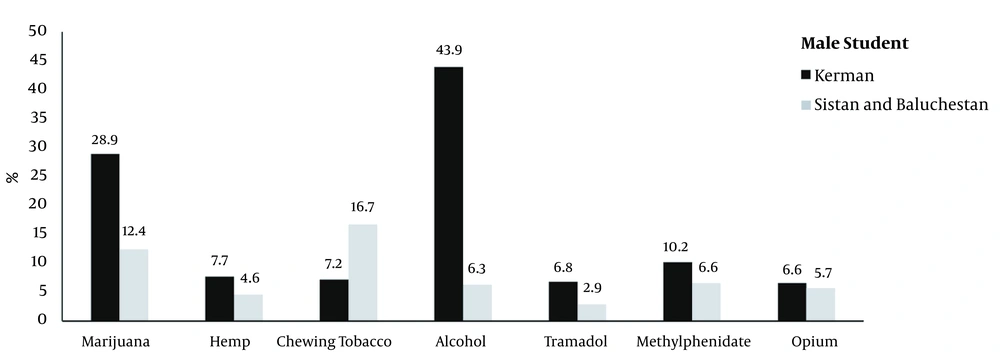
Figure 1.
The prevalence of substance use estimated by NSU methods among male students, Iran 2019
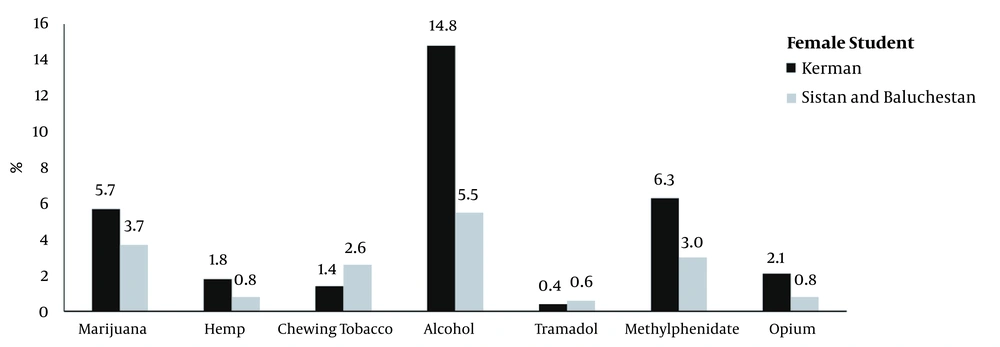
Figure 2.
The prevalence of substance use estimated by NSU methods among female students, Iran 2019
5. Discussion
The findings of the current study indicated that substance use in Kerman and Sistan, and Baluchestan medical universities are more common in male students than females. Consistent with this study, Zahedi et al. reported that the use of water pipe, alcohol, and cigarettes in female students of Kerman universities was less than males (4). In a national study conducted by Nikfarjam et al. the prevalence of hashish, shire (a combination of opium residue and pure opium), heroin, methamphetamine, LSD, and ecstasy consumption in males was higher than in females (22). Previous studies in Iran and other countries reported that the prevalence of alcohol and illicit substance use, as well as prescription drug misuse, was more frequent in males than females (23-25). Due to the social stigma and cultural taboo of substance abuse by women (26), the prevalence of these behaviors was higher among men.
As the results showed, drinking alcohol (20.6%) had the highest prevalence among students of both provinces. The highest prevalence after alcohol was reported for marijuana use among students of Kerman (16.3%) and chewing tobacco (10.0%) among students of Sistan and Baluchestan. Zahedi et al. (4) estimated the prevalence of alcohol consumption in students of Kerman universities as 18.1% by direct method and 18.2% by NSU method. In Zahedan city, the prevalence of alcohol use was estimated as 9.7% in high school students (27). Increased advertising on some social networks (28), easier access to alcohol and marijuana illegally (29), and unawareness of their side effects (30) may be the major causes of growing trend among young people for consumption of these agents.
After alcohol and marijuana, methylphenidate (6.5%), chewing tobacco (6.3%), hemp (4.1%), opium (4.0%), and tramadol (3.1%) were the most common substances used in both provinces. However, the prevalence rate and the pattern of substance use were different among the students of the two provinces. The prevalence of methylphenidate consumption was 6.5%, which is more than estimated rate of this drug in other studies: 2.7% (23), 6.4% (31), and 1.8% (32), 1.2% (5). It is reported that some medical university students have a positive attitude toward using some pharmaceutical drugs to enhance normal brain function (33). In another study by NSU method in Kerman University of Medical Sciences, it was found that the prevalence of alcohol, opium, methamphetamine, and tramadol was 8.1%, 2.2%, 1.2%, and 4.8%, respectively (5).
Our results showed that the use of opium was more frequent among students of Sistan and Baluchestan universities than Kerman universities, which may be due to shared border of Sistan and Baluchestan province with Afghanistan and high availability of this substance in this province (34). Also the World Health Organization (WHO) reported that Iran has a high rate of opium abusers in comparison to other countries in the world (35). According to the results of a study conducted in Tehran universities, the prevalence of opium and heroin was reported 2.3% and 2.2%, respectively (36), which is less than in eastern provinces, possibly due to the easier availability of these substances in eastern regions. In another study, the prevalence of marijuana, cocaine, and heroin use in the United States were 49.1, 5.2, and 0.5%, respectively (37). Normalization, lack of restrictive rules, and considering the drug as a safe substance are other reasons for tendency of young people toward them. Thus, setting some restrictive rules in living places (home or dormitory) or workplace (38) and providing information about substances’ side effects and risk of addiction can be effective in preventing these risky behaviors (39).
Gathering sensitive information was the main limitation for both the researchers and participants of this study. In this regard, trained interviewers who could make a good relationship with the respondents were needed. Considering that alcohol and illegal substance use are serious problems among young people, especially university students, and high prevalence of these behaviors in students of medical science universities in the eighth macro-region of Iran, increasing awareness level of authorities, adolescent, and young people about this issue and changing students’ attitude toward using these drugs is essential.
5.1. Conclusions
The results of this study indicated that substance use was more rampant in university students of eighth macro-region of Iran and in males than females. Alcohol was the most prevalent item among students of medical universities in both provinces. Marijuana use was in the second level in Kerman and chewing tobacco in Sistan and Baluchestan. The use of opioids was more common in students of Sistan and Baluchestan province compared to Kerman province.
So the authorities of universities should the monitor risky behaviors among students, educate them about the disadvantages, and also provide healthy activities and entertainment for students. Further studies are required to determine the incidence rate of high-risk behaviors in school students. Also studies for assessing the effectiveness of various prevention programs are needed.