
1. Background
Proper understanding and using health information are essential for high-risk health behaviors in vulnerable situations. An example of a situation in which health behaviors are of particular importance is pregnancy, because, at this stage, behaviors affect the health of the mother and fetus (1). Pregnancy is a vulnerable period in which women face various changes, not only physically but also in terms of pregnancy and parental responsibilities. These changes make parents accountable for preventive health information (2, 3). During pregnancy, women are exposed to a variety of health information from various sources. Lifestyle is likely to affect the long-term consequences of maternal and childhood health. Through a process called pregnancy planning, external factors such as maternal health behaviors and genetic factors affect fetal growth (4, 5).
In today's society, infectious diseases and social deprivation are not the primary causes of illness and premature death, but new dangers have emerged that are closely related to our behavior. Meanwhile, health psychology deals with behaviors that have consequences for our health. These behaviors include health promotion behaviors (such as exercise and healthy diet), health-maintaining behaviors (such as vaccination), and harmful health behaviors (such as smoking). Health belief patterns are attempts toward the personal and social effects of these types of behavior, predicting their consequences and helping to design necessary interventions in appropriate places such as providing matters related to health promotion (6). The care system report regarding the risk factors of non-communicable diseases shows that 21.7% of men and 0.9% of women smoked daily in Iran in 2015. In addition, researchers expressed concerns about a phenomenon known as second- and third-hand cigarette smoke (7).
Health literacy is one of the concepts that has received much attention in the health sector. Health literacy refers to the ability of an individual to obtain, perceive, and use information about health services and protection against potential harms (8-10). Processing information and understanding existing information requires appropriate health literacy. The World Health Organization defines health literacy as "The cognitive and social skills that determine the motivation and ability of individuals to acquire, understand, and use health information to promote and maintain good health." Benefiting health literacy can increase healthy behaviors and improve access to health care (6). Tobacco literacy is defined as the capacity of individuals to understand and use health information related to smoking (11, 12). Wang et al. (13), in a study in China, found that children who were exposed to second-hand smoke during pregnancy were more likely than other children to develop developmental disorders, including hyperactivity. Exposure to second-hand smoke has more destructive effects than exposure to first-hand smoke on the fetal lung through the umbilical cord (14). Mojibyan (15) showed that exposure to second-hand smoke in pregnant women might be significantly associated with preterm delivery.
Moreover, Do et al. (16) found that mothers' social and family backgrounds affected their fetuses' exposure to second-hand smoke. Awareness and self-confidence help them express their opposition more easily when exposed to tobacco smoke. Rao et al. (17) conducted research in India on parental perceptions of the harmful effects of smoking on children, specifying that only 25% of the statistical population was aware of the adverse effects of second-hand smoke on their children. Since mothers are in direct contact with the fetus, they are known as the most critical persons influencing the fetus's health. The behavior and reaction of pregnant women, in this case, are critical. Mothers' health literacy can solve many growing problems in healthcare.
According to Bourdieu, cultural capital has an irreplaceable role in confronting social phenomena. In other words, cultural capital allows each individual to achieve a more appropriate position of knowledge, skills, training, and benefits that each individual is capable of. In fact, it is an acquired form and is generally considered an asset, which helps the person when confronting various issues (18, 19). While the prevalence of unhealthy life behaviors has increased globally and many people, including fetuses, are inadvertently exposed to tobacco smoke every day, cultural capital can affect people's perception of health and increase tobacco health literacy as an intangible resource that shapes people's tastes. Dehghan Dehnavi et al. (20) concluded that increasing people's inner awareness significantly reduces the tendency to high-risk behaviors.
Therefore, cultural capital is a sociological concept related to the talent and capacity of the individual in recognizing and applying facilities and information to improve living standards (21). Also, this study investigated women's health literacy and its essential role in promoting health and disease prevention in themselves and their fetuses as two influential variables on fetal tobacco smoke exposure. Considering that little research has been done on women's health literacy about tobacco smoke and the status and quality of pregnancy care in our country (Iran), the present study examined the relationship between cultural capital and health literacy in tobacco smoke exposure in pregnant women referred to health centers.
2. Objectives
This study aimed to investigate the cultural capital of pregnant women and their health literacy related to tobacco smoke. We also examined the chance of second-hand smoke exposure in pregnant women with different levels of health literacy and cultural capital (Figure 1).
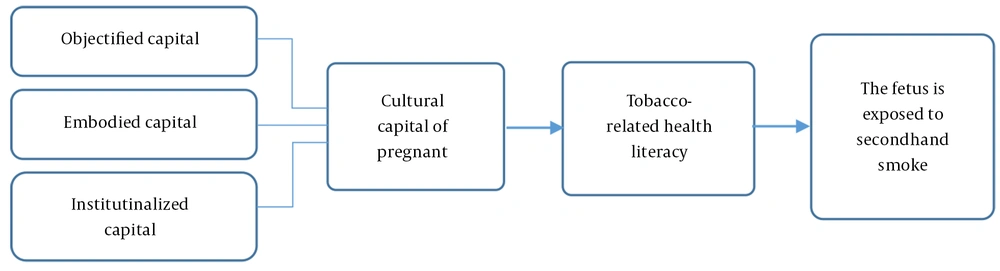
Figure 1.
Analytical model
3. Materials and Methods
This study was approved by the Research Ethics committee of Alzahra University (code: IR.ALZAHRA.REC.1399.001).
This research utilized a cross-sectional design. The statistical population included pregnant women referred to the antenatal care departments of hospitals affiliated with Tehran University of Medical Sciences (Valiasr Hospital located in Imam Khomeini, Arash, Yas, Baharlou, and Shariaty hospitals).
The sample size was 384 people, but for more accuracy in answering the questions, 500 pregnant women were selected among those referred to the maternity departments of the hospitals. Due to the sensitivity of the sample (pregnant women) and to maintain their comfort (which was one of the priorities of the questioners), the available sampling method was used, and pregnant women who were in the right position or felt comfortable with the questionnaire were asked. Questionnaires were usually collected near the doors of pregnancy care clinics because pregnant women usually go to hospital infirmaries for monthly care while their general condition may not be well enough. Due to the sensitivity of pregnant women and for maintaining their calmness, researchers considered the availability and appropriateness of response conditions for sample selection and the complete satisfaction of pregnant women. At the time of collecting the questionnaires, ethical considerations were observed by the questioners, and they took care of the comfort and convenience of the respondents. They were assured that no personal information would be requested.
The main reason for entering the sample was being pregnant and referring to one of the hospitals of the University of Tehran for high-quality pregnancy care. Exclusion criteria included pregnant women who felt stressed after reading the questionnaire. At this time, the pregnant woman was voluntarily and respectfully excluded from the sample not to be damaged. The questionnaire survey is a very structured technique for data collection, in which each respondent is asked the same set of questions. Since the research method was a survey, the appropriate tool for collecting information was a questionnaire. A researcher-made questionnaire was used here. To develop the questionnaire, after studying and selecting theories related to pregnancy, health literacy, and cultural capital, which were repeatedly reviewed and evaluated by researchers, and taking into account previous studies, we modeled and constructed the indicator. Finally, according to the developed indicator, the questionnaire items were adjusted.
In the first part of the questionnaire, we asked about their age, education, husbands’ education, family income, occupation, ownership status, etc. In the next section, the questionnaire was developed to measure the health literacy index of pregnant women with questions about second-and third-hand smoke, information about the health effects of cigarette smoke and second-hand smoke, health information, and other similar questions. Also, to measure the cultural capital of pregnant women, we used questions about the level of general study, health studies, literacy, and general information. Finally, the respondents were asked questions directly to assess whether the fetus was exposed to tobacco smoke or not: Do they, their spouse, or relatives smoke? If yes, do they react to smoking or not? During completing the questionnaire, it was considered if pregnant women did not feel good about some questions or were bothered by many questions. Therefore, the researchers developed a selected questionnaire with the help of a health literacy questionnaire and cultural capital assessment questionnaire. The questions were designed on a Likert scale.
The expert evaluation method was used to assess the validity of the questionnaire. There was a research team of obstetricians and infertility specialists who asked questions. The tobacco-related items were confirmed by and expert team from the Tobacco Control Research Center. Also, sociology professors were asked to comment on the evaluation of cultural capital indicators concerning cultural capital questions. Cronbach's alpha coefficients were used to evaluate the reliability of the designed questionnaire. A sample of 30 people was selected before collecting the total questionnaire. An alpha coefficient of 0.884 was obtained for the total questionnaire, 0.760 for cultural capital, and 0.884 for tobacco-related health literacy.
Variables were created based on indicators after data collection. Each index was measured with items on the Likert scale ranging from 1 to 5. The minimum and maximum scores of the constructed variables were examined and defined in three levels: Low, medium, and high. Then, the answers were described and analyzed using SPSS. In this study, in addition to assessing the level of tobacco-related health literacy and cultural capital of pregnant women, we attempted to find their impacts on the rate of pregnant women’s exposure to tobacco smoke. Since exposure to tobacco smoke was a binomial test, codes “0” and “1” were considered for measurement, and we used logistic regression.
4. Results
Table 1 shows that the age of the research sample was between 20 and 39 years, which represents the medically appropriate gestational age. The highest frequency was in the age group of 20 to 29 years. Housewives had the highest frequency with 75%. Other occupations accounted for a tiny percentage. The highest frequency of education was diploma (46.6%), followed by bachelor's degrees (35%), showing that the literacy level of the women surveyed was neither too high nor too low, and they had ability to access information. Therefore, most (90%) of the sample had literacy, indicating their ability to understand and obtain information.
Table 1.
Demographic Data of Pregnant Women
| Descriptive Variable | No. (%) |
|---|---|
| Age of pregnant woman (y) | |
| 20 | 12 (2.4) |
| 20 - 29 | 274 (54.8) |
| 30 - 39 | 201 (40.2) |
| + 40 | 11 (2.2) |
| Occupation of pregnant women | |
| Housewife | 375 (75) |
| Employee | 63 (12.6) |
| Student | 23 (6.4) |
| Worker | 27 (5.4) |
| Doctor | 12 (2.4) |
| Education of pregnant women | |
| Under-educated | 52 (11.4) |
| Diploma | 233 (46.6) |
| Bachelor | 177 (35.4) |
| Master and higher | 38 (7.6) |
As seen in Figures 2 and 3, concerning cultural capital, the medium level with 81.4% had the highest frequency. Cultural capital, as defined earlier, means the knowledge, skills, and ability to perceive cultural codes, which is examined in three dimensions. Objectified capital is measured by the question of their beliefs and thoughts, embodied capital by the amount of study, participation in training programs, and access to various articles and books, and institutionalized capital by the employment literacy level. The results showed that objectified capital was mainly reported as "medium" with 69.7%. Embodied capital had the highest percentage in the medium level, indicating that pregnant women had a middle class of reading and access to cultural products. In institutionalized capital, most people in the sample were reported at a low level.
Tobacco-related health literacy was relatively high. This variable was measured by indicators such as health literacy, health study, awareness of second-hand smoke and its effects, and awareness of third-hand smoke and its effects. Among these indicators, health literacy and awareness of second-and third-hand smoke and its effects were moderate to high. Nevertheless, the health study was lower than moderate. This issue is not far from the mind due to Iran's low per capita reading.
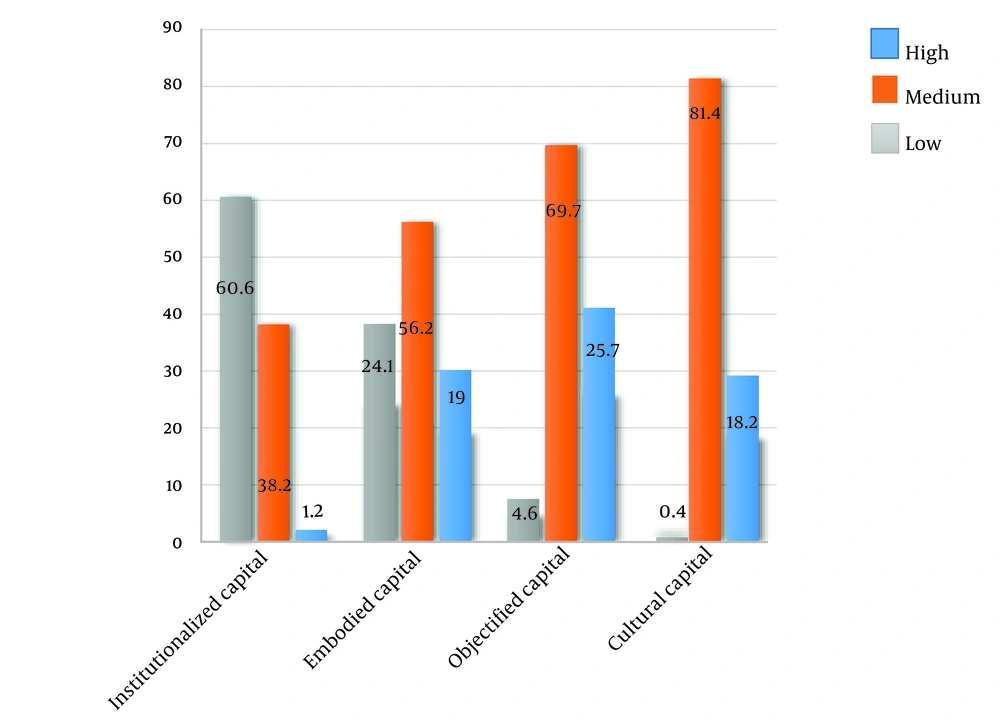
Figure 2.
Cultural capital
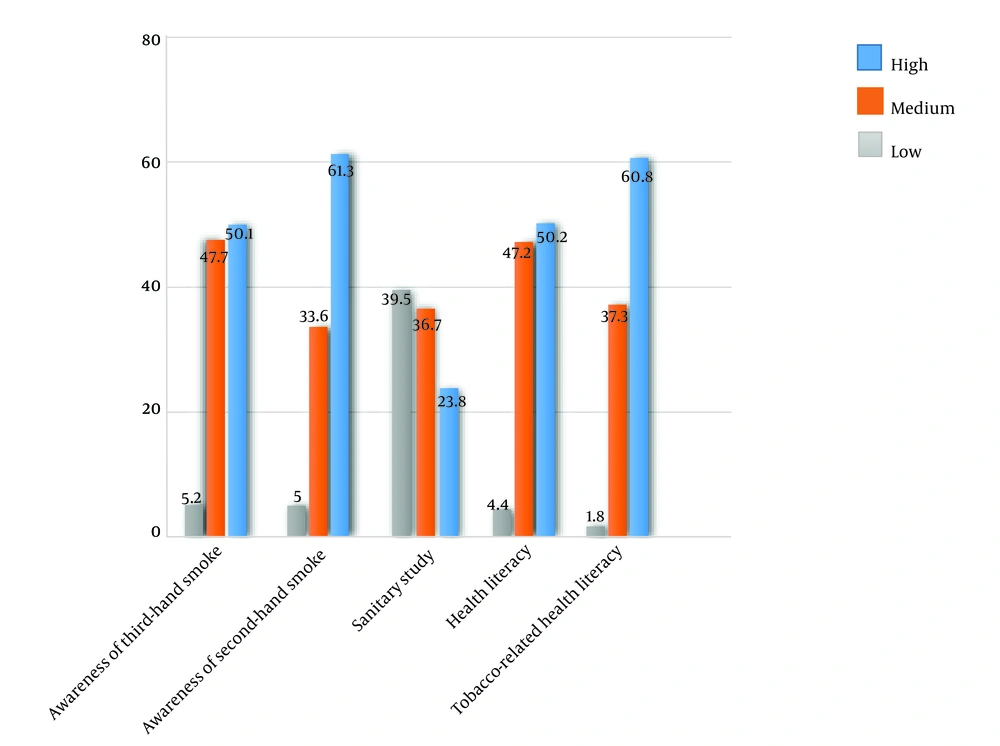
Figure 3.
Tobacco-related health literacy
4.1. Analytical Results
4.1.1. Logistic Regression
Regression analysis is used to analyze the designed model better when the dependent variable is two-dimensional (0 and 1). According to Table 2, based on the logistic regression model, the cultural capital of pregnant women affected the amount of fetal exposure to second-hand tobacco smoke. This effect was negative (B = -0.727). Due to P < 0.05, this effect was meaningful. Given the OR = 0.47, it can be said that if the cultural capital increases, the chances of not being exposed to tobacco smoke will be higher in the sense that pregnant women would be less likely to be exposed to second-hand smoke if they had high cultural capital. The mediating variable of this study, health literacy related to smoking in pregnant women, also affected fetal tobacco smoke exposure. This effect was also negative (B = -0.0257). Because the OR was 0.77, the chance of being exposed to tobacco smoke would be reduced if tobacco-related health literacy increased.
Table 2.
Results of the Logistic Regression Model Report for the Effect of Cultural Capital on the Fetus Being Exposed to Tobacco Smoke
| B | SE | Wald | OR | P-Value | |
|---|---|---|---|---|---|
| Cultural capital | -0.737 | 0.232 | 10.13 | 0.47 | 0.001 |
| Tobacco-related health literacy | -0.257 | 0.135 | 3.592 | 0.77 | 0.05 |
5. Discussion
Today, the issue of health has become more widespread. Governments and health activists have considered the health of individuals from the embryonic period. Women are essential pillars of fetal health care and maintenance (22).
The results showed that about half of the study sample had tobacco smoke exposure. Their cultural capital was moderate, and women's tobacco-related health literacy was slightly above average. The study of the effect of cultural capital and health literacy related to smoking in pregnant women and fetal tobacco exposure showed that the chances of pregnant women and fetuses being exposed to tobacco smoke were lower in people with higher cultural capital and higher health literacy associated with tobacco smoke. An inverse relationship was observed, suggesting that women with stronger cultural capital and higher health literacy were better able to protect themselves and their fetuses (23, 24). A study by Lupattelli A et al. (25) showed that women with low health literacy levels had a lower understanding of drug risks and therefore were at risk. Thus, physicians should pay special attention to the patient’s ability to understand health information (24).
In a Canadian study, Yang et al. (26) concluded that cultural and social factors were associated with fetal exposure to tobacco smoke, which is somewhat consistent with the results of the present study. Various studies have shown that health literacy is stronger in people with higher education, employment, study, and access to various information (27-29). The results of regression model analysis showed the inverse negative effect of cultural capital so that with increasing cultural capital, the amount of fetal exposure to tobacco smoke decreased. Also, the effect of tobacco-related health literacy on tobacco smoke exposure was negative (21). Choi's research showed the impact of fetal tobacco exposure on fetal health.
As shown, cultural capital was inversely related to fetal exposure to tobacco smoke, which shows the importance of strengthening women's cultural capital for fetal health (11). This is because of the consequences and effects of tobacco smoke on the fetus through the umbilical cord. As the results of various bodies of research show, it affects the respiration, intelligence, and skin of the fetus. Based on these results, this study evaluated some factors affecting the prevention of fetal tobacco exposure.
5.1. Conclusions
In this study, by examining health literacy related to smoking in pregnant women and its relationship with their cultural capital, we found that when pregnant women have enough information about the effects of tobacco smoke, they can protect themselves and their babies from exposure to second-hand smoke. Also, according to these results, it can be understood that tobacco-related health literacy increases in women who are at a higher level of cultural capital. Therefore, one of the ways to reduce the effects of tobacco smoke on the fetus is to strengthen the health literacy of pregnant mothers and encourage them to study and obtain information about the effects of tobacco smoke. It is suggested that a simultaneous study be conducted on the health literacy of pregnant women's husbands because the awareness of the spouses' health literacy impacts will help shape future policies to reduce the effects of tobacco smoke. Encouraging the increase of information about tobacco and its adverse effects can develop both cultural capital and health literacy associated with smoking in pregnant women. It is effective in combating tobacco smoke exposure, too, which can be obtained through strategies such as raising interest in reading or proposing easier solutions, including creating appropriate educational and informational programs for broadcast on mass media. Besides, the negative effect of second-hand smoke is prevented by strengthening the related infrastructure.
5.2. Strengths
In most existing research, health literacy has been discussed in general, but this research studied the tobacco-related health literacy of pregnant women. Also, this research showed that by examining the amount of fetal tobacco smoke exposure and strengthening cultural capital and smoke-related health literacy, the destructive effects of tobacco smoke on the fetus could be reduced. Also, we could not measure other effective factors due to the cross-sectional design of the study.
5.3. Limitations
There were some problems due to the sensitivity of pregnant women and their impatience to respond to questions. It is suggested that a longitudinal study be performed on a group of pregnant women to assess the effects scientifically.