
1. Background
It is difficult to provide an exact estimation for running away from home. Several studies report that 6 - 7% of adolescents run away from home and sleep in the street every year (1, 2). In the United States, 1.7 million adolescents have run away from home and spent nights on the streets (3). In Iran, almost 3000 girls and women have left their homes, according to Iran’s Social Emergency Coordination Center, of whom 644 individuals have been admitted to the residency centers of the State Welfare Organization. Compared to Iranian girls, the prevalence of running away is lower in Iranian boys. Iran’s Social Emergency Coordination Center reported that almost 3000 girls and women left their homes in 2017 (4). Runaway adolescents are those who leave home intentionally and without their parent’s permission, spend at least one night out of home, and do not want to go back home (3).
Running away from home negatively affects the developmental transition from adolescence into adulthood (3). The literature demonstrates that runaway adolescents show significantly more likelihood of substance abuse (5), delinquent behaviors (6), high-risk sexual behaviors (7), and depressive symptoms (5, 8). In addition, runaway adolescents are more likely to become homeless adults (6). This perspective implies that runaway adolescents should receive greater and early attention in the context of preventive programs (1, 3).
Research on adolescents has incorporated a risk factor approach to Bronfenbrenner’s ecological framework (9) to determine the risk factors of high-risk behaviors. According to this framework, high-risk behaviors are not the direct consequences of individuals’ characteristics. Rather, they emerge due to the complex interactions between an individual’s characteristics and the contexts or systems (e.g., microsystem, mesosystem, ecosystem, and macrosystem) in which he/she lives. Also, in line with Bronfenbrenner’s ecological framework, some theorists linked running away from home with the family’s economic and social resources in terms of financial and social capital resources (9-11). Financial capital refers to the economic resources available to the family, while social capital refers to the relationship between family members, as well as bonds between parents and children (11). Parcel and Bixby (11) postulated that social and financial capital resources are inter-correlated and that a good economic status paves the ground for a good parent-child relationship. This hypothesis was confirmed by the studies showing that economic stressors would reduce the capacity of parents to provide financial and social support, which in turn increases the likelihood of adolescents being engaged in high-risk behaviors (12-14).
Consistent with Bronfenbrenner’s ecological framework, studies in Western and Iranian populations have highlighted the multifactorial nature of problems of runaway adolescents. A number of studies indicated that long-lasting conflicts between parents/caregivers and adolescents and poor parental functioning were the primary reasons for adolescents’ leaving their houses (2, 8, 15). Furthermore, runaway adolescents experience high rates of physical or sexual abuse and neglect from family members before leaving home (16). Other studies show that the female gender (1), living in a disrupted or single-parent family (1), and school disengagement and earning poorer grades in school (8, 17) have been associated with the increased risk of running away from home. In addition, adolescents who experience depression symptoms (8, 16, 18), use substances (8, 17), are engaged in delinquent behaviors (2, 16), and are exposed to violence (2) are at increased risk of running away from the house.
However, to our knowledge, there is no study exploring the risk factors of running away from home among Iranian young girls. Most researchers in this area have investigated the psychological problems of Iranian youth, while the risk factors of running away from home among young Iranian girls appear to be missed (19, 20).
2. Objectives
In light of the high prevalence of running away among Iranian females, this study explored the role of conflictual familial relationships, history of sexual or physical abuse, low socioeconomic status, low self-esteem, dysfunctional coping strategies, depression symptoms, and poor religious beliefs in predicting the running away behavior among Iranian young girls.
3. Patients and Methods
3.1. Study Design and Participants
This cross-sectional study included all 120 young girls who ran away from home (age range: 12 to 21 years) and were arrested by police and referred to the Residency Centers of State Welfare Organization (RCSWO) in 31 provinces of Iran from February 2019 to July 2019. The girls who left home intentionally and without their parent’s permission, spent at least one night out of home, and did not want to go back home were included in the study. The RCSWO provides shelter, food, and necessary health services. In addition, the social workers of RCSWO try to provide social support to the girls and contact with their families. Runaway girls usually stay in this center for ten days. Twenty-five of the runaway participants did not answer more than 15% of inquiry items. Therefore, the data of 95 subjects were finally analyzed. The demographic characteristics of the runaway girls have been presented in Table 1. The participants excluded did not differ from other runaway girls in terms of the father’s education (χ2 (2, N = 230) = 3.11, P = 0.37), father’s job status (χ2 (2, N = 230) = 4.73, P = 0.18), mother’s education (χ2 (2, N = 230) = 4.54, P = 0.20), and the family’s socioeconomic status (χ2 (2, N = 230) = 1.29, P = 0.52).
The girls included in the control group were female students (grade 7th to 12th) at intermediate and high schools of Tehran and Kerman, who were recruited via convenience sampling (n = 135) during the same timeframe. The exclusion criterion was the history of running away from the house. The demographic characteristics of control girls have also been presented in Table 1.
Table 1.
Sociodemographic Characteristics of Runaway Girls (n = 95) and Control Girls (n = 135) a
| Sociodemographic Characteristics | Runaway Girls (n = 95) | Control Girls (n = 135) | χ2 | P |
|---|---|---|---|---|
| Father’s education | 46.45 | 0.0001 | ||
| Primary school | 82 (92.1) | 98 (79) | ||
| High school or higher | 7 (7.9) | 26 (21) | ||
| Father’s occupational status | 39.69 | 0.0001 | ||
| Employed | 51 (54.8) | 103 (79.2) | ||
| Unemployed | 44 (45.2) | 30 (20.8) | ||
| Mother’s education | 43.40 | 0.0001 | ||
| Primary school | 85 (97.7) | 116 (90.6) | ||
| High school or higher | 2 (2.3) | 12 (9.4) | ||
| Family income status | 37.35 | 0.0001 | ||
| Low | 69 (74.2) | 45 (33.8) | ||
| Moderate | 21 (22.6) | 66 (49.6) | ||
| High | 3 (3.2) | 22 (16.5) | ||
| Life time substance use | ||||
| Cigarette | 32 (33.7) | 14 (10.37) | 17.54 | 0.0001 |
| Alcohol | 14 (14.73) | 4 (2.96) | 14.52 | 0.0001 |
| History of using illicit drugs | 20.70 | 0.0001 | ||
| Cannabis | 5 (5.4) | 1 (0.8) | ||
| Opium | 6 (6.5) | 0 (0) | ||
| Heroin | 5 (5.4) | 0 (0) | ||
| Amphetamine | 6 (6.5) | 0 (0) | ||
| Ecstasy | 4 (4.3) | 0 (0) | ||
| Pure heroin | 3 (3.3) | 1 (0.8) |
a Values are expressed as No. (%).
3.2. Data Collection
For runaway girls, 31 psychologists cooperating with the social welfare organization in 31 provinces were recruited as assessors. In other words, each assessor collected the data from one province. The third by-line author held a 4-hour workshop and trained the assessors about the purpose and procedures of the study and the content of the questionnaire used. Then the assessors invited runaway young girls admitted to RSCWO to participate in the study. Those who agreed to participate in the study and signed informed written consent were asked to complete the questionnaire package anonymously, and while completing the questionnaires, the assessor was available to answer their questions.
In order to collect the data of the control group, two assessors referred to the classrooms of selected schools in Tehran and Kerman. They explained the aims and procedures of the study to students, and the girls who agreed to participate in the study were provided with the questionnaires and asked to complete them anonymously. During completing the questionnaires, the assessor was available to answer any questions by the participants.
All participants older than 16 years signed an informed written consent form. For the runaway girls who were less than 16 years old, the social worker at RCSWO contacted their parents/guardians. When parents/guardians of runaway girls referred to RCSWO, they were provided with informed written consent to sign. Likewise, for the control girls who were less than 16 years old, parents/guardians signed an informed written consent form. The Ethics Review Board of the Zanjan University of Medical Sciences and the State Welfare Organization approved the research procedure.
3.3. Measurements
(1) Sociodemographic characteristics: These include age, religion, father’s and mother’s educational status, father’s employment status, and family’s economic status.
(2) Prevention Planning Survey (PPS) (21, 22) consists of items and short scales to assess a number of personal and social risk factors. The items of the PPS are short and use simple wording so that individuals with poor reading skills could answer them. In the current study, the subscales included the family’s strength (e.g., “Does your family care about you?, “Does your family care what you do?”, and “How much do you care about your family?”), religious beliefs (e.g., "How important is religion in your life?", and “Are you religious?”), physical, emotional, and sexual abuse (e.g. “Have you ever beaten up by someone?”), and lifetime substance abuse (e.g., "How often have you ever used opium? If yes, how many times?"). The strength of the family and religious belief scales used a 4-point Likert scale (1 = a lot to 4 = not at all), with higher scores indicating lower levels of family strength and religious beliefs. The subscale of physical, emotional, and sexual abuse was assessed via questions with binary (yes/no) responses. In the current study, the internal consistency values of these scales were satisfactory, ranging from 0.73 to 0.84.
(3) Beck Depression Inventory, the Second Edition (BDI-II), measures the severity of depression symptoms (23) using a 4-point scale (from 0 to 3). Each item consisted of four sentences, and the participant was asked to choose a sentence that described him/her best. The scale showed good validity and reliability (24). The internal consistency and test-retest reliability of BDI-II were reported in a Persian language population as 0.91, 0.89, and 0.94, respectively (25). In the current study, the internal consistency coefficient of BDI-II was 0.93.
(4) Rosenberg Self-esteem Scale (RSES) (26) is a self-reporting scale that measures self-esteem using a 4-point Likert scale, with higher scores reflecting higher self-esteem. The internal consistency and validity of RSES have been satisfactory in Western (27, 28) and Persian language populations. In the current study, RSES also showed satisfactory internal consistency (0.81).
(5) Coping Inventory for Stressful Situations (CISS) (29) is a 46-item inventory that assesses task-, emotion-, and avoidance-oriented coping strategies. The validity and reliability of CISS have been confirmed in Italian (30), Japanese (31), and Iranian (32) populations. In the present study, the internal consistency coefficient of the scale was 0.81.
3.4. Data Analysis
Data analysis was performed in Statistical Package for the Social Sciences (SPSS) software version 24. The demographic characteristics of the participants were presented using descriptive statistics. Missing data were replaced by the means of the items in the corresponding group. We used the independent t-test and chi-square to compare runaway girls with control girls in terms of sociodemographic characteristics and independent variables. We also used logistic regression to examine the association of the behavior of running away from home (i.e., the dependent variable) with each independent variable, including the family’s strength and income, history of drug abuse in life, the strength of religious beliefs, coping styles, self-esteem, depression, and experiencing physical, emotional, or sexual abuse. After checking for collinearity, the variables that were found to be significant in comparative analyses (P < 0.05) were included in a logistic regression model to obtain adjusted odds ratios (aORs) and 95% confidence intervals (CIs).
4. Results
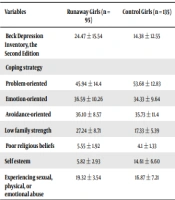
The mean age of runaway girls was 16.92 years (SD = 2.54, the range of 12 to 21). The mean age of control girls was 16.57 years (SD = 1.16, the range of 13 to 20). The fathers and mothers of the control girls had higher educational levels than the fathers and mothers of runaway girls. Also, the employment rate was higher among the fathers of control girls compared to the fathers of runaway girls. The two groups were different in terms of socioeconomic status. Most of the runaway girls (74.2%) declared their families as low-income. However, in the control group, 33.8% of the girls reported that their families had low income, while 49.6% of them came from reportedly moderate-income families. Runaway girls reported significantly higher rates of cigarette/hookah use, alcohol consumption, and abusing illicit drugs (e.g., cannabis, opium, amphetamine, LSD, and cocaine) than control girls in their lifetime (Table 1). Also, runaway girls scored higher than control counterparts on BDI-II (t = 5.29, df = 228, P = 0.0001) and reported lower family strength (t = 9.36, df = 228, P = 0.000), higher rates of sexual, physical, or emotional abuse (t = 3.39, df = 228, P = 0.001), and weaker religious beliefs (t = 6.76, df = 228, P = 0.0001). On the other hand, girls in the control group scored significantly higher than runaway girls in terms of self-esteem (t = 5.68, df = 228, P = 0.0001) and problem-oriented coping styles (t = 4.29, df = 228, P = 0.0001) (Table 2).
Table 2.
Mean and Standard Deviation of Predictor Variables in Runaway Girls (n = 95) and Control Counterparts (n = 135)
| Variables | Runaway Girls (n = 95) | Control Girls (n = 135) |
|---|---|---|
| Beck Depression Inventory, the Second Edition | 24.47 ± 15.54 | 14.38 ± 12.55 |
| Coping strategy | ||
| Problem-oriented | 45.94 ± 14.4 | 53.68 ± 12.83 |
| Emotion-oriented | 36.59 ± 10.26 | 34.33 ± 9.64 |
| Avoidance-oriented | 36.10 ± 8.57 | 35.73 ± 11.4 |
| Low family strength | 27.24 ± 8.71 | 17.33 ± 5.39 |
| Poor religious beliefs | 5.55 ± 1.92 | 4.1 ± 1.33 |
| Self esteem | 5.82 ± 2.93 | 14.61 ± 6.60 |
| Experiencing sexual, physical, or emotional abuse | 19.32 ± 3.54 | 16.87 ± 7.21 |
Pearson correlation was used to determine correlation coefficients between the independent variables (Table 3). Depression was found to be significantly associated with emotion-oriented coping style, low family strength, poor religious beliefs, and experiencing sexual, physical, or emotional abuse. Also, low family strength was positively correlated with poor religious beliefs and experiencing sexual, physical, or emotional abuse. The task-oriented coping style negatively correlated with depression, low family strength, and poor religious beliefs. Also, there was a positive association between the task-oriented coping style and self-esteem. On the other hand, self-esteem was negatively correlated with emotion-oriented coping style, depression, low family strength, and weak religious beliefs.
Table 3.
Correlations Between Independent Variables
| N | Variables | 1 | 2 | 3 | 4 | 5 | 6 | 7 |
|---|---|---|---|---|---|---|---|---|
| 1 | Task-oriented coping style | 1 | ||||||
| 2 | Emotion-oriented coping style | 0.12 | 1 | |||||
| 3 | Avoidance-oriented coping style | 0.12 | 0.13 | 1 | ||||
| 4 | Depression | -0.27 a | 0.56 a | 0.006 | 1 | |||
| 5 | Low family strength | -0.41 a | 0.16 | -0.13 | 0.42 a | 1 | ||
| 6 | Poor religious beliefs | -0.32 a | 0.003 | 0.01 | 0.26 a | 0.41 a | 1 | |
| 7 | Self-esteem | 0.38 a | -0.42 a | -0.04 | -0.67 a | -0.35 a | -0.24 a | 1 |
| 8 | Experiencing sexual, physical, or emotional abuse | 0.14 | 0.00 | 0.04 | -0.19 a | 0.18 a | -0.10 | 0.05 |
a Statistically significant
Multivariate logistic regression analysis with the enter method showed that there was a significant association between independent variables and running away from home (Table 2). The full model, including all predictors, rendered a statistically significant outcome (χ2 (10, N = 228) = 164.54, P < 0.001), explaining 51% of the variance observed in the dependent variable (i.e., running away from home) (Cox & Snell R square), classifying 64.5% (Nagel Kerke R Square) of the cases. Family income had the strongest contribution to the model. In other words, girls who came from low-income (aOR = 31.62, 95% CI = 2.87 - 347.80) and moderate-income (aOR = 4.63, 95% CI = 0.47 - 45.18) families had significantly higher odds to run away than girls belonging to high-income families. In addition, the girls who had a history of using illicit substances (e.g., cannabis, opium, amphetamine, LSD, and cocaine) had higher odds (aOR = 1.28, 95% CI = 0.98 - 1.67) of running away from home. Finally, girls who reported low family strength (aOR = 1.19, 95% CI = 1.10 - 1.29) and poor religious beliefs (aOR = 2.15, 95% CI = 1.49 - 3.18) were more likely to run away from home (Table 4).
Table 4.
Multiple Logistic Regression Analysis of Factors Associated with Running Away from Home Among Young Girls
| Variables | Adjusted Odds Ratio | 95% CI | P-Value |
|---|---|---|---|
| Family income | |||
| Low | 31.62 | 2.87 - 347.80 | 0.005 |
| Moderate | 4.63 | 0.47 - 45.18 | 0.18 |
| High | 1 | 1 | 1 |
| History of smoking and alcohol consumption | 0.91 | 0.44 - 1.82 | 0.46 |
| History of using illicit drugs | 1.28 | 0.98 –1.67 | 0.05 |
| Task-oriented coping style | 1.00 | 0.95 – 1.04 | 0.98 |
| Emotion-oriented coping style | 0.96 | 0.90 - 1.03 | 0.96 |
| Avoidance-oriented coping style | 10.01 | 0.96 – 1.07 | 0.47 |
| Depression | 1.01 | .96 - 1.05 | 0.67 |
| Low family strength | 1.19 | 1.10 - 1.29 | 0.0001 |
| Poor religious beliefs | 2.15 | 1.49 - 3.18 | 0.0001 |
| Self-esteem | 0.89 | 0.82 - 0.92 | 0.03 |
| Experiencing sexual, physical, or emotional abuse | 0.89 | 0.82 - 0.97 | 0.29 |
5. Discussion
To our knowledge, the present study was the first research that investigated the contribution of psychological and social factors to the prediction of running away from home among Iranian adolescent girls. In light of the number of Iranian families and adolescents affected by the running away behavior (20), it is necessary to identify the risk factors of and contributors to running away to help policymakers and practitioners appropriately target the psychosocial needs of at-risk adolescents.
Our results indicated that a low socioeconomic status was a significant and the strongest predictor of running away from home. Girls who were reared in families with poor socioeconomic status were nearly 32 times more likely to run away from home than girls who lived in families with high socioeconomic status. In addition, girls in middle-socioeconomic families were approximately five times more likely to leave home than girls living in high-socioeconomic families. These results were consistent with previous reports indicating that a low socioeconomic status was associated with higher rates of various antisocial behaviors (33), as well as running away from home (2, 34). In addition, these results were in line with Bronfenbrenner’s ecological framework (9) and Radu’s theory (10).
Girls who experienced more conflictual relationships with their parents and less parental support and control were 1.19 times more likely to run away from home. This finding was in line with previous literature identifying poor parental control and conflictual relationships between family members as the primary risk factors for running away from home (3, 16, 17, 35).
At the individual level, a history of using illicit drugs in a lifetime significantly anticipated the running away behavior. This finding was consistent with the observations of previous studies highlighting substance abuse as a strong predictor of running away from home (2, 8, 17). In addition, some researchers pointed out that runaway adolescents were more likely to use substances than their housed counterparts (8, 36). One path-analytic study on homeless adolescents showed that a history of trauma, lower levels of family functioning, and experiencing familial conflicts significantly predicted greater mental health problems, delinquent behaviors, high-risk sexual behaviors, and substance abuse. These results raised the question of whether or not running away from home, substance abuse, and other externalizing symptoms could be conceptualized as the consequences of other etiological factors (e.g., undesirable socioeconomic status or poor family functioning). Although this was an enthralling question, the cross-sectional nature of our study hindered us from testing this hypothesis.
Finally, our results indicated that poor religious beliefs significantly predicted the running away behavior. In other words, the girls who had weaker religious beliefs were 2.15 times more likely to run away from home. These results were consistent with the findings of previous studies indicating a significant relationship between religiosity and the rate of high-risk behaviors (8, 36, 37).
Our findings must be interpreted by taking into mind some limitations of the study. First and most importantly, our study only included runaway youth arrested by police and admitted to the RCSWO. Therefore, these results could not be generalized to runaway young girls who did not come under police custody. Second, the retrospective nature of the current study hindered us from drawing casual relationships. Thus, it is advisable to design and conduct longitudinal studies to investigate the risk and protective factors of the running away behavior among Iranian female adolescents. Finally, we utilized self-reporting instruments, which might have been associated with recall bias and, therefore, overestimation and underestimation due to social desirability.
5.1. Conclusions
The results of the current study indicated that the girls who came from low- and moderate-income families had significantly higher odds of running away from home than girls who belonged to high-income families. Also, the girls who had a history of using illicit drugs had higher odds of running away from home. Moreover, low family strength and poor religious beliefs significantly predicted running away from home. These findings implied the need for implementing appropriate programs to promote households’ economic capacity through training work skills, encouraging entrepreneurship, and supporting low-income families financially to cope with adolescents’ and youth’s running away from home. Furthermore, psychoeducational interventions to teach effective parenting and life skills and internalize religious values in children and adolescents should be an incremental component of such prevention programs.