
1. Background
During the COVID-19 pandemic, there was a significant increase in rumors all around the world. The United Nations (UN) secretary general has identified these as a major challenge that needs to be addressed (1). In public health crises, individuals and communities may experience stress and turn to rumors to reduce it. Therefore, managing such situations is critical (2). The World Health Organization and other international health agencies have recognized rumors as a threat to pandemic preparedness and control that can decrease community trust in governments. Consequently, they have suggested implementing systematic monitoring and control procedures to tackle this issue (3). On-time detection, assessment, and correction of rumors are challenging (1).
According to empirical research, repeating a rumor can make it more influential. Some people are more likely to believe in conspiracy theories and related rumors, even if they are logically contradictory (4).
Rumors can sometimes be mistaken for believable infection prevention and control strategies. The rumor of the significant effect of consuming highly concentrated alcohol in disinfecting the body and eliminating the coronavirus resulted in the death of several sufferers (5). Furthermore, cases of blindness were reported after drinking methanol as a treatment for COVID-19 (6, 7).
Meanwhile, there were reports of an increase in the use of opioids after the COVID-19 pandemic. Drug overdose deaths increased in the United States in 2019, coinciding with the outbreak of COVID-19, primarily propelled by the widespread production of illicit fentanyl. It seems that the rise of COVID-19, along with disruptions in healthcare and social support, coupled with social and economic stress, worsened the drug epidemic (8). The rumors and inaccurate claims that opioid users are not at risk for COVID-19 led to a surge in demand for opioids compared to before the outbreak (9). Nevertheless, scientific evidence suggests that individuals who use drugs or smoke are more susceptible to COVID-19 (10, 11).
The COVID-19 pandemic involved a broad range of ages and social groups (12). In the meantime, homeless people were considered a high-risk group. Poverty, addiction, and mental health problems are some of the difficulties in these communities (13). Drug addiction in these individuals can be a risk factor for respiratory viral infections due to a lack of personal hygiene, lung infections, mucociliary dysfunction, weakened immunity, and disregard for social distancing (14, 15).
Like many countries, Iran is also facing the problems of homelessness and addiction (9). This country is considered a leading case in creating and expanding the model of integrating mental health and addiction into primary health care (PHC). Providing educational and health services to addicted homeless is defined in the health system (16).
Sistan and Baluchestan Province in southeastern Iran is still one of the main transit routes for drug trafficking from Afghanistan to European countries (17). In addition, the rate of addicted homeless per population is higher than in other parts of the country in this province (18). Therefore, it is a suitable area to study the accuracy of the rumor about the positive effect of opium and other addictive substances in preventing coronavirus infection.
2. Objectives
This study aimed to investigate the abundance of COVID-19 infection among homeless drug abusers in southeast Iran.
3. Patients and Methods
The data collection of this cross-sectional (descriptive-analytical) study was performed from April to May 2021, coinciding with the second-highest peak in Zahedan, the capital of Sistan and Baluchestan Province, southeastern Iran. It is the most populous city in the southeastern part of the country, with a population of 660 575. It is located near the shared border with Afghanistan and Pakistan (Figure 1).
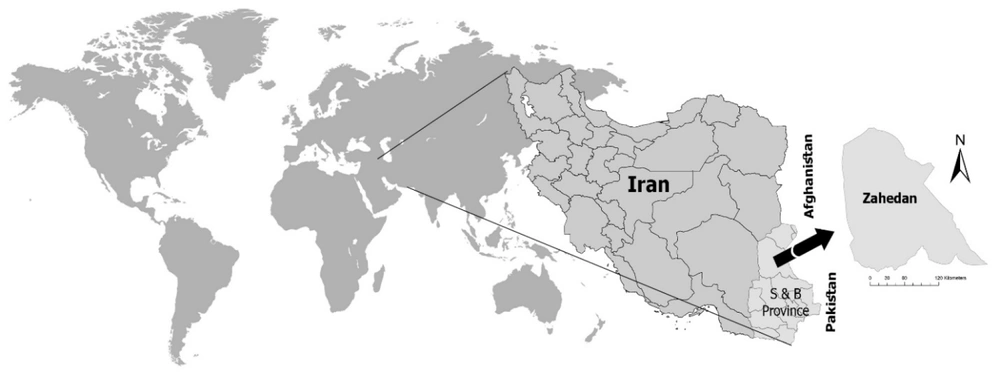
Figure 1.
Location of the study area: Zahedan, southeastern Iran.
All homeless individuals with drug addiction, gathered by Zahedan Municipality and scheduled for placement in the rehabilitation camp between April and May 2021, were included in the study. The participants' addiction was confirmed by their declaration and the laboratory examination. The research team obtained informed consent from all the participants. They were assured that the obtained information and their identities would be kept confidential.
For each participant, a questionnaire was completed by the health experts. It included demographic information, symptoms, type of addictive substances, and frequency and methods of drug abuse.
For a definite diagnosis of COVID-19, a combined oropharyngeal/nasal sampling method was used in the laboratory under standard polymerase chain reaction (RT-PCR).
The collected data were analyzed using SPSS v. 19 (IBM Corp., Armonk, NY, USA) software. Descriptive analyses were expressed as numbers and frequency percentages. The chi-square test was used to compare the number of positive COVID-19 cases in the types of substance consumed, drug abuse methods, and the number of times of consumption. The level of significance was established as P < 0.05.
4. Results
4.1. Demographic Characteristics
In this study, 295 homeless drug abusers participated, most of whom were male (89.5%) and in the age group of 35 - 45 years. Totally, positive COVID-19 was recorded for 21 (7.1%) participants. People aged above 45 years (10.8%) had the highest incidence of the disease, and regarding sex, it was related to men (7.6%). Most participants were waste pickers (60.5%), and 3.9% of them had COVID-19. Although the positive cases were more seen in people who slept in roofed places and with others, the difference was not statistically significant (P > 626). The demographic and social characteristics of the participants are shown in Table 1.
Table 1.
Demographic Characteristics and Positive COVID-19 Status of Homeless Drug Abusers
| Characteristic | Frequency (%) | COVID-19 + | Characteristic | Frequency (%) | COVID-19 + |
|---|---|---|---|---|---|
| Age (y) | Duration of homelessness | ||||
| ≤ 25 | 20 (6.8) | 0 (0) | ≤ 5 | 37 (29.6) | 4 (10.8) |
| 26 - 35 | 91 (30.8) | 3 (3.3) | 5 - 10 | 25 (20.0) | 0 (0) |
| 36 - 45 | 114 (38.6) | 11 (9.6) | > 10 | 63 (50.4) | 5 (7.9) |
| ≥ 46 | 65 (22) | 7 (10.8) | Waste picker | ||
| Sex | Yes | 178 (60.5) | 7 (3.9) | ||
| Male | 264 (89.5) | 20 (7.6) | No | 116 (39.5) | 14 (12.1) |
| Female | 31 (10.5) | 1 (3.2) | Education level | ||
| Marital status | Illiterate | 80 (27.3) | 4 (5.0) | ||
| Single | 129 (44.2) | 7 (5.4) | Elementary school | 80 (27.3) | 4 (5.0) |
| Married | 113 (38.7) | 7 (6.2) | Junior high or high school | 120 (41.0) | 13 (10.8) |
| Divorced | 41 (14.0) | 6 (14.6) | University graduate | 13 (4.4) | 0 (0) |
| Widow | 5 (1.7) | 0 (0) | Night sleep | ||
| Separated | 1 (.3) | 0 (0) | Roofed place | 190 (66) | 14 (7.4) |
| Others | 3 (1.0) | 0 (0) | Roofless place | 98 (34) | 5 (5.1) |
| Night sleep | |||||
| Alone | 112 (38.2) | 9 (8.0) | |||
| With others | 181 (61.8) | 12 (6.6) |
4.2. Possible Symptoms of COVID-19
Headache (33.3%), diarrhea (25%), stomachache (25%), fatigue (20%), and cough (12%) were the most common symptoms of COVID-19 positive cases in homeless drug abusers. The frequency of possible COVD-19 symptoms has been reported in Table 2.
Table 2.
Frequency of the Possible Symptoms of COVID-19 in Homeless Drug Abusers
| Symptom | Frequency (%) | COVID-19 + | Symptom | Frequency (%) | COVID-19 + |
|---|---|---|---|---|---|
| Fever | Nausea and vomiting | ||||
| Yes | 12 (4.1) | 1 (8.3) | Yes | 5 (1.7) | 1 (20.0) |
| No | 283 (95.9) | 20 (7.1) | No | 290 (98.3) | 20 (6.9) |
| Cough | Diarrhea | ||||
| Yes | 8 (2.7) | 1 (12.5) | Yes | 4 (1.4) | 1 (25.0) |
| No | 287 (97.3) | 20 (7.0) | No | 291 (98.6) | 20 (6.9) |
| Difficulty breathing | Stomachache | ||||
| Yes | 41 (13.9) | 3 (7.3) | Yes | 4 (1.4) | 1 (25.0) |
| No | 254 (86.1) | 18 (7.1) | No | 291 (98.6) | 20 (6.9) |
| Sore throat | Fatigue | ||||
| Yes | 2 (.7) | 0 (0) | Yes | 5 (1.7) | 1 (20.0) |
| No | 293 (99.3) | 21 (7.2) | No | 290 (98.3) | 20 (6.9) |
| Runny nose | Dizziness | ||||
| Yes | 5 (1.7) | 0 (0) | Yes | 0 (0) | 0 (0) |
| No | 290 (98.3) | 21 (7.2) | No | 295 (100) | 0 (0) |
| Chest pain | Body pain | ||||
| Yes | 16 (5.4) | 0 (0) | Yes | 1 (.3) | 0 (0) |
| No | 279 (94.6) | 21 (7.5) | No | 294 (99.7) | 0 (0) |
| Headache | Joint pain | ||||
| Yes | 6 (2.0) | 2 (33.3) | Yes | 1 (.3) | 0 (0) |
| No | 289 (98.0) | 19 (6.6) | No | 294 (99.7) | 0 (0) |
4.3. Types of Addictive Substances, Drug Abuse Methods, and Daily Use
The number of addicted participants who used narcotic analgesics, including opium and/or heroin, was 172 (59.5%), of which 10 (5.8%) people had positive COVID-19 results. Twenty patients (6.9%) used central nervous system (CNS) stimulants such as methamphetamine, and 3 of them (15%) were positive for COVID-19. Among those who used narcotics and stimulants in combination, 7 (7.2%) were positive for the disease. The chi-square test showed that there was no significant difference in the number of positive COVID-19 cases among narcotics, stimulants, and both combinations. In other words, none of the drugs had an effect on the number of patients with COVID-19 (Table 3).
Table 3.
Frequency of Addictive Substance Types and COVID-19 Positivity in Homeless Drug Abusers
| Category | No. (%) | COVID-19, No. (%) | P-Value |
|---|---|---|---|
| Narcotic analgesics (opium and/or heroin) | 172 (58.3) | 10 (5.8) | 0.209 |
| Central nervous system stimulants (methamphetamine) | 26 (8.8) | 4 (1.5) | |
| Both narcotics and stimulants | 97 (32.9) | 7 (7.2) |
Abbreviation: CNS, central nervous system.
Table 4 shows the frequency of drug abuse methods and the incidence of COVID-19 in homeless drug addicts. There was no significant difference in positive COVID-19 and drug abuse methods.
Table 4.
Frequency of Drug Abuse Methods and COVID-19 Positivity in Homeless Drug
| Category | No. (%) | COVID-19, No. (%) | P-Value |
|---|---|---|---|
| Only oral | 19 (6.4) | 1 (0.3) | 0.945 |
| Both oral and inhalation | 15 (5.1) | 1 (0.3) | |
| All typesa | 261 (88.5) | 19 (6.4) |
a All types of drug use: Oral ingestion, inhalation, smoking, and intravenous injection.
Additionally, the analysis did not show any significant difference in COVID-19 positivity and the number of times of drug abuse per day (Table 5).
Table 5.
The Number of Drug Abuses Per Day and the Incidence of COVID-19 in Homeless Drug Abusers
| Characteristic | No. (%) | COVID-19, No. (%) | P-Value |
|---|---|---|---|
| No. of drug abuses per day | 0.405 | ||
| 1 | 37 (12.5) | 1 (0.3) | |
| 2 | 86 (29.2) | 9 (3.1) | |
| 3 | 113 (38.3) | 8 (2.7) | |
| ≥ 4 | 59 (20.0) | 3 (1.0) |
5. Discussion
Access to addictive substances may be easier in a society with a high rate of addicts per population, so the rumor of the positive effect of addiction on the prevention or treatment of COVID-19 can encourage more people to abuse them. Therefore, an inspection of the accuracy of this opinion is necessary as a research point and can be effective in limiting or expanding drug addiction. Many studies have investigated COVID-19 in homeless people, but the literature review showed few studies on homeless drug addicts. Therefore, comparing the current study with similar ones is difficult.
It is expected that a high percentage of waste pickers get COVID-19 due to more exposure and contact with infectious rubbish. In addition, increased incidence and severity of airborne diseases have been recorded in homeless people. Also, the median age has been reported to be lower for the homeless than for non-homeless (19). In the present study, 7.1% of homeless drug abusers were infected with COVID-19. Most participants were in the age group of 35 - 45, and the highest incidence of COVID-19 was seen in the upper 45 years. Similarly, a study conducted on homeless drug addicts in Iran showed a 6.04% COVID-19 positivity rate (20). In another research in Ireland, the COVID-19 infection rate was 8.4% (63 out of 750 people) in homeless drug addicts (21). An investigation conducted in homeless shelters in the United States showed that the majority of participants were classified in the age group of 35 - 59. The researchers showed the most positive COVID-19 infection in both 35 - 49 and above 60 years equally (22). In Brussels, researchers observed male predominance and a median age of about 56 years among homeless people hospitalized with COVID-19 (19).
Most participants slept in roofed places with other friends at night. In a study conducted in the United States, 86% of people with positive test results slept in public places. The researchers expressed that it can increase this group's infection probability (22). Overcrowding in shelters can enhance COVID-19 in the homeless population (19). Some studies have concluded that using prevention tools within homeless shelters can limit COVID-19 transmission (23).
In the current study, the most common symptoms of COVID-19 are similar to many other kinds of research. Other studies have also reported headaches, diarrhea, stomachache, fatigue, and cough. However, the ranking was different compared to our study. A case series study showed fever, fatigue, myalgia, lack of appetite, dry cough, and anosmia as the most common COVID-19 symptoms respectively (24). Perhaps the reason for that is the different target group, in which they were not homeless addicts. Despite the broad spectrum of COVID-19, it seems that due to addictive substances' effects, some of the symptoms can be reduced or increased.
In our study, the statistical test did not show a significant difference in the number of COVID-19-positive cases between addictive substance types. However, the percentage of this disease was lower in people who used narcotics. Perhaps the last result has caused the rumor of the positive effect of traditional drug abuse on preventing COVID-19 in society. In the United States, increases in addictive substance use and drug overdoses have been documented since the COVID-19 pandemic (25-27). Some researchers have expressed that the COVID-19 pandemic or other stressful conditions can even cause small changes in the amount of drug abuse among addicts (28). Our study also did not prove the positive effect of drug abuse methods and the frequency of daily drug abuse on the incidence of this disease. The literature review did not confirm the positive role of addictive substances in the prevention and treatment of COVID-19. A COVID-19 serological study conducted in Iran on intravenous drug users showed no statistically significant between them and non-drug users (29).
5.1. Conclusions
During the COVID-19 pandemic, unreliable, incorrect, and incomplete information was spread in societies, and officials were forced to prevent and manage it (30). Rumors can be more dangerous than a pandemic, so they should be investigated and the results announced to the societies. Even with such a report, it is recommended that further laboratory and psychological studies be conducted with a focus on high-risk communities such as the homeless to determine the direction of future studies and understand the impact of rumors on society's behavior regarding healthcare.