
1. Background
Abuse is defined as doing, not doing, or quitting an activity by healthcare providers that may have negative consequences for the patient (1). Abuse includes physical, sexual, psychological, or emotional abuse, as well as neglect, abandonment, and financial exploitation (2). The change in family roles, life stresses, and crises caused by accidents and diseases have weakened the social bases of family and have led to abuse by family members (3). Abuse is one of the cases of deprivation of human rights and dignity that occurs in various forms, such as deprivation of individual authority, rejection, psychological and physical harassment, and financial exploitation. Family members intentionally or unintentionally neglect the person by neglecting emotional needs, safety care, and dignified life and leaving the patient alone in activities inside and outside the house. Abuse can lead to negative physical (ie, reduced physical dimensions of the quality of life) and psychological (ie, reduced mental health) effects on patients (4, 5).
Chronic or contagious diseases can be one of the factors effective in augmenting abuse prevalence (3). One of the chronic diseases that causes various challenges for patients is spinal cord injury (SCI). The SCI is defined as damage to the spinal cord that results in the loss of sensory, motor, or autonomic function (6). These complications might lead to problems, such as pain, pressure ulcers, psychological problems, care stress, and reduced physical activity (7-9). The SCI is one of the chronic diseases that cause caregiver burden in healthcare providers (10). Studies have shown that perceived caregiver burden is significant among the caregivers of these patients (9, 11, 12). The caregiver burden can be an essential and influential risk factor for abuse (13).
Furthermore, the spread and prevalence of coronavirus disease 2019 (COVID-19) have been an effective risk factor for abuse. Patients with SCI are a vulnerable group, and it is essential to consider psychological issues, especially abuse, in these people (14). COVID-19 is an infectious disease that has become increasingly prevalent in recent years and has caused many problems in patients and their companions (15). One of the best preventive solutions for COVID-19 is social distancing, which has led to problems for patients, such as stress, anxiety, fear, and reduced social support (16). On the other hand, the SCI process can lead to abuse by creating disability in patients and diminishing their abilities because patients with SCI become increasingly dependent on caregivers. Consequently, abuse may be developed or exacerbated in these patients (17, 18).
2. Objectives
The authors of the present study have not yet found a similar study worldwide, which indicates the importance of this issue. The worldwide spread of COVID-19 has affected the care taken of chronic patients, especially SCI cases, who need special consideration. Therefore, the present study aimed to assess abuse in patients with SCI during the COVID-19 pandemic.
3. Methods
This cross-sectional descriptive study population included all patients with SCI in Ilam, Iran. Similar to previous studies, 95 of these patients, who met the inclusion criteria, were included in the study (19-21). The inclusion criteria entailed consent to participate in the study, no history of mental disorder, being over 18 years, and being affected by SCI for at least one year. Patients who did not complete the questionnaires completely or were reluctant to continue were excluded from the study.
All patients were trained by a researcher, interviewed privately, and ensured the confidentiality principle. The interviewers completed the abuse questionnaire by referring to and interviewing the participants. If the patient was literate enough to understand the research questions, the questionnaire was completed in a self-reported manner, and otherwise, the survey was completed by the interviewer. After data collection, statistical analyzes were performed.
3.1. Ethical Approval
written informed consent, data confidentiality, the Helsinki and Belmont Declaration, and ethical guidelines of the university were considered as ethics criteria in this research. In addition, the necessary COVID-19-related health protocols were observed.
3.2. Study Tools
Researcher-made forms and questionnaires with confirmed validity and reliability, including the demographic characteristics form and perceived abuse questionnaire for patients with SCI, were used. The perceived abuse questionnaire for SCI patients was a researcher-made questionnaire designed using library studies, interviewing patients, and determining abuse instances. This instrument consisted of 20 questions answered as yes (score 1) or no (score 0). The final score had a range of 0 - 20. Content validity was used and provided to the experts to evaluate tool validity. The test-retest reliability was accepted by Pearson’s correlation coefficient (P = 0.96). In order to assess the content validity of the instrument, Waltz and Basel content validity index was utilized. The necessity, relevance, clarity, and simplicity of the instrument were measured using the Likert Scale. The items were maintained, modified, and deleted for scores ≥ 79, 70 - 79, and < 70, respectively (22).
3.3. Statistical Analysis
The prevalence of quantitative variables, such as age, history of SCI, and abuse, was calculated using descriptive statistical analyzes (ie, mean calculation and standard deviation. Furthermore, descriptive statistics were used to describe the qualitative variables of the research, including gender, level of education, and abuse items which were answered as yes/no. All analyzes were performed using the SPSS software version 16 (IBM, USA), and P-value < 0.05 was considered statistically significant.
4. Results
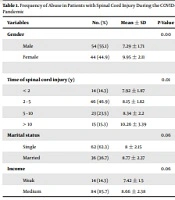
According to our results, the mean ± SD of the perceived abuse score by caregivers and patients was 8.48 ± 2.31 and 42.45% during the COVID-19 pandemic, respectively. The mean ± SD of the age of patients was 62.86 ± 19.15 years, and abuse increased with age (P = 0, F = 27.42). In addition, the final abuse score had a range of 0 - 20 that was divided into three categories low (20, 20.4%), moderate (76, 76.5%), and high (2, 2%). Table 1 shows a significantly higher perceived abuse score among women and patients with a history of more than 10 years of SCI. However, abuse prevalence did not have a significant relationship with income and marital status (P > 0.05) (Table 1).
Table 1.
Frequency of Abuse in Patients with Spinal Cord Injury During the COVID-19 Pandemic
| Variables | No. (%) | Mean ± SD |
|---|---|---|
| Gender | ||
| Male | 54 (55.1) | 7.29 ± 1.71 |
| Female | 44 (44.9) | 9.95 ± 2.11 |
| P-Value | - | 0.00 |
| Time of spinal cord injury (y) | ||
| < 2 | 14 (14.3) | 7.92 ± 1.87 |
| 2 - 5 | 46 (46.9) | 8.15 ± 1.82 |
| 5 - 10 | 23 (23.5) | 8.34 ± 2.2 |
| > 10 | 15 (15.3) | 10.26 ± 3.39 |
| P-Value | - | 0.01 |
| Marital status | ||
| Single | 62 (63.3) | 8 ± 2.15 |
| Married | 36 (36.7) | 8.77 ± 2.37 |
| P-Value | - | 0.06 |
| Income | ||
| Weak | 14 (14.3) | 7.42 ± 1.5 |
| Medium | 84 (85.7) | 8.66 ± 2.38 |
| P-Value | - | 0.06 |
Table 2 shows the frequency (percentage) of perceived abuse among SCI cases in Ilam. According to the mentioned frequencies and percentages, none of the patients reported abuse in items "abandonment in hospitals, nursing homes, or relatives' houses" and "threatening or attempting to beat if got COVID-19". In addition, for the item "unreasonable blame for non-compliance with the health protocols", the number of Yes and No answers was completely equal.
Table 2.
Prevalence of Abuse in Patients with Spinal Cord Injury During the COVID-19 Pandemic a
| No. | Items | Yes | No |
|---|---|---|---|
| 1 | Failure to provide hygiene equipment, such as masks, gloves, and alcohol to prevent COVID-19 | 37 (37.8) | 61 (62.2) |
| 2 | Lack of financial support to purchase essential disease-related equipment, such as wheelchairs and canes | 55 (56.1) | 43 (43.9) |
| 3 | Help to see a doctor following health protocols | 38 (38.8) | 60 (61.2) |
| 4 | Abandonment in a hospital, nursing home, or relatives' houses | 0 (0) | 98 (100) |
| 5 | Negligence in performing corona test even in the case of COVID-19 symptoms | 50 (51) | 48 (49) |
| 6 | Unreasonable blame for non-compliance with the health protocols | 49 (50) | 49 (50) |
| 7 | Threatening patients with rejection and the lack of physical care if they develop COVID-19 | 26 (26.5) | 72 (73.5) |
| 8 | Decreased emotional support by family members during the COVID-19 outbreak | 52 (53.1) | 46 (46.9) |
| 9 | Not observing health protocols by family members when contacting a person | 29 (29.6) | 69 (70.4) |
| 10 | Self-medication for the prevention or treatment of COVID-19 | 83 (84.7) | 15 (15.3) |
| 11 | Forcing the patient to perform outdoor work | 31 (31.6) | 67 (68.4) |
| 12 | Failure to have healthy nutrition during the COVID-19 pandemic | 19 (19.4) | 79 (80.6) |
| 13 | Lack of assistance with personal affairs, such as toilet and bathing during the COVID-19 outbreak | 64 (65.3) | 34 (34.7) |
| 14 | Lack of physical assistance in the daily activities during the COVID-19 outbreak | 41 (41.8) | 57 (58.2) |
| 15 | Not using amenities, such as telephone and TV at the isolation room during the COVID-19 period | 71 (72.4) | 27 (27.6) |
| 16 | Preventing awareness and information regarding the latest COVID-19 news | 37 (37.8) | 61 (62.2) |
| 17 | Lack of cooperation in cleaning and disinfecting the house during the COVID-19 pandemic | 51 (52) | 47 (48) |
| 18 | Lack of life expectancy and unreasonable fear and stress disrupting the life of patients (eg, stating that patients with SCI will die if they develop COVID-19) | 62 (63.3) | 36 (36.7) |
| 19 | Helping the patient regardless of respect for the patient | 37 (37.8) | 61 (62.2) |
| 20 | Threatening or attempting to beat if got COVID-19 | 0 (0) | 98 (100) |
a Values are expressed as No. (%).
The items with the highest abuse rate were "self-medication for the prevention or treatment of COVID-19" (84.7%) and "no use of amenities, such as telephone and TV after admission to an isolation room during COVID-19 period" (72.4%). On the other hand, the items "failure to have a healthy nutrition during the COVID-19 pandemic" (19.4%) and "threatening patient with rejection and the lack of physical care if they develop COVID-19" (11.2%) had the lowest abuse rates (Table 2).
5. Discussion
The present study aimed to determine the abuse prevalence and risk factors among individuals with SCI in Ilam during the COVID-19 pandemic. This is the first study in the world to compare the prevalence of abuse in patients with SCI during the COVID-19 pandemic. Therefore, the findings of the current study will be compared with other studies performed at other times. Attention to chronic patients, especially the psychological issues of these patients, should be prioritized as one of the essential tasks of healthcare staff (23). Another important and necessary issue that necessitates attention to vulnerable groups is emerging diseases, such as COVID-19. The spread of this disease has created various challenges and problems for distinct vulnerable patient groups, including SCI cases (24).
According to our findings, the abuse prevalence was higher in women than men, which is consistent with the results of Brandao et al. in Brazil (68.9%) (25) and El-Khawaga et al. in Egypt (56.6%) (26). The present study also revealed that the abuse prevalence was higher in older patients, which is consistent with the findings of the study by Sathya et al. These authors showed that the rate of elder abuse increased with age (27). With age, the disability of the elderly exacerbates, and this factor can lead to an elevation in elder abuse (27, 28).
The current study results also demonstrated that patients experienced abuse during the COVID-19 pandemic in 42.45% of cases. El-Khawaga et al. in Egypt showed that the elderly with chronic diseases experienced more frequent abuse than the elderly without chronic diseases, which is similar to our results concerning abuse in patients with SCI (26). In a meta-analysis of 15 articles on the abuse prevalence in the elderly in Iran during 2005 - 2017, Abdi et al. indicated that abuse prevalence was 48.3% in this age group (3). Moreover, in a meta-analysis of elder abuse in 28 countries, Yon et al. reported the abuse rate as 15.7% (29), which shows the presence of abuse among older people. Farnia et al. reported the abuse prevalence in the Spanish and Iranian elderly groups as 80.5% and 39.1%, respectively, which was much higher in the Iranian elderly than the Spanish elderly. The mentioned finding is consistent with the results of the present study that showed patients with SCI experienced abuse in 42.45% of cases (30).
Furthermore, in a study on the elderly group in Qazvin, Oveisi et al. found that these people experienced financial, psychological, or neglect abuse in at least 80% of cases (31), which is more than our study. This discrepancy may result from the differences in the study population and study instruments. It should also be noted that the present study investigated the abuse prevalence during the COVID-19 pandemic.
There were no cross-sectional and epidemiological studies on the abuse prevalence during the COVID-19 pandemic. However, similar investigations can be mentioned. For example, Karimian et al., in their letter to the editor, published during the early outbreak of COVID-19 in 2020, emphasized the importance of abuse prevention during COVID-19 in elderly individuals (15). In a retrospective study, Sharma et al. showed that child abuse prevalence was 158, 199, 204, and 215 cases in 2017, 2018, 2019, and 2020, respectively, which indicates an increasing trend during COVID-19 (32). Moreover, Sserwanja et al. revealed that the rate of physical, sexual, and child abuse, as well as child labor, has augmented since the beginning of the COVID-19 outbreak (14), which is consistent with the results of the present study.
5.1. Conclusions
In the present study, the variables of age, gender, and time of SCI were effective in the abuse of patients with SCI. Therefore, it is necessary to take preventive measures in this regard. Moreover, the prevalence of abuse related to COVID-19 in patients was 42.45%. It is recommended to consider the novel results of this study in practice. In addition, similar studies are suggested to be conducted in other cities of Iran and other countries to provide more comprehensive and extensive information for health policymakers.