
1. Background
Addiction is considered one of the four main global crises, alongside environmental destruction, atomic threats, and poverty, and remains a significant health issue in the 21st century. Recent statistics highlight the high prevalence of addiction, particularly among young people (1). According to the United Nations Office on Drugs and Crime, approximately 275 million people, or 5.5% of the global population aged 15 to 64, have used drugs (2). In Iran, the addiction rate is notably high, with 1 in 100 individuals affected (3). Various factors contribute to addiction vulnerability, including psychological, interpersonal, cultural-social, and biological-genetic elements (4, 5).
Researchers have identified personality traits (6), particularly dark personality traits (narcissism, Machiavellianism, and antisociality) (7), as significant predictors of addiction vulnerability (8-10). These traits are linked to risk-taking, sensation-seeking, and self-control issues. However, research findings have been inconsistent (8, 9). For example, Javak and Dietrich (8) found that narcissism and antisociality are associated with addictive behaviors, while Machiavellianism is not. Conversely, Karimikian's research (11) indicated that Machiavellianism predicts addiction tendencies, but antisociality and narcissism do not.
Curiosity, particularly morbid curiosity, is another factor influencing vulnerability to addiction (12). Morbid curiosity focuses on disturbing topics such as death, violence, or other events that may be emotionally or physically harmful (13). This type of curiosity is linked to attentional processes and, consequently, to addiction vulnerability. Focusing on unpleasant aspects of the environment may aid in learning about them. Although Zuckerman and Little (14) introduced the concept of morbid curiosity over 35 years ago, research in this area remains limited. Examining morbid curiosity in relation to high-risk behaviors such as suicide (15), violence (16), and substance abuse, including drugs and alcohol, offers a new perspective on these behaviors. This study is the first to investigate the relationship between morbid curiosity and addiction vulnerability.
Additionally, cognitive abilities play a role in addiction vulnerability (17). Cognitive abilities involve neural processes related to storing, processing, and using information. Individuals with weaker cognitive abilities often exhibit less control over impulsive behaviors, poor decision-making, and a tendency to imitate peers, which can increase vulnerability to addiction (18). The prevalence of cognitive disorders in drug addicts is still uncertain (19), with estimates ranging between 30% and 80% (20). This wide range suggests that the relationship between cognitive abilities and addiction requires further investigation.
2. Objectives
Given the ongoing issues, particularly the growing challenge of drug addiction in societies like Iran, this research aimed to fill a gap by examining the relationship between morbid curiosity and addiction vulnerability. The primary objective is to investigate the structural relationship between dark personality traits, morbid curiosity, and cognitive abilities with vulnerability to addiction.
3. Materials and Methods
3.1. Research Environment and Society
This descriptive-correlational study targeted students at Zanjan University during the 2020 - 2021 academic year, with a population of 10,414 students. Based on Cochran's formula, the minimum sample size required was 370; however, 500 participants were recruited to enhance credibility and generalizability. In the end, 479 students were included in the analysis, ensuring a robust sample for statistical purposes. Cluster random sampling was used to ensure validity, with inclusion criteria being willingness to participate and student status. Data were collected anonymously to maintain confidentiality, and participants were fully informed about the voluntary nature and purpose of the study.
3.2. Research Tools
In addition to demographic questions, the research tools include four scales:
3.2.1. Addiction Vulnerability Scale
The Zinali Addiction Vulnerability Scale (university student version) is a 40-item instrument designed to assess students' susceptibility to drug addiction. Each item is rated on a scale from 1 (none) to 3 (a lot), yielding a total score range of 40 to 120. The scale has demonstrated a criterion validity of 0.62 when compared to the addiction susceptibility scale and has been validated through exploratory factor analysis. The overall reliability of the scale is notably high, with a Cronbach's alpha of 0.98, and subscale reliabilities ranging from 0.92 to 0.97 (21). In the current study, however, the overall reliability (Cronbach's alpha) was 0.70, with subscale reliabilities ranging between 0.70 and 0.72.
3.2.2. Dark Personality Traits Scale
The Dark Personality Traits Scale, developed by Johnson and Webster in 2010, consists of 12 self-report items measuring Machiavellianism, narcissism, and antisocial behavior. Responses are rated on a Likert scale ranging from 1 (completely disagree) to 7 (completely agree), yielding scores ranging from 12 to 84. The scale demonstrates strong internal consistency, with a reported Cronbach's alpha of 0.83 (22). In Iranian research, test-retest reliability coefficients ranged from 0.66 to 0.80, with subscale consistencies between 0.68 and 0.77. Correlation coefficients for the total score were 0.57 for narcissism, 0.42 for antisocial behavior, and 0.55 for Machiavellianism (23). In the present study, Cronbach's alpha was 0.78 for the overall scale and 0.72, 0.75, and 0.74 for the narcissism, Machiavellianism, and antisocial behavior subscales, respectively.
3.2.3. Morbid Curiosity Scale
Scrivener's Morbid Curiosity Scale consists of 24 items that assess morbid curiosity across four dimensions: Dangerous people, body violation, supernatural danger, and interpersonal violence. Items are rated on a 5-point Likert Scale, ranging from 1 (completely disagree) to 5 (completely agree). Retest reliability coefficients were high: 0.80 for interpersonal violence, 0.81 for body violation, 0.86 for dangerous people, and 0.84 for supernatural danger. Cronbach's alpha values indicate strong reliability: 0.89, 0.87, 0.92, and 0.90 for these respective subscales (13). Validation research conducted by Ghaemi et al. (24) among Iranian university students reported a Cronbach's alpha of 0.85 for the entire scale and 0.80, 0.81, 0.79, and 0.79 for the subscales.
3.2.4. Cognitive Abilities Scale
The Cognitive Abilities Scale, developed by Nejati (25) in 2013, consists of 30 items designed to assess cognitive functions. Each item is rated on a five-point Likert scale, ranging from 1 (almost never) to 5 (almost always), with reverse scoring applied to items related to social cognition. The total score is based on seven factors identified through exploratory factor analysis: Memory, inhibitory control and selective attention, decision-making, planning, sustained attention, social cognition, and cognitive flexibility. Test-retest reliability, with a correlation coefficient of 0.86, demonstrated strong consistency over time. In the present study, Cronbach's alpha for the entire scale was 0.77, with subscale reliabilities ranging from 0.70 to 0.76.
3.3. Data Analysis Method
To analyze the research data, descriptive statistical measures such as frequency, mean, standard deviation, minimum, and maximum scores were utilized. Structural equation modeling (SEM) was applied to test the research hypotheses. Data analysis was conducted using SPSS version 25 and AMOS version 24.
4. Results
The study collected demographic data on participants, including age, gender, and educational level. The average age of participants was 24.13 years, with a standard deviation of 4.54, and ages ranged from 19 to 49 years. The youngest participant was 19, while the oldest was 49. Of the total participants, 259 (54.1%) were male, and 220 (45.9%) were female. Regarding educational levels, the sample included 10 associate students, 320 bachelor’s students, 124 postgraduate students, and 25 Ph.D. students. Table 1 presents the descriptive statistics for these demographic details.
Table 1.
Descriptive Statistics of the Research Variables
| Variables and Subscale | Average | Standard Deviation |
|---|---|---|
| Vulnerability to addiction | ||
| Behaviors | 24.75 | 2.92 |
| Way of life and social relations | 24.17 | 3.46 |
| Personality characteristics | 19.91 | 2.63 |
| Emotions and opinions | 11.98 | 1.92 |
| Dark personality traits | ||
| Narcissism | 15.13 | 3.90 |
| Machiavellianism | 14.58 | 3.69 |
| Anti-social | 15.74 | 4.13 |
| Morbid curiosity | ||
| Violence | 16.34 | 6.36 |
| Body | 19.81 | 6.26 |
| Supernatural | 15.95 | 6.16 |
| Mind | 16.34 | 6.28 |
| Cognitive abilities | ||
| Memory | 18.12 | 3.76 |
| Selective attention and inhibitory control | 18.30 | 3.86 |
| Decision making | 15.12 | 3.75 |
| Planning | 8.60 | 2.62 |
| Sustained attention | 9.27 | 2.35 |
| Social cognition | 9.15 | 2.38 |
| Social flexibility | 11.57 | 3.31 |
As shown in Table 2, the research variables are presented with their mean, standard deviation, minimum, and maximum values across the respective subscales. All variables exhibit absolute skewness coefficients below 3 and kurtosis coefficients below 10, indicating a normal distribution (26). Therefore, parametric statistical methods are suitable for analysis. The correlations among the research variables are detailed below before proceeding with the structural equation modeling.
Table 2.
Correlation Between Research Variables
| Variables | 1 | 2 | 3 | 4 | 5 | 6 | 7 | 8 | 9 | 10 | 11 | 12 | 13 | 14 | 15 | 16 | 17 | 18 |
|---|---|---|---|---|---|---|---|---|---|---|---|---|---|---|---|---|---|---|
| 1. Behaviors | 1 | |||||||||||||||||
| 2. Way of life and social relations | 0.10 a | 1 | ||||||||||||||||
| 3. Personality traits | 0.00 | 0.07 | 1 | |||||||||||||||
| 4. Emotions and opinions | 0.10 a | 0.00 | -0.01 | 1 | ||||||||||||||
| 5. Narcissism | 0.12 a | 0.07 | 0.05 | 0.03 | 1 | |||||||||||||
| 6. Machiavellianism | 0.20 a | 0.08 | 0.08 | 0.05 | 0.29 b | 1 | ||||||||||||
| 7. Anti-socialism | 0.19 a | 0.03 | 0.06 | 0.10 a | 0.27 b | 0.33 b | 1 | |||||||||||
| 8. Violence | 0.30 a | 0.11 a | 0.11 a | 0.12 a | 0.23 b | 0.38 b | 0.37 b | 1 | ||||||||||
| 9. Body | -0.01 | -0.07 | 0.02 | 0.04 | 0.00 | 0.00 | 0.05 | 0.04 | 1 | |||||||||
| 10. Supernatural | 0.24 b | 0.17 b | 0.04 | 0.04 | 0.17 b | 0.24 b | 0.27 b | 0.55 b | 0.21 b | 1 | ||||||||
| 11. Mind | 0.24 b | 0.09 a | 0.05 | 0.07 | 0.13 b | 0.29 b | 0.28 b | 0.67 b | 0.25 b | 0.34 b | 1 | |||||||
| 12. Memory | 0.07 | -0.03 | -0.03 | 0.06 | 0.02 | 0.04 | 0.01 | 0.09 a | -0.01 | 0.15 b | 0.09 a | 1 | ||||||
| 13. Selective attention and inhibitory control | 0.13 a | 0.00 | 0.01 | 0.05 | 0.07 | 0.01 | 0.00 | 0.08 | 0.01 | 0.07 | 0.10 a | 0.07 | 1 | |||||
| 14. Decision making | 0.13 a | 0.08 | 0.09 a | 0.08 | 0.12 b | 0.13 b | 0.08 | 0.22 b | 0.03 | 0.16 b | 0.14 b | 0.11 a | 0.14 b | 1 | ||||
| 15. Planning | 0.11 a | 0.04 | 0.11 a | 0.01 | 0.14 b | 0.14 b | 0.05 | 0.12 a | 0.04 | 0.04 | 0.09 a | 0.00 | 0.10 b | 0.21 b | 1 | |||
| 16. Sustained attention | 0.12 b | 0.03 | 0.06 | 0.03 | 0.03 | 0.04 | 0.04 | 0.14 b | -0.01 | 0.05 | 0.11 a | -0.01 | 0.07 | 0.12 b | 0.15 b | 1 | ||
| 17. Social cognition | 0.16 b | -0.01 | 0.00 | 0.09 a | 0.08 | 0.10 a | 0.06 | 0.17 b | 0.08 | 0.12 b | 0.12 a | 0.20 b | 0.14 b | 0.25 b | 0.08 | 0.07 | 1 | |
| 18. Social flexibility | 0.10 a | 0.04 | 0.03 | 0.04 | 0.11 a | 0.09 a | 0.09 a | 0.15 b | -0.03 | 0.13 b | 0.16 b | 0.06 | 0.20 b | 0.24 b | 0.17 b | 0.18 b | 0.16 b | 1 |
a P < 0.05.
b P < 0.01.
As shown in Table 2, certain variables demonstrate a direct significant relationship with one another, while none of the research variables display an inverse significant relationship. Following this, we will assess the fit indices of the proposed model, as presented in Table 3.
Table 3.
The Fit Indices of the Model
| Acceptable Value | Acceptable Value | The Amount Obtained |
|---|---|---|
| Chi-square | - | 214.59 |
| Degrees of freedom | - | 129 |
| Chi-square/degrees of freedom | Less than 3 | 1.66 |
| goodness of fit | More than 0.9 | 0.95 |
| Adjusted goodness of Fit | More than 0.9 | 0.93 |
| Parsimony normed fixed | More than 0.6 | 0.69 |
| Incremental fit | More than 0.9 | 0.92 |
| Tucker-lewis’s coefficient | More than 0.9 | 0.90 |
| Comparative Fit Index | More than 0.9 | 0.91 |
| Root mean square error of approximation | Less than 0.08 | 0.037 |
As shown in Table 3, the reported fit indices indicate that the model developed by the researchers demonstrates a good fit. This suggests that the proposed structural model adequately represents the data. Additionally, the structural model of the research is illustrated in Figure 1.
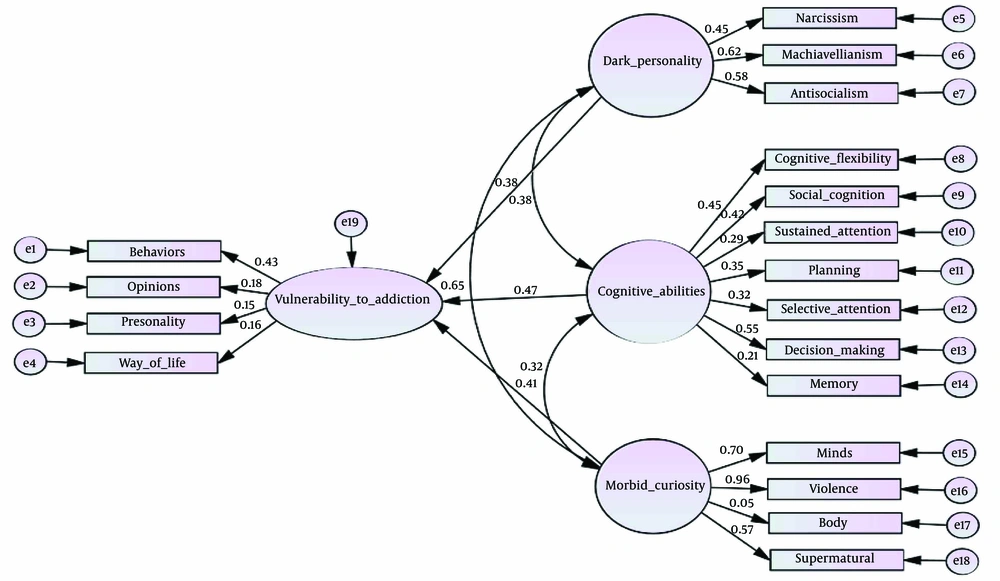
Figure 1.
The model is drawn in AMOS software
In the final section of the findings, the path coefficients and significance of the relationships between the variables are reported. The maximum likelihood method was used to calculate the path coefficients and determine the significance of these relationships. The results are presented in Table 4.
Table 4.
Path Coefficient and Significance of Relationships Between Variables
| Path | Non-standard Estimate | Standard Estimate | Standard Error | Critical Ratio | Significance Level |
|---|---|---|---|---|---|
| Dark personality traits → vulnerability to addiction | 0.19 | 0.37 | 0.09 | 2.06 | 0.039 |
| morbid curiosity → vulnerability to addiction | 0.09 | 0.31 | 0.04 | 2.02 | 0.043 |
| Cognitive abilities → vulnerability to addiction | 0.75 | 0.46 | 0.30 | 2.44 | 0.014 |
Table 4 shows significant structural relationships between dark personality traits and vulnerability to addiction (P = 0.039), as well as between morbid curiosity and vulnerability to addiction (P = 0.043), since both values are below the 0.05 threshold. The structural relationship between cognitive abilities and vulnerability to addiction, with a P-value of 0.14, is also significant. These findings support the research hypotheses. Additionally, multiple linear regression analysis reveals that dark personality traits, morbid curiosity, and cognitive abilities collectively explain only 14% of the variance in vulnerability to addiction.
5. Discussion
The study aimed to develop a structural model to examine the relationship between addiction vulnerability and dark personality traits, morbid curiosity, and cognitive abilities among students. The findings revealed that dark personality traits significantly influence addiction vulnerability, consistent with the research of Jauk and Dietrich (8), Yousefi and Teimoori (9), and Sadri Damirchi et al. (10). This result is also in line with the hierarchical taxonomy of psychopathology (HiTOP), which positions narcissism and antisociality on the externalizing spectrum of mental disorders, adjacent to substance use disorders. The HiTOP model suggests that narcissistic and antisocial traits elevate addiction vulnerability through externalizing behaviors—hostile behaviors linked to narcissism and disinhibited behaviors related to antisocial traits. It further indicates that antisocial traits are more strongly associated with substance use than narcissistic traits due to their relationship with impulsivity and disinhibition (27). Additionally, individuals with dark personality traits, characterized by emotional instability and low empathy, may experience psychological insecurity, driven by a constant need for admiration, distrust of others, and interpersonal conflicts (28). This insecurity can make them more susceptible to substance use disorders, as they may turn to substances as a coping mechanism to manage emotional distress and unmet psychological needs (29).
The second key finding of the study was the significant structural relationship between morbid curiosity and vulnerability to addiction. This finding is novel and lacks direct precedence in the existing literature, though it aligns with the research of Asadi and Porzor (30), while contrasting with Racz's findings (31). This relationship can be understood through the identity formation process during adolescence and early adulthood, where increased risk-taking behaviors and curiosity often manifest in unhealthy activities, such as smoking or drug use (32). According to the optimal level of arousal theory, individuals who seek excitement and novelty may turn to substance use to meet their need for stimulation. The desire for novelty and escape from monotony, particularly in sensation-seeking individuals, can contribute significantly to substance abuse (33). Additionally, the link between morbid curiosity and addiction vulnerability can be explained by an individual's inherent drive to resolve uncertainty, even if negative outcomes are expected (34). This drive can lead individuals to explore ambiguous or dangerous phenomena, such as accidents or drugs, thus heightening their curiosity and making them more vulnerable to addiction.
The third key finding of the research revealed a significant structural relationship between cognitive abilities and vulnerability to addiction, aligning with the studies by Mosalman et al. (17) and Gould (35). One explanation for this relationship is that individuals with poor cognitive abilities tend to exhibit higher impulsivity, which cognitive neuroscience links to disruptions in cognitive inhibition within brain regions responsible for regulating behavior (36). This impulsivity is a known factor contributing to addiction (37). Furthermore, deficiencies in learning and working memory also increase vulnerability to addiction (38, 39). A working memory deficit prior to drug exposure is considered a factor that heightens susceptibility to addiction. This is particularly evident in individuals with psychiatric disorders such as depression and schizophrenia, who often exhibit significant learning and memory deficits and have higher rates of stimulant addiction (34). Another study found that adolescents with impaired working memory are more prone to drug addiction (40). Acute drug use, such as nicotine and cocaine, has been shown to increase hippocampal activity (41), suggesting that individuals may turn to psychostimulants as a way to compensate for memory deficits (37). Moreover, lower cognitive abilities can reduce health literacy and promote unhealthy lifestyles, making individuals more emotionally vulnerable to addiction (42).
5.1. Conclusions
This research demonstrated a significant structural relationship between dark personality traits, morbid curiosity, and cognitive abilities in predicting vulnerability to addiction. However, as the study was conducted solely on students from Zanjan University, caution is advised in generalizing the findings to other populations. Given Iran's cultural and ethnic diversity, it is recommended that further research be carried out in different cultural contexts to gain a more comprehensive understanding of addiction vulnerability. Additionally, investigating addiction vulnerability in other social groups beyond students would provide valuable insights into the broader societal factors influencing addiction.