1. Background
In Iran, the most common mode of HIV transmission among male intravenous drug users is sharing injection needles and syringes (1). However, because of the large group of young adults and low average age of HIV/AIDS patients, this mode has been shifting to sexual contacts (2). The prevalence rate of HIV/AIDS in the overall population is below 1%, but it has surpassed 5% in some high-risk groups, such as IDUs (3, 4). Substance-using women who exchange sex for money, drugs, or shelter are at risk for many health problems arising from non-sterile injecting practices, direct drug effects, and lifestyle factors associated with drug dependence (1, 2). They are potential carriers of HIV, and they can transmit HIV to clients and, indirectly, to the general population (5).
Harm reduction initiatives, as a way of reducing the burden of this problem (6), are a set of policies and programs which attempt primarily to reduce the adverse health, social, and economic consequences of substances to drug users, their families, and communities (7). Harm reduction strategies have been successful in reducing the spread of infectious diseases among people who use drugs by injection. This success has led to attempts to broaden the application of harm reduction to other public health issues. They now commonly involve working with highly marginalized and stigmatized groups (8).
Results from different countries have shown the benefits of harm reduction policies on the prevention of sexually transmitted diseases as well as social and economic benefits of the programs. For this reason, serious political support for harm reduction program measures is provided in many countries (9). Despite the evidence, however, efforts to implement harm reduction strategies have met some challenges. A study in Russia reported major challenges in service provision for drug users, including lack of resources, rehabilitation programs, and social support (10). Another study of service providers in Canada identified potential barriers to implementing harm reduction strategies, including lack of staff and funding, as well as anticipated staff resistance (11).
In 2003, the government of Iran announced a harm reduction approach, and drop-in centers were established in high-risk settings (6). Very limited research has explored the challenges and successes of harm reduction policies in Iran. For this reason, we were specifically interested in examining these issues, and this study was conducted to determine and evaluate the views of service providers and experts in the field of harm reduction services in order to provide a picture of the current situation, challenges, and successes of harm reduction programs.
2. Objectives
The specific objective of this study was to evaluate what are the challenges and successes associated with HIV/AIDS services delivery provided by drop-in centers.
3. Patients and Methods
3.1. Study Setting and Participants
Data was drawn from 20 in-person, semi-structured interviews conducted with purposively sampled sub-national service providers, service managers, regional government decision-makers in the HIV/AIDS-related field, and outreach groups from three DICs in Shiraz in 2014. Recommendations for interviewed participants were obtained from the public health department in order to include service providers who were relatively well-informed. All interviews were conducted in consultation rooms on service provider premises or in offices to maintain anonymity and confidentiality.
3.2. Data Collection
Before the interview, informed consent was obtained. The interviews lasted approximately 60 - 100 minutes and continued until data saturation. All interviews were digitally audio-recorded and were executed according to specific guidelines. The interview guide targeted the following domains: (1) identify the project’s successes and achievements, (2) identify challenges or barriers experienced, (3) identify the difficulties of implementing the harm reduction program, and (4) identify suggestions for better management and delivery of services, provision options for future developments, and sustainable expansion.
3.3. Data Analysis
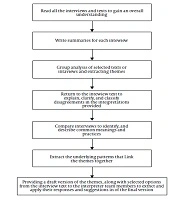
The digitally-recorded interviews were transcribed. To reduce bias and enhance the internal validity of the synthesis, an investigator triangulation approach was adopted, and a research team member contributed in phases of analysis and interpretation of data. A content analysis approach was used to analyze the data. The five-stage process of qualitative data analysis was done: understanding (familiarization), identifying a thematic framework (thematic), coding (indexing), charting, and mapping, and interpretation do will. A first draft of the code list and common themes was developed based on the interview guidelines and content of interview transcripts. The code lists were revised throughout the analysis process.
4. Results
Based on framework analysis, three sub-themes, including 1) policies, performance, and acceptance, 2) human resources, and 3) barriers to services delivery were revealed in terms of challenges, and three main sub-themes, including 1) quality of health services, 2) peer groups, and 3) promotion of cross-section and intra-section coordination in terms of successes were classified.
4.1. Challenges
Policies, performance, and acceptance. According to interviewees, welfare organizations and the University of Medical Sciences are responsible for running the harm reduction programs. Full faith is required for continuous service delivery, which should be supported by various organizations and continuous communication between the executive authorities of policy and other organizations including the governor, mayor, law enforcement, and Ministry of Education.
Harm reduction is commonly misunderstood and misperceived as encouraging or condoning substance use. This lack of policy clarity about harm reduction was viewed as a serious hindrance for those involved in service delivery. A major concern for most respondents was the lack of policy clarity and transparency in political positions regarding harm reduction services. They stated that, despite the formation of the Governor's Task Force, there are contradictions and conflicts between policy and practice.
“County officials do not understand the extent of the issue, and the concept of harm reduction is still not fully understood. I think the responsibility should be given to individuals who are the subject of intense belief.” (p. 3)
Almost all interviewees believed that, along with the change in law enforcement officials, the policies have changed. The new officials’ individual interests and goals play an important role in policies and their performance, as well as the acceptance of HIV and sexually transmitted diseases as behavior diseases. Some service providers explained difficulties in implementing harm reduction interventions due to police arresting substance-using women and disrupting delivery of services. This punitive approach can have a negative impact on IDUs, as they fear coming to drop-in centers, and the program falls into a state of impairment.
According to some respondents, the responsibility of running the harm reduction program was given to the NGOs. As a result, coordination between the university and welfare organizations encountered some problems, and there is no cohesive team composed of two main trustees of drop-in centers. Despite having the same harm reduction goals, preferences and priorities of the two organizations are different.
According to interviewees, collaboration by the Ministry of Education has improved, but there are still shortcomings based on cultural issues. Perhaps one of the greatest challenges to implementing harm reduction is community resistance.
4.1.1. Human Resources
Program managers stated that a shortage of trained supervisory staff and lack of time for consulting and delivery of care were the main challenges to successful implementation of harm reduction policies. They stated that they need ongoing training, especially in psychological counseling, health education intervention, and new education and communication materials.
4.2. Barriers to Service Delivery and Accessibility
According to experts, establishment of drop-in centers was based on field studies and needs assessment studies where the geographic concentration of potential service users is higher. However, province officials assume that these centers have caused an increase in the rate of addiction and high-risk sexual behaviors. They believe that their establishment in the central metropolitan area and some historical sites damages the cultural context of the city, and therefore they prefer to close these centers.
Currently, despite intensive efforts, they failed to convince mass media to exploit the high-risk behaviors in the community. They believe that public media has many diverse audiences, and the use of mass media and condom social marketing would be effective in increasing condom sales and distribution. This could significantly promote the level of people’s knowledge and, therefore, could help reduce the increasing rate of sexually transmitted diseases in the community.
“Mass media has a large proportion of the national budget, and most people follow its programs. Therefore, it has certainly an important role in the education of people.” (p. 3)
A serious concern of the interviewees was financing of services and sustainability. They stated that some grant-makers, such as Health Donors Assembly, lack the willingness to help drop-in centers, because sex outside of marriage is held in wide disapproval, based on its lack of cultural and legal acceptance in Iran. They prefer to give their financial resources to building schools, new medical facilities, and education. Another important constraint mentioned by interviewees was referral. In terms of referral, fortunately, all care services are provided free for HIV-infected people by the Deputy of care of university, but for other individuals, these services are not free.
“We support MMT programs as possible as we can, but drop of some sex workers because of high costs of some service is inevitable.” (p. 9)
Service provision for curative care for STIs is limited. For some expensive services, such as STI services and related diagnostic services, it is necessary to refer them to secondary and tertiary-level health facilities. Some clients are not covered by health insurance, and for those who are, the medical services package does not provide a comprehensive set of curative services.
Interviewees believed that these services must be accompanied by education and counseling because, in addition to having sexually transmitted diseases and infections, individuals also suffer from mental health problems. In fact, addiction is just one of the problems these people face. Social support for these people is a more controversial issue that tends to be ignored.
“Studies show that 80% to 90% of women are turning to be sex workers due to economic problems. To deal with these problems, it is necessary that proper planning is done in the field of entrepreneurship and job skills training.” (p. 3)
4.3. Achievements
4.3.1. The Quality of Health Service
Almost all respondents emphasized that the provision of free healthcare services was valued and helped improve clinical service-seeking and increase clinic attendance. These services help clients build self-confidence, cope with their financial and physical needs, overcome depression, and create social networks for people who are marginalized. These centers encourage personal empowerment and skill building in order to help people confront their problems and eliminate their sense of isolation. The harm reduction program is assumed to have made a considerable impact on drug use and HIV infection among drug users.
4.3.2. Peer Groups
Program managers expressed that one of the main features of peer groups is to develop trusting relationships between personnel and vulnerable women. The majority of women in peer groups have similar backgrounds and experiences, which also helps them to support one another.
“I was an addict and sex worker before, but now I have more self-confidence and work in a drop-in center. This job makes me happy. It is because of these centers that I have a good position right now.” (p. 16)
4.3.3. Promotion of Cross-Section and Intra-Section Relationship and Coordination
As mentioned by participants, drop-in centers’ services are substantially supportive, so optimal functioning of health services delivery requires solidarity and coordination between other social and military organizations with these centers. The decisions and performance of these organizations have substantial impact on the outcomes of drop-in centers. The disease management center of the ministry of health (DMCMH), University of Medical Sciences, and international organizations have greatly supported the implementation of the harm reduction policy. They also acknowledged that lack of insurance was one of the barriers to health service delivery for vulnerable women. Therefore, supportive organizations, such as the relief committee and health insurance organization, have a substantial role in supporting these people.
In relation to the educational system, key informants reported that the change in their response toward harm reduction is noteworthy. Sustained efforts and cooperation with universities (e.g., sharing equipment and facilities) has resulted in an increasing interest in the harm reduction policy and support of these programs.
Finally, Holding Task Group in the Governor and reporting to the political deputy are some activities that facilitate coordination between policy-makers and harm reduction service providers.
Interviewees commonly held clear views on the need for advocacy by religious leaders to promote and sustain harm reduction programs. They also said that the presence of clergy and head prayer (Imam Gomee) in a task group meeting provides them with sufficient knowledge about the content and context of the drop-in center. As a result, clergy are more likely to cooperate in promoting and supporting the activities of these centers.
Telecommunications companies have taken on the task of advertising and printing of slogans, health messages, and symbols relating to the harm reduction program in phone bills. These companies are also trying to establish telephone hotlines at universities to provide prevention counseling.
5. Discussion
Iranian harm reduction policy-makers adopted a gradual policy shift from a supply-reduction policy to a revised policy allowing for drug abuse treatment (12). In order to expand the domains of this policy, drop-in centers have been established to strengthen harm reduction programs, particularly for vulnerable women (5, 13).
Close cooperation of non-governmental organizations and civil society with governmental support play an important role in advocacy and the implementation of successful programs (14, 15). The harm reduction concept is accepted, and commitment to these policies is increasing (16). However, there are challenges in running and organizing such programs. Findings suggest the need to provide even more support, and still a change in attitude toward harm reduction is needed to increase the success of the programs. There is a conflict between law enforcement policy cleaning up the streets with the implementation of harm reduction programs. In addition, there is policy commitment among high-level officials at the ministry of health to create the kind of supportive political environment that is not seen at lower levels (17).
Although coordination between different national policy-makers of harm reduction programs is better than in previous years, it still has shortcomings. There is no clear approach among organizations to how to collaborate; thus, establishing an effective coordination mechanism and facilitating concerted effort appears to be necessary (6).The integrity of all the influential people stockholders and local police to encourage women to accept harm reduction program, is effective (18). A study in San Francisco found that the most important challenges of DICs in dealing with homeless women involved effective communication with policy-makers (19). The lack of financial resources, a comprehensive package of harm reduction interventions, health insurance coverage, and weak monitoring have also been identified as challenges (16, 19). Harm reduction is under-funded in recent years, and delivery of some services has been suspended due to funding constraints. Furthermore, limited hours of service delivery by centers caused restrictions on stability and continuity of services (14). Moreover, lack of skilled health workers and technical capacities represents a significant gap facing harm reduction centers (16). Findings suggest the need to provide more support for the service providers, specifically in terms of ongoing training in psychological counseling and health education intervention, as well as support for the salaries of providers.
The results emphasize that, despite providing education and prevention measures, there is no guarantee that people will cease high-risk behavior. In a study in Bangladesh, service providers suggested that the stability and continuity of clients’ behavioral changes is a major concern. They stated that training even five year plans for women preparing for continued treatment is inadequate (18). According to service providers, training and support from the community must be continuous (17).
Despite conflict with the social and Islamic values of Iranian society with drug use and prostitution (20), because Islam emphasizes promotion of health and prevention of risky behaviors, religious leaders, clergymen, and teachers play an important role in health education (21). Further expansion of harm reduction programs requires solidarity between related organizations, more coordination between welfare organizations and the University of Medical Sciences, avoidance of personal tastes, and better acceptance of such programs at high levels of decision making. It is recommended that enforcement of the decisions of the County Task Group and other relevant organizations be in line with accepted policies and that every organization fully comply with written policies while avoiding interference with other organizations. Consistent with the results of the present study, to understand the depth of the tragedy of the AIDS epidemic and the role of vulnerable women in the disease’s transmission, encouragement of empathy toward those affected, creation of shared understanding of the structural barriers of prevention programs, and holding sensitization workshops for high-ranking governmental officials and police are necessary (22).
5.1. Conclusion
It appears that the essential components for scaling up harm reduction programs include coordination between different institutions to implement harm reduction policies and understanding of the multifactorial nature of addiction and high-risk sexual behaviors. In truth, universities and welfare organizations cannot bear the load of the program alone. Thus, the cooperation of other organizations in terms of financing and providing space and other facilities is vital. In conclusion, overcoming these challenges means that policy-makers, health administrators, welfare organizations, the education ministry, and volunteer organizations must address the urgent need to attract donors and to recognize and respond to the needs of the service users. The collaboration of organizations such as the Islamic Republic of Iran Broadcasting, which carries great influence, will be most effective in directing aid to the harm reduction centers and enhancing public acceptance of these centers.
5.2. Limitations
We conducted interviews in Shiraz; thus, the samples are not representative of all provinces in Iran, and the data do not permit us to make complete comparisons across provinces about service providers’ perspectives concerning service delivery.
Some interviewers declared that they had previous drug use experience and were also providers of harm reduction services. In these cases, the interviewers’ multiple roles (interviewer, service provider, and possibly a previous peer user) could have influenced the nature of the interview and the information provided. Nonetheless, interview participants appeared to respond with honesty, even when, for example, complaining about some aspect of service delivery.
Table 1.
Educational Level of Participants in the Study
| Sector | Educational Level | Number of Participants |
|---|---|---|
| Health deputy of Shiraz University of Medical Sciences | ||
| 1. Department of communicable diseases | Social Medicine | 1 |
| 2. Department of communicable diseases | Physician | 4 |
| 3. Department of communicable diseases | Staff | 3 |
| Shiraz Counseling Center of Behavioral Diseases | Physician and staff | 2 |
| Outreach and peer groups | High school or secondary school | 10 |