
1. Background
Today, the Internet has become an essential part of daily life for many people especially college students for both academic and entertaining purposes (1). Mental health experts agree that the Internet has provided valuable services to people looking for support groups, treatment options, and other usages. Web sites, newsgroups, and E-mail lists all are powerful resources for people to find the information and help they need (2). Internet addiction or pathological Internet use, is defined as the inability to control a person’s usage of the Internet, which eventually causes psychological, social, school and/or work difficulties in a person’s life (3, 4). Based on the results of recent studies, the prevalence of this disorder varied between 8% and 13% among undergraduate students (1). The prevalence of this disorder was estimated to be 10.8%, according to the results of our recent study in Arak, Iran, with moderate and severe prevalence equaling 8% and 2.8%, respectively (5). It is believed that the diagnosis of Internet addiction disorder (IAD) is conceptually an irrational-impulsive variety of disorders. This disorder involves online and offline computer usage which is diagnosable with at least three types of behaviors including extreme games, sexual preoccupations, and E-mail/text messaging (6). Thus, patients with IAD excessively use the Internet, which is often related to the waste of time and neglect of basic jobs and feeling of anger, anxiety and depression when the computer is inaccessible (7-10). Moreover, these patients consequently attempt to buy better computer equipment and more software, while they try to increase their time spent on the computer (2, 6). Although, personality and environment are related to addiction behaviors yet according to a meta-analysis, the effect of environmental causes is more than individual factors in addiction (0.61 vs. 0.45) (11). Reliability and validity are key concepts in measurement processes. Reliability refers to the stability of a test measure or protocol (12-16) and validity means the scale or instrument measures truly what it has planned to measure (16). In other words, reliability is the extent to which the test yields consistent results, and it is a major concern when a psychological test is used to measure some attribute or behavior (14, 17). The Yang Internet Addiction Test (YIAT) is a reliable and standard questionnaire for measuring Internet addiction, which was developed in 1998 by Kimberly Young. It has 20 items in a five point Likert scale (18, 19). This instrument is accepted as a valid and reliable questionnaire in English speaking countries (18). Although, according to some studies on the Iranian society, the reliability of YIAT has been reported appropriate (5, 20-23) but, it has not been validated by a methodological approach in Persian societies.
2. Objectives
We designed and conducted the current study to develop the Persian version of the YIAT for the Iranian society. Since assessments of Internet addiction disorder are common in student groups, the current study was conducted at Qom University of Medical Sciences in Iran.
3. Patients and Methods
A cross sectional study was carried out on 254 students of Qom University of Medical Sciences to validate the Persian version of YIAT. A pilot study was conducted on 28 students and after 3 weeks the study was repeated to test the reliability of the questionnaire for reliability assessment. After approving the reliability and face validity, the second phase of the study was conducted on 254 students to assess construct validity. Sampling was done in two stages by the proportional stratified sampling method for the first stage with the education level as the strata. In the second stage, each student in the strata was selected by the simple random sampling method. Being in the third or higher educational term was the inclusion criterion and the students without the inclusion criterion were excluded from the study. Construct validity including face and content validity were conducted. For face validity, backward and forward translation of the original questionnaire was conducted by the expert’s opinions. First, the original English questionnaire was translated into Persian by two independent experts and then compared with two Persian translations. Translators were sometimes consulted with, to determine the best and most agreed upon Persian sentences in the questionnaire. In the second step, which was reverse translation, this Persian version was translated into English by another expert who did not see the original text of the questionnaire. Therefore, comparison of the translated English questionnaire with the original version was conducted to assess the conceptual sameness of the questionnaire. In the third step, the translated questionnaire in the second step was turned to the Persian language and the final Persian version of the questionnaire was prepared after consulting with expert translators and the research team. Then, face validity was conducted after consulting with 11 medical students for detection of ambiguous or unclear items, avoiding special words and using simple and understandable phrases. Moreover, quantitative assessment for face validity was conducted with the importance score index. A five-point Likert scale, ranging from the most important (score 5) to least important (score 1), was considered for each of the 20 items of the questionnaire and distributed among the target population. The following formula was used for the calculation of importance score of each item (Equation 1).
In the above formula, f is the frequency of repetition.
Content validity was assessed by 10 experts in health education, psychology, biostatistics and epidemiology and their comments were used to improve content validity. In addition to the interviews with the experts, for assessment of the use of appropriate words, application of grammatical notes and items importance, the content validity ratio (CVR) and content validity index (CVI) were calculated for each item. In calculating CVR, (15, 24, 25) 10 independent raters valued each item as not necessary, useful and essential. The CVR was calculated by the following formula:
In this formula N is the total number of raters and ne is the number of raters who rated the item as necessary (25, 26).
In calculation of CVI, 10 raters valued each item of the questionnaire regarding three criteria, including specificity, simplicity, and celerity of items. Scoring was conducted in a four point Likert scale from 1; Irrelevant, 2; somewhat important, 3; quite important and 4; extremely important (15, 24-27).
Explanatory factor analysis was used for assessment of construct validity. Principle component analysis (PCA) method with varimax rotation was used for explanatory factor analysis (25, 28-31), to create factors with separate variables, which are more related to each other (29, 32, 33). Also, convergent validity and discriminant validity were assessed by Pearson’s correlation coefficient (27, 29). Kaiser Meyer Olkin (KMO) index for adequacy of sampling, Kronuit Bartlett index, scree plot, PCA and varimax rotation were used in explanatory factor analysis. The eigenvalue for protecting each items in extracted factors of factor analysis considered as 1. Criterion validity including convergent and discrimination validity calculated by Pearson’s correlation coefficient. Convergent validity was measured by high correlation of items of each factor, and discriminant validity was shown by low correlation of each item with items of other factors (34). Interclass correlation coefficient (ICC) and consistency tests were used for testing of the reliability of the questionnaire. The ICC was measured by Cronbach’s alpha and the consistency of the instrument was evaluated by the test retest method and Pearson’s correlation coefficient test. The time interval between test and retest was three weeks according to literature suggestions (35-37). In the pilot study the questionnaires were distributed among 30 medical students and after three weeks this was repeated yet during the second time only 28 of the students were present and answered the questionnaires. In reliability analysis, the Kappa coefficient was calculated for each item as well as marginal homogeneity test, a modified version of McNemar. The used questionnaire was YIAT that was developed in 1998 by Kimberly Young. It has 20 items in a five-point Likert scale (18, 19) varying from rarely; 1, occasionally; 2, frequently; 3, often; 4, and always; 5. The participants should select one of the alternatives in each item based on the concordance to self-status. Total scores of each item were summed and a higher score for the scale showed a greater level of Internet addiction. The scores varied between 20 and 100 (18, 19, 38). The participants’ scores were categorized in three groups from 20 to 39 as online users with complete control on usage, 40 to 69 as users with frequent problems due to Internet usage, and 70 to 100 as sever addiction where Internet is causing significant problems (18, 19, 38). Informed consent was taken from all studied subjects and the study protocol was approved by the ethical committee of Qom University of Medical Sciences. The SPSS statistical software was used for data analysis and significance level of P values was set at 0.05.
4. Results
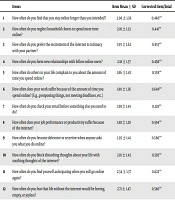
In the pilot study, the Kappa coefficient in pretest and posttest on 28 medical students was 0.654. In addition, the Kappa coefficient was calculated for all 20 items and showed that the correlation coefficient for all items varied between 0.45 and 0.96. In addition, the marginal homogeneity test showed that the significance value for all items was more than 0.05. Also, the estimated Cronbach’s alpha in the pilot study was 0.936 (CI 95%; 0.914 - 0.948) yet the Cronbach’s alpha in the final study was calculated as 0.917 (CI 95%; 0.901 - 0.931). Table 1 shows the value of reliability and correlation between items for the final study. Face validity was measured by item importance index and this index showed that all items have an importance index higher than 1.5. These measurements showed that all items are important for the target group. Furthermore, CVI and CVR were used for content validity assessment. The CVR and CVI index for all items were higher than 0.8 and the average of scale-level content validity index (S-CVI/Ave) and CVR was calculated as 0.89 and 0.92, respectively (Table 2). Construct validity was conducted by explanatory factor analysis. Kaiser Meyer Olkin measure was used for sampling adequacy and Bartlett’s test (BT) of sphericity was used to show the appropriateness of using factor analysis. Principle components analysis, scree plot, and varimax rotation were used in factor analysis. The determinant value was 0.00044 and the Chi square of BT was 2463 (P < 0.001) and KMO was 0.927. All these measures showed that principle component analysis is acceptable for data. Factor analysis extracted three components with an eigenvalue of higher than one (Table 2). More than 55.8% of total variances were explained with the three components. The first component (including 11 items) explained 42.7%. The second (including 6 items) and third component (including 3 items) explained 6.9% and 6.5%, respectively. Figure 1 shows that only three of the first components are the most important factors of the questionnaire. According to varimax rotation the items 5, 6, 8, 9, 10, 14, 15, 17 and 20 were located in the first factor. Second factors included 4, 7, 11, 12 and 13 items. The items 1, 2 and 3 described the third factor. The first to third factors defined personal activities disorder (PAD), emotional and mood disorder (EMD) and social activities disorder (SAD), respectively. The ICC for each factor was calculated and showed that all three factors are reliable. The ICC for different factors of Persian version of Young questionnaire including PAD, EMD and for SAD was r = 0.884; CI95%; 0.861 - 0.904, r = 0.766; CI95%; 0.718-0.808 and r = 0.745; CI95%; 0.686 - 0.795, respectively. Also, Pearson’s correlation coefficient used for construct validity and showed that there was high convergent validity among the items in each factor, and good discriminant validity among items of different factors.
Table 1.
Reliability Analysis by Cronbach’s Alpha Test in Young’s Internet Addiction Test
| Scale Mean if Item Deleted | Scale Variance if Item Deleted | Corrected Item-Total Correlation | Squared Multiple Correlation | Cronbach’s Alpha if Item Deleted | Before and After Correlation | |
|---|---|---|---|---|---|---|
| i1 | 32.09 | 144.007 | 0.433 | 0.372 | 0.916 | 0.54 |
| i2 | 32.69 | 141.134 | 0.592 | 0.489 | 0.913 | 0.65 |
| i3 | 33.25 | 141.879 | 0.669 | 0.550 | 0.911 | 0.69 |
| i4 | 33.26 | 142.982 | 0.550 | 0.370 | 0.913 | 0.81 |
| i5 | 33.33 | 139.259 | 0.726 | 0.600 | 0.910 | 0.91 |
| i6 | 33.34 | 141.079 | 0.660 | 0.693 | 0.911 | 0.83 |
| i7 | 32.71 | 144.277 | 0.375 | 0.249 | 0.919 | 0.48 |
| i8 | 33.50 | 145.342 | 0.594 | 0.659 | 0.913 | 0.68 |
| i9 | 33.31 | 143.455 | 0.579 | 0.452 | 0.913 | 0.96 |
| i10 | 32.98 | 139.201 | 0.386 | 0.208 | 0.922 | 0.58 |
| i11 | 32.20 | 143.582 | 0.410 | 0.310 | 0.917 | 0.48 |
| i12 | 33.08 | 140.270 | 0.591 | 0.456 | 0.913 | 0.57 |
| i13 | 33.01 | 140.063 | 0.669 | 0.553 | 0.911 | 0.60 |
| i14 | 33.36 | 139.497 | 0.719 | 0.584 | 0.910 | 0.73 |
| i15 | 33.33 | 142.042 | 0.660 | 0.528 | 0.911 | 0.62 |
| i16 | 33.04 | 139.176 | 0.672 | 0.581 | 0.911 | 0.59 |
| i17 | 33.27 | 141.606 | 0.634 | 0.504 | 0.912 | 0.55 |
| i18 | 33.41 | 141.626 | 0.668 | 0.552 | 0.911 | 0.64 |
| i19 | 33.37 | 142.367 | 0.629 | 0.493 | 0.912 | 0.68 |
| i20 | 33.48 | 142.686 | 0.657 | 0.569 | 0.912 | 0.50 |
| Average | 0.917 | 0.654 |
Table 2.
Variances and Varimax Rotation of Extracted Factors of Young’s Internet Addiction Questionnaire by Factor Analysisa
| Items of Questionnaire | Rotated Component Matrix | CVR | CVI | ||
|---|---|---|---|---|---|
| Component | |||||
| 1 | 2 | 3 | |||
| Q 1 | 0.755 | 1.0 | 1 | ||
| Q 2 | 0.724 | 1.0 | 0.8 | ||
| Q 3 | 0.564 | 0.8 | 0.8 | ||
| Q 4 | 0.429 | 0.8 | 0.89 | ||
| Q 7 | 0.502 | 0.8 | 1 | ||
| Q 11 | 0.724 | 1.0 | 0.8 | ||
| Q 12 | 0.622 | 1.0 | 1 | ||
| Q 13 | 0.650 | 1.0 | 1 | ||
| Q 16 | 0.465 | 0.8 | 0.8 | ||
| Q 5 | 0.525 | 0.8 | 0.8 | ||
| Q 6 | 0.617 | 1.0 | 1 | ||
| Q 8 | 0.668 | 1.0 | 0.8 | ||
| Q 9 | 0.660 | 1.0 | 1 | ||
| Q 10 | 0.546 | 0.8 | 0.8 | ||
| Q 14 | 0.615 | 0.8 | 0.8 | ||
| Q 15 | 0.634 | 1.0 | 1 | ||
| Q 17 | 0.617 | 1.0 | 0.8 | ||
| Q 18 | 0.700 | 1.0 | 1 | ||
| Q 19 | 0.554 | 0.8 | 0.8 | ||
| Q 20 | 0.685 | 1.0 | 1 | ||
| Total Eigenvalues | 8.539 | 1.318 | 1.302 | ||
| Percentage Variance | 42.695 | 6.589 | 6.510 | ||
| Cumulative Percentage Variance | 42.695 | 49.284 | 55.794 | ||
| Mean of Content Validity | 0.92 | 0.89 | |||
a Abbreviations: CVI, correlation matrix and factor analysis; CVR, content validity index.
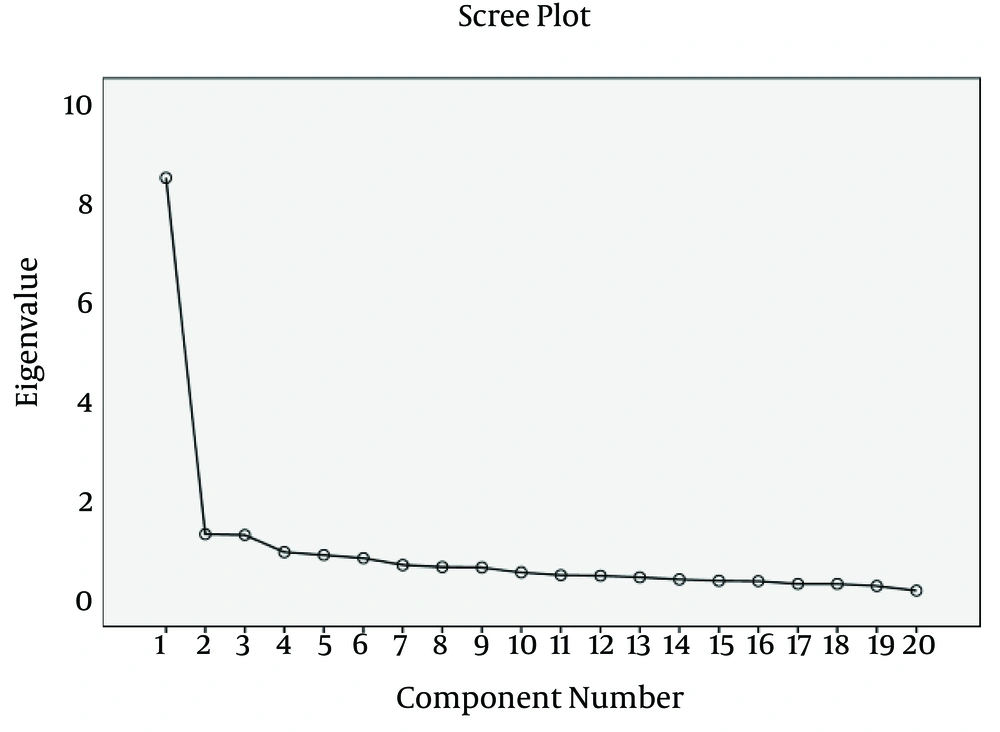
Figure 1.
The Scree Plot of Young’s Internet Addiction Questionnaire by Factor Analysis
5. Discussion
Based on the methodological approach for assessing the reliability and validity, the current study showed that the Persian language version of YIAT is usable in Iran. The reliability of the instrument was very good in the pilot study as well as the final study. Moreover the reliability and validity of the three extracted factors from the Persian version of YIAT were evaluated as acceptable. In another study by Kheirkhah et al. (4), the construct validity of Young Internet Addiction test was evaluated by Pearson’s correlation coefficient. Also, internal consistency was evaluated with Cronbach’s alpha. In that study reliability and validity of IAT was assessed as good. The CVI index for each item was higher than 0.8 and the average of scale-level content validity index (S-CVI/Ave) was calculated as 0.89. This was higher than the Lawshe table for ten raters (0.62) (16, 25). Therefore, all 20 items are essential in the scale at significance level of 0.05. This index was higher than 0.79, the critical value for revision or removing items (24, 30). The validity indexes reported by other studies also confirmed our results (4, 23, 39, 40). In Alavi’s study, the convergent validity was calculated as 0.5 (12). However, the content validity was not reported by other studies using CVI or CVR indexes. The validity of Persian version of YIAT was excellent and calculated more than 0.9 in both pilot and final study. In addition, the test retest and Kappa coefficient showed that the YIAT has enough stability. According to the literature an ICC of over 0.8 is good for consistency (37). Other studies showed that the reliability of YIAT is good (1, 3, 23, 40). In the study by Johansson and Götestam the split-half reliability was 0.729 and 0.713 by Cronbach’s alpha (41). Also this was calculated as 0.722 in Cao and Su’s (3) study. The KMO index in our study was 0.927 and showed the adequacy of sampling and appropriateness of factor analysis of data. In another study the KMO index was reported as 0.85 (23). Also, the correlation matrix in factor analysis showed the adequacy of sampling. It is recommended that the KMO measure should be over 0.5, while over 0.9 is excellent (29, 36, 42-44). Also, based on the literatures the minimum sample size for factor analysis should be greater than 100 (29, 45). Another study suggested that at least 5 to 10 samples are needed per item of scale (26, 36). According to these studies, it can be assumed that the sample size of the current study was adequate. The explanatory factor analysis in our study extracted three different dimensions from YIAT, which are helpful for researchers to conduct the Internet addiction disorder assessment with more details. According to the explanatory factor analysis, it is applicable for the scores of consequences of Internet addiction in PAD, EMD and SAD domains to be calculated and compared among subgroups. These three factors explained 55.8% of total variance but in Alavi’s study 56% of variance was described by the five extracted factors (23). Also, it is helpful to find the most important effect of Internet addiction on studied subjects’ activities or behaviors. The explanatory factor analysis has shown different results and factors in different studies (1, 23, 39, 40). In Chang et al.’s study on students from Hong Kong, three different dimensions were extracted by explanatory factor analysis including, “withdrawal and social problems”, “time management and performance” and “reality substitute” (39). These three factors explained nearly 55% of the total of variances and in that research two items were removed from the questionnaire due to the cross-loadings on factor two (39). However, in another study by Khazaal et al. on French people, only one factor was extracted from the explanatory factor analysis. They approved the French version of YIAT (40). In another study (23), five different factors were extracted from principle component analysis. The content and convergent validity, internal consistency and test–retest reliability were acceptable. However, the factor analysis fitted the data of the current study well yet there was no golden standard to diagnose Internet addicted students from normal ones. Although, based on Young’s suggestions, subjects with a score of 40 and higher are affected by Internet addiction yet we cannot determine a cut off point score as a threshold for screening. Therefore, it is suggested for future studies to apply this scale along other tests for detecting Internet behaviors. The psychometric properties of the Persian modified version of YIAT are acceptable and usable as a reliable and valid scale for detecting Internet-related abuse behaviors. This modified scale can predict Internet addiction and three different dimensions about the consequences of this social disorder. Moreover, the reliability and validity of the three extracted factors of YIAT were evaluated and are acceptable.