1. Background
Drug abuse is a lifestyle disease and a chronic and enduring phenomenon, which is among the important challenging and costly health problems, leading to physical, mental and psychiatric outcomes in persons, families and communities (1-4). In Iran, the drug abuse was reported as the third leading cause of disease burden for males in 2003 (5). According to the recent national survey of drug abuse, 1.2 million of addicts need treatment services in Iran (1). Opium and heroin were reported as the main drugs of abuse, respectively. However, in the recent years, drug abuse has accrued an important shift from opium use towards using heroin (1-6). The anti-narcotic laws have been approved to the extension of addiction treatment and reduction programs have been performed since 1997 by Iran. The most important program for reducing drug abuse was establishing methadone maintenance treatment (MMT) centers (7). Relapse following the beginning of drug abuse treatment is a common outcome (8). In addition, the treatment success rates of addicts in these centers were different. Previously, a survey showed a six-month retention rate of about 23% which often required overtime treatment (9, 10). In another study, Sadegiye indicated a relapse rate of about 80% at the first six-month treatment (11). Furthermore, researches in the last decade have revealed increase of drug usage in most countries (12, 13). It is believed that drug abuse is viewed as a chronic disorder; however, relapse is considered as the natural section of the recovery process, which is defined when subjects return to even a single usage of a drug, same as the condition prior to treatment (14). Some researches, related to methadone maintenance programs in treatment centers, showed that although treatment with methadone can be efficient for risk factors such as decreasing the crime-associated incidents, employment increase and the improvement of quality of life for addicts, many subjects continue drug abuse with concurrent use of methadone (12). Several factors are involved in the drug abuse relapse, which are determined by interaction of individual, environmental, and physiological factors (15). A period over 75% of all drug abuse relapses were found related to involve interpersonal struggle, lack of social and family support, socio-economic risk factors, negative psychological states, and some of demographic variables such as age and employment status (15-17). The spent time with others and unpleasant emotions were the most important causes of relapse in the study conducted by Shafiei et al. in Iran (18). In addition, the accruing of relapse increases in persons with insufficient job skills who are exposed to high-risk situations (15). The relationship between psychiatric disorders and drug abuse relapse after treatment may be bi-directional, prior to relapse, coping with persistent psychiatric symptomatology, and specially increase in the intensity of symptomatology can affect the risk of drug abuse relapse. Additionally, the relapse risk of drug abuse may differ by the types of psychiatric symptoms experienced. The relapse after treatment can influence the psychiatric symptomatology. The side-effects of drugs used by patients can change particular psychiatric symptoms (cocaine intoxication can increase irritability). Drug abuse relapse may also lead to environmental stressors, such as struggle with family and criminal acts, which may accelerate psychiatric symptoms (19, 20).
2. Objectives
Interpretation of relapse situations needs a prerequisite for the identifying persons with high-risk situations. In addition, the efficient treatment of addiction requires treatment planning, adequate knowledge for policy-making, and determination of characteristics and background variables regarding drug use by addicts to reduce addiction relapse. A few surveys are available on addicts to seek addiction relapse in treatment centers in Iran. Few researches have specifically focused on drug abuse using survival analysis method. Therefore, the present study investigated the relapse rates and patterns of drug abuse relapse and their determinant in addicts of treatment centers in Ilam city, Iran, using the survival analysis method.
3. Patients and Methods
This survey was a retrospective cohort design conducted in four addiction treatment centers in Ilam, Iran, in 2012. The target population comprised all self-referred addicts who had been treated in those centers. Sample size was calculated by Equation 1:
(Z1-α/2: level of significance 5%, P: prevalence of relapse in a previous study (9), D: absolute precision). Cluster sampling method was used for selecting the centers because all the addiction treatment centers get the same fees from their subjects, and partly, all the centers were similar in different aspects. In terms of the subjects cost, variation between the centers is small. The centers provided the same services based on the reports of the ministry of health in Iran (1). Therefore, four addiction treatment centers were selected among eight centers randomly; thus, all the addicts’ records in the four centers were considered from 2008 - 2012 and subjects with eligible criteria were entered to study. In total, 140 males were selected for this research. Relapse was defined as the subjects returned to even a single usage of a drug or more (14). The inclusion criteria were treatment with methadone for at least one month and accurate registration date of the treatment beginning. The data were collected by interview and referred to records with questions including demographic variables such as age, sex, marital status, job status and relevant information including addiction history in family, family size, drug abuse history, kind of drug, relapse status and time of treatment to relapse (per month). In addition, subjects were provided with a complete description of the study and written informed consents were obtained. This study was approved by the ethics committee of Ilam University of Medical Sciences. The gathered data from the subjects were analyzed using SPSS-21 software, through the life table, Kaplan-Meier analysis, log rank test, and Cox regression (conditional forward method), which are applicable statistics methods for analyzing studies conducted as follow-up time design. Moreover, we considered the base at the P value cut-off point of 0.25 (20) in the univariate analysis (log rank test); the variables with P value ≤ 0.25 were entered to multivariate analysis (Cox regression). The level of significance was considered 0.05.
4. Results
The mean and the standard deviation (SD) of variables of age, family size, addiction history and time of follow‑up were obtained as 31.03 ± 7.68 years, 5.01 ± 2.16 individuals, 9.47 ± 7.51 years and 17.18 ± 1.24 months, respectively. In addition, the relapse rate was 30.42% based on the total time. The subjects with relapse constituted 43.6% (61 subjects) of the study, while subjects without relapse in the time lag of survey constituted only 56.4% (79 subjects). Other characterizations of the participants’ survival times are shown in Table 1. According to Table 1, the log rank test analysis revealed that the time to relapse of the married subjects was more than the other groups. In addition, subjects who used opium had a higher time to relapse compared to subjects who used other types of drugs. Nevertheless, there was no significant difference in the time to relapse based on the variable of addiction in family. Other information are also shown in Table 1. Based on Table 2, the most relapses occurred within the first six months and it reduced in other intervals. In addition, cumulative survival index showed that in the first six months, about 83% of the subjects did not experience relapse to drug abuse, while this index was around 46% in the 24th month and was consistent in the next follow-up. The results of the Kaplan-Meier method showed that mean and SD of the time to relapse was 27.40 ± 1.63 months (CI 95%: 24.19 - 30.60) and the median of time to relapse was obtained 25 ± 2.25 months (CI 95%:22.5 - 27.5). The diagram of time to relapse (survival diagram) with the Kaplan-Meier method is shown in Figure 1. A Cox regressing model with conditional forward method was used to evaluate the association of all the significant variables with relapse to drug abuse. The final model is indicated in Table 3. The results of this analysis indicated that after adjusting the other factors, job status had the most association with relapse to drug abuse (OR = 2.46; CI 95%: 1.35 - 5.19). In addition, the variables including the education status (P = 0.10), addiction in family (P = 0.30) and addiction history (P = 0.15) were removed from the cox regression model.
Table 1.
Characterization of Participations and Their Survival Times
| Categorization | Values a | Survival Time Mean, mo | CI 95% | P Value b |
|---|---|---|---|---|
| Marital Status | 0.03 | |||
| Single | 65 (46.4) | 22.94 | 18.70 - 27.17 | |
| Married | 66 (47.1) | 31.23 | 26.81 - 35.65 | |
| Widow and divorced | 9 (6.4) | 15.11 | 9.27 - 20.94 | |
| Job Status | 0.01 | |||
| Employed | 67 (47.9) | 32.14 | 28.28 - 36.54 | |
| Unemployed | 70 (50) | 19.89 | 15.90 - 23.89 | |
| Retired | 3 (2.1) | 24 | 24 - 24 | |
| Education | 0.02 | |||
| Illiterate | 13 (9.3) | 27.41 | 20.42 - 34.40 | |
| Primary and middle school | 49 (35) | 19.13 | 14.52 - 23.75 | |
| High-school diploma | 61 (43.6) | 31.57 | 26.90 - 36.24 | |
| Academic education | 17 (12.1) | 30.49 | 21.17 - 39-80 | |
| Addiction history in family | 0.95 | |||
| Yes | 45 (32.1) | 27.37 | 22.18 - 32.56 | |
| No | 95 (67.9) | 27.65 | 23.61 - 31.69 | |
| Drug | 0.03 | |||
| Opium | 67 (47.9) | 31.05 | 26.57 - 35 - 54 | |
| Other | 73 (52.1) | 24.11 | 19.68 - 28 - 55 |
a Data are presented as No. (%).
b Used from the log rank test.
Table 2.
The Relapse Status of Subjects Using the Life Table
| Follow-up Intervals, month | With Drawl, No. | Exposed to Risk, No. | Relapse, No. | Survival Rate | Cumulative Survival | Hazard Rate |
|---|---|---|---|---|---|---|
| 1 - 6 | 12 | 134 | 23 | 0.83 | 0.83 | 0.03 |
| 6 - 12 | 7 | 101 | 13 | 0.87 | 0.72 | 0.02 |
| 12 - 18 | 8 | 81 | 11 | 0.86 | 0.62 | 0.02 |
| 18 - 24 | 14 | 59 | 9 | 0.85 | 0.53 | 0.03 |
| 24 - 30 | 7 | 39 | 5 | 0.87 | 0.46 | 0.02 |
| 30 - 36 | 18 | 55 | 0 | 1 | 0.46 | 0 |
| 36 - 42 | 10 | 8 | 0 | 1 | 0.46 | 0 |
| 42 - 48 | 3 | 1 | 0 | 1 | 0.46 | 0 |
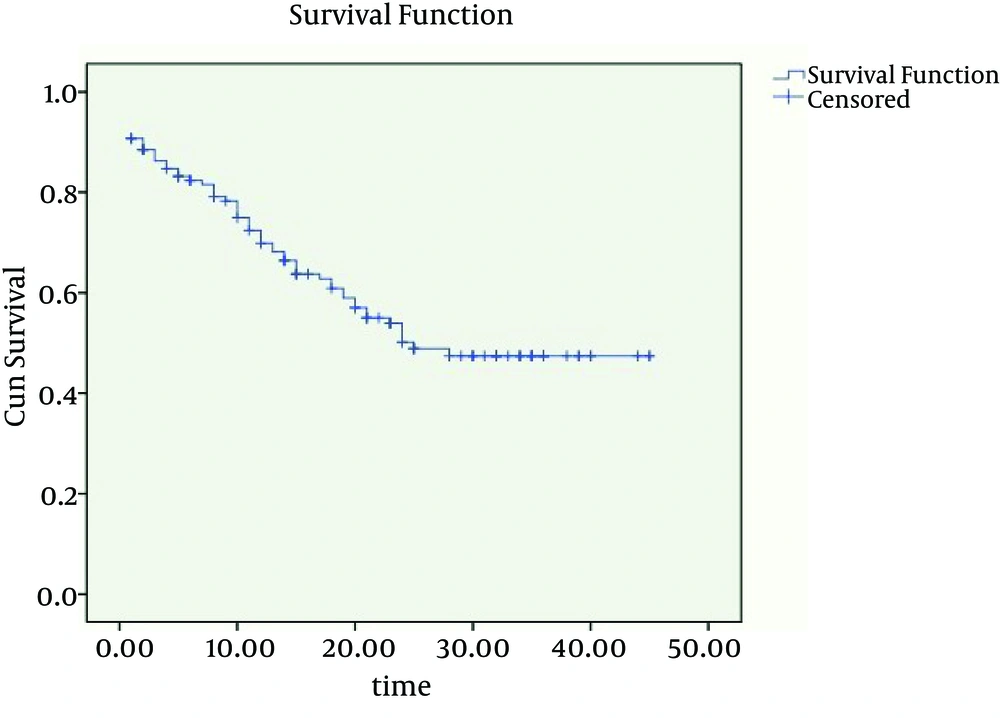
Figure 1.
Survival Diagram Using the Kaplan-Meier Method
Table 3.
Associated Variables With Relapse to Drug Abuse in Cox Regressing Modela
| Variables | B | SE | Wald | OR Adjusted | CI 95% |
|---|---|---|---|---|---|
| Age | -0.07 | 0.02 | 11.46 | 0.93 | 0.89 - 0.97 |
| Family size | 0.18 | 0.07 | 6.16 | 1.20 | 1.02 - 4.94 |
| Marital status (married/single) | 0.44 | 0.35 | 0.48 | 1.55 | 1.21 - 1.88 |
| Job status | 0.97 | 0.34 | 7.98 | 2.64 | 1.35 - 5.19 |
a Abbreviations: B, Unstandardized (B) coefficien; C, confidence interval; OR, Odds Ratio; SE, Standard Error.
5. Discussion
In the present survey, the rate and time to relapse episode (survival time) and their determinants following the treatment for drug abuse were described. In brief, the relapse rate of 30.4% in this study was similar to the relapse rates summarized by Greenwood et al. and Ramo and Brown, and Brown et al. (8, 10, 15). However, in a study by Shafiei, the relapse prevalence was around 70% during 12 months (18). Therefore, it is necessary to monitor and supervise the addicts treatment to reduce the relapse rate, which should be implemented more effectively and accompanied with the contribution of addicts’ families (21). Based on the life table model, most of the relapses of drug abuse accrued in the first six months of the treatment (23 of 61 evens), which was approximately consistent with previous studies (10, 22). These differences can be due to erratic and cyclic periods of relapse and abstinence in addicts (15). The survival accumulations at the end of 6, 12, 18, 24 and 30 months in the subjects were 83%, 72%, 62%, 53%, and 43%, respectively. In the first six months, 83% of the under treatment addicts did not return to drug abuse. There was no relapse to drug abuse (survival rate = 100%) after the 30th month of the treatment. However, accumulative survival that reveals the possibility of return to drug abuse in the previous intervals was around 46% in the 30th month and consistent after the 30th month of the treatment. In other words, the most possible time of drug abuse relapse was during one to six months following the beginning of treatment and the lowest risk to relapse was after the 30th month. Further, when we look deeply at the Kaplan-Meier diagram in Figure 1, we can have a better understanding of this finding. There were noteworthy differences in the survival time between the married, single and widowed or divorced subjects, which were 31.23 (CI 95%: 18.70 - 27.17), 22.94 (CI 95%: 18.70 - 27.17) and 15.11 (9.27 - 20.94) months, respectively. Sau and Mukherjee argued that lower relapse rate in married people rather than singles and divorced or separated persons can be due to family support and financial security, which are critical for recovery and social rehabilitation (14). In addition, in the study of Hosseini, marital duration played a significant role in relapse time (16). The association between the survival time and job status was statistically significant (P = 0.01). The mean of survival time was 32.14 months (CI 95%: 28.28 - 36.54) in the employed subjects, 19.89 (CI 95%: 15.90 - 23.89) in unemployed, and 24 months in the retired subjects. Several studies have documented the association between addiction treatment relapse and employment status (16, 22, 23); for instance, there is a report of association between employment and addiction relapse reduction (23), a positive correlation between employment and lower rates of drug abuse relapse as well as longer term heroin abstinence (24). Richardson believed that employment is usually upheld as a main consequence, indicator of the context of drug abuse treatment and recovery (17). In fact, any reduction in subjects’ income due to economic adversity as unemployment can efficiently worsen the access to drug abuse treatment services (7, 25). In contrast, a few studies have indicated that employment is a risk factor for drug abuse treatment outcome, which supports the assumption that employment with providing an income source and reinforcement of the lives of addicts can encourage them to continue the drug abuse (17, 26). In adolescents, the drug use patterns and circumstances are different from adults. In the situations that a group of under-treatment friends use drugs, the probability of return to drug is higher in teenagers than in adults. Consequently, the characteristics of adolescent relapse may also vary (17, 27), which was similar to the findings of the present study (OR = 0.93 CI 95%: 0.89 - 0.97). The treatment outcome of relapse is dependent on social and economic status in each country, based on the Universal Declaration of Human Rights which states that “everybody has the right to a standard living for the well-being and health of him/herself and of his/her family, such as food, clothing, housing and medical care and necessary social services”; thus, access to suitable healthcare is a right. Certainly, addiction and its associated consequences such as relapse are not restricted to people in a certain country (28, 29). Ultimately, the prevention of return to drug abuse is a multifactorial approach which necessitates expertise and specific skills. Recognizing the rate, patterns and processes of relapse risk factors is a main strategy which can be achieved with effort, providing the unset of addicts’ treatment. In this method, addiction treatment centers with supports of addicts families can distinguish situations related with a higher risk to reducing the rate of drug abuse relapse. Furthermore, suitable medical and psychological interventions can be efficient to reduce relapse simultaneously (18, 30).
As limitations of our study may be the recall and misclassification biases, which could not be totally excluded because some information were not registered in the subjects’ records and were collected through interview. A few researches have specifically focused on the drug abuse relapse using survival analysis, which can be considered as one the advantages of the present study. In the initial treatment, it seems necessary to supervise and monitor the treatment process through staff in addiction treatment centers with the company of addicts’ families to reduce the relapse rate. In addition, the treatment is a complex process, dependent on demographical, environmental, psychological and therapeutic factors. The determinants of drug abuse relapse in the present study were age, marital status, family size and job status of subjects, regarded in programs of addiction treatment. Perhaps, the most important finding from the survival analysis of addiction relapse was the association of employment and relapse; thus, it is necessary to be carefully taken into account by policy makers and authorities in the field of addiction and conduct more detailed studies in specific job groups of addicts under treatment.