1. Background
Risk-taking behaviors are common and can lead to serious consequences, such as unintended pregnancies, sexually transmitted infections, drug and alcohol abuse, injuries, and even death. Despite their prevalence and consequences, the psychological correlates that underlie these behaviors are not well understood. To test the role of close relationships on risk-taking behaviors, we examined the relationship between adult parent attachment and risk-taking behaviors, while accounting for the person’s sex and level of emotional adjustment.
A review of the literature showed that these variables have not been examined jointly with adults, despite the significant amount of research that has accumulated with children and adolescents and that linked attachment to adjustment on the one hand, and adjustment and risk-taking behavior on the other. In a theoretical speculation advanced in the literature and examined this study is that psychological attachment to parents in adults serves similar functions as it does with children and adolescents (1). Psychological attachment to parents represents a security behavioral system that promotes safety and survival in adults, as well as help-seeking and coping behaviors that promote adjustment and healthy emotional regulation (1, 2). By studying risk-taking behaviors in adults in relation to parent attachment, the research will show if the salubrious effects of parent attachment is extended to adults and yield a better understanding of some of the psychological sources of risk-taking in adults. The results may also inform ways in which counselors can reduce risk-taking, promote healthier attachments, and better interpersonal functioning in adults.
Bowlby (3, 4) first described attachment as the “lasting psychological connectedness between human beings” (p. 194), and proposed that the earliest bonds formed by children with their caregivers endure throughout adolescence and adulthood and impact the psychological development, safety, and health of the person. Much in line with evolutionary thought, Bowlby (3) proposed that attachment between caregivers and children developed biologically because of its survival value; attachment activates behavior that helps to protect newborns from harm or injury. Infants, toddlers, and children stay physically close to their caregivers/parents and vice-versa so that the caregiver can protect them from danger. Any scenario that is psychologically or physically threatening to the developing toddler/child will activate a move toward physical proximity with the caregiver, fostering and strengthening a psychological connection to the parents (4). According to Bowlby (4), as the child develops, attachment to parents fosters healthy psychological connections to others, healthy coping during stress, and adjustment. From this conception of attachment, children develop the ability and flexibility to seek protection and care in light of physical threats or negative emotions, and to practice communication and resilience as they venture farther away from the immediate proximity of the caregiver (3, 5). Soothing and protective parent-child and care giver-child interactions and attachment also foster appropriate emotional self-regulatory abilities in the developing child (5). With cognitive and emotional maturity, individuals develop internal working models (i.e., mental constructs) of themselves in relation to others, including parents, which help to guide attachment processes, self-control, and survival from infancy through adulthood (3).
Parent attachment is defined as a sense of connection between child and parent characterized by trust, comfort, and reliability (6) and is theorized to play a role in predicting routes of personal adjustment and development across the life span, including the ability to develop new interpersonal relationships that are trusting, comforting, and reliable (7). Bowlby (3, 4) recognized that psychological attachment to parents has a significant influence on relationships throughout the life span, and that this lasting bond between a parent and child is also a contributing factor in the developing person’s ability to deal with stressful or demanding situations (1). Much like children, adults who experience stress may attempt to reach out to an attachment figure (in the form of a parent, significant other, or a spouse) in an attempt to reestablish a sense of emotional harmony and/or security (1, 3, 4).
According to Laschinger (1), secure parent attachment provides the developing individual with the affective and cognitive resources with which to process and handle temptations toward risk-taking behaviors later in life. Parents who provide children with secure attachment relationships also provide them with models for healthy relationships and positive internal working models or representations of self and others. A healthy internal model will increase the chances that a person can find other relationships that are characterized by love and which are reliable; these models also provide the mechanism for individuals who may be ill or in trouble to turn to those they trust for assistance (1, 8). As secure children and adolescents mature, they are more likely to become independent, to have appropriate self-esteem, and to be confident and healthy individuals (1). In contrast, insecurely attached children and adolescents are likely to develop adult attachment styles that are avoidant and anxious (9), are more susceptible to engage in impulsive behaviors, to exhibit poor emotional regulation, and to have difficulties in functioning and adjustment (3, 9).
Risk-taking behavior has been defined as “any behavior that may endanger the well-being of the self or others, either through immediate risk of physical injury, or by violating rules, laws, or norms established to prevent negative consequences” (10) (p. 2). Risk-taking behavior may include a range of behaviors, from substance abuse to adventure seeking to speeding while driving; thus it is considered a multidimensional construct (10). Studies in young adult populations indicate that 71% of the deaths that occur between the ages of 10 to 24 years old are due to risk-related events, such as motor vehicle crashes (10). Farley and Farley (11) proposed that individuals with dispositions toward high risk and delinquent behavior have attachment-related deficits, arousal difficulties, and stronger sensation-seeking needs, all which stem from the absence of and/or failures in security and soothing care in early childhood. Psychological attachment has also been discussed as a key aspect to personal control over dangerous urges (12). Hirschi (13) defined psychological attachment in terms of “the level of psychological affection one has for prosocial others and institutions” (14) (p. 58). From this perspective, children who establish close ties to their parents and schools are able to accept and exhibit greater social control, and are more likely to avoid deviant behaviors out of fear of losing connections to significant others (14). A commitment to friends, parents, teachers, and to work is at the core of self-control (14), and Hirschi (13) proposed individuals conform to social laws as a form of commitment and attachment to others (15). With more risk-taking inhibitors, in the forms of attachments to others and/or more social bonds, the individual is compelled to refuse to engage in risky, criminal, or antisocial behaviors (12, 13). From this perspective, psychological attachment to parents may be deduced to be an important “inhibitor” against risk-taking behavior. Despite the conceptual links between attachment and risk-taking behavior, the empirical link between attachment to parents and risk-taking behavior has not been studied with adults.
It is well-known in psychology, as well as in other disciplines, that men are more likely than women to engage in a variety of risk-taking behaviors; increasing men’s risk of disease, injury, and death (16). For example, it has been found that men engage in higher lifetime use of tobacco and are more likely to engage in binge drinking and marijuana use than women (17). Additionally, men tend to have more sexual partners and are more likely to be the perpetrators and the victims of violence or criminal acts (18). Explanations for differences between males and females in risk-taking behaviors have varied due to physiological factors, differences in parenting styles, and cultural influences that allow, encourage, and even romanticize men who engage in risk-taking behavior (16). In the current study, we account for sex in examining attachment, adjustment, and risk-taking behavior, and will examine if participant sex is a moderator variable between attachment to parents, adjustment, and risk-taking behavior.
We operationalized attachment in terms of parental attachment, and sampled adults who would be able to provide self-reports regarding their attachment to their mother and father. Adjustment has been examined in various ways in the literature, but recent studies (19, 20) examining parental attachment have operationalized adjustment in terms of self-esteem and depression, and in the current we followed this pattern established in the literature. Since risk-taking is deemed a multidimensional construct, we chose a measure that would capture the range of behaviors associated with risk-taking.
1.1. Research Questions and Hypotheses
Several research questions stimulated the current study. First we were interested in the relationship between attachment to parents and risk-taking behavior in adults. Second, we were interested in examining whether emotional adjustment mediated the relationship between attachment to mother and father and risk-taking behaviors. Finally, we were interested in whether sex moderated the relationship between attachment, adjustment, and risk-taking behaviors. The hypotheses that arose from these questions are the following: 1) we hypothesized an inverse relationship between secure attachment to mother and father and risk-taking behavior; 2) we also hypothesized that level of adjustment would mediate the relationship between attachment to mother and father and risk-taking; and 3) we hypothesized that men, more so than women, would engage in risk-taking behavior, above and beyond the level of attachment and adjustment. Figure 1 depicts a model of our hypotheses. The paths on Figure 1 from attachment to father and attachment to mother to risky behavior represent our first hypothesis. The paths from attachment to father and attachment to mother to adjustment and then from adjustment to risk-taking behavior represent the second hypothesis. The paths from sex, attachment, and adjustment to risk-taking behavior represent the third hypothesis.
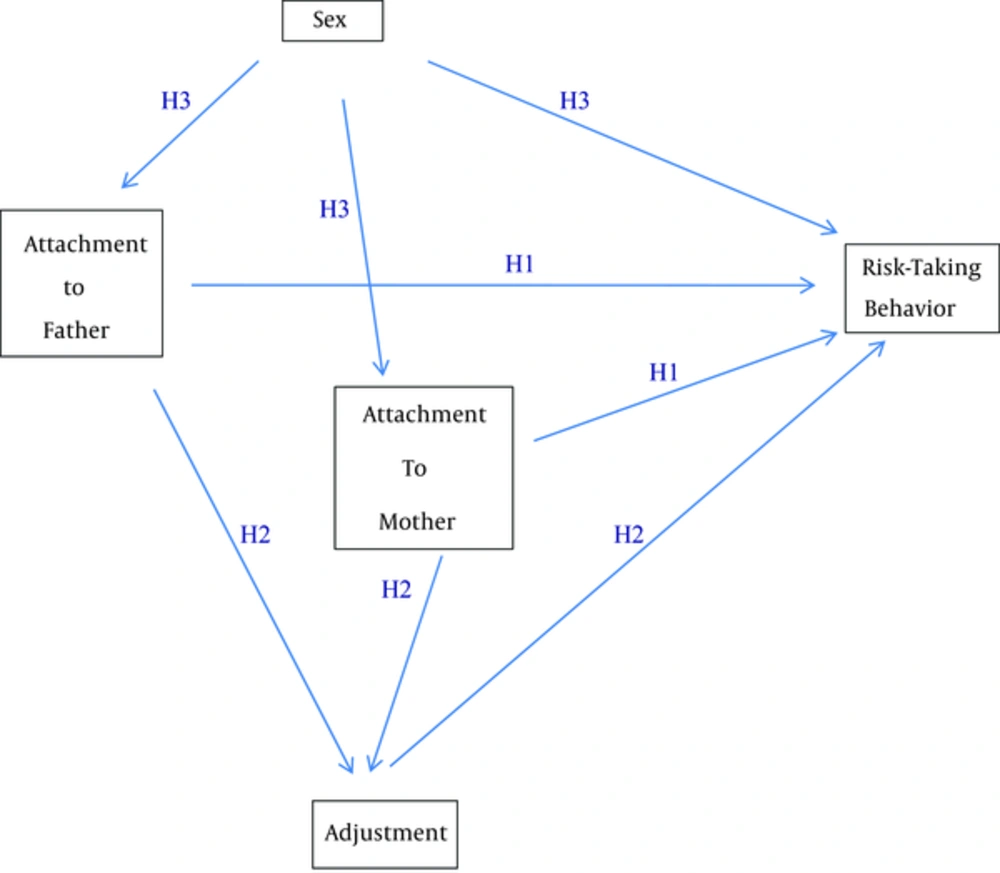
Figure 1.
Conceptual Model and Hypotheses
2. Objectives
The study aimed to evaluated the role of Sex, Parent Attachment and Emotional Adjustment on Risk-Taking Behaviors.
3. Patients and Methods
In this study, we collected data using amazon mechanical turk (MTurk). With hundreds of thousands of subscribers (i.e., “turkers”) from over 100 countries, MTurk can help recruit a large number of diversified individuals to work on surveys in a short time period at a very low cost, such as a few cents per user response (21). In this study we paid each “turker” $0.50 to participate in our research. Prior to the study a power analysis was conducted to ascertain the number of participants that would be required to adequately test the hypotheses in the study. With power set at .80, a medium effect size expected for the effect of the parent attachment on the variables of interest (based on zero order correlations from previous research; (19, 20)), and with significance levels set at .05, the power analysis specified that between 84 and 118 participants would be needed in order to adequately test the hypotheses (21).
A total of 269 participants from Amazon’s MTurk website completed our survey. There were 105 men (39%) and 164 women (61%). The mean age of the participants was 30.17 (SD = 10.23), and the self-reported race classification for the group was nine American Indian (4%), 147 Asian or Pacific Islander (54%), three Hispanic (1%), eight Black or African-American (2%), 93 Whites or Euro-Americans (35%), and nine “Other” (4%) of these respondents, 114 reported being single (42%), 115 married (42%), 30 as single/in a committed relationship (11%), nine divorced (4%), and one did not specify his/her relationship status (< 1%). Eighty-nine reported being born in the U.S. (33%), 153 as born outside of the U.S. (57%), and 27 left this item blank (10%). For participants not born in the U.S. the average number of years living in this country was 12.71 (SD = 14.16).
Two hundred and thirteen respondents reported having been raised by their “mother and father” (80%), 16 by “mother only” (6%), six by “father only” (2%), three by a “legal guardian” (1%), and four by “Other” (1%) twenty-seven participants left this question blank (10%). One hundred and fifteen participants (43%) responded “yes” to the question as to whether they still lived with the person(s) who raised them, while 127 responded “no” (47%), and 27 left this information blank (10%). In terms of father’s highest level of education, five reported “grade school” (2%), 13 “middle school” (5%), 57 “high school” (21%), 42 “some college” (16%), 123 “college graduate” (45%), two “did not attend school” (1%), and 27 did not respond (10%). In terms of mother’s highest level of education, seven reported “grade school” (3%), 29 “middle school” (10%), 79 “high school” (30%), 45 “some college” (17%), 79 “college graduate” (29%), and three “did not attend school” (1%). Twenty-seven participants did not respond to this item (10%). In terms of the respondents’ highest level of education, four reported “grade school” (1%), one “middle school” (1%), 17 “high school” (6%), 50 “some college” (19%), and 169 “college graduate” (63%). Twenty-eight participants did not respond to this item (10%). Finally, in terms of income, 71 participants (26%) reported an approximate annual income that is less than $9,999, 42 (16%) reported annual income that is $10,000 to $19,999, 47 (18%) reported annual income that is $20,000 to $29,999, 28 (10%) reported annual income that is $30,000 to $39,999, 22 (8%) reported annual income that is $40,000 to $49,999, and 31 (12%) reported an annual income that is $50,000 or more. Twenty-eight respondents did not respond to this item (10%).
3.1. Measures
3.1.1. Inventory of Parent and Peer Attachment - Revised (IPPA-R)
The IPPA (22) assesses the participants’ perceptions of the quality of parental and peer attachments, particularly how well said figures act as sources of psychological security (23). The IPPA was first developed to measure adolescents’ perceptions of the positive and negative affective and cognitive dimensions of their relationships with their parents and close friends. The questionnaire is a 75-item self-report measure, where each item is responded to using a five-point Likert scale that ranges from 1 “Almost never or never true” to 3 (Sometimes true) to 5 (Almost always or always true). For the current study, the 25 items assessing peer attachment were excluded (22, 23).
The IPPA specifically assesses three dimensions in addition to general attachment, which are as follows: degree of mutual trust, quality of communication, and extent of alienation. The IPPA is scored via the reverse scoring of the negatively worded items and then summing the response values in each section (23). High scores indicate secure attachment and low scores indicate insecure attachment. Armsden and Greenberg (23) reported Cronbach’s alpha internal consistency coefficients of 0.87 for mother attachment, 0.89 for Father Attachment, and 0.92 for peer attachment. In a sample of 18-20 year olds, Armsden and Greenberg (23) also reported three-week test-retest reliability coefficients for the original version of the IPPA-R of 0.93 for Parent Attachment (mothers and fathers rated together) and 0.86 for peer attachment. Armsden & Greenberg (22) maintained that minor changes were made to the original IPPA, so test-retest reliability data were not reported for the revised questionnaire. Armsden and Greenberg (23) also reported that parent attachment scores were significantly related to indicators of family environment, family and social self-concepts, and a tendency to seek the support of parents in times of need. Parent and peer attachment scores were also predictive of self-esteem, life satisfaction, and depression and anxiety scores (23).
3.1.2. Rosenberg’s Self-Esteem Scale
The Rosenberg Self-Esteem scale is a 10-item measure that assesses global self-worth through inquiry about both positive and negative feelings about the self (24). Along with the depression scale described below, we used the self-esteem scale to assess emotional adjustment. All items in the self-esteem scale are answered using a 4-point Likert scale format ranging from 3 for “strongly agree” to 0 “strongly disagree”, with 5 items being reversed scored. Previous studies have reported alpha reliabilities for the RSE ranging from 0.72 to 0.88. In terms of scoring, several items are reverse scored, and then the scores for all ten items are summed together. Higher scores indicate higher levels of self-esteem.
3.1.3. Cognitive Appraisal of Risky Events Questionnaire (CARE)
CARE (25) is a 90-item questionnaire that assesses beliefs about the potential benefits, consequences, and behavioral intentions for 30 risky behaviors (25). The six dimensions of risky behaviors include heavy drinking, illicit drug use, risky sexual activities, aggressive and illegal behaviors, high risk sports, and irresponsible academic/work behaviors. For each of these 30 risky activities, participants use a seven-point Likert scale (“not at all likely” to “extremely likely”) to rate the frequency with which they have participated in said behaviors and activities over the course of the previous six months. Each of the CARE subscales has been shown to have acceptable psychometric properties (25, 26). Fromme et al. (25) found adequate test-retest reliability for the CARE questionnaire. Fromme et al. (25) also found that the CARE possessed adequate internal reliability, with Cronbach’s alpha coefficients of 0.81 - 0.83 for risks and 0.82 - 0.84 for benefit. Scoring of the CARE is accomplished by computing summary frequency scores for each factor of the Past Frequency of Involvement scale (25, 27).
3.1.4. Kandel Depression Scale (KDS)
The Kandel depression scale (KDS) (28) is a commonly-used 7-item measure designed to evaluate for depressive symptoms in adolescents and young adults (28, 29). The scale utilizes a Likert scale, wherein responses range from 1 (“not at all”) to 5 (“very much”) for the questions (29). Questions relate to feeling troubled by feelings of exhaustion, unhappiness, hopelessness, etc., during the past 12 months (29, 30). Kandel and Davies (28) reported an adequate reliability for the scale, with a Cronbach alpha coefficient (α) of 0.79. In addition, Lytle et al. (30) reported a Cronbach α of 0.78 for the scale. The KDS has been used previously with college students, and demonstrated adequate internal consistency (Cronbach α = 0.75; Gnilka et al., 2013). Kandel and Davies (28) reported a test-retest reliability coefficient of 0.76 after 5 - 6 months. Kandel and Davies (31) also demonstrated adequate construct validity and concurrent validity with strong correlations between the KDS and other measures of depression. Differences by sex in self-reported depression have been documented using the KDS, with girls and women reporting higher levels than boys and men (28, 31).
3.2. Procedure
Participants were presented with a brief description about the investigator and the survey. The participant would then click the survey link given to the actual survey, which was uploaded through surveymonkey.com. The participant was then presented with a consent form. After reading the consent form and agreeing to participate, the participants took the survey. They were then debriefed and instructed to enter their code in order to receive payment for completing the survey. In addition to the textual responses, we recorded the turkers’ IP addresses for the purpose of removing redundant responses, since some turkers may have created multiple accounts to be able to perform the same task multiple times in order to earn more money.
4. Results
Table 1 presents the means and standard deviations for men and women for all the variables examined in the study. This table shows that there were no significant differences between men and women in levels of attachment to father or mother, self-esteem, or depression. However, significant differences are evident between men and women on all six risk-taking behaviors, with men reporting higher levels than women on all six areas: 1) demonstrating problematic academic/work behaviors; 2) engaging in high-risk sports; 3) engaging in heavy drinking; 4) engaging in risky sexual behavior; 5) engaging in aggressive/illegal behaviors; and 6) engaging in illicit drug use. Table 1 also reports the internal consistency alpha coefficients for all the measures in the study, which ranged from acceptable to excellent. Table 2 reports the correlations between the measures in the study for men and women combined. We used Cohen’s (21) guidelines for the classification of effects as small, medium, and large when the correlations are 0.10 to 0.29, 0.30 to 0.49, and 0.50 and above, respectively. Table 2 shows that the correlation between attachment to father and attachment to mother was at a medium level (r = 0.32, P < 0.001), which indicates that, with the current sample, these forms of attachment are in some ways similar but in other ways different. The correlation between self-esteem and depression is large and negative (r = - 0.57, P < 0.001), which is consistent with theoretical predictions about the inverse nature of high self-esteem and depression. Furthermore, the correlations between attachment to mother and father and the six high-risk behaviors are all small; the correlations between self-esteem, depression, and the six high risk behaviors are mostly small with two being medium; and the correlations among the six high-risk behaviors are large. Table 3 presents the correlations separated by men and women, along with a test of significance between the differences in means; the results on Table 3 are presented in more detail below.
Table 1.
Means, Standard Deviations, and Internal Consistency Estimates (N = 269)a
| Men | Women | Observed Alpha Coefficients | |
|---|---|---|---|
| Mean ± SD | Mean ± SD | ||
| Father general attachment | 86.20 ± 19.60 | 84.76 ± 23.35 | 0.83 |
| Mother general attachment | 92.06 ± 19.04 | 90.14 ± 20.53 | 0.81 |
| Self-esteem | 19.66 ± 5.10 | 19.98 ± 5.73 | 0.85 |
| Depression | 10.46 ± 2.93 | 10.73 ± 3.19 | 0.83 |
| Prob academic/work behaviorb | 15.86 ± 6.36 | 13.66 ± 6.17 | 0.83 |
| High risk sportsc | 12.23 ± 5.07 | 10.04 ± 4.84 | 0.75 |
| Heavy drinkingb | 8.00 ± 4.65 | 6.51 ± 4.34 | 0.85 |
| Risky sexual behaviorc | 13.75 ± 7.66 | 11.33 ± 6.10 | 0.85 |
| Aggressive illegal behaviorc | 21.38 ± 10.88 | 16.57 ± 8.43 | 0.90 |
| Illicit drug useb | 6.59 ± 4.32 | 5.26 ± 3.49 | 0.84 |
aDifferences between men and women.
bP < 0.05.
cP < 01.
Table 2.
Intercorrelations Among all Study Variables (N = 269)
| A FAttach | EMattach | S-Est | Depress | ProbAcd | HRSports | HvDrink | R SexBeh | AggrBeh | IDU | |
|---|---|---|---|---|---|---|---|---|---|---|
| FAttach | 1.00 | - | - | - | - | |||||
| MAttach | 0.33a | 1.00 | - | - | - | |||||
| S-Est | 0.38a | 0.33a | 1.00 | - | - | |||||
| Depress | - 0.38a | - 0.25a | - 0.57a | 1.00 | - | |||||
| ProbAcd | - 0.21a | - 0.22 | - 0.37a | 0.35a | 1.00 | |||||
| HRSports | 0.09 | 0.04 | - 0.00 | 0.01 | 0.31a | 1.00 | ||||
| HvDrink | - 0.17a | - 0.19a | - 0.27a | 0.21a | 0.48a | 0.37a | 1.00 | |||
| R SexBeh | - 0.12b | - 0.28- | - 0.26a | 0.15a | 0.45a | 0.45a | 0.57a | 1.00 | ||
| AggrBeh | - 0.11b | - 0.20a | - 0.29a | 0.18a | 0.58a | 0.58a | 0.64a | 0.73a | 1.00 | |
| IDU | - 0.15a | - 0.27a | - 0.23a | 0.23a | 0.45a | 0.42a | 0.71a | 0.73a | 0.70a | 1.00 |
Abbreviations: FAttach, attachment to father; MAttach, attachment to mother; S-Est, self-esteem; Depress, depression; ProbAcd, problematic academic/work behaviors; HRSports, high-risk sports; HvDrink, heavy drinking; R SexBeh, risky sexual behaviors; AggrBeh, aggressive & illegal behaviors; IDU, Illicit Drug Use.
aP < 0.001.
bP < 0.01.
Table 3.
Correlations by Sex with High-Risk Behaviors and Test of Significance of the Difference Between the Two Correlation Coefficients
| Sex | Depression | Self-Esteem | Mother Attachment | Father Attachment | |
|---|---|---|---|---|---|
| Illicit drug use | Male | 0.13 | - 0.11 | - 0.22a | - 0.22a |
| Female | 0.14 | - 0.16a | - 0.26b | - 0.14 | |
| ZStatistic | - 0.10 | 0.33 | 0.36 | - 0.72 | |
| Aggressive illegal behaviors | Male | 0.06 | - 0.25b | - 0.17 | - 0.10 |
| Female | 0.10 | - 0.27b | - 0.21b | - 0.13 | |
| ZStatistic | - 0.35 | 0.17 | 0.27 | 0.26 | |
| Risky sexual behavior | Male | 0.01 | - 0.26b | - 0.25b | - 0.19a |
| Female | 0.07 | - 0.17a | - 0.32b | - 0.08 | |
| ZStatistic | - 0.48 | - 0.72 | 0.57 | - 0.93 | |
| Heavy drinking | Male | 0.11 | - 0.08 | - 0.11 | - 0.13 |
| Female | 0.15a | - 0.27b | - 0.20b | - 0.21b | |
| ZStatistic | - 0.37 | 1.57 | 0.76 | 0.72 | |
| High risk sports | Male | - 0.17 | 0.17 | 0.13 | 0.14 |
| Female | - 0.08 | - 0.04 | - 0.01 | 0.03 | |
| ZStatistic | - 0.73 | 1.74 | 1.13 | 0.89 | |
| Prob academic work behaviors | Male | 0.37b | - 0.43b | - 0.31b | -0.17 |
| Female | 0.30b | - 0.24b | - 0.18a | -0.24b | |
| ZStatistic | 0.65 | -1.73 | -1.12 | 0.58 |
aCorrelation is significant at the 0.05 level (2-tailed).
bCorrelation is significant at the 0.01 level (2-tailed).
Figure 2 shows results from Partial Least Squares Path Modeling (32-34) as implemented by the following programs: SmartPLS (35) and the R-package, plspm (36). Table 4 shows the coefficients and t-tests values for the path coefficients. In order to obtain goodness-of-fit indices (37) the data were reanalyzed with the R-package, lavaan (38). The path coefficients and loadings produced by lavaan were the same as those from the partial least-squares model, but the goodness-of-fit indices evidenced only a fair fit (Chi-square (28) = 96.78, P < .01, GFI = 0.93, RMSEA = 0.09). Examination of modification indices suggested that the fit would be improved if the risky sports variable was dropped from the latent variable risk. Following this action, the new fit was acceptable (Chi-square (20) = 61.99, P < 0.01, GFI = 0.95, RMSEA = 0.08).
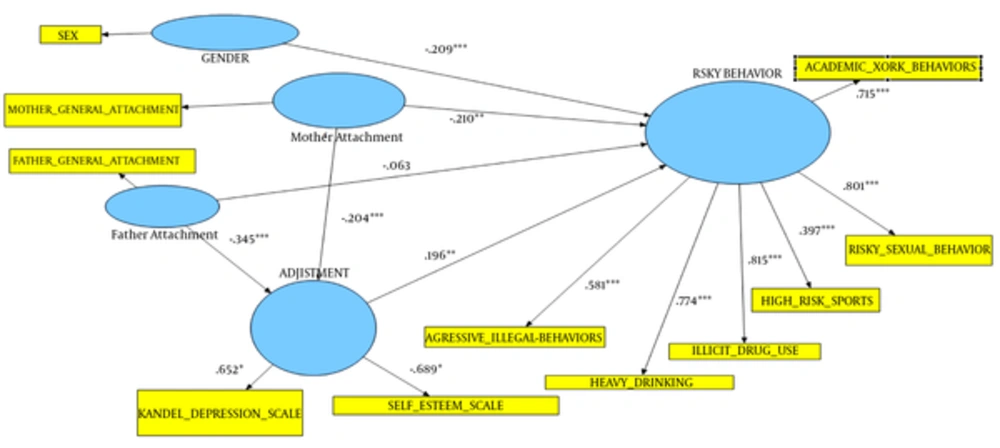
Figure 2.
Note: * P < 0.05, ** P < 0.01, ***P < 0.001.
Table 4.
Study Models
| Measurement Model (Outer Model) Coefficients and t-test Values | |||||
|---|---|---|---|---|---|
| Scale | Original | Mean.Boot | Std.Error | Bootstrap t-test | Sig. |
| Kandel depression scale | 0.854 | 0.652 | 0.544 | 1.199 | ns |
| Self esteem scale | - 0.902 | - 0.689 | 0.579 | - 1.190 | ns |
| Illicit drug use | 0.819 | 0.815 | 0.032 | 25.791 | < 0.001 |
| Aggressive illegal behaviors | 0.858 | 0.851 | 0.030 | 28.367 | < 0.001 |
| Risky sexual behavior | 0.803 | 0.801 | 0.037 | 21.826 | < 0.001 |
| Heavy drinking | 0.778 | 0.774 | 0.036 | 21.500 | < 0.001 |
| High risk sports | 0.405 | 0.397 | 0.090 | 4.406 | < 0.001 |
| Academic work behaviors | 0.719 | 0.715 | 0.037 | 19.429 | < 0.001 |
| Structural Model (Inner Model) Path Coefficients | |||||
| Estimate | Std. Error | Bootstrap t-Value | Pr (> |t|) | ||
| To Adjustment | |||||
| MotherAttachment | - 0.204 | 0.058 | - 3.540 | < 0.001 | |
| Father Attachment | - 0.345 | 0.058 | - 5.980 | < 0.001 | |
| To Risk | |||||
| Sex | - 0.209 | 0.056 | - 3.710 | < 0.001 | |
| MotherAttachment | - 0.210 | 0.061 | - 3.450 | 0.001 | |
| Father Attachment | - 0.063 | 0.063 | - 0.991 | 0.322 | |
| Adjustment | 0.196 | 0.063 | 3.110 | 0.002 | |
Abbreviations: Original, original solution; Mean.Boot, bootstrapped mean.
Now we turn to the results for each hypothesis. Hypothesis 1 proposed an inverse relationship between secure attachment to parents and risk-taking behavior. This hypothesis is partially supported by our data. The zero-order correlations presented on Table 2 show an inverse relationship between attachment and risk-taking, however, the correlations are small, though significant, and there was no significant relationship between attachment to mother or father and engaging in high-risk sports. Figure 2 shows the results from structural equation modeling analyses which indicate that attachment to mother, but not to father was significantly and negatively associated with risk-taking behavior.
Our second hypothesis proposed that adjustment would mediate the relationship between attachment and risk-taking. As observed in Figure 1 and Table 4, this hypothesis was partially supported. There were statistically significant effects for attachment to mother and attachment to father on adjustment, in which higher levels of attachment to both were associated with better adjustment. Figure 2 also shows a significant path from adjustment to risk-taking behavior. Using Sobel’s (39) test to examine the significance of a mediation effect for adjustment, there was a significant indirect effect in which the path between attachment to father and risky behavior was significantly mediated by adjustment (Z = 2.75, P < 0.01).
Hypothesis 3 was that men, more than women, would engage in risk-taking behavior, above and beyond level of attachment and adjustment. Since differences in the mean scores were evident by sex on all six risk-taking behaviors (as shown on Table 1), we calculated separate correlation coefficients by sex and then compared and tested whether these correlations differed by sex (see Table 3). These analyses by sex allowed us to examine if sex moderates the relationship between adjustment, parent attachment, and high-risk behavior. The results show that none of the 24 comparisons were significantly different. Therefore, sex is not a moderator of the relationships between adjustment, parent attachment, and high-risk behavior although, sex directly affects the levels of risk-taking behavior.
5. Discussion
Our results are consistent with previous research (19, 40), which shows that there is a mild correlation between attachment to father and attachment to mother. These two forms of attachment are related, but also distinct, and represent similar and different psychological experiences for both men and women. While the measure of parent attachment (i.e., the IPPA-R) (22) assesses the same areas in the relationship with father and mother, these relationships appear to be different in their cognitive and affective components. It may be that the different roles that fathers and mothers typically enact in raising their children translate into distinct patterns of attachment. For example, on the one hand, the child connects and forms attachment bonds with both parents in ways that are similar and have a common core (e.g., trust and safety). However, based on different manifestations of care and rearing from the parents, the child may develop different psychological and internal representations and experiences with each parent. Previous research has demonstrated that mothers and fathers may react differently to their child’s risky behaviors based on the child’s sex, thereby providing further complications to these links (41). Future research is clearly needed to examine the reasons for these linkages and relationships, including perhaps looking at the level of traditional role adherence that each parent enacts in child rearing and the type of messages that each parent conveys to the child regarding his or her behavior.
We found partial support for the hypothesis that there would be an inverse relationship between secure attachment to parents and risk-taking. Attachment to mother, but not attachment to father, had a direct inverse effect on risky behavior for both men and women in the sample, a finding that is consistent with recent research demonstrating that attachment to mother is associated with better adaptive behaviors, more prosocial behaviors, and better conflict resolution (19, 40, 42). A close attachment to mother can last into adulthood and seems to provide security and guidance that regulate the adult’s propensity toward risky behavior. As Christopher and Conner (15) theorized, attachment to parents, in this case attachment to mother in childhood, establishes healthy and lifelong ideas of safety and security for adults with which to engage in and survive in beyond childhood and adolescence.
There was also partial support to the hypothesis that adjustment would mediate the relationship between attachment to parents and risk-taking. Attachment to father, but not to mother, had an indirect effect on risk-taking through adjustment. The results indicated that attachment to father is more powerful than attachment to mother in decreasing depression and in increasing self-esteem, and is, in turn, inversely related to risk-taking behavior. This result is consistent with related findings from Fuertes and Ross (19), who found that attachment to father was predictive of better social skills and relational competence, which were in turn predictive of emotional adjustment in a sample of young male and female adults.
The results paint a complex picture where attachment to mother is directly associated with less risk-taking in adults, and attachment to father is indirectly associated with less risk-taking by way of emotional adjustment. A theoretical speculation is that perhaps one of the ways in which attachment to father and mother differ may be in the internalized messages (and emotionally-toned cognitive processes) that come from close contact with the mother, in comparison to the father. In attachment to mother, the tone of the messages may be for being careful, for being safe, or for inhibiting dangerous behavior, and this may be a powerful direct antidote to risk-taking behavior in adulthood. Attachment to father may invoke memories of a closely related father who provided security and comfort in childhood and does so in adulthood, but it is an attachment that does not seem to provide the inhibition toward risk-taking that attachment to mother provides. Thus, attachment to mother and father are both important in curbing risk-taking behavior for adults, but each attachment plays a different role. Attachment to mother is powerful in that it is associated with diminished risk-taking directly, irrespective of the individual’s level of adjustment. Attachment to father is also important and necessary in diminishing risk-taking behavior, but only in well-adjusted adults.
Hypothesis three was that men, more than women, would engage in risk-taking behavior, above and beyond level of attachment and adjustment. Despite similar levels in attachments and adjustment for men and women, differences did emerge by sex in relation to risk-taking, with men being much more prone to these behaviors than women. This result is consistent with previous research conducted on the topic of risk-taking, as demonstrated by Hagan & Kuebli (41), as well as in related areas of behavior for men, such as a propensity toward impulsivity and violence. However, the results in the current study are novel in that we controlled for psychological factors that were estimated to possibly explain sex differences in risk-taking (i.e., attachment to parents and adjustment); these psychological factors did not differentiate risk-taking between men and women. We found that men are more likely than women to engage in all areas risky behaviors, such as drug use, heavy drinking, aggressive illegal behaviors, risky sexual experiences, despite the sexes being similar in level of attachment and emotional adjustment. Why this difference emerges between men and women above and beyond similarities in levels of attachment and adjustment will remain an empirical question for future researchers, and possible lines of inquiry may involve the inclusion of measures of internalized cultural expectations and socialization patterns, peer pressure effects that are different for men than for women, and perhaps factors revolving around exposure to anti-social behavior. Differences between males and females in risk-taking behaviors have been discussed as due to independently or a combination of factors including physiological factors, parenting expectations, and/or discipline that is different for boys and girls (16). Differences in risk-taking may also be due to cultural influences in the ways that men are socialized to engage into riskier behaviors as a part of developing a masculine identity (16).
5.1. Implications for Counseling
There are several implications for counseling that stem from the current results. In counseling, it may be valuable to explore the nature of attachment with each parent, to explore the pattern of socialization that took place at home, and the messages that were conveyed with respect to factors such as being safe, taking care, and “going for it” or taking risks. This may be especially important for men, since they are more likely to engage in risk-taking behavior, and to be influenced by peer and media socialization, and socialization taking place at home that encourages risk behavior (15). Psycho-educational interventions might help the client review expectations and assumptions about risk-taking and evaluate consequences. Open-ended questions may promote exploration and insight and a questioning of the effects of socialization on identity, adopted sex roles and internalized stereotypes, and help diminish risky behavior. Since attachment to mother and father is associated with adjustment, interventions to help the client examine the quality of these bonds in counseling may be particularly useful in promoting adjustment, particularly in crisis situation where support and guidance is needed. Exploring and encouraging the history and quality of parent attachments, when possible, may be useful in clinical presentations where there is a diagnosis of clinical depression and/or very low and dysfunctional self-esteem. An examination of these attachments may uncover valuable material that helps to explain some of the sources of depression and low self-esteem (e.g., neglect by one or both parents), and may also help the client establish lines of communication and sources of support to help him/her move forward in their recovery. The current results indicate that attachment to mother is particularly important in lowering risk-taking, so encouraging clients to seek and engage in that secure base may in fact be conducive to their safety and well-being.
5.2. Limitations and Future Research
There are several limitations to the current study, including the cross-sectional design based on survey methodology. This methodology allowed us to sample a good number of participants about a sensitive topic, but provided only a snap shot in time, and not a longitudinal perspective. The participants’ responses represent their views and beliefs at one particular time and may not adequately reflect their views on complex constructs such as attachment to parents. The participants were also a heterogeneous group of “turkers” who participated online where such an environment may not have elicited their true views on the survey or where surveys may not fully capture the complete picture of the participants’ social-emotional development. Given the demographic profile of the respondents, primarily Asian and White female respondents with high levels of education and access to the internet, these results have limited external validity as they probably do not represent the views of a more diverse and heterogeneous sample of participants. Nevertheless, more and more psychological research is being conducted through the internet and through Amazon Turk in particular, and these studies tend to generate results that are consistent with and replicate non-internet studies (20). The current study also provides evidence for the possibility of studying concepts such as attachment, adjustment and risk-taking with international samples, as the measures performed reliably with the current sample and the level and direction of the associations observed were in theoretically predicted ways. The results are also consistent with some of the results with U.S. based samples, for example, the higher level of risk-taking behavior for men in comparison to women.
Future research is clearly needed to examine the link between sex, rearing and attachment to mother and father, including perhaps looking at the level of traditional role adherence that each parent enacts in child rearing and the type of messages that each parent conveys to the child regarding his or her behavior. Researchers might also examine internalized roles such as masculinity and femininity, not just sex alone, in linking attachment to participants’ sex and the development of adaptive and maladaptive behavior. Psychologists might also investigate ways of intervening in reducing or eliminating high risk behaviors by targeting behaviors that are closely associated with healthy attachments, such as positive coping, appropriate help-seeking and emotional regulation. Since risk-taking is multi-dimensional, research is needed to examine the more dangerous of these behaviors, such as violent and illegal behaviors, versus those that may be less dangerous though still problematic, such as neglecting studies or engaging in high-risk sports. The link between sex, rearing, and attachment, and their relationship to adjustment and risk-taking behavior needs to be studied among varying cultural groups in the U.S., given the effects of cultural differences and varying traditions on the socialization of men and women, on child rearing practices, and expected role orientations for adults. Finally, since many homes are not composed of a father and a mother, researchers might investigate how parent attachments are established in homes with single parents or parents who are both of the same sex, and if differences in attachment, and by extension childhood or adult adjustment and risk-taking, can be explained by the quantity and quality of these attachments.