


1. Background
The importance of understanding how risk factors may affect the likelihood of engaging in high-risk behaviors (HRB) has been studied in detail in the criminology literature (1). High-risk behaviors refer to behaviors that increase the risk of physical, psychological and social outcomes. Researchers consider behaviors such as smoking, alcohol and drug abuse, risky driving, and early sexual behaviors as HRB (2). It has been found that compared to juvenile non-offenders, offender youth show higher rate of truancy, risky driving, gambling, running away from home, and most notably, drug abuse (3). However, there is one developing body of research, which considers risk factors for juvenile offence including age, neurological functioning deficits, low IQ, lack of future-orientation, impulsivity, cruelty and apathy traits, impaired information processing, negative attributional bias, lack of social skills, emotional and avoidant coping styles, parents’ violent behavior, lack of attachment to a caregiver, poor anger management, independent life, lack of interpersonal, decision-making and stress reduction skills, peer rejection, relationship with offending peers, and exposure to social and domestic violence (1). However, what seems important is that a significant proportion of people known as high-risk are resilient against pressures and conflicts that arise in high-risk environments. More specifically, despite their development in high-risk environments, approximately 25 to 50% avoid engaging in delinquency. Indeed, resiliency is not avoidance of crime, rather it refers to the ability of those who live in high-risk social and personal environment and oppose criminal situations that make others commit a crime. The youth who are able to avoid aggressive and desperate behaviors are “resilient” (4).
The intelligent use of emotions is necessary for physical and psychological adaptation. Processing ability and using emotional information are conceptualized as emotional intelligence. In fact, theory of emotional intelligence indicates that emotions make cognitive processes adaptive and that people can think logically about their emotions (5). Emotional intelligence has a correlation with strengthening mental health, emotional well-being, improved interpersonal relationships and social adjustment (3). Environmental stresses in youth with low emotional intelligence make them vulnerable to mental disorders and challenge their adjustment with the environment (6). The results reported by Deb and Walsh (7) suggest that social adjustment scores of people who have experienced violence (regardless of the nature of violence) is significantly lower than the scores of those who have not experienced violence. Hence, low levels of involvement in HRB provide an experimental environment for learning more about the impact of behaviors that provoke future coping strategies. However, increased risk can result in HRB in a curved shape fashion, illustrating lower returns due to the absence or lack of protective factors in an individual’s resiliency profile (8).
Many studies to date indicate that self-concept is a predictor of HRB. This approach minimizes the dynamic relationship between the self and behavior. Not only does the self-affect one’s behavior, but also there is a firm belief that perceiving self-root is different from individual’s observations and assessments of one’s own behavior (9). Identity is the way people define themselves as unique individuals (10). Berzonsky believes that identity style is what people think they are and is the manner by which they act (11). Fundamental works of Erikson conceptualize identity formation as a process that is very active in adolescence and continues to adulthood. It includes who the individual might become in the future (identity exploration), the process of making stronger inferences about who the individual is (identity commitment). Identity commitment formation is very important during adolescence and has a positive correlation with adjustment. The importance of identity exploration is their style to explore identity. These styles may emphasize openness to various and diverse information (informational style), guidance from others (normative style), or avoiding engagement in the identity acquisition process (avoidance style). Informational style is associated with many positive consequences for adolescents; avoidance style is associated with non-adjusting behaviors; and normative style is correlated with positive and negative indicators of adjustment (10). In support of these theoretical assumptions, a growing body of scientific evidence suggests that individuals who have not resolved the challenges of this phase of growth and have no clear understanding of identity are at risk of more personal and behavioral problems, such as academic problems, poor relationships with peers, low self-esteem, depression, eating disorders, alcohol/drug abuse problems, and conduct disorders (12).
According to the world health organization statistics, different types of psychosocial damages are alarmingly growing. Therefore, mental disorders, addiction, anti-social behavior and crime, particularly in the younger generation, have increased.
2. Objectives
On the basis of the above-mentioned researches, the primary purpose of this study was to examine a model of factors that place individuals at risk of engaging in HRB. The circles represent latent variables and the rectangles represent measured variables. It was hypothesized that emotional intelligence (latent variable with three indicators including “emotion regulation”, “profiting of emotion “ and “emotion appraisal”) and identity style (latent variable with four indicators including “information orientation”, “normative orientation”, “diffuse orientation” and “commitment”) indirectly predict HRB via the mediation role of social adjustment and resiliency. The hypothesized model is illustrated in Figure 1.
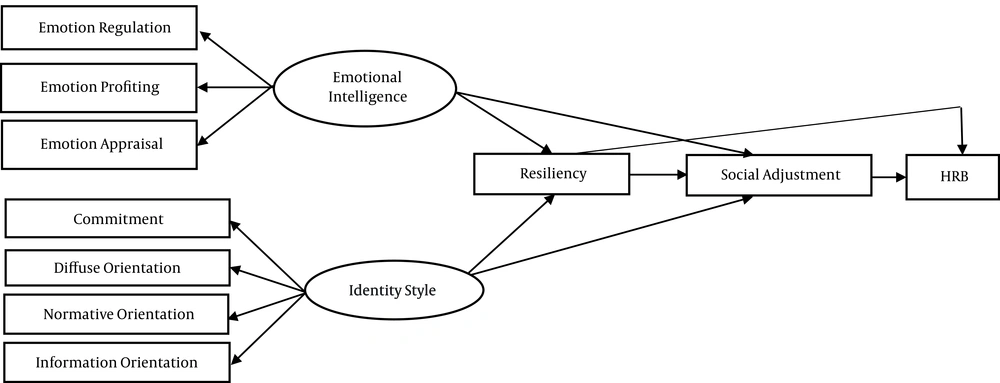
Figure 1.
Proposed Structural Equation Model of Precedents and Outcomes of High Risk Behavior
3. Materials and Methods
This is a correlational study via structural equation modeling (SEM), which is a general linear model testing a collection of regression equations, simultaneously. Structural equation modeling through AMOS-20 and SPSS-20 were used for data analysis. The sample size depends on several factors, including the size of the model, distribution of the variables, amount of missing data, reliability of the variables and strength of the relations among variables (13). An ideal sample size-to-parameters ratio would be 20:1 (14), and Kline (15) asserts that a typical sample size in studies where SEM is used is about 200 cases. In this study, with total observed variables of 10, an ideal minimum sample size would be 20 × 10 = 200. In order to achieve adequate statistical power (desired statistical power of 0.8, anticipated effect size of 0.1, with a model of two latent variables and ten observed variables) to observe true relationships in the data, the investigators decided to have a bigger sample size.
3.1. Participants
The participants of this study included prisoners that were prisoned during year 2014 (Iranian year 1393). The sample included 293 male prisoners chosen via simple random sampling. The participants ranged in age from 19 to 62 years old (M = 34.50, SD = 11.2). Overall, 69.9% of the subjects were married, 21.6% were single and 8.5% were divorced. Inclusion criteria were having at least 18 years of age, high school degree and willingness to participate in the research by answering the questionnaire; those participants who didn’t answer the questionnaire completely were excluded from the study. In order to gain the prison officials cooperation, a justification meeting was held to explain the objectives of the project for prison officials and prison psychologist. The subjects were justified by the prison psychologist, individually, and filled the questionnaire with no time limitation. Data collection lasted for about five months.
3.2. Instruments
Each participant filled out the following five questionnaires:
Youth risk behaviors survey (YRBS; 1992): this tool was developed by centers for disease control and prevention (CDC) to monitor health risk behaviors that contribute markedly to the main causes of death, disability and social problems among youth and adults. The YRBSS detects six categories of behaviors including those that contribute to violence, tobacco use, alcohol and drug abuse, high risk sexual behavior, dietary behaviors and physical activity (16). In the current study the 25-item version was administered, six items had to be answered by Yes/No and the other items were rated on a five-point Likert scale. Cronbach’s α in an Iranian sample was calculated as 0.79 (17). In the current study Cronbach’s α was 0.77.
Schutte emotional intelligence scale (SEIS: Schutte et al. 1998): The 33-item scale was developed based on the subcategories of Salovey and Mayer’s original EI model. The SEIS is structured on a five-point Likert scale (5 = strongly agree and 1 = strongly disagree), three of which (5, 28 and 33) are reverse coded and a total score is derived by summing up the items responses (18); a high score represents higher level of emotional intelligence, while a low score represents decreased level of emotional intelligence (19). The SEIS assesses three factors, including emotion regulation, profiting of emotion and emotion appraisal (20). Chan et al. (21) reported on the high internal consistency of SEIS with Cronbach’s alpha of 0.87. Cronbach’s α in the Iranian sample was reported as 0.81 (20). In the current study, Cronbach’s α was 0.88 for total scale and 0.82, 0.85 and 0.80 for subscales, respectively.
Identity style inventory (ISI; Berzonsky, 1989): This 40-item self-report instrument assesses four subscales including informational (eleven items), normative (nine items), diffuse-avoidant (ten items) and commitment identity styles (ten items). Participants rate each item using a five-point Likert scale (one = uncharacteristic to five = characteristic). Cronbach’s α for the informational style scale was 0.68, for the normative style scale was 0.62, for the diffuse-avoidant style scale was 0.72, and 0.71 for commitment (12). Cronbach’s α for the Iranian sample was 0.73 (22). In the current study, Cronbach’s α was 0.74, 0.82, 0.85 and 0.88 for informational, normative, diffuse-avoidant and commitment identity styles, respectively.
Social adjustment scale-self report (SAS-SR: Weissman and Paykel, 1978): SAS is a 54-item self-report scale established to measure social and vocational functioning. It assesses six subscales including work, social and leisure activities, family relationships, role as a marital partner, parental role and role within the family unit, such as perception about economic conditions. Each item is rated on a five-point Likert scale, with lower scores representing increased level of functioning. Cronbach’s alpha for the SAS-SR was 0.88 (23). In the Iranian sample the Cronbach’s alpha was reported to be 0.93 (24). In the current study, the Cronbach’s alpha was 0.92.
Connor-Davidson resilience scale (CD-RISC: Connor and Davidson, 2003): This 25-item self-report scale is rated on a five-point Likert scale ranging from strongly disagree (0) to strongly agree (4). The total score was calculated by summing up all responses and ranges from 0 to 100, with higher scores indicating increased level of resiliency (25). Previous research has shown that the CD-RISC has good internal consistency: values found for Cronbach’s alpha (0.89) (26). Cronbach’s alpha for CD-RISC in the Iranian sample was calculated as 0.93 (27). In the present study Cronbach’s alpha was 0.90.
4. Results
Descriptive statistics and correlation matrix for the variables are indicated in Table 1.
Table 1. Correlation Matrix and Descriptive Statistics for Study Variablesa
| Variables | 1 | 2 | 3 | 4 | 5 | 6 | 7 | 8 | 9 | 10 | 11 | 12 |
|---|---|---|---|---|---|---|---|---|---|---|---|---|
| HRB | - | |||||||||||
| Emotional intelligence | 0.51 b | - | ||||||||||
| Emotion regulation | 0.47 b | 0.86 b | - | |||||||||
| Emotion profiting | 0.44 b | 0.89 b | 0.68 b | - | ||||||||
| Emotion appraisal | 0.42 b | 0.85 b | 0.57 b | 0.57 b | - | |||||||
| Identity style | 0.62 b | 0.48 b | 0.45 b | 0.39 b | 0.41 b | - | ||||||
| Information orientation | 0.56 b | 0.51 b | 0.49 b | 0.38 b | 0.45 b | 0.86 b | - | |||||
| Normative orientation | 0.57 b | 0.39 b | 0.34 b | 0.33 b | 0.34 b | 0.89 b | 0.70 b | - | ||||
| Diffuse orientation | 0.32 b | 0.27 b | 0.21 b | 0.21 b | 0.28 b | 0.60 b | 0.33 b | 0.46 b | - | |||
| Commitment | 0.39 b | 0.25 b | 0.22 b | 0.22 b | 0.11 | 0.46 b | 0.49 b | 0.53 b | 0.005 | - | ||
| Resiliency | -0.20 b | 0.5 b 1 | 0.47 b | 0.44 b | 0.42 b | 0.62 b | 0.56 b | 0.57 b | 0.32 b | 0.39 b | - | |
| Social adjustment | 0.01 | 0.11 | 0.007 | 0.14 | 0.13 | -0.08 | -0.37 | -0.11 | 0.09 | -0.18 | -0.05 | - |
| Mean ± SD | 28.99 ± 12.06 | 108.4 ± 17.55 | 42.41 ± 6.89 | 33.24 ± 6.60 | 32.24 ± 6.65 | 129.4 ± 23.50 | 37.29 ± 8.85 | 30.10 ± 7.75 | 29.26 ± 7.61 | 32.79 ± 6.53 | 59.36 ± 21.27 | 27.66 ± 8.43 |
an = 150.
bSignificant numbers.
According to the data presented in Table 1, the mean (SD) scores obtained by the sample (n = 300) on variables of HRB was 28.99 (12.06), emotional intelligence 108.4 (17.55), identity style 129.42 (23.50), resiliency 59.36 (21.27) and social adjustment 27.66 (8.43). The HRB were positively associated with all the predictor and mediator variables, except social adjustment.
Model fit was evaluated based on several indicators including the root mean square of approximation (RMSEA), normed fit index (NFI), comparative fit index (CFI), goodness of fit index (GFI), incremental fit index (IFI) (Table 2). The RMSEA fit indices of zero are considered a perfect fit, and values less than 0.05 are considered a close fit. The CFI and NFI values range from zero to one with one representing a perfect fit. Values above 0.90 are considered to be excellent (28).
Table 2. Final Structural Equation Model Fit Based on Fit Indicators
| Fit Indicators | χ2 | df | χ2/df | GFI | IFI | CFI | NFI | RMSEA |
|---|---|---|---|---|---|---|---|---|
| Final model | 58.30 | 30 | 1.94 | 0.93 | 0.95 | 0.95 | 0.91 | 0.07 |
As seen in Table 2, the best fit to the data was obtained in the final model; χ2 = 58.30, P < 0.001; RMSEA = 0.07, CFI = 0.95, NFI = 0.91 and GFI = 0.93. The final model with a direct effect of emotional intelligence, identity style on social adjustment and resiliency, direct effect of social adjustment on resiliency, direct effect of resiliency on HRB and indirect effect of emotional intelligence and identity style on HRB with mediating role of social adjustment and resiliency is presented in Figure 2.
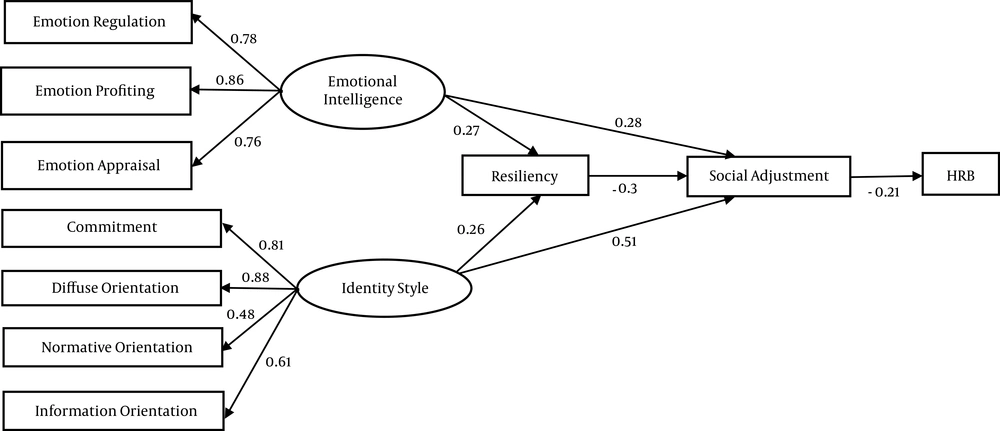
Figure 2.
All values are standardized coefficients, P < 0.001.
Indirect effects in the final model (Figure 2) indicate increased HRB was predicted by emotional intelligence via the mediating role of social adjustment and resiliency. The final model also indicates that HRB was predicted by identity style through the mediating role of social adjustment and resiliency. Indirect effects were tested by bias-corrected bootstrapped confidence intervals (29). The results of indirect effect are presented in Table 3.
Table 3. The Indirect Effect of Independent Variables on High-Risk Behavior via Mediator Variables
| Two Indirect Paths | β | Bootstrap | P Value | |
|---|---|---|---|---|
| Lower | Upper | |||
| EI → SA → R → HRB | -0.126 | -0.244 | -0.046 | 0.009 |
| IS → SA → R → HRB | -0.184 | -0.30 | -0.094 | 0.009 |
Abbreviations: EI, emotional intelligence; HRB, high risk behavior; IS, identity style; R, resiliency; SA, social adjustment.
As shown in Table 3, standard coefficients for both indirect paths are significant (P < 0.05) and because the obtained β was between lower and upper intervals, the mediator effect was confirmed.
5. Discussion
Overall, this study provides support for the hypothesis that the linkage between HRB, emotional intelligence and identity style is fostered through social adjustment and resiliency. The Structural equation modeling (SEM) revealed that the adequate fit for the theoretical model and all the paths in the modified model were significant. We find support for the indirect relationship of emotional intelligence on HRB with a mediating role of resiliency and social adjustment. Our results also highlight the indirect role of identity style on HRB through the mediating role of social adjustment and resiliency. Our findings are consistent with the previous research (27, 30-32).
Such a finding fits well with the Mayer-Salovey model of emotional intelligence that determined four components of emotional perception, emotional facilitation of thinking, emotional cognition, and emotional management. It can be explained that the higher a person’s level of emotional intelligence, the more emotional perception and emotional facilitation increase. Therefore, the person can face issues and stresses related to the social environment by organizing thoughts, memory, evaluation of environmental stimuli, and enhancing the ability to communicate in an integrated manner. On the other hand, people with high emotional intelligence have optimal emotional management and they can better handle negative emotions such as anxiety, depression, and irritability. They face fewer problems in difficulties of life and they can get rid of difficult situations more easily (33). Moreover, according to emotional intelligence structure and components, it can be said that perception and expression of emotions, efficiency of emotions, and emotion regulation in an unsafe and unpleasant situation act as protective factors and enhance one’s resiliency. As previously mentioned, the higher emotional intelligence, the more the likelihood of increase in resiliency against high-risk situations (34).
Additionally, resilient people are able to have control, they can avail themselves of confusion, and they are able to provide social support systems and broader family relationships to help them cope better (35). Furthermore, when people are unsuccessful in obtaining identity, behavioral and psychological problems may follow such as academic problems, drug abuse, and depression (36, 37). It can be said that informational and normative style of identity is associated with higher self-esteem and lower depressive reactions, neuroticism and HRB. In contrast, avoidance identity style has a relationship with problems of HRB such as alcohol and drug abuse, low self-esteem, and increased depressive reactions (38).
Overall, the findings of the present study have certain theoretical and practical implications. Theoretically, due to the novelty of the present model, this research leads to the expansion of existing models in the field of HRB. It is recommended for future studies to use another scale along with the Schutte emotional intelligence scale, to measure specific dimensions of emotional intelligence, so that, in addition to achieving more analytical data, the reliability of the present model would become obvious. Additionally, the research community and type of study limit the generalizability of the findings, interpretations, and etiological documents of the variables, which should be considered. Regarding the issue that emotional intelligence, social adjustment and constructive and effective confrontations are skills that must be learned and its quality like all other training tasks depends on people’s efforts to learn, it seems reasonable that emotional intelligence and social adjustment can be enhanced by regular and useful intervention and educational programs. Accordingly, the results of the present study can lead to intervention research in order to train emotional intelligenc skills and foster resiliency, and ultimately to prevent or reduce the tendency toward HRB.


