1. Background
School is a compulsory environment that affects the social development of adolescents, so it is important that the social connections occurring at school are rich and satisfying for students. However, some relationships between peers at school are abusive, which can negatively impact the lives of students (1). Bullying is the most common form of violence occurring at school (2).
Bullying is defined as repetitive aggressive behavior that causes damage to another person. Bullies and their victims exist in an unequal power relationship (3). Bullying can be direct or indirect. There are three types of direct bullying: physical (e.g, fighting, pushing, kicking, pulling hair, etc.), verbal (e.g., name calling, laughing, mocking, etc.), and intentional negative behavior. Indirect or relational bullying includes social isolation, exclusion (e.g, preventing access, holding out, avoiding, etc.), and spreading rumors about another student (4, 5).
Bullying is an unpleasant act with harmful and lifelong effects (6). Concerns about bullying are increasing in part because of the prevalence of the suicides of adolescent victims who were repeatedly harassed by their peers (7). In a study of 79 countries conducted between 2003 and 2011, the prevalence of bullying of students aged between 11 and 16 years was reported to be nearly 30% (8). The results of a study by Lotfi et al. (2014) on 591 students in Yazd aged between 10 and 14 years showed a 38% prevalence of bullying, where 6/22 students were bullied and 7/15 students were bullies (9).
A bullied student can experience a variety of psychological problems, such as insecurity, academic failure, isolation, absence from school, and even drop out. Bullying also has unpleasant effects on the bullied student’s physical and mental health, which can be put at serious risk (10, 11). Bullied students can experience victimization and show symptoms of borderline personality disorder (12). In addition, although little research has been done on the physical complaints of victims of bullying, it has been shown that head, arm, leg, knee, back, and abdominal pain are more prevalent in victims of bullying (13). Many factors play role in effectively reducing the severity of consequences resulting from bullying and in increasing victims’ psychological well-being, including a victim’s behaviors and coping strategies (14).
Victims of bullying often use emotion-focused coping strategies and avoidance to manage bullying, which are associated with depression, psychological problems, self-esteem issues, mental health concerns, low social support, and stress, causing the cycle of victimization to continue. Such strategies are generally considered incompatible (15). In addition, poor cognitive strategies such as ruminating and catastrophizing are related with increased depression levels. However, cognitive re-evaluation is associated with decreasing victims’ depression levels (16).
Cognitive-behavioral therapy is one of the interventions used for decreasing emotional problems in adolescents. The fundamental principle of cognitive-behavioral therapy is that individual cognitive processes, such as perception, concepts, judgments, and assessments, play a main role in the growth and survival of the emotional and behavioral responses of a person. Studies in this area (17, 18) have shown that cognitive–behavioral therapy is useful for internalizing symptoms in adolescents and children with anxiety disorders, depression, disruptive behavior patterns at school, antisocial and aggressive behavior patterns, sexual abuse histories, victimization risks, or deficits in cognitive or social skills.
2. Objectives
This study aimed to investigate the effectiveness of cognitive-behavioral group therapy on improving coping strategies and in reducing the symptoms of anxiety and depression as well as reducing physical complaints in victims of bullying.
3. Patients and Methods
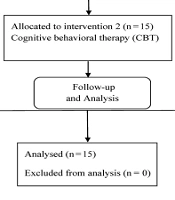
The current interventional study included a pretest and a posttest with a control group. The statistical population of the study consisted of all male students in the city of Zahedan studying in the 2014 - 2015 academic year. Samples were selected in two stages; the first was carried out to select people who were victims of bullying. At this stage, 400 people were selected through cluster sampling and were administered a questionnaire about bullying. The second stage of sampling focused on selecting a sample of people with high scores on a scale of bullying. Of the victims determined in the first phase of sampling, 30 people were randomly selected based on a cut-off point. Then, the participants were randomly assigned to the experimental group (n = 15) or to the control group (n = 15).
3.1. Olweus Bully/Victim Questionnaire
The Olweus bully/victim questionnaire has 26 items that measure the victimization of students experiencing bullying behaviors in three areas: verbal, physical, and emotional. Each item uses a six-degree Likert scale, where never = 0, once or twice = 1, a few times a month = 2, every week = 3, two or three times a week = 4, and almost every day = 5. Thus, the highest total score is 130. Since 5/49 is the average score, any higher score is considered to determine a victim of bullying.
The validation of the scale was conducted by Razieh Moradi et al. (2010). The construct validity of the questionnaire, which is determined by measuring the internal consistency of the micro-scale, was found to be between 0.75 and 0.93. The reliability is as follows: 0.98 for the total test, 0.99 for the verbal behavior section, 0.98 for the physical behavior section, and 0.98 for the emotional behavior section (19).
3.2. Youth Self-Report (YSR)
Another instrument used in this study was the YSR, which is used for people aged between 11 and 18 years and is based on the ASEBA (20). Three subscales for anxiety/depression, withdrawal/depression, and physical complaints were used from the YSR questionnaire to comprise the internalizing symptoms dimension. Participants are able to give a score of zero for any item that is not true, 1 for any item that is somewhat or sometimes true, and 2 for any item that is mostly or completely true. This questionnaire was normalized by Asghar Minaee (2006), and the Cronbach’s alpha coefficient for the YSR is between 0.74 and 0.88 (21).
3.3. Billings and Mouse’s Coping Strategies Scale
The scale introduced by Billings and Mouse (1984) was used to measure the coping strategies of the participants. This scale has 32 questions and measures 5 areas of coping strategies: emotion-focused coping, problem-focused coping, coping based on the evaluation of the situation, coping based on achieving social support, and coping based on physical inhibition or on the somatization of problems. Scoring has 4 levels, from zero (never) to three (always). The retest reliability coefficient is reported to be between 0.79 and 0.90 for the subscale of problem solving, 0.65 for the subscale of coping based on emotional inhibition, 0.68 for the subscale of coping based on cognitive assessment, 0.90 for the subscale of coping based on the somatization of problems, and 0.90 for the subscale of coping based on achieving social support. The internal consistency validity of the questionnaire is reported to be between 0.41 and 0.66 (22).
3.4. Method
After visiting the department of education in the city of Zahedan and obtaining the necessary licenses, the first stage of sampling was conducted. Then, the victim of bullying questionnaire was conducted on 400 students in the first stage. Between the 400 students included in first stage of sampling and in considering the 49.5 cut-off point of the victims of bullying questionnaire, 50 students in total were diagnosed as victims of bullying. Taking into account the inclusion criteria (i.e., obtaining a high score on the victims of bullying questionnaire, giving willing and informed consent to participate in the research, and completing the satisfaction form for treatment) and the exclusion criteria (having a severe physical illness that prevents further treatment, the unwillingness to continue treatment, and having certain general medical conditions), 30 students were randomly selected. Then, they were randomly assigned to either the experimental group (n = 15) or to the control group (n = 15).
A pretest was administered to both groups, and then the YSR and the Billing and Mouse’s coping strategies scale were given to both groups. The intervention was applied to the experimental group, which included 12 therapy sessions of 90 minutes each held at the Institute for the intellectual development of children and young adults. During this period, no intervention was implemented for the control group. After the intervention, a posttest was administered to both groups.
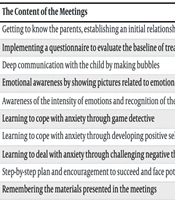
The structure of the cognitive-behavioral group therapy sessions was as follows (18, 23, 24). In the first session, the pretest was administered, the members and groups leaders were acquainted, and the treatment was standardized. In the second session, the students practiced good listening and verbal skills through practice and repetition. In the third session, the students were taught about the main aspects of the cognitive theories of emotion, distortion, and main logical errors, and they were trained to identify these intellectual errors. In the fourth session, students were trained on progressive muscle relaxation techniques and Ellis’ ABC pattern. In the fifth session, students were introduced to the downward arrow technique, the nature of schemes and their relationships to automatic thoughts, and to the ways of replacing irrational thoughts with rational thoughts. In the sixth session, students were trained to solve problems by distributing stress, identifying specific needs, identifying controllable and uncontrollable aspects, selecting targets by matching coping strategies, and assessment in certain situations. They also reviewed the downward arrow technique. In the seventh session, exercises were performed related to demanding and providing appropriate responses and skills related to showing positive and negative emotions. Students were also taught how to appropriately attack shameful emotions. In the eighth session, students were taught about softening techniques for overwhelming stress and perceptual shifts. In the ninth session, students were taught skills to say no to peer pressure. In the tenth session, students were trained on self-rewarding, consolidating the learned skills, and preparing for the end of treatment. In the eleventh session, students learned about anger, the impact of anger on behavior, and ways to control anger. In the twelfth session, discussions were reviewed and summarized, feedback about the meetings was obtained from the students, and the posttest was administered.
4. Results
Table 1 shows the means and standard deviations of variables in the intervention and control groups (Table 1). Before using parametric tests of covariance analysis to comply with its assumptions, Box’s and Levene’s tests were conducted. Based on Box’s test, which did not find significance for any of the variables of internalizing symptoms (BOX = 7.244; F = 1.066; P = 0.381) nor for coping strategies (BOX = 0.786; F = 0.242; P = 0.867), the homogeneity of variance-covariance matrices was properly observed. According to Levene’s test, which found no significance for any of the variables, the equality of variances was observed between the groups.
Table 1.
Means and Standard Deviations of Variables in the Intervention and Control Groups
| Variable | Group | Number | Pretest Mean | Pretest Standard Deviation | Posttest Mean | Posttest Standard Deviation |
|---|---|---|---|---|---|---|
| Anxiety/depression | Experimental | 15 | 16.66 | 1.29 | 13.86 | 1.06 |
| Control | 15 | 17.13 | 1.18 | 16.26 | 1.57 | |
| Withdrawal/depression | Experimental | 15 | 9.53 | 1.18 | 5.13 | 0.99 |
| Control | 15 | 9.46 | 1.12 | 8.73 | 1.16 | |
| Physical complaints | Experimental | 15 | 11.06 | 1.16 | 8.06 | 0.88 |
| Control | 15 | 11.36 | 1.18 | 10.26 | 0.96 | |
| Internalizing symptoms | Experimental | 15 | 37.26 | 1.90 | 27.06 | 1.23 |
| Control | 15 | 37.66 | 2.19 | 35.26 | 1.90 | |
| Problem-focused strategy | Experimental | 15 | 17 | 1.25 | 21.20 | 1.08 |
| Control | 15 | 16.73 | 1.16 | 17.66 | 1.04 | |
| Emotion-focused strategy | Experimental | 15 | 24.53 | 1.06 | 17.66 | 1.11 |
| Control | 15 | 24.60 | 1.24 | 23.06 | 1.16 | |
| Coping strategy | Experimental | 15 | 41.53 | 1.18 | 38.26 | 1.55 |
| Control | 15 | 41.33 | 1.58 | 40.73 | 1.79 |
As shown in Table 2, after adjusting the pretest scores, cognitive–behavioral therapy was found to have a significant effect on coping strategies (F (23,3) = 11.039, P < 0.001). In other words, the hypothesis that cognitive–behavioral therapy improves coping strategies in student victims of bullying was confirmed at a significant level (P < 0.001). In addition, after adjusting the pretest scores, cognitive-behavioral therapy was also found to have a significant effect on internalizing symptoms (F (23,3) = 12.134, P < 0.001). In other words, the hypothesis that cognitive–behavioral therapy reduces internalizing symptoms in student victims of bullying was confirmed at a significant level (P < 0.001), as shown in Table 2.
Table 2.
Credit Indices of a Multivariate Covariance Analysis on Internalizing Symptoms and Coping Strategies Variables
| Effect | Test | Value | df Hypothesis | df Error | F | P | Eta-Squared |
|---|---|---|---|---|---|---|---|
| Group membership of internalizing symptoms | Bartlett’s test | 0.678 | 3 | 23 | 12.134 | P ≤ 0.001 | 0.678 |
| Wilks’s lambda | 0.322 | 3 | 23 | 12.134 | P ≤ 0.001 | 0.678 | |
| Hotelling’s law | 14.788 | 3 | 23 | 12.134 | P ≤ 0.001 | 0.678 | |
| Roy’s largest root | 14.788 | 3 | 23 | 12.134 | P ≤ 0.001 | 0.678 | |
| Group membership of coping strategies | Bartlett’s test | 0.712 | 3 | 23 | 11.039 | P ≤ 0.001 | 0.712 |
| Wilks’s lambda | 0.288 | 3 | 23 | 11.039 | P ≤ 0.001 | 0.712 | |
| Hotelling’s law | 16.313 | 3 | 23 | 11.039 | P ≤ 0.001 | 0.712 | |
| Roy’s largest root | 16.313 | 3 | 23 | 11.039 | P ≤ 0.001 | 0.712 |
As shown in Table 3, after adjusting the pretest scores, the averages of the posttest scores of problem-focused coping strategies (F(1,26) = 159.169, P ≤ 0.001), the averages of the posttest scores of the excitement-focused coping strategies (F(1,26) = 285.476, P ≤ 0.001 ), and the averages of the posttest scores of coping strategies in general (F(1,26) = 26.013, P ≤ 0.001) were different between the experimental group and the control group. More specifically, cognitive–behavioral therapy was found to have an effect on the coping strategies of student victims of bullying, with 95% confidence. According to Eta-squared measurements, cognitive–behavioral therapy was found to be 50% effective. In addition, after adjusting the pretest scores, the means of the posttest scores of anxiety/depression (F(1,25) = 20.392, P ≤ 0.001), withdrawal/depression (F(1,25) = 99.346, P ≤ 0.001), somatization (F(1,25) = 95.540, P ≤ 0.001), and internalizing symptoms (F(1,25) = 277.325, P ≤ 0.001) were different between the experimental group and the control group. More specifically, cognitive-behavioral therapy was found to be effective in reducing the internalizing symptoms of student victims of bullying, with 95% confidence. According to Eta-squared measurements, cognitive–behavioral therapy was found to be 81% effective (Table 3).
Table 3.
Results of Multivariate Covariance Analysis Comparing Internalizing Symptoms and Coping Strategies Variables in the Intervention and Control Groups
| Variable | Component | SS | df | MS | F | Sig | Eta-Squared |
|---|---|---|---|---|---|---|---|
| Coping strategies | Problem-focused | 83.498 | 1 | 83.498 | 159.169 | P ≤ 0.001 | 0.860 |
| Emotion-focused | 218.601 | 1 | 218.601 | 258.476 | P ≤ 0.001 | 0.840 | |
| Coping strategies | 31.894 | 1 | 31.894 | 26.013 | P ≤ 0.001 | 0.500 | |
| Internalizing symptoms | Anxiety/depression | 36.610 | 1 | 36.610 | 20.392 | P ≤ 0.001 | 0.449 |
| Withdrawal/depression | 97.520 | 1 | 97.520 | 99.346 | P ≤ 0.001 | 0.799 | |
| Somatization | 34.296 | 1 | 34.296 | 95.540 | P ≤ 0.001 | 0.793 | |
| Internalizing symptoms | 474.458 | 1 | 474.458 | 277.325 | P ≤ 0.001 | 0.812 |
5. Discussion
This study aimed to investigate the effectiveness of cognitive-behavioral group therapy on coping strategies and in reducing internalizing symptoms (such as anxiety, depression, and physical complaints) in student victims of bullying. The results showed that cognitive-behavioral group therapy improves the use of coping strategies by increasing victims’ use of problem-oriented strategies and reducing the use of emotion-focused strategies. The results of this study correspond with those of Wesner et al. (25) and Hamdan-Mansour et al. (23), concluding that problem-focused strategies are more effective than emotion-focused strategies. Many factors cause the victimization of students, including victims’ coping strategies. In our study, after the intervention, the participants were aware that their problems should not be ignored but instead accepted and solved. Before the intervention, they were unaware of the behaviors that caused their conditions to continue; after the intervention, they attempted to solve their problems and benefit from the support of teachers at school.
In fact, cognitive techniques like changing catastrophic thoughts and dysfunctional beliefs correct distorted interpretations and increase victims’ ability to deal with stressful situations. In addition, behavioral techniques like exposure and role-play change the situations that cause a person to become and stay a victim of bullying. The combination of these techniques facilitates the use of problem-focused coping strategies to create positive emotions in people and.
The results of this study showed that cognitive–behavioral therapy is effective in reducing internalizing symptoms (i.e., anxiety, depression, and physical complaints) in student victims. The results of this study correspond with the results of Chu et al. (26), Lau et al. (27), Berry and Hunt (24), Fox and Boulton (28), and Kashikar-Zuck et al. (29) on the effectiveness of cognitive–behavioral therapy in improving anxiety, depression, and physical complaints. The experience of being a victim may equip the student with a unique cognitive bias that prepares him or her for failure, which is a characteristic of depression. In addition, victims and people with symptoms of depression show biases in cognitive processing, such as the deep encoding of negative information in the memory or the negative interpretation of ambiguous events (30). According to the cognitive model of depression, the experience of being a victim leads to the formation of assumptions or schemas about both the victim and the school environment. The activation of these dysfunctional assumptions stimulates automatic negative thoughts on the interpretation of current experiences, predictions about future events, or reminders of events in the past; these thoughts create depressive symptoms. Cognitive-behavioral group therapy disrupts this cycle and helps people to not only detect dysfunctional assumptions and negative emotions in stressful situations but also to challenge them. In addition, cognitive-behavioral group therapy can improve symptoms of physical pain in victims of bullying by changing their pain beliefs, such as believing that pain is a disease or that pain is harmful and disabling (29).
Using emotion-focused coping strategies, avoidance, and cognitive styles such as catastrophizing and self-blaming is associated with increased emotional problems in victims, such as anxiety and depression. However, cognitive-behavioral group therapy can increase self-esteem and a sense of control and can decrease internalizing symptoms in victims of bullying in educational environments. The use of questionnaires to identify victims of bullying, sampling the training course, the use of all male students, and the inability to pursue the results are the limitations of this study. It is recommended that future research considers these limitations.