1. Background
Oral cancer, one of the top 10 leading causes of death worldwide, has eluded state-of-the-art preventative and diagnostic procedures, despite the widely its known risk factors, signs, and symptoms, giving rise to an staggering incidence of 1 - 10 adults per 100000 men and women (1).
The first and foremost measure to be taken in assessing those prone to such malignancies, and cases of pre-cancerous lesions, is to conduct a thorough oral cancer examination following the reporting of a medical history. The former is particularly important on an annual basis for those above the age of 40 with an underlying propensity, according to American cancer society (2). There has been no official statistical data released regarding the essential frequency of these periodic examinations.
Given the expertise, knowledge, and experience of dentists in their frequent encounters with head and neck lesions, they have a particular advantage in the early detection, diagnosis, and prevention of oral cancers. Dentists are also expected to play a pivotal role in convincing those with a propensity to cancer to avoid known risk factors.
To our dismay, findings obtained from national surveys attest to the contrary, as, for instance, an overwhelming majority of dentists (90%) in Oroumieh were shown to have been inadequately informed in such respects, not to mention that they failed to carry out even the most routine physical (dental) exams as a part of their practice (3).
Another study, conducted in 2004 in Baabol, revealed that an overwhelming majority of dentists in that small city had been blissfully ignorant of the predisposing factors, the involved sites, and the pre-cancerous conditions pertaining to oral cancer (1). Hamedan was not shown to have fared any better when dentists in that state capital were assessed in terms of their theoretical knowledge regarding risk factors, predisposing conditions, and the most commonly affected sites (4).
Most studies in Iran have focused on dentists’ overall levels of knowledge of oral cancer (its risk factors, the most common sites of oral cancer, common age range of oral cancer patients, the most common precancerous lesions, etc.), but several have documented the considerable variability in dentists' knowledge and the thoroughness of the examinations and prevention practices they employ (5).
The aim of this study, unlike other nationwide research efforts that focus on theoretical knowledge regarding oral cancer, was to evaluate dentists’ opinions and practices regarding oral cancer assessment /prevention measures, the use of head and neck physical examinations during initial and recall appointments, and the strategies they adopt to convince those prone to avoid chief risk factors.
2. Objectives
This study provided information on current practices and perceptions of dentists, something that had not hitherto been reported in this region. More importantly, the findings of this study will help us facilitate better participation of dentists in preventing and detecting oral cancers early, which would ultimately benefit the healthcare system as a whole and improve survival rates among oral cancer patients.
3. Patients and Methods
A total of 134 randomly selected dental graduates were registered in this cross-sectional, analytical study. This is a good number, given the abundance of subjects, and lends support to our statistical analysis.
The study was conducted in Mashhad, the state capital of Khorasan Razavi, in the years 2011 and 2012.
Dentists were randomly selected using a table of randomized numbers. The vice chancellery of medical affairs of Mashhad provided a list of dentists working in the city, and questionnaires were distributed to them during their clinic hours and CME (continuous medical education) courses. Participation was voluntary, and all were informed that they could withdraw at any time and that their responses would be anonymous and treated confidentially. The entire questionnaire took 20 minutes to complete (Appendix 1).
This medical ethics committee at Mashhad University of Medical Sciences approved the study.
We decided to apply the modified standardized questionnaire (Horowitz et al., 2000) with corroborated reliability and viability (2). The questionnaire was adapted from previously validated items that have been applied in similar studies. The questionnaire was first pre-tested among a convenience sample, to ensure its clarity of interpretation and ease of completion.
The questionnaire is divided into six parts. Section one focused on the demographic data of the subjects, whereas the second part elicited information pertaining to risk factors of oral cancer.
Regarding dentists’ knowledge of the risk factors of oral cancer and for history taking, we used their responses to the eight health-history questions to develop a rating score, or index, of the comprehensiveness of oral cancer risk factors probed in medical histories. We based on this index on the number of risk factors probed, with each factor probed receiving a score of “1.”
Based on this index, which reflects the number of risk factors probed, we classified the dentists into one of three approximately equal categories of screening comprehensiveness: low (0 - 3 items), medium (4 - 6 items), or high (7 - 8) items.
We also used the five questions about the provision of oral cancer examinations in part three to develop two additional indices of compliance with recommended practices for identifying the number of different examinations that dentist provide for all of their patients.
Section 4 consists of three questions of self-assessment on the part of the dentists, considering their approaches and practices in their encounters with pre-cancerous lesions, and nuchal signs and symptoms such as lymphadenopathy. To measure their opinions, we provided dentists with five pre-coded response categories: “strongly agree”, “ agree,” “disagree,” “strongly disagree,” and an off-scale response category “don’t know”. For the purposes of this study, we collapsed the “strongly agree” and “agree” responses to identify any agreement with an item.
We added part 5 to the original questionnaire to assess dentists’ practices regarding encouraging patients to avoid risk factors, knowledge about symptoms of oral cancer, their estimation of visiting oral cancer patients, and referral patterns.
The latter part focuses on dentists’ predilection for participating in CME training courses, concentrating on these seemingly neglected hot topics and suggestions for how to maximize the efficacy of these training programs.
Data management and statistical analyses were performed using the statistical software SPSS version 11.5 Inc., Chicago, IL.
4. Results
First, it is worth noting that not every dentist managed to respond to all given questions. Thus, the findings presented are the absolute percentage of frequency concerning every question, which involves only those who responded to the entity, rather than the total number of respondents. It is, therefore, no wonder that the response rate did not reach 100%.
With an average age of 48.7 ± 6.41 (five participants declined to state their age), a majority of 71% male and a minority of 27% female participants were recorded into our registry.
Mashhad dental school graduates constituted 56% of subjects, whereas 25% had graduated from other dental schools. Fully 67.2% were identified with work experience in excess of five years, and the majority was in private practice (60.4%).
4.1. Screening Patients for Oral Cancer Risk Factors
Only 27.4% of the registered participants considered all eight items pertaining to risk factors.
Former smoking and/or tobacco use was investigated by a considerable number, 69%, followed by current tobacco use being considered by 63% of dentists. Further details regarding the quantity and type of tobacco used were asked about by half of dentists, whereas 43% of practitioners required an explanation from their patients regarding drug use other than smoking as a part of their history taking (Figure 1).
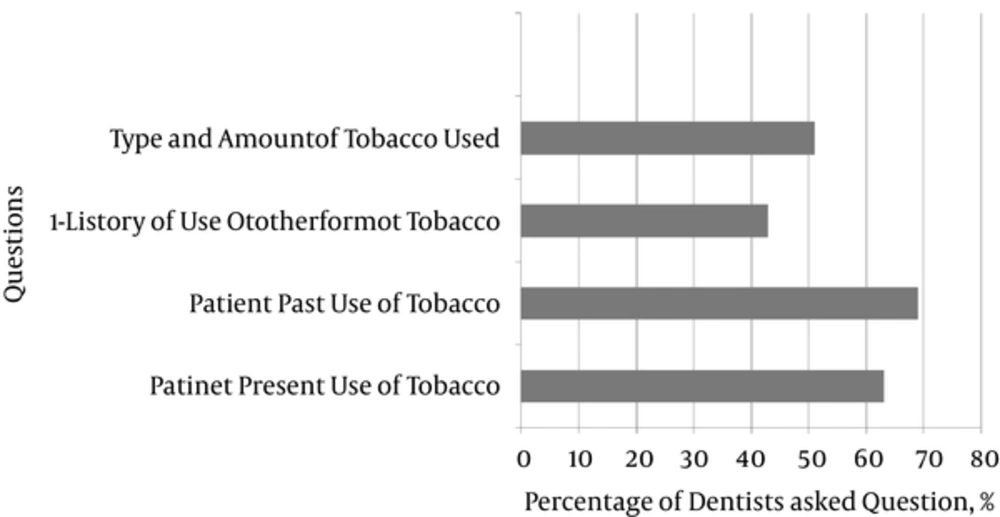
Figure 1.
. Investigation of Smoking/and Tobacco Use by Dentists
4.2. Provision of Oral Cancer Examination
An average of 35.4% of dentists claimed to have examined their patients for pre-cancerous and cancerous lesions. These figures declined to a staggering 11.6% when it came to regular periodic assessments for those above the age of 40, and 33.4% for the edentulous. Also, the care declines when only 16% of patients over the age of 18 were examined for nuchal lymphadenopathy. Oral exams were conducted for only 76.6% of those with a high propensity for cancerous conditions.
4.3. Dentists’ Opinions About Their Education in Oral Cancer
Questions 7 - 9 required participants to state their personal opinion pertaining to every given question. They used terms including: “totally agree”, “agree”, “disagree”, “totally disagree” and “I don’t know”.
As can be seen in Figure 2, 59.3% of dentists (agree/ totally agree) believed in their diagnostic skills pertaining to assessing pre-cancerous or cancerous lesions (Figure 2).
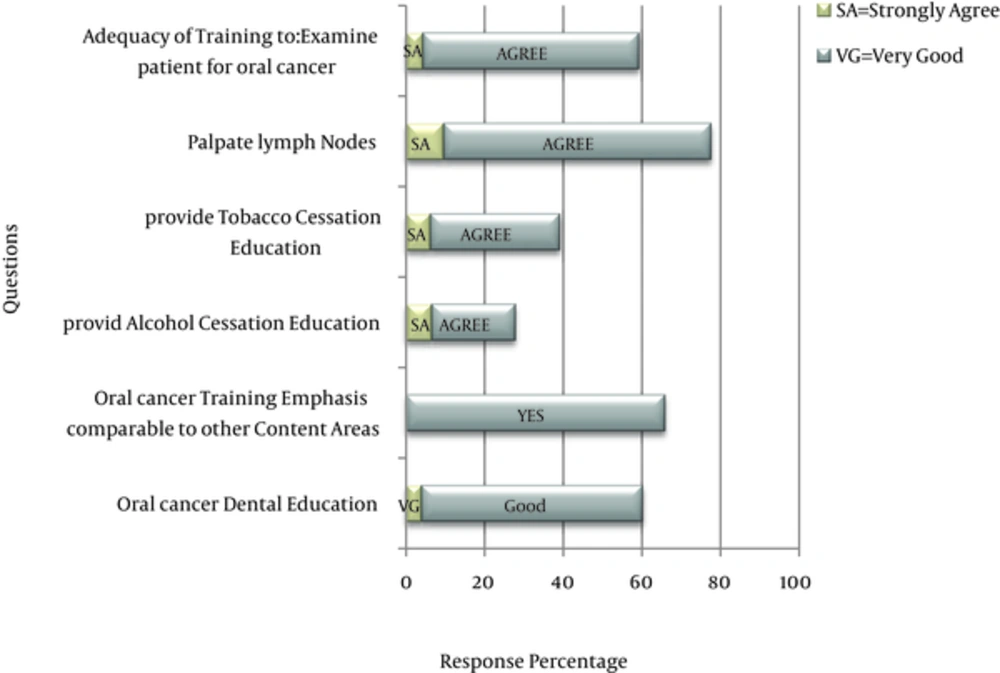
Figure 2.
Opinion of General Practice Dentists Regarding the Adequacy of Their Oral Pharyngeal Cancer Training and Education
This self-confidence in dentists’ screenings rose to 77.6% when speaking of detecting nuchal lymph nodes, while only 39.1% chose agree/totally agree when asked about the knowledge and skill needed for assisting their patients in efforts to abandon smoking. In a sharp contrast, only 27.8% asserted (agree/totally agree) that they are sufficiently equipped with knowledge and experience to help their patients break their excessive drinking habits.
Unsurprisingly, a great majority, almost 90%, of dentists encouraged patients to stop smoking.
Roughly two-thirds (65.9%) of dentists rated their training in cancer detection on par with other professional skills, while 60% assessed the quality of this training to be “good” or “very good”.
More than half (55%) reported their annual encounter rate with cases of suspected malignancy (1.77 patients on average, annually). More than 90% of dentists preferred to refer possible cases to oral medicine specialists.
The respondents’ knowledge concerning the symptoms of oral cancer was assessed through question 11; however, a small percentage of dentists correctly mentioned one to three symptoms of oral cancer (24.6 - 20.1%).
There was no significant relationship between age, gender, city of graduation, years of experience, and the practice of oral cancer prevention.
It is interesting to note that an overwhelming majority (96.7%) was willing to receive further training in cancer detection. Less than half (45.7%) of respondents preferred seminars as their preferred mode of training for both knowledge and skill acquisition.
5. Discussion
As previously mentioned, this was the first study of its kind at the national level. Therefore, there is no way to make a nationwide comparative analysis. Caution has to be practiced when comparing data with other nationalities, given intervening parameters affecting knowledge, motive, therapeutic techniques, and preventive patterns. Key influential parameters include study design, the diversity of questionnaires, and, above all, educational systems, which can vary greatly across countries.
It is well established that virtually all oral cancers are preceded by visible changes in the oral mucosa, therefore a comprehensive oral cancer examination and risk habits assessment are among the measures that lead to the prevention and early detection of oral cancers. Having appropriate knowledge of the cancer’s risk factors, and the ability to recognize oral cancer, is a prerequisite for dentists’ providing appropriate information and oral examinations.
The first and foremost step regards history-taking with a focus on risk factors, providing sufficient insight to patients in this regard and persuading them to avoid risks. To our dismay, this has been rated relatively low among our dentists (34%).
As for asking about current and past smoking (63% and 69%, respectively), a study in Italy presented rates of asking there at 89.3% and 74.4% (6), whereas in the U.S. 90% and 77% were questioned. Another 72% of dentists investigated the details pertaining to the smoking habits of their patients (2). A study in Massachusetts, in the US, also returned somewhat similar figures (7), whereas among dentists in Germany and Ireland, 90% took the related history and 83% felt it was their duty to help patients break their unhealthy habit, as opposed to the U.K where there were only 19% felt the same urge (2, 8, 9).
As can be observed, Iran is almost at the bottom of the table in this comparison, which stirs the urge for certain drastic actions.
As for helping patients to avoid risks factors, dentists not only need the expertise to advise, there must also be motivation and willingness to change on the part of the patient. We came up with a 39% intervention rate for smoking and 27% for that of alcohol, in terms of dentists’ self-assessments of their expertise, in contrast with a considerable 90% who, despite their insufficient knowledge, intervened to stop patients from smoking. This rate is only 13% in Canada (10) and 27% in Ireland, though 90% believed this falls within their sphere of duty (9). Dentists in South Carolina (19%) stated that they were aware of the basis for such intervention (11), whereas their Colombian counterparts (75%) believed they were capable of informing their patients on the potential hazards (12).
In Sri Lanka, 62% of dentists considered themselves capable as such, while 60% considered the training “essential” (13).
Generally, there have been contradictions in findings reported through various studies. Nevertheless, the common ground is that there is insufficient self-trust in dentists’ professional capacity to provide such consultations to their patients, with many practitioners practicing on a spontaneous basis without any organized or official training. This is despite the fact that the WHO identifies dentists as one of the most capable and potent healthcare providers in this respect. This is heartening to know, as the mortality and morbidity of oral cancers can only be significantly reduced through education about the risks posed by tobacco, betel liquid chewing, and alcohol abuse, in addition to parallel programs on oral cancer examination.
In recent years, training has been incorporated into Iran’s national dental curriculum (13), giving us hope for better outcomes in the coming years (14).
The next in the list of priorities is to screen for cancerous and pre-cancerous lesions via thorough head and neck examinations. The only two existing national studies, ours and one in Isfahan, indicated that only 34% of dentists seem equipped with essential knowledge in this respect (15).
American dentists were shown to be a far cry ahead of Iranian ones, with 92% performing thorough exams for patients aged 40 - 55, 93% for those above age 56, and 82% for clients above 40 (2, 7). In Ireland and South Carolina, the rate was 89% (for patients 18+) and 81% (for half of all referred patients) (9, 11). Almost half of Italian dentists routinely did this for their patients over the age of 40 during their first visit, with the confidence in their skill and expertise (6).
In the U.K., 92% of dentists, maxi-mandibular surgeons, and oral disease specialists use their knowledge in their daily practice.
Despite the high prevalence of oral cancer in India, only 37% of dentists performed the through exam. In Sri Lanka, 77% agreed that it is essential, but 70% needed training for it (13, 16).
Asian nations, Southeast ones in particular, have reported higher prevalences of oral malignancies compared with American and European counterparts, yet there has not been sufficient emphasis on regular periodic exams or screaming measures.
Despite the training Iranian dentists receive on the matter along with other entities, only 35% use this during a first visit to detect malignant and pre-malignant lesions, though 65% believed they had had the relevant training to do so.
What is most disappointing is that Iranian screening measures fall short of other nations. Moreover, although our dentists seem more than willing to acquire the essential knowledge and skill in this respect, they do not feel obliged to practice this knowledge of theirs, as they believe it falls beyond the scope of their professional duty. It is clear that early detection and diagnosis constitute the core of secondary prevention, which can only be accomplished through regular screenings and check-ups in the middle-aged and among those with pertinent risk factors. For now, Iranian dentists suggest proper and due referrals to oral medicine specialists, which can effectively prevent both confusion and delay.
We acknowledge the limitations of self-reporting surveys, where dentists may have a tendency to provide socially acceptable responses that may not necessarily reflect their daily professional practices, and this could not be assessed within this study. However, the anonymous nature of the questionnaire should have minimized this type of information error.
It is well established that dentists’ knowledge, attitudes, and practices are positively influenced by continuous education courses; therefore, it is not surprising that CME in the area of oral cancer is a strong influence in motivating dentists to conduct examinations for oral cancer. Normally, with increasing age and time passed after graduation, we can expect dentists’ knowledge to decrease, but this was not the case in our study.
Surprisingly, there can be seen a degree of incongruity between our dentists’ capabilities, knowledge, and expertise in performing thorough head and neck exams on the one hand, and their level of actual performance on the other, which requires further investigation and/or intervention to be resolved. Yet, field studies across the cities of Mashhad and Sari revealed that neither our dentists’ theoretical knowledge of the signs and symptoms of malignancy nor their competence in detecting and preventing oral cancer are within an acceptable range (17, 18). However, this study should be viewed as a pioneering, methodological study, rather than as a general survey of dental practice in anticipation of conducting a larger, nationwide validation study in the future.
5.1. Conclusion
The findings of the present study suggest that there is a need to reinforce the undergraduate dental curriculum with regards to oral cancer education, particularly in its prevention and early detection.
Akin to other domestic and overseas centers, our dentists expressed their willingness to attend training courses in cancer screening and prevention in the form of interactive CME seminars.
This must be noted by our dental and medical education planners, so as to include content on smoking and related cessation programs, along with the latest diagnostic and detection techniques, pertaining to oral cancer.