
1. Background
Dentistry is a specialized field that contributes significantly to oral and dental health, which are vital components of overall mental and physical well-being, aesthetics, and pronunciation. With advances in dentistry, many diseases can be detected in their early stages, allowing for prevention of further progression (1). Dentistry is rapidly evolving, especially with the integration of new technologies (2).
The global increase in mobile phone and wireless technology use has transformed practices in both medicine and dentistry. These advancements have improved patient management quality and enabled the remote management of healthcare centers and consultation with experienced professionals from afar. This remote delivery of health services, known as Telemedicine, has applications across various fields, including psychotherapy, imaging, pathology, home healthcare, and emergency microbiota treatment. The exchange of clinical information and images over distances specifically for dental consultation and treatment planning is termed tele-dentistry (3-5).
Tele-dentistry employs two primary methods: (1) a synchronous, real-time interaction, and (2) an asynchronous (store-and-forward) method, where clinical information, radiographs, photos, and lab tests are sent to facilitate consultation between dentists and patients. Tele-dentistry also supports remote monitoring of treatment progress, preventive care, dental education programs, and access to oral health services (6-9).
While many studies highlight the benefits of tele-dentistry, a gap remains in awareness among dentists and dental students in universities and private practices regarding its potential applications. Evaluating dentists' true attitudes and knowledge of tele-dentistry is essential to promote its routine adoption (10, 11).
A study by Ozveren et al. explored the knowledge and attitudes of dentists and patients in Turkey toward tele-dentistry. Using a Google Docs Questionnaire distributed virtually among 336 Turkish dentists, they found that 86.9% were interested in using tele-dentistry for radiological exams, follow-ups, and vacation care, though only 34.0% were willing to try tele-dentistry. Additionally, 21.1% thought tele-dentistry could become a new standard of care (12). Similarly, Aktas et al. investigated the knowledge, attitude, and practices (KAP) of dental students concerning tele-dentistry in pediatric dentistry. This cross-sectional analytical study involved an online survey assessing socio-demographic information and KAP about tele-dentistry. Results revealed that prior to COVID-19, only 2.8% of students were aware of tele-dentistry; however, this awareness increased to 45% post-pandemic (10).
In a recent study, Mohamed et al. investigated the KAP of dental interns in Libya regarding the use of tele-dentistry for diagnosing periodontal diseases. This analytical cross-sectional study employed a 28-question survey among 42 dental interns. The results showed that most participants (59.5%) considered tele-dentistry reliable for diagnosing periodontal diseases, and the majority (64.3%) had a satisfactory level of trust in tele-dentistry equipment. However, over 45% of participants expressed concerns about patient privacy. Most interns indicated they would likely incorporate tele-dentistry into their future practice (13). In another study, Prasidhati et al. explored the KAP of dentists in Jakarta, Malaysia, regarding tele-dentistry. This cross-sectional study used an online self-administered questionnaire with a purposive sampling method, completed by 183 dentists. The findings revealed that 95.6% of respondents demonstrated good knowledge of tele-dentistry, 83.1% had a positive attitude, and 60.7% reported previous tele-dentistry use. Additionally, a significant proportion (86.3%) expressed a desire to adopt tele-dentistry in their future practice (5).
With advancements in information technology, dental knowledge has progressed significantly beyond previous limits. Tele-dentistry can play a crucial role in managing oral and dental health issues for people in rural areas who lack access to a dentist (8, 10). This technology is increasingly accessible, reducing treatment costs and enabling patients to connect with dental professionals remotely. Additionally, the COVID-19 pandemic has led to a rise in tele-dentistry use as social distancing measures reduced the need for in-person visits (5, 11). Recently, certain misconceptions and misapplications within tele-dentistry have been noted, drawing parallels with issues explored in Tele-veterinary fields (7, 9).
2. Objectives
Given the growing importance of tele-dentistry and its potential to enhance dental service delivery, this study aimed to assess the KAP of general dentists toward this technology, as well as to explore ways in which tele-dentistry could be effectively utilized. The null hypothesis of this study is that the KAP of general dentists toward tele-dentistry is acceptable.
3. Methods
In this cross-sectional study, all general dentists in Semnan were invited to participate. Dentists who consented were included, and incomplete questionnaires were excluded from the final analysis. The study received ethical approval from the University’s ethics committee (IR.SEMUMS.REC.1403.007), and written consent was obtained from all participants. Demographic data, including age, gender, and years since graduation, were collected. The KAP of general dentists toward tele-dentistry were assessed using a 15-item self-designed questionnaire, developed with inspiration from a previous study (10). The questionnaire consisted of three sections: Three questions with eight options assessing knowledge, ten questions assessing attitude, and two questions assessing practice. For knowledge questions, correct responses were scored as 1, while incorrect responses were scored as 0. Attitude responses were based on a 5-point Likert Scale, ranging from 1 (strongly disagree) to 5 (strongly agree). For practice questions, responses were scored as 1 (practice) or 0 (no practice), allowing for a comprehensive assessment of the dentists’ understanding, perception, and use of tele-dentistry in their practice.
The Persian version of the final questionnaire underwent qualitative content validity assessment by faculty members at Semnan University of Medical Sciences. Reliability was determined through a test-retest method, following the guidance of a statistician. For this purpose, the questionnaire was administered to five dentists twice—initially and then again after seven days—to measure the correlation coefficient.
Data analysis was conducted using SPSS version 26. Skewness, Kurtosis, Kolmogorov-Smirnov, and Shapiro-Wilk tests confirmed a normal distribution of the data. Consequently, Independent t-tests, Mann-Whitney U-tests, and Pearson correlation were applied, with a significance level set at 0.05.
4. Results
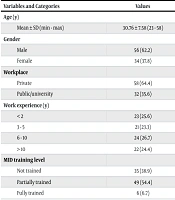
In this study, 50 general dentists from Semnan participated, with 54% (27 participants) being female and 46% (23 participants) male. The mean age of the participants was 30.2 ± 6.48 years, and the mean number of years since graduation was 7.74 ± 5.13 years. Based on the findings, 68% (34 participants) of participants had graduated less than 10 years ago, while 32% (16 participants) had been practicing for more than 10 years. Detailed responses to each question are presented in Table 1.
Table 1.
The Participants’ Answer to Each Question
| Questions | Scores; (%) | ||||
|---|---|---|---|---|---|
| Strongly Agree | Agree | No Opinion | Disagree | Strongly Disagree | |
| Tele-dentistry can be used for children. | 2 | 20 | 70 | 8 | 0 |
| Tele-dentistry helps pediatric patients to consult with a specialist about their problems. | 12 | 48 | 26 | 14 | 0 |
| Tele-dentistry can provide early and easy consultation with a specialist. | 8 | 42 | 14 | 36 | 0 |
| Tele-dentistry improves access to oral health services for pediatric patients, especially in rural areas. | 6 | 82 | 6 | 2 | 0 |
| Tele-dentistry can be a good tool to provide oral and dental hygiene instructions to pediatric patients. | 4 | 68 | 26 | 2 | 0 |
| In tele-dentistry, in pediatric patients, dental examination through online video calls and intraoral cameras is as effective as a traditional office environment. | 4 | 2 | 18 | 68 | 8 |
| Tele-dentistry can help monitor the oral and dental health of a pediatric patient. | 6 | 88 | 0 | 6 | 0 |
| In addition to regular examinations provided by a pediatric dentist, tele-dentistry can also be used. | 4 | 22 | 64 | 8 | 2 |
| Tele-dentistry saves time for patients and dentists. | 10 | 18 | 70 | 2 | 0 |
| Tele-dentistry can be used for continuous training of dentists. | 14 | 82 | 2 | 0 | 2 |
The mean knowledge score of the participating dentists regarding tele-dentistry was 5.96 ± 1.07. Analysis indicated a significant relationship between knowledge and gender; according to the Mann-Whitney test, knowledge of tele-dentistry was significantly higher in male dentists than in female dentists (P = 0.037). Additionally, Pearson correlation showed a significant relationship between knowledge score and years since graduation, with knowledge decreasing as the number of years since graduation increased (P = 0.009, r = -0.367) (Figure 1 and Figure 2).
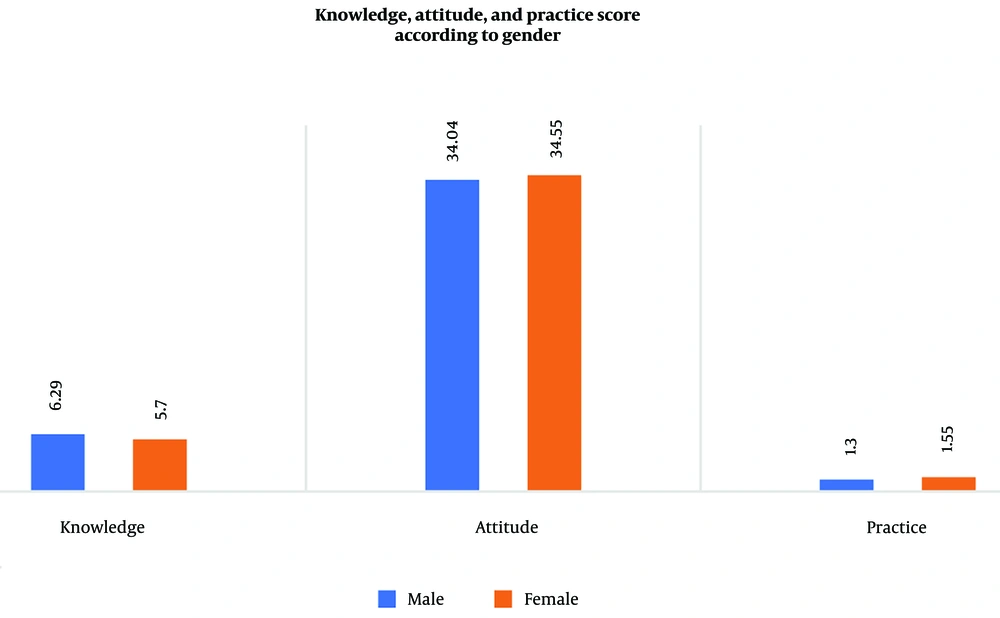
Figure 1.
Knowledge, attitude and practice score according to gender
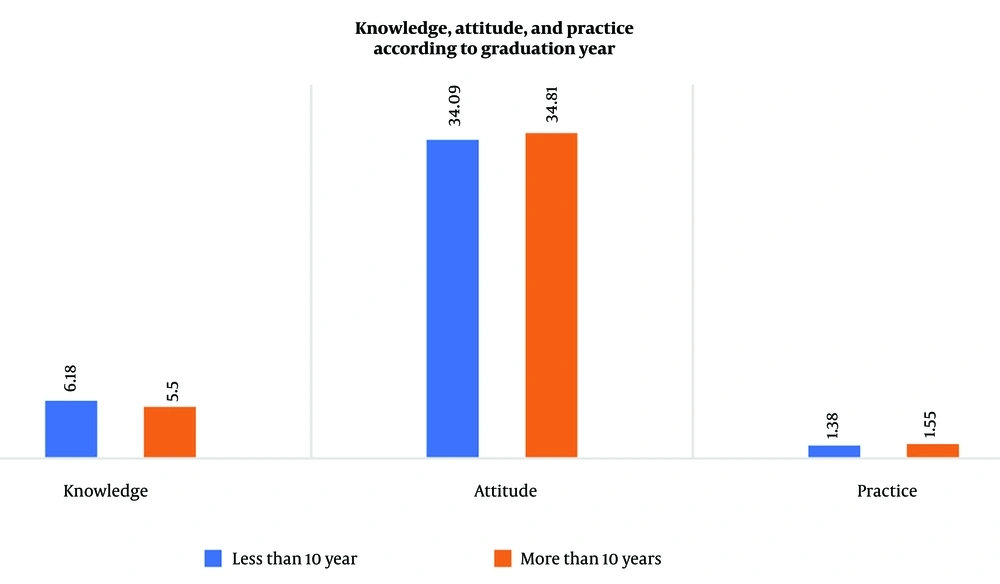
Figure 2.
Knowledge, attitude and practice score according to graduation year
The mean attitude score of the dentists regarding tele-dentistry was 34.32 ± 3.41 out of a possible 50, with scores ranging from 30 to 47. The Mann-Whitney test showed no significant relationship between attitude and gender (P = 0.535). Furthermore, Pearson correlation analysis found no significant relationship between attitude score and years since graduation (P = 0.702, r = -0.055) (Figure 1 and Figure 2).
The mean practice score of the dentists regarding tele-dentistry was 1.44 ± 0.5 out of a possible 2, with scores ranging from 1 to 2. According to the Mann-Whitney test, there was no significant relationship between practice score and gender (P = 0.077). Additionally, Pearson correlation analysis indicated no significant relationship between practice score and years since graduation (P = 0.240, r = 0.169) (Figure 1 and Figure 2).
5. Discussion
This research aimed to assess the KAP of general dentists towards tele-dentistry. The study found that male participants had significantly higher knowledge scores than female participants. A similar result was observed in a study by Aktas et al. in Turkey, which investigated the KAP of dental students regarding tele-dentistry in pediatric dentistry and found that male students had significantly higher knowledge scores than female students (10). This finding aligns with the results of our study.
In another study, Prasidhati et al. in Malaysia examined the KAP of dentists in Jakarta concerning tele-dentistry and found that men had higher knowledge scores than women (5), further supporting our findings. However, a contrasting result was reported by Mohamed et al. in Libya, who investigated the KAP of final-year dental students regarding tele-dentistry for diagnosing periodontal diseases. Their study, which used a 28-question Likert-Scale Questionnaire to evaluate KAP, found no significant difference between KAP scores by gender (13). This discrepancy may be attributed to the sample composition in Mohamed et al.'s study, where only 5 out of the final-year students were female, and the majority were male, potentially affecting the comparability of gender-based results.
The results of this study indicated a significant inverse relationship between the knowledge score of participants regarding tele-dentistry and the number of years since graduation, with knowledge decreasing as years since graduation increased. A similar finding was reported by Alshammari and Almaktoom in Saudi Arabia, who investigated dentists' knowledge and attitudes toward tele-dentistry using a questionnaire. Their study found an inverse relationship between tele-dentistry knowledge and years since graduation (14), consistent with the results of this study.
In contrast, Zotti et al. conducted a study examining the use of selfies and text messages shared between patients, parents, and dentists through WhatsApp. They found no significant relationship between the number of years since graduation and dentists' knowledge regarding tele-dentistry (7), which differs from the findings of this study. This discrepancy may be attributed to differences in the demographic characteristics of the populations studied, as well as variations in sample sizes across the studies.
In terms of practice, the current study found that 52% of participants had used tele-dentistry, and 96% expressed an intention to use it in the future. This aligns with findings from a similar study by Alshammari and Almaktoom in Saudi Arabia, which assessed dentists’ knowledge and attitudes toward tele-dentistry. Using a five-point Likert Questionnaire with 203 dentists and 309 patients, the study revealed that over 50% of dentists recognized the value of tele-dentistry and actively used it, while more than 85% found it beneficial and planned to use it in the future. Both dentists and patients showed optimism and support for tele-dentistry, consistent with the results of the present study (14). Similarly, Ozveren et al. in Turkey examined the knowledge and attitudes of general and specialist dentists toward tele-dentistry. The questionnaire, distributed online among 336 dentists, revealed that 86.9% of respondents expressed a desire to use tele-dentistry in the future for tasks such as radiological examinations, certain follow-up assessments, and remote consultations during vacations. Overall, the study suggested that tele-dentistry offers convenience in dentist-patient relationships and contributes to cost-effective and efficient dental care (12), findings that also align with the current study’s results.
In Libya, Mohamed et al. explored the knowledge, attitudes, and practices of final-year dental students regarding tele-dentistry for diagnosing periodontal disease. Their study, which involved a 28-question Likert-Scale Questionnaire, found that 59.5% of participants used tele-dentistry for periodontal diagnosis (13), a finding that closely matches the results of the current study.
In a study by Prasidhati et al. in Malaysia, the KAP of dentists in Jakarta regarding tele-dentistry were examined. The results showed that 60.7% of dentists had used tele-dentistry, and 95.9% intended to use it in the future (5), findings that align closely with those of our study. In contrast, Zotti et al. conducted a study examining the use of selfies and text messages shared by patients and parents with dentists, finding that only 29.9% of dentists had used tele-dentistry (7), a percentage notably lower than in our study. This difference may be attributed to the fact that Zotti et al.'s study was conducted before the COVID-19 pandemic, a period when awareness and adoption of tele-dentistry were relatively low. The pandemic likely heightened interest and familiarity with tele-dentistry, leading to increased usage in recent years.
5.1. Limitations
As with any research, this study has certain limitations. One limitation is the presence of various known and unknown factors that may have influenced the results, necessitating further time and precision to fully investigate these elements. While efforts were made to control for limitations that could be addressed, ensuring the accuracy of the results and enhancing their generalizability, certain factors remain beyond control.
Additionally, given the broad scope of the topic and the inherent limitations of the measurement tools used, any conclusive interpretation of the findings should be approached cautiously. To build on these findings, further extensive studies are recommended for future researchers to gain a deeper understanding of the topic.
5.2. Conclusions
The study found that knowledge of tele-dentistry was significantly higher in male dentists compared to female dentists, and there was a notable inverse relationship between knowledge scores and years since graduation. However, no significant relationships were observed between gender and attitude or practice regarding tele-dentistry, nor between years since graduation and attitude or practice.
These findings suggest that health policies should prioritize training for general dentists to enhance their knowledge and practical application of tele-dentistry. This focus on education can support more informed decision-making in clinical management and the practical use of tele-dentistry. Adopting the best treatment methods will ultimately lead to higher patient satisfaction, which is strongly recommended.