
1. Background
High-risk behaviors are potentially harmful and are conducted by people arbitrarily or inadvertently without awareness of possible adverse outcomes (1). The involvement in high-risk behaviors depends on biological, individual, environmental, social, and cultural factors. Some researchers believe that adolescents’ tendency to high-risk behaviors reflects their involvement with emotional and psychological issues (2). Among the individual factors mindfulness that includes a number of components required for adaptive coping strategies (3).
Mindfulness is defined as a form of meditation achieved by paying attention purposefully to the present time without having any judgments and prejudices. It requires specific behavioral, cognitive, and metacognitive strategies to focus on the attention process. This, in turn, prevents diminishing spirals of negative moods/negative thoughts and tendencies to provide worrisome responses, aids in developing a new perspective, and leads to the emergence of pleasant thoughts and emotions (4). Christina et al. (5) concluded that there was an association between mindfulness and high-risk behaviors in terms of alcohol consumption, cigarette smoking, violence, and hookah smoking. Several factors play mediating roles in the relationship between mindfulness and high-risk behaviors among which, the role of social-virtual networks is noticeable (6). Social-virtual networks are tools that enable users to connect with each other by creating personal information profiles and inviting their friends, acquaintances, and coworkers to share their information and send e-mails and instant messages to them. These personal profiles include different types of information, photos, videos, audios, and weblogs (7).
The speared of high-risk behaviors has made determining and explaining factors affecting delinquent behaviors the focus of sociology of deviations (8). Moreover, the attractiveness of social-virtual networks, on the one hand, and the ease of using these networks, on the other hand, have raised a serious question about the relationship between being a member of these social-virtual networks and changing adolescents’ behaviors in a way that they become more interested in conducting high-risk behaviors. While the importance of mindfulness in young adults’ mental health is quite clear, as far as the authors know, no studies investigated the relationship between the above-mentioned variables. This could make a serious gap in the literature of high-risk behaviors and cause much harm to society, especially teenage students. Therefore, the current study aimed to develop a causal model between mindfulness and high-risk behaviors mediated by social-virtual networks.
2. Objectives
This study sought to answer the following questions:
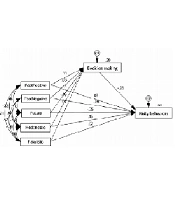
-Is the causal model between mindfulness and high-risk behaviors mediated by social-virtual networks (Figure 1)?
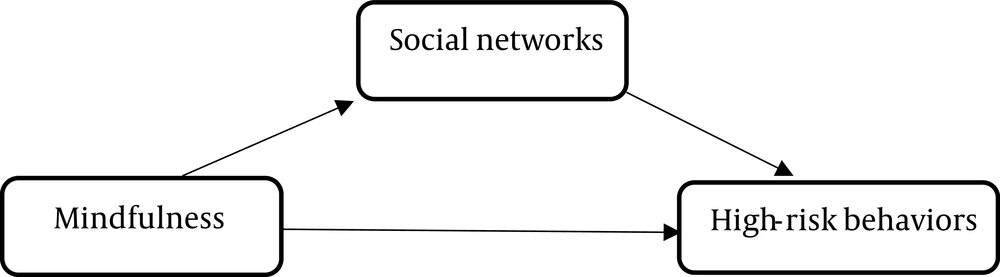
Figure 1.
The hypothetical model of research
-Are the components of mindfulness and social networks related to having a tendency to high-risk behaviors?
3. Patients and Methods
This was a descriptive correlational study done on senior high school male students in Zahedan. Among these students, based on the Krejcie and Morgan’s table, 370 students were selected randomly using the cluster random sampling method. For this purpose, first, four schools were randomly chosen from four regions of Zahedan (north, south, east, and west) and three classes (with 93 students in total) were selected from each school. Finally, 372 students were chosen to answer the questionnaires. However, two questionnaires were eliminated due to that the responders left the study. Hence, a corpus of 370 students was tested. Data collection tools were as follows.
The inclusion criteria included an age of 15 years, sufficient physical and mental capacity, and the lack of diseases interfering with attending the sessions. The exclusion criteria included a history of other illnesses, such as mental disorders, cognitive disorders, and recurrence of disease, an age of more than 18 years, and the lack of interest in participating in research.
After explaining the goal of the study, written informed consent was obtained. Subsequently, the questionnaires were distributed to the students. Some additional explanations were presented for possibly unclear questions to avoid any kind of ambiguity and/or bias. The information of all participants was completely kept confidential and a code was assigned to each person.
3.1. Mindful Attention Awareness Scale
This scale was designed by Brawn and Ryan (9) to measure mindfulness. The Cronbach’s alpha coefficient of this scale was assessed by Brown and Ryan (9) and it was reported as 0.82 and 0.87 for the samples of students and adults, respectively. Additionally, this scale had a positive correlation (convergent validity) and a negative correlation (differential validity) with other scales, such as NEO-FFI, NEO-PI, Beck depression scale, Rosenberg self-esteem scale, and Spielberger State-Trait anxiety inventory (9). In a study (10), the validity of the was confirmed by professors and its reliability was 0.87 using the Cronbach’s alpha coefficient. In the current study, using Cronbach’s alpha coefficient, the overall reliability of this scale was 0.74.
3.2. Questionnaire on Effects of Being a Member of Social Networks
This questionnaire was developed by Moghimi and Latifi (11). It consists of 37 items on three subscales, i.e. individual (items 1 - 15), social (items 16 - 29), and cultural-moral (items 30 - 37) subscales. The validity of the scale was examined using a content analysis method. To this end, the items were handed over to 10 experts and researchers working in the field including university professors and experts working at FETA Police. Considering 217 gathered questionnaires, the Cronbach’s alpha coefficient of this questionnaire was obtained as 0.87. In another study conducted on a corpus of 230 people, this coefficient was reported as 0.88 (11). In the present study, using Cronbach’s alpha coefficient, the reliability of this questionnaire was 0.83.
3.3. Risk-Taking Scale
This scale was developed and standardized by Zadeh Mohammadi et al. (12) and it includes a total of 38 items. This scale is to assess high-risk behaviors in seven subscales of cigarette smoking (items 15 - 19), alcoholic beverages consumption (items 9 - 14), substance abuse (items 1 - 8), violence (items 20 - 24), sexual behaviors and relations (items 25 - 28), relations with the opposite sex (items 29 - 32), dangerous driving (items 33 - 38) and a general aspect of high-risk behaviors (12). In a study by Nouruzi and Amiri Majd (13), the results of the exploratory factor analysis showed that this scale explained 64.84% of the variance of risk-taking. The Cronbach’s alpha coefficient for the whole scale was 0.94 and it ranged from 0.74 to 0.93 for its subscales, which all indicated its good reliability. In this study, using Cronbach’s alpha coefficient, the reliability of the scale was 0.86.
Pearson correlation test in SPSS V. 22 and path analysis in Amos were used for testing the hypotheses. We observed all relevant ethical considerations including the confidentiality of the data obtained from questionnaires, obtaining the informed consent of participants, and the freedom to abandon the study.
4. Results
According to Table 1, the mean score of mindfulness was 39.32, the mean score of the individual dimension of social networks was 30.27, the mean score of the social dimension of social networks was 25.64, the mean score of the cultural-moral dimension of social networks was 23.36, and the mean score of high-risk behaviors was 86.11. In Figure 2, the standard coefficients of the proposed model are presented to examine the mediating role of social-virtual networks in the relationship between mindfulness and high-risk behaviors.
Table 1.
The Mean Scores and Standard Deviation of Research Variables
| Skewness | Kurtosis | M | SD | |
|---|---|---|---|---|
| Mindfulness | -0.110 | -0.690 | 39.32 | 10.086 |
| The individual dimension of social networks | 0.486 | 0.604 | 30.27 | 4.229 |
| The social dimension of social networks | -0.661 | 0.970 | 25.64 | 3.146 |
| The cultural-moral dimension of social networks | -0.546 | 0.412 | 23.36 | 4.621 |
| High-risk behaviors | -0.507 | 1.694 | 86.11 | 9.503 |
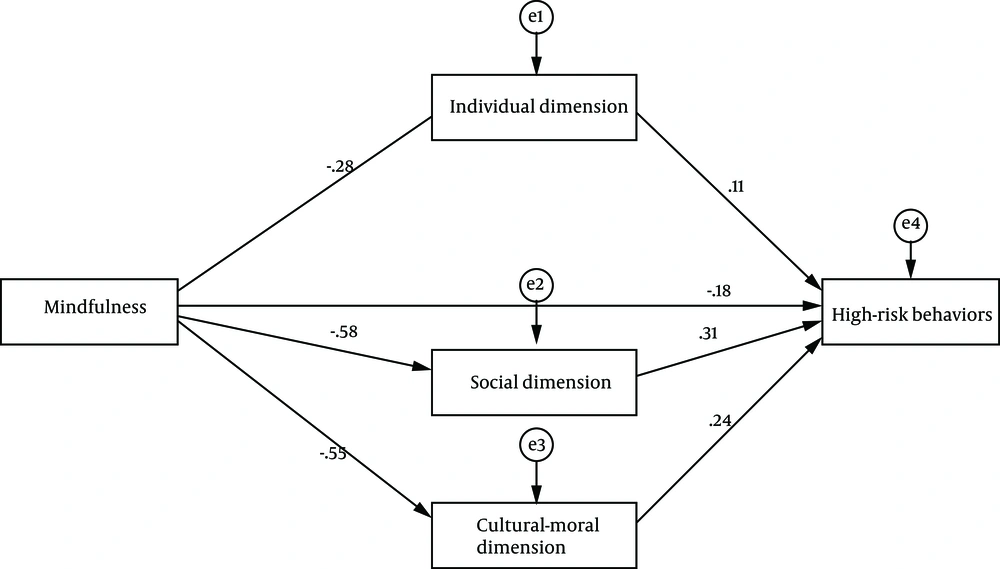
Figure 2.
Standard coefficients of the model related to the mediating role of social-virtual networks in the relationship between mindfulness and high-risk behaviors
The model fit indices are presented in Table 2.
Table 2.
The Model Fit Indices
| Fit Indices | Acceptable Domains | Observed Values | Evaluating Fit Indices |
|---|---|---|---|
| IFI | > 0.9 | 0.948 | Good fit |
| GFI | > 0.9 | 0.953 | Good fit |
| RMSEA | < 0.08 | 0.067 | Good fit |
| SRMR | < 0.08 | 0.052 | Good fit |
| CFI | > 0.9 | 0.947 | Good fit |
| NFI | > 0.9 | 0.945 | Good fit |
The root-mean-square error of approximation (RMSEA) was 0.067 and the standardized root mean square residual (SRMR) was 0.052, which are smaller than the criterion value (0.08); therefore, they confirmed that the model fitted well. Finally, the IFI, CFI, GFI, and NFI indices were all larger than the criterion value (0.9). Overall, considering the sum of the calculated fit indices, the fit of the causal model between mindfulness and high-risk behaviors mediated by social-virtual networks was confirmed.
Based on the results presented in Table 3, the relationship between mindfulness and high-risk behaviors was negative and significant at the alpha level of 0.01 (P < 0.01). In addition, the coefficients related to the relationships of the individual, social, and cultural-moral dimensions with high-risk behaviors were positive and significant at the alpha level of 0.01 (P < 0.01).
Table 3.
A Direct Path Coefficient Between Mindfulness and High-Risk Behaviors via Social-Virtual Networks
| Path | Standardized Coefficient | Unstandardized Coefficient | Test Statistics | Sig. | |
|---|---|---|---|---|---|
| Mindfulness → | High-risk behaviors | -0.522 | -0.178 | -3.064 | 0.002 |
| The individual dimension → | High-risk behaviors | 0.232 | 0.106 | 2.504 | 0.012 |
| The social dimension → | High-risk behaviors | 0.912 | 0.311 | 6.206 | 0.001 |
| The cultural-moral dimension → | High-risk behaviors | 0.483 | 0.242 | 4.076 | 0.001 |
Table 4.
The Indirect Path Coefficient Between Mindfulness and High-Risk Behaviors via Social-Virtual Networks
| Indirect Effect | Standardized Coefficient | Unstandardized Coefficient | Sig. | |
|---|---|---|---|---|
| Mindfulness → | High-risk behaviors | -1.01 | -0.344 | 0.012 |
Given the obtained results, the indirect coefficient related to the relationship between mindfulness and high-risk behaviors mediated by social-virtual networks was significant at the alpha level of 0.05. Therefore, the research hypothesis was confirmed indicating that mindfulness affects high-risk behaviors via social-virtual networks.
5. Discussion
The present study was conducted to examine the causal model between mindfulness and high-risk behaviors mediated by social-virtual networks. The first finding of the current study demonstrated that there was a significant negative relationship between mindfulness and high-risk behaviors. The fact that the obtained coefficient was negative indicated an inverse relationship between mindfulness and high-risk behaviors. It can be deduced that the higher the levels of mindfulness, the lower the risk of conducting high-risk behaviors. The finding is in line with the results obtained from several previous studies in this field (5, 14, 15). A study conducted by Alvarez-Jimenez et al. (14) showed that mindfulness-based therapy was effective in reducing high-risk behaviors and improving adolescent’s performance. In another study, Khanna and Greeson (15) demonstrated that yoga and mindfulness as complementary therapies were effective in reducing high-risk behaviors, including addiction. In explaining this finding, it can be noted that mindfulness, due to its mechanisms such as acceptance, increased awareness, desensitization, presence at the moment, observation without judgment, confrontation, and release of emotions, prevents and even treats high-risk behaviors, as shown by previous studies. As mentioned in its theoretical foundations, mindfulness is based on three basic assumptions, i.e. awareness, lack of judgment, and presence at the moment. As a result, it helps people understand the fact that negative emotions may occur, but they are not a permanent part of their personalities. Furthermore, instead of responding incidentally to events, it allows people to respond to them in a thoughtful manner (16); therefore, it seems that promoting mindfulness is an important step in preventing high-risk behaviors.
The second finding of the current study indicated that there were significant positive relationships between the individual, social, and cultural-moral dimensions and high-risk behaviors; therefore, it can be concluded that social-virtual networks provide the basis for increasing high-risk behaviors. This result is consistent with the results of a number of previous studies (8, 17-19). In a study conducted on 157 adolescents aged 12 to 14 years, Turpyn and Chaplin (17) found out that there was a significant correlation between mindfulness and high-risk behaviors. Valente et al. (18), in a study on adolescents, showed that the existence of interactive networks, including social networks, had harmful effects on health and increased adolescents’ tendency to high-risk behaviors. In another study, Bussing et al. (19) showed that high-risk behaviors in children could be assessed by considering the effects and consequences of social networks. In explaining this hypothesis, it should be stated that the dissemination of violence, substance consumption, and drug trafficking are parts of the cyberspace content. Substance abuse, violence, and sexual behaviors are responsible for many mortalities in adolescence and early adulthood. Therefore, alcohol consumption, murder, suicide, rape, sexual activities out of marriage, destruction of public property, and substance abuse are regarded as high-risk behaviors, the occurrence of which is a strong predictor of the incidence of other behaviors. This means that by engaging in each of these behaviors, such as drinking alcohol or abusing substances, the likelihood of conducting other high-risk behaviors increases (12). Therefore, being active in social-virtual networks paves the ground for increasing the tendency to a number of high-risk behaviors.
The last finding obtained from this study demonstrated that the indirect coefficients in the relationship between mindfulness and high-risk behaviors mediated by social-virtual networks were significant. Therefore, the research hypothesis was confirmed and it can be concluded that mindfulness affected high-risk behaviors via social-virtual networks. Examining the research background showed that there were no similar studies in the literature to be compared with the current study. In explaining the above hypothesis, it can be said that mindfulness, by paying purposeful attention, being present at the moment, and trying to avoid judgment, emerges in response to the momentary experiences. The key elements of this definition of mindfulness include voluntary awareness, presence at the moment, and lack of judgment. As we know, mindfulness is closely related to the ability to regulate emotions such that it helps people react to events in a proper way and enables them to cope with difficult situations. Most people who develop addictive behaviors usually do not have the ability to deal with critical conditions in an appropriate manner (20). Moreover, social networks, on the one hand, have the ability to exacerbate insecurity, promote delinquency, and encourage individuals’ susceptibility to crime and on the other hand, by acting responsibly in informing people and promoting healthy life patterns, are effective in reducing crime and providing a sense of security (21). Similarly, some researchers believe that one of the main causes of the incidence of violence in a society is the spread of violence in social networks. Therefore, it can be noted that, by promoting these states, social networks can increase people’s tendency to high-risk behaviors (22).
A limitation of this study was its cross-sectional design. In addition, the use of self-reporting tools was another limitation of this study. Accordingly, it is suggested that semi-structured interviews be used in future studies. Considering the relationship between mindfulness and high-risk behaviors, it is suggested that the components and principles of mindfulness be trained in the form of educational workshops. Moreover, it is also necessary to train people on how to use social-virtual networks properly and incorporate their disastrous outcomes into textbooks.
5.1. Conclusions
In general, the results of the model fit indices indicated that the causal model between mindfulness and high-risk behaviors mediated by social-virtual networks fitted sufficiently well. Hence, the results of this study showed the importance of the mentioned variables in increasing the tendency to high-risk behaviors.