
1. Background
According to a systematic review, the prevalence of child physical abuse, emotional abuse and neglect in Iran was 43.5%, 64.5% and 40.9%, respectively (1).
A history of child abuse in patients suffering from major mental disorders is accompanied with a low level of life meaningfulness in adulthood (2). Furthermore, the lifelong consequences of child abuse are mental health problems (3), poor academic performance (4), impulsive behaviors (5), anxiety disorders (6), symptoms of post-traumatic stress disorders (7, 8), antisocial behavior (9), severe depression symptoms (10-13), suicidal thoughts (13-15), and early maladaptive schemas (16).
A “schema” is called an “outline” or a “framework”. In psychology and, more specifically, cognitive psychology, a schema is an outline formed based on previous experiences or reality to enable individuals to explain their experiences (17, 18).
The research findings indicate that the likelihood of deviations in the cognitive schemas is higher in individuals with a history of childhood abuse in comparison to those without such experience (19, 20). Furthermore, individuals with EMSs show the symptoms of borderline personality and antisocial personality disorders (21), eating disorders (22), drug abuse (23), aggressive sexual behavior (24), and impulsivity (impulsiveness) and impulsive behaviors (25).
Moeller et al. (26) defined impulsivity as a state of preparedness for taking immediate and unplanned actions in response to internal and external stimuli regardless of its negative consequences for oneself and the others. Impulsive individuals fail to postpone pleasure and practice self-control (27).
Impulsivity is involved in disorders such as eating disorders (28), attention deficit hyperactivity disorder (29), depression, anxiety, personality disorders, and suicidal schemas and patterns (30).
Wright et al. (31) studied 301 university students to analyze the mediating role of the EMSs in the relationship between childhood emotional maltreatment and later psychological distress. Their findings showed that emotional maltreatment experience and emotional neglect were associated with the later symptoms of depression and anxiety and were mediated by schemas self-sacrifice, vulnerability to harm and shame. In their study, the experience of emotional neglect was associated with the later dissociative symptoms with regard to the mediating role of two maladaptive schemas, i.e., shame and vulnerability to harm (31).
Previous studies have been carried out on this field, especially on the victims of have documented that childhood abuse experience might be associated with the EMSs and impulsive behaviors; however, such findings cannot be generalized since few studies different forms of child abuse. Accordingly, further investigations are required to clarify how the EMSs are associated with impulsive behaviors in individuals with abuse experience, which schemas have the strongest correlation with childhood abuse, and how some demographic variables affect the severity of the abuse experience. More studies are also needed to confirm the previous evidence and reach an agreement in this regard.
2. Objectives
The present study was to examine the role of childhood abuse experience and EMSs in predicting impulsivity in patients with psychiatric disorders. To this end, the following research questions were posed: Which component of childhood abuse experience is correlated with impulsivity? Which dimension of the EMSs interacts with childhood abuse and impulsivity?
3. Patients and Methods
The present research was a descriptive-analytical study. Afterwards, sampling was carried out using a pilot study’s method.
The sample size of the study was estimated to be 151 patients referring to Psychiatric Health Centers in Zahedan, IR Iran.
Before the research questionnaires were filled out, they were completed by a few participants to ensure understandability of the questions. The ambiguities were removed to reduce the misunderstandings and to increase the accuracy of the questions.
The inclusion criteria were as follows:
(1) Aged 18 years and older; and; (2) informed consent to participate in the study. Moreover, the exclusion criteria also were suffering from a mental disability, having symptoms of psychosis and suffering from a disease inhibiting cooperation in the study.
3.1. Instruments
3.1.1. Mohammadkhani’s Child Abuse Self-Report Scale
This 38-item questionnaire developed by Mohammadkhani et al. (32) was to measure four subscales, namely physical abuse, sexual abuse, emotional/psychological abuse, and neglect. The items are scored based on a 4-point Likert scale ranging from never (0) to always (3). In addition, the items on neglect are ranked inversely. Mohammadkhani calculated Cronbach’s alpha coefficient of the scale to be 0.92, indicating its high internal consistency. This coefficient ranged from 0.79 to 0.89 for the emotional abuse, neglect, physical abuse, and sexual abuse, and all the coefficients were significant at P < 0.001 (32).
3.1.2. Young Schema Questionnaire (YSQ)
This questionnaire consists of 75 questions aiming at measuring 15 EMSs. Each item in this questionnaire is scored based on a 6-point Likert scale ranging from completely wrong (1) to completely right (6) (33-35). According to Cronbach’s alpha coefficient, the total reliability of this scale was 0.964, and the reliability was higher than 0.80 for all the subscales (34). The internal consistency coefficients varied from 0.73 to 0.93 (36, 37). The 15-factor structure of the short version of the schema questionnaire has been proven in Iran (36).
3.1.3. Barratt Impulsiveness Scale
This 30-item scale is developed by Barratt, and the items are scored based on a four-point Likert scale. The questionnaire contains the following three categories: non-planning impulsiveness, motor impulsiveness, and cognitive impulsiveness (38). Javid et al. (39) analyzed the psychometric features of this scale in a study on 259 students at Shiraz University and reported a Cronbach’s alpha of 0.81 and a re-test coefficient of 0.77. They also reported Cronbach’s alpha coefficients of 0.80, 0.67, and 0.81 for non-planning impulsiveness, motor impulsiveness, and cognitive impulsiveness, respectively. The Persian version of this questionnaire also measures the same three subscales (39).
The study samples were selected individually and the questionnaires were distributed after explaining the research objectives and ensuring the respondents’ informed consent. In this study, the respondents interviewed individually in a quiet room. The interviews were held by clinical psychologists or psychiatrists. After running face-to-face interviews and assessing the inclusion and exclusion criteria, the participants were explained how to complete the questionnaires. After completing Barratt Impulsiveness scale, the short version of Young Schema questionnaire, and Mohammadkhani’s child abuse questionnaire, the collected data was analyzed. There was no time constraint on completing the questionnaires.
The data obtained in the present study was analyzed in SPSS 21 using descriptive statistics such as frequency, mean, standard deviation, and percentile rank as well as inferential statistics (i.e., stepwise linear regression model and independent sample t-test). The results were also compared in item of gender using independent sample t-test. The correlation between childhood abuse experience and impulsivity with EMSs was also analyzed using correlation matrix coefficient.
4. Results
The research sample included 151 patients referring to psychiatric treatment centers in Zahedan from December 30, 2017 to July 29, 2018. The sampling process followed a pilot study. The sociodemographic characteristics of the participants is summarized in Table 1.
Table 1.
Sociodemographic Characteristic of the Participants (n = 151).
| Values | |
|---|---|
| Gender | |
| Male | 92(60.9) |
| Female | 59 (39.1) |
| Marital status | |
| Single | 73 (48.3) |
| Married | 70 (46.4) |
| Divorced or widow | 8 (5.3) |
| Occupational status | |
| Employed | 86 (57) |
| Unemployed | 65 (43) |
| Education | |
| Below high school diploma | 58 (38.4) |
| Diploma and higher | 93 (61.6) |
| History of chronic medical conditions | |
| Yes | 39 (25.8) |
| No | 112 (74.2) |
| History of Addiction | |
| Have | 18 (11.9) |
| Have not | 133 (88.1) |
| Age | |
| 18 - 23 | 32 (21.2) |
| 24 - 29 | 72 (47.7) |
| 30 - 35 | 23 (15.2) |
| 36 - 41 | 20 (13.2) |
| 42 - 47 | 4 (2.6) |
| History of psychiatric Hospitalization | |
| Yes | 21 (13.9) |
| No | 130 (86.1) |
| Parents’ history of Addiction | |
| Father | 27 (17.9) |
| Mather | 12 (7.9) |
| Both | 6 (4) |
| None | 106 (70.2) |
aValues are expressed as No. (%).
There is a significant difference between the two genders with respect to physical abuse and neglect. Furthermore, physical abuse is more prevalent among males than females; however, neglect is more prevalent among females than males. These differences account for the difference between the impulsivity levels between males and females. In other words, there is a significant difference between the levels of impulsivity in males and females as impulsivity is higher among males, as compared to females (Table 2).
Table 2.
The Comparision of Child Abuse, Impulsivity and EMSs Between Male and Femalea
| Variables | Number | Values | t | Sig. |
|---|---|---|---|---|
| Total abuse | 1.21 | 0.226 | ||
| Male | 92 | 40.5 ± 13.8 | ||
| Female | 59 | 37.96 ± 11.50 | ||
| Emotional abuse | 1.24 | 0.215 | ||
| Male | 92 | 13.3 ± 10.2 | ||
| Female | 59 | 11.2 ± 9.6 | ||
| Sexual abuse | 1.90 | 0.059 | ||
| Male | 92 | 1.76 ± 2.5 | ||
| Female | 59 | 1 ± 2.1 | ||
| Physical abuse | 3.05 | 0.003 | ||
| Male | 92 | 5.60 ± 5.90 | ||
| Female | 59 | 3.13 ± 4.04 | ||
| Neglect | -2.34 | 0.020 | ||
| Male | 92 | 19.81 ± 7.35 | ||
| Female | 59 | 22.59 ± 6.66 | ||
| Total Ems | -0.19 | 0.843 | ||
| Male | 92 | 254.88 ± 70.32 | ||
| Female | 59 | 257.13 ± 64.81 | ||
| Disconnection and rejection | 0.17 | 0.862 | ||
| Male | 92 | 82.83 ± 27.67 | ||
| Female | 59 | 82.03 ± 27.37 | ||
| Impaired autonomy and performance | -0.25 | 0.801 | ||
| Male | 92 | 59.34 ± 24.85 | ||
| Female | 59 | 60.38 ± 24.54 | ||
| Impaired limits | -0.38 | 0.702 | ||
| Male | 92 | 38.2 ± 8.68 | ||
| Female | 59 | 38.55 ± 7.99 | ||
| Other-directedness | -0.80 | 0.420 | ||
| Male | 92 | 34.67 ± 10.84 | ||
| Female | 59 | 36.5 ± 9.10 | ||
| Hypervigilance /inhibition | -0.05 | 0.958 | ||
| Male | 92 | 40 ± 1049 | ||
| Female | 59 | 40.1 ± 13.01 | ||
| Total impulsivity | -2.63 | 0.009 | ||
| Male | 92 | 61.46 ± 8.22 | ||
| Female | 59 | 64.76 ± 6.20 | ||
| Motor impulsiveness | -2.24 | 0.020 | ||
| Male | 92 | 32.10 ± 6.47 | ||
| Female | 59 | 34.35 ± 5.15 | ||
| Cognitive impulsiveness | 0.73 | 0.433 | ||
| Male | 92 | 8.9 ± 2.3 | ||
| Female | 59 | 8.7 ± 1.6 | ||
| Non-planning impulsiveness | -1.24 | 0.214 | ||
| Male | 92 | 20.39 ± 6.8 | ||
| Female | 59 | 21.69 ± 5.2 |
aValues are expressed as mean ± SD.
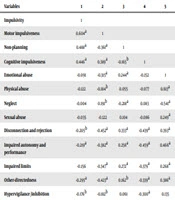
According to Table 3, the emotional child abuse and neglect have a significant relationship with non-planning impulsiveness. In addition, emotional child abuse, physical child abuse, and neglect have a significant relationship with motor impulsiveness. The impulsivity score is also higher in females than males, reflecting the higher impulsivity in males, as compared to females , the upper score shows lower impulsivity. There is also a significant relationship between the childhood abuse components and impulsivity components. In other words, the emotional abuse and neglect have a significant relationship with non-planning impulsiveness.
According to the statistics shown in ((3), there is no relationship between the childhood abuse components (i.e., physical abuse, emotional abuse, sexual abuse, and neglect) and impulsivity. Besides, our findings reflected the negative and positive effects of childhood abuse on impulsivity in males and female, respectively. The results of the present study also revealed that the participants’ total score has a negative significant relationship between the schemas and impulsivity, a negative significant relationship between impulsivity and disconnection/rejection schema, a negative significant relationship between impaired autonomy and performance schema with impulsivity, a negative significant relationship between impaired limits and impulsivity, and a negative relationship between the other-directedness schema and impulsively. On the other hand, the findings also has a negative significant relationship between hypervigilance schema and impulsivity. The statistical results of the present study revealed that the total child abuse score had a significant relationship with the total score of the schemas and schema components (i.e., disconnection and rejection, impaired autonomy and performance, impaired limits, and other-directedness). Regarding the child abuse components, emotional child abuse had a positive and significant relationship with the total score of schemas, disconnection/rejection, impaired autonomy and performance, impaired limits, and other-directedness. The neglect also had a negative significant relationship with the total score of schemas and schema subscales, including disconnection/rejection, and impaired autonomy and performance. Furthermore, the physical child abuse had a positive and significant relationship with the total score of the schemas and the schema subscales, including impaired autonomy and performance. It also had a positive and significant relationship with the total score of schemas and disconnection/rejection. Finally, the hypervigilance schema had no significant relationship with the child abuse components.
Table 3.
Correlation Matrix Between the Concerned Variables (N = 151)
| Variables | 1 | 2 | 3 | 4 | 5 | 6 | 7 | 8 | 9 | 10 | 11 | 12 | 13 | 14 | 15 |
|---|---|---|---|---|---|---|---|---|---|---|---|---|---|---|---|
| Impulsivity | 1 | ||||||||||||||
| Motor impulsiveness | 0.604a | 1 | |||||||||||||
| Non-planning | 0.488a | -0.361a | 1 | ||||||||||||
| Cognitive impulsiveness | 0.446a | 0.389a | -0.165b | 1 | |||||||||||
| Emotional abuse | -0.091 | -0.315a | 0.244a | -0.152 | 1 | ||||||||||
| Physical abuse | -0.122 | -0.184b | 0.055 | -0.077 | 0.613a | 1 | |||||||||
| Neglect | -0.004 | 0.191b | -0.218a | 0.083 | -0.541a | -0.382a | 1 | ||||||||
| Sexual abuse | -0.035 | -0.122 | 0.104 | -0.086 | 0.249a | 0.374a | -0.313a | 1 | |||||||
| Disconnection and rejection | -0.205b | -0.452a | 0.333a | -0.439a | 0.393a | 0.124 | -0.201b | 0.215a | 1 | ||||||
| Impaired autonomy and performance | -0.219a | -0.382a | 0.256a | -0.459a | 0.466a | 0.215a | -0.162b | 0.086 | 0.721a | 1 | |||||
| Impaired limits | -0.156 | -0.347a | 0.272a | -0.379a | 0.268a | 0.096 | -0.130 | 0.139 | 0.468a | 0.462a | 1 | ||||
| Other-directedness | -0.295a | -0.423a | 0.162b | -0.339a | 0.386a | 0.135 | -0.078 | 0.105 | 0.678a | 0.686a | 0.497a | 1 | |||
| Hypervigilance /inhibition | -0.176b | -0.182b | 0.061 | -0.300a | 0.135 | 0.024 | -0.077 | 0.070 | 0.541a | 0.423a | 0.394a | 0.445a | 1 | ||
| Child abuse total | -0.134 | -0.245a | 0.115 | -0.124 | 0.802a | 0.774a | -0.082 | 0.374a | 0.294b | 0.390a | 0.208b | 0.343a | 0.88 | 1 | |
| EMSs total | -0.255b | -0.458a | -0.295a | -0.492 | 0.441a | -0.164b | -0.181b | 0.163b | 0.916a | 0.885a | 0.621a | 0.809a | 0.656a | 0.352a | 1 |
aP < 0.001.
bP < 0.005.
A stepwise linear regression model was conducted to identify the predictors of motor, cognitive, and non-planning impulsiveness, as presented in Table 4. Disconnection/rejection and other-directedness could predict 20% of the variation in motor impulsiveness (F = 38.17, P < 0.001). Moreover, neglect and disconnection/rejection could predict 11% of variation in cognitive impulsiveness (F = 18.60, P < 0.001). Impaired autonomy and performance and impaired limits could predict 21% of variation in non-planning (F = 39.73, P < 0.001) (Table 4).
Table 4.
Results of Liner Regression Model for Predictors of Motor and cognitive Impulsiveness And Non-Planning
| Variables | Motor | Cognitive | Non-Planning | ||||||
|---|---|---|---|---|---|---|---|---|---|
| Ba | SE (B)b | P Value | Ba | SE (B)b | P Value | Ba | SE (B)b | P Value | |
| Constant | 43.087 | 1.625 | < 0.001 | 18.07 | 2.29 | < 0.001 | 12.70 | 0.69 | < 0.001 |
| Disconnection and rejection | -0.067 | 0.22 | 0.002 | 0.069 | 0.018 | < 0.001 | - | - | - |
| Other-directedness | -0.129 | 0.059 | 0.029 | - | - | - | - | - | - |
| Neglect | - | - | - | -0.137 | 0.068 | 0.046 | - | - | - |
| Impaired autonomy and performance | - | - | - | - | - | - | -0.030 | 0.007 | < 0.001 |
| Impaired limits | - | - | - | - | - | - | -0.053 | 0.020 | 0.009 |
| R2 = 20%, F = 38.17, P < 0.001 | R2 = 11%, F = 18.60, P < 0.001 | R2 = 21%, F = 39.73, P < 0.001 | |||||||
aRegression coefficients.
bStandard error (SD/√n).
5. Discussion
The first question of the study addressed the components of childhood abuse experience which were correlates with impulsivity. Surprisingly, the results indicated that there was no relationship between impulsivity and the childhood abuse components (i.e., physical abuse, sexual abuse, emotional abuse, and neglect); however, there was a relationship between the childhood abuse components and the impulsivity components. In other words, the emotional abuse and neglect had a significant relationship with the non-planning impulsiveness. Furthermore, emotional abuse, physical abuse, and neglect had a significant relationship with motor impulsiveness.
The results of this study are not in line with the findings reported by Narvaez et al. (40). These researchers conducted a study to analyze the relationship between childhood traumas, impulsivity and executive functioning in outpatients suffering from cocaine abuse disorders (n = 84). Their findings indicated that childhood traumas were associated with the participant’s impulsive behaviors. Their results also indicated that impulsivity was an unwanted outcome of the trauma in such drug users and a risk factor for the development of a pathologic response to traumatic incidents (40). According to our findings, emotional child abuse, physical child abuse, and neglect have a significant relationship with motor impulsiveness.
McMahon et al. (41) studied different effects of childhood maltreatment and impulsivity on interpersonal violence, self-injury, and suicide attempts. Their findings revealed that childhood maltreatment and impulsivity exclusively and separately increased suicide attempts, self-injury, and interpersonal violence. Furthermore, the childhood maltreatment experience played a more critical role in the onset of self-injury as compared to interpersonal violence in both genders. The severity of impulsiveness, however, played a more important role in self-injury than interpersonal violence or suicide attempts. Their study thus concluded that the childhood maltreatment experience and impulsivity were probably involved in different types of harmful and aggressive behaviors towards oneself and others (41). In the present study, females impulsivity score was higher than males, suggesting that impulsivity was higher in males than females. According to our findings, the severity of the experienced childhood abuse, inefficient self-concepts/beliefs about others, and destructive and impulsive behaviors were more noticed in individuals with a history of a chronic medical condition prior to the age of 18 years. This finding probably reflects the interaction between childhood abuse experience and EMSs, which may result in some harmful and impulsive behaviors in adulthood depending on the severity and extent of the abuse experience and the EMSs.
The researcher also spared his efforts to deal with the second research question, which dimension of the EMSs interacts with childhood abuse experience and impulsivity?
The findings showed a significant relationship between the childhood abuse components and the dimensions of the EMSs and a significant relationship between the EMSs and impulsivity.
The results of the present study are in line with those reported by Estevez et al. (25), who studied 182 victims of sexual child abuse referred to child abuse treatment centers. These researchers analyzed the mediating role of the EMSs and impulsivity symptoms. Their findings show that childhood sexual abuse experience has a significant relationship with the EMSs. Moreover, the disconnection/rejection schema plays a mediating role in the relationship between childhood abuse experience with eating disorders, alcohol abuse, and impulsive behaviors (25). In contrast, in addition to sexual abuse in the present study, physical and emotional abuse and neglect were significantly correlated with the EMSs. The inconsistencies can be attributed to different statistical population and questionnaires used in these studies. In Estevez’s et al. study, the statistical population included 182 female patients who had the sexual abuse experience and had referred to the treatment centers because of maltreatment. Furthermore, only sexual abuse was addressed in their questionnaire; however, the physical abuse, emotional abuse, and neglect were also deal with in the present study. Such a difference can explain the inconsistency of the research findings.
The findings of the present study suggest that emotional abuse, sexual abuse, and neglect may be more common in individuals who fail to establish safe and satisfactory attachments to others and believe that their needs for security, love, kindness, and attachment are not met (disconnection/rejection). Individuals with a history of emotional and physical abuse and neglect also failed to develop an independent identity and lead their lives without the others’ constant and unlimited help (impaired autonomy and performance).
Moreover, individuals with emotional abuse experience may experience difficulties in committing or achieving long-term goals (impaired limits). These individuals were not probably allowed to voluntarily follow their natural tendencies during childhood; therefore, instead of self-directedness during adulthood, they are impressed by the outer world and follow others’ desires and demands (other-directedness).
Kaya Tezel et al. (42) studied 300 healthy young individuals to explore the relationships among the interpersonal styles, childhood traumatic experience, and the EMSs (as the study variables). Their findings showed a significant relationship between interpersonal styles and childhood abuse experience and a significant relationship between the interpersonal styles and childhood abuse experience with regard to the mediating role of the EMSs (42).
The results of the present study are consistent with those reported by Estevez et al. (43), who studied 168 victims of sexual child abuse. They reported the significant relationship between childhood sexual abuse experience with the EMSs and displaced aggression. In their study, females gained higher scores in sexual abuse and emotional abuse aspect, in comparison to men (43). However, in the present study, males gained higher scores in sexual abuse aspect than females. Furthermore, females’s neglect score was higher than males, leading to the difference between the impulsiveness levels in both genders. In other words, there was a significant difference between the impulsivity levels in females and males since impulsivity was higher in males than females.
In their study on 653 academic females, Roemmele and Messman-Moore (44) analyzed the self-reports on sexual abuse, physical abuse, and emotional abuse. Their findings indicated that childhood abuse experience had a significant relationship with rejection and other-directedness dimensions. The disconnection and rejection schemas revealed a significant relationship between child emotional maltreatment and the number of sexual partners, while they partly mediated the relationship between sexual abuse and physical abuse (44).
Rostami al. (45) conducted a study to analyze the relationship between childhood abuse experience with coping strategies and the EMSs. They examined 318 individuals referring to the counseling centers in the west of Tehran and reported that childhood abuse experience played a critical role in the formation of the EMSs and emotion-focused responses (45). These finding were in line with the findings of the present study. To justify the findings of the present study, it can be stated that childhood traumas result in the formation of the EMSs (17, 18). Moreover, the development of an early maladaptive schema during childhood is a threat, which represents a form of failure to meet and satisfy a fundamental emotional need during childhood (17, 18).
As a response to this threat and as a coping mechanism, a child may use a combination of surrender, avoidance, and overcompensation styles. This response is an adaptive response during childhood; however, it is considered to be maladaptive in adulthood because this combination leads to the continuation of the schemas even if the individual’s life conditions change and he/she is provided with better opportunities. In addition, these maladaptive coping styles lead to the imprisonment of the individuals in their own schemas. Similar studies suggest that individuals disregard their schemas when they try to change their lives in order to prevent the activation of their schemas. These individuals are unwilling to feel the activated schemas, and when such feelings reach a conscious level, they immediately avoid them in any possible way. Although they seem to be completely normal in their relationships, excessively drink alcohol, and eat or engage in promiscuous sexual relationships. They may also be sensation seekers or workaholics. Moreover, they often avoid situations invoking their schemas (e.g. intimate relationships or professional challenges) (17, 18).
The limitation of this study are similar to those involved in all questionnaire-based studies that might be the result of biased answers. In other words, the respondents might become anxious by recalling their childhood abuse experiences or get embarrassed to answer the maltreatment questions as such they may try to share a more acceptable (or unacceptable) image of their social and personal experience. There are differences among different cultures so that the responses to childhood traumas and the results cannot be generalized to other cultures.
Further research is recommended to investigate the role of other variables, including self-esteem, the severity of the psychological symptoms, and the role of protective variables such as high or low socioeconomic status, which might be involved in the components of childhood abuse experience. More studies on different statistical populations and larger samples are also suggested.
5.1. Conclusions
This study documented the relationship between childhood traumas with the EMSs and impulsivity. Childhood and adolescence abuse or maltreatment experiences lead to the formation of the EMSs, which probably play a key role in an individual’s self-misconception, perceptions of the incidents and events, and the others’ motives. These schemas may result in to inefficient interpersonal relationships, risky behaviors, self-harm, harmful behavior towards others, and reduced mental health during an individual’s lifetime. The findings of this study could be used by psychological and psychiatric treatment centers to develop counseling and psychological treatment plans in order to identify the EMSs and coping styles and consider the vital roles of childhood and adolescence experiences in fruitful lives and mental health.