
1. Background
Malaria infection is a major cause of morbidity and mortality worldwide. In 2019, there were estimated 229 million cases of malaria worldwide, and the estimated number of malaria-related deaths stood at 409000 with developing countries having the heaviest burden of the disease (1). Africa carries a disproportionately high share of the global malaria burden. In 2019, the continent was home to 94% of malaria cases and deaths (1). The burden is mostly borne by pregnant women and their unborn babies and children who are mostly at the risk of infection and its adverse outcomes due to their undermined and immature immunity (2). Annually, Sub-Saharan Africa has estimated 25 million pregnant women who are at the risk of malaria, the undesirable effects of which can be severe for both the mother and fetus with respect to morbidity and mortality (2, 3). Malaria during pregnancy is linked with adverse health consequences such as maternal anemia, intrauterine growth retardation, and low birth weight. Actually, a birth weight less than 2.5 kg is considered to be the leading cause of death among infants in Sub-Saharan Africa (4). Malaria has been a public health main concern for over four decades now. The severity of symptoms is influenced by the level of immunity before the prenatal period, which depends on the local malaria transmission rate (5).
It is estimated that about the 50 million women worldwide living in malaria endemic countries become pregnant, of whom the majority live in tropical Africa which has a high transmission rate of Plasmodium falciparum. About 10000 of these women and 200000 infants die as a consequence of malaria infection during pregnancy (6). Sub-Saharan Africa is home to an estimated 25 - 30 million pregnant women who are at the risk of infection, of whom 25% show evidence of placental malaria (2, 7, 8). Placental malaria in Nigeria causes morbidity and mortality varying from 29.9% (9) to 71% (10). Maternal losses, maternal anemia, and low birth mass in most malaria pervasive zones are twofold, with about 10000 deaths annually, in pregnant women than non-pregnant women (11), which has been linked to the sequestration of plasmodium parasites in the placenta (12, 13). Malaria deterrence during pregnancy entails administering intermittent preventive treatment for pregnancy (IPTp), usage of insecticide- treated bed nets, and effective patient management programs. For malaria IPTp during pregnancy in endemic areas, Sulphadoxine-Pyrimethamine (SP) has been effective and the drug of choice for reducing placental malaria parasites and improving mothers’ haemoglobin levels and new-borns’ birth weights (14).
In Nigeria, there is scarcity of data on the number of pregnant women at the risk of malaria. There is only slight knowledge about the distribution of endemic foci within Local Government Areas in each state of the federation, and this is a challenge for the National Control Program. On the other hand, malaria control efforts are hindered by under-funding.
Various studies have been conducted in some endemic areas to appraise the knowledge, attitude and practice of pregnant women about averting malaria during pregnancy, particularly by adhering to IPTp-SP (15, 16). In spite of improved antenatal care services and the provision of health education during these services, the prevalence of malaria during pregnancy continues to be high.
2. Objectives
It becomes necessary to ascertain the knowledge and practice of pregnant women regarding malaria prevention programs, which was the aim of the current study conducted in Obio-Cottage Hospital, Rumubiakani Port Harcourt, Rivers State.
3. Methods
3.1. Study Area
This survey was carried out on 300 pregnant women who had their antenatal care (ANC) at Obio-Cottage Hospital, Rumubiakani Port Harcourt, located at Trans-Amadi industrial layout, Rumubiakani, Obio-Akpor Local Government area. This is the largest Local Government in Rivers State and a city in the southern part of Nigeria. The study was conducted between September and December 2018.
3.2. Study Population
The study population included 300 pregnant women who had completed their ANC and had been admitted to the labour ward of the hospital. The Obio Cottage hospital (OCH) Rumubiakani operates a private-public partnership and is fully supported by the Shell Petroleum development company (SPDC). The hospital offers maternal and child care services and has a monthly delivering of 300 neonates (17). The hospital is the first to offer a community health system intervention scheme (CHSIS). The women who are registered under this scheme enjoy a free ANC program. Those who are eligible to benefit from this scheme should be registered within 12 weeks of gestation. The support by the SPDC and the introduction of CHSIS improved health care services during delivery and made the hospital to attract many people, especially pregnant women, and to be patronized by patients (18).
3.3. Inclusion and Exclusion Criteria
The neonates of the mothers who met the following inclusion criteria were enrolled in this study, attending the ANC program and delivering the baby in the labour ward of the hospital.
3.4. Ethical Approval
Permission was obtained from Rivers State Ministry of Health, OCH local ethics committee, and the University of Port Harcourt Ethical Committee. Informed consent was obtained from mothers.
3.5. Data Collection
Samples were collected from 300 pregnant women who completed their ANC and admitted to the labour ward of the hospital. Gathered information were the types of preventive drugs used during pregnancy, SP consumption, as well as its dosage and the frequency of consumption. The consumption of SP was under the directory observed therapy (DOT) program and based on the WHO recommendations noting that women should receive at least three doses of SP during pregnancy, with each dose being given at least one month apart from the second trimester onward (19). All of this information was recorded.
3.6. Birth Weight
The birth weight was obtained by weighing naked newborns on an electronic scale.
3.7. Administration of Questionnaires
The prepared questionnaires containing the obstetrics and demographic questions related to age, education, parity, types of preventive drugs taken during pregnancy, number of times the drugs were taken, and knowledge about SP.
4. Results
At pre-test, questionnaires were given to 300 women in the labor ward. They were all in labor or had been just put to bed. About half (50.33%) of them were aged 21 - 30 years while 42.33% had 31 to 40 years old. The least were ≤ 20 years (3%) and ≥ 40 years (4.33%). Regarding parity-wise distribution, 24.66% of the pregnant women were primigravidae while secundigravidae and multigravidae were 41.33% and 34%, respectively (Table 1)Of the women, 57% had tertiary education while secondary and primary education were recorded in 41% and 2%, respectively. Regarding occupation, civil servants (36.66%) constituted the highest followed by businesswomen (29.33%) while students and farmers were the least, 4% each. Most women (69.39%) took SP thrice during pregnancy while 24.19% and 6.40% took it twice and once, respectively.
Table 1.
Social Demographic Characteristics and Knowledge About SP of 300 Pregnant Women Admitted to Port Harcourt
| Frequency (%) | |
|---|---|
| Age (y) | |
| ≤ 20 | 9 (3) |
| 21 - 30 | 151 (50.33) |
| 31 - 40 | 127 (42.33) |
| ≥ 41 | 13 (4.33) |
| Total | 300 |
| Parity | |
| Primigravidae | 74 (24.66) |
| Secundigravidae | 124 (41.33) |
| Multigravidae | 102 (34) |
| Education | |
| Primary | 6 (2) |
| Secondary | 123 (41) |
| Tertiary | 171 (57) |
| Occupation | |
| Student | 12 (4) |
| Housewife | 38 (12.66) |
| Farmer | 12 (4) |
| Self-employed | 40 (13.33) |
| Civil-servant | 110 (36.66) |
| Businesswoman | 88 (29.33) |
Table 2 shows that the majority of the women registered during their first trimester (87%) while 11.33% registered in their second trimester, and those who registered in their third trimester were the least (1.66%).
Table 2.
Utilization of Sulphadoxine-Pyrimethamine Among 300 Pregnant Women Admitted to Port Harcourt Health Facility
| Factors | Frequency (%) |
|---|---|
| Time of ANC registration | |
| First trimester | 261 (87) |
| Second trimester | 34 (11.33) |
| Third trimester | 5 (1.66) |
| Preventive drugs | |
| SP | 281 (93.66) |
| Other drugs | 19 (6.33) |
| Approach towards SP usage | |
| Preventive | 267 (89) |
| Therapeutic | 33 (11) |
| Mode of SP intake (DOT) | 281 (100) |
| Trimesters SP usage started | |
| Second | 273 (97.15) |
| Third | 8 (2.85) |
| Number of times SP was taken/compliance level | |
| Once | 18 (6.40) |
| Twice | 68 (24.19) |
| Thrice | 195 (69.39) |
Regarding knowledge about SP usage, 89% of the women viewed SP as a preventive drug for malaria while 11% viewed it as a therapeutic drug. Sulphadoxine–pyrimethamine was the drug of choice for the vast majority (93.66%) of the women who took it for prevention of malaria, and 6.33% of the participants consumed other drugs for this purpose. Among the 281 women who took SP, all of them were subjected to the DOT program. Considering the trimester in which SP usage was started, 97.15% and 2.85% of the pregnant women started consuming the drug during their second and third trimesters, respectively (Table 2)
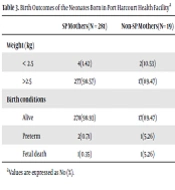
Assessing the birth outcome of the neonates whose mothers took SP indicated that 1.42% had birth weights less than 2.5 kg while 98.57% had birth weights higher than 2.5 kg. On the other hand, 10.53% of the mothers who did not use SP gave birth to neonates with birth weights less than 2.5 kg, and 89.47% of them gave birth to the neonates who weighed above 2.5 kg (Table 3).
Table 3.
Birth Outcomes of the Neonates Born in Port Harcourt Health Facilitya
| SP Mothers (N = 281) | Non-SP Mothers (N= 19) | |
|---|---|---|
| Weight (kg) | ||
| < 2.5 | 4 (1.42) | 2 (10.53) |
| > 2.5 | 277 (98.57) | 17 (89.47) |
| Birth conditions | ||
| Alive | 278 (98.93) | 17 (89.47) |
| Preterm | 2 (0.71) | 1 (5.26) |
| Fetal death | 1 (0.35) | 1 (5.26) |
aValues are expressed as No (%).
Birth conditions revealed that 98.93% of the neonates born of SP-compliant mothers and 89.48% of the babies born of non-SP compliant mothers were alive. Non-SP compliant mothers had a higher prevalence of premature birth (5.76%) and fetal death (5.26%) than SP-compliant mothers (0.7% and 0.35%, respectively).
5. Discussion
Women within the age range of 21 - 30 years constituted the majority of the participants in this study compared with other age groups. This finding is comparable to the result obtained in similar research (20, 21). Mothers within this age range are mostly primigravidae, so they more seriously attend ANC, leading them to have more knowledge about this program.
In the present study, educational status played a role as the majority of the medium used in malaria prevention campaigns is more accessible to educated people among the population. It could also be as a result of their inability to read and understand drug prescriptions in the absence of DOT and health experts. The results of this report are similar to the findings of Exavery et al. stating that education beyond primary, secondary, and tertiary schools considerably influenced the use of antimalarial drugs during pregnancy (22).
In this study, pregnant women expressed good adherence to SP usage with the majority of them having early ANC registration. This is because of the Community Health Care Insurance Scheme (HCIS) which is supported by the Shell Petroleum development company (18), that provides subsidy to the women who register during the first trimester. This makes them enjoy free drug administration, including SP and other required treatments. The DOT rule is highly practiced in this facility with a compliance rate of 100%. The high knowledge of SP as a preventive drug for the control of MiP could be a result of teaching by health professionals during ANC visits. So, because of the subsidized cost of delivering a baby and quality health care services, many women (87% in the current study) tend to register early (i.e., during the first trimester). Also, a high percentage of the women (97.15%) started SP usage during their second trimesters, and 69.89% completed the indicated dose, showing a high compliance rate. This finding agrees with that of Akpa et al. (23) who reported a 74% compliance rate in Ebonyi State. Our report; however, disagrees with a report in Lagos state, noting that only about 5% of respondents took SP three times during pregnancy (24). The wide variation in the compliance level can be attributed to late ANC registration, failure of health workers to enforce DOT, unstable supply of SP, poor knowledge about the benefits of SP usage, and irregularity in attending ANC appointments. In another study on the utilization of IPTp-SP in Ibadan, Nigeria, it was observed that pregnant women receiving ANC at an axillary Health centre had low knowledge about the utilization of SP compared with tertiary health centres. In general, the level of compliance in the current study implied that using IPTp had been greatly improved among pregnant women in Rivers State, and they showed a better health seeking behaviour towards malaria prevention during pregnancy by utilizing IPTp. The high compliance is due to the campaign aiming to raise awareness on malaria control, the teaching received during ANC, early ANC registration, as well as the strict practice of DOT plan. This finding could also be due to the nature of the study setting which included largely urban areas, so the majority of the women were educated. This study almost achieved the WHO recommended target of 100%, but could not hit the exact target because some women were not compliant to IPTp due to its adverse side effects (25).
About 99% of the neonates weighed above the acceptable birth weight of > 2.5 kg. This could be due to high compliance to the utilization of SP, which agrees with the findings of Igboeli et al. (26) who reported no difference in the birth weights of the babies born to SP and non-SP users. Our observation in the current study; however, contradicts the findings of another study reporting a significant difference in the birth weight between the two groups (27). The reason for the variation could be because the majority of the women participating in our study were well-educated, which directly affects one’s social economic level. There are other factors associated with low birth weight, such as prematurity, twin births, and maternal malnutrition, obesity, and smoking (28).
5.1. Conclusion
Most of the pregnant women participating in this study registered for ANC during their first trimesters so that they could benefit from the (HCIS). The knowledge of and compliance rate with SP usage were high because of early ANC registration and strict adherence to DOT. The government should ensure the sustainability of policies that will increase knowledge about and utilization of SP up to rural areas. The government should also encourage mothers to register early for ANC (i.e., during the first trimester) by offering them a discount for all charges. This can be achieved if the government can set up HCIS so that the pregnant women who register in their first trimesters and attend all ANC appointments can benefit from it.