1. Background
Human brucellosis is a disease that is found worldwide and develops when a person comes in contact with contaminated animals or animal products such as infected milk and cheese (1, 2). The disease is caused by a group of bacteria belonging to the genus Brucella. Three species of Brucella cause the most illness: B. abortus, commonly affects cattles; B. suis, principally affects swine; and B. melitensis, principally affects goats. Brucellosis occurs more commonly in areas with less established animal disease control programs and also in regions where public health activities are less effective (1-3). High-risk regions include Mediterranean countries such as Greece and Turkey, South and Central American countries, Africa, Asia, the Middle East, and Eastern Europe. In humans, it is known as undulant fever (because of its severe intermittent nature) or Malta fever because it was first identified as a human disease on the island of Malta in the Mediterranean ocean (1-4). Everyone is susceptible to the bacteria and may gain the disease if exposed to the bacteria. It is more likely to be found in people associated with cleaning and butchering of live stocks or with consumption of unpasteurized dairy products. Symptoms of brucellosis include intermittent or irregular fever with variable duration, headache, generalized bone pain, weakness, sweating, chills and weight loss (1, 2, 4). Definite diagnosis of brucellosis is made by clinical manifestations and the isolation of microorganism from blood or bone marrow cultures but this is very difficult in patients with local complications. In the absence of bacteriologic confirmation, a positive serology test for brucella such as standard tube agglutinin testing (STA) is considered definitive. Another test is the indirect enzyme linked immune sorbent assay (ELISA). A comparison with the STA yields higher sensitivity and specificity (1-4). There is no effective way to detect infected animals by their appearance. The most obvious signs in pregnant animals are abortion or birth of weak calf or lamb (5, 6). Brucellosis can affect almost any part of the body, including the reproductive system, bone, liver, heart and central nervous system. The musculoskeletal system is one of the most commonly affected. The disease can present bursitis, arthritis (commonly in knee hip and ankle), sacroiliitis, osteomyelitis, spondylitis and paraspinal abscess. Spondylitis or vertebral osteomyelitis can be particularly hard to treat and may cause permanent damage (3, 7, 8). Many complications due to brucellosis are reported around the world, but paraspinal abscess, vertebral osteomyelitis or spondylodiscitis are rare (1, 2, 4, 9, 10). Brucellosis may be prevented by proper sanitation methods. The most important approach for preventing human brucellosis is the control and elimination of the infection in animals. Like other animal diseases eradication attempts, success of the program depends on the support and participation of livestock producers. Pasteurization of milk is another important protective method. Vaccination of domestic animals is recommended for control of brucellosis in enzootic areas with high prevalence rate.
2. Objectives
We aimed to evaluate the prevalence of vertebral osteomyelitis and paraspinal abscess in patients with brucellosis who were admitted to an infectious hospital in Zahedan, Southeastern Iran.
3. Patients and Methods
In this prospective study, during four years, from December 2008 to October 2012, we evaluated all patients who referred to infectious clinics of Boo-Ali hospital (located in Zahedan, Southeastern Iran) because of fever, myalgia, arthralgia, chronic lower back pain, bone pain, and had a wright test more than 1/80. Blood samples were tested again for 2ME. A titer of more than 1/80 was positive. All patients with low back pain, who had an MRI or Spine CT-Scan, which showed a sign of osteomyelitis and paravertebral abscess, were included in our study.
4. Results
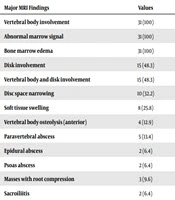
Among 73 patients with brucellosis (56 males, 17 females; age range 12-69 years), 14 patients (19%; 12 males) had a diagnosis of brucella osteomyelitis. Eleven patients (11%) had spinal osteomyelitis and five (7%) also showed a paravertebral abscess next to the involved vertebrae. Patients were treated with a triple regimen including: doxycycline, rifampin and streptomycin for 3-6 months. One patient required surgery due to the pressure effect on the spine.
5. Discussion
Brucellosis has been classified clinically as acute, subacute, and a chronic disease. It can be mild and self-limited (B. abortus) or fulminant with severe complications (B. melitensis). Localized complications of brucellosis are usually reported in patients with acute form or in patients with chronic untreated infection (1, 2, 9, 10). Osteoarticular, genitourinary and hepatosplenic involvement are the most common complications of brucellosis (2, 4, 9). Bones are normally resistant to infections. However, Brucella infection has aspecial tropism for osteoarticular involvement and osteoarticular brucellosis is the most common localization of active disease (2, 3, 10-19). Focal osteomyelitis of the vertebrae, tibia and especially the knees has also been reported with brucellosis infection even in the absence of other significant systemic symptoms (1, 4, 12-14). Osteoarticular brucellosis, including spondylitis and arthritis, may be destructive and associated with osteopenia and cartilage damage. Tissue damage may happen due to a direct invasion of brucella infection on osteoblasts. Sometimes, this damage occurs as a result of persistent inflammatory response during infection (14-16). Among our patients osteoarticular involvement was the most common complication (19%).Among patients with osteoarticular involvement, 11% had vertebral osteomyelitis. Paravertebral abscess was seen in five cases with spondylitis. Two patients had epididymo-orchitis and three cases had meningoencephalitis. There are many reports about bone involvement in brucella patients (4-18). Koubaa et al. reported thirty-two patients with spinal brucellosis during a period of 21 years. Among their patients, paravertebral mass was detected in 65.6% of patients and back pain (100% of patients) was the most common symptom (13). Sanaei-Dashti reported that sacroiliitis is the most common form of the skeletal involvement of brucellosis in adults yet we had no patients with sacroiliitis involvement and most of them showed spondylitis in lumbar vertebra (14). al-Eissa observed no patient with brucellosis spondylitis among 40 children with skeletal complications (15). In a study by Geyik, 24.59% of adults and 17.9% of children who were suffering from skeletal complications of brucellosis had spondylitis (16). The incidence of spondylitis in Geuik’s research was higher than ours. In both age groups, the most common sites of involvement were the lumbar and dorsal, respectively. The lumbar area is the most common site of involvement. Sometimes para-spinal abscess (cold abscess) with a smaller size than that of tuberculous abscess also occurs. An incidence rate of up to 16% for these abscesses in brucellosis has been reported (14).Our study showed that 7% of patients with brucella had paravertebral abscesses. Geyik compared 39 children with 122 adults the patterns of the skeletal brucellosis. They found that sacroiliitis was present in 48.7% of all the skeletal involvements of brucellosis in children but the rate in adults was 62.2% (16). Spondylolisthesis, paraplegia and sphincter malfunction as a result of brucellosis have been reported. No one of our patients had this complication. In Kaptan’s research, among 135 patients with brucellosis, 31 patients (23%) had spondylodiscitis. Sites of involvement were lumbar (58.1%), lumbosacral (22.6%) and thoracolumbar (6.5%) regions. Abscesses occurred in 19 (61.3%) of their patients (18). For patients suspected of brucellar spondylitis, detailed medical history, imaging tests such as MRI and serologic tests should be performed for early diagnosis and treatment(1-4, 11). There is no standard recommended treatment regimen, and various combinations of antibiotics for different periods can be used to treat brucella spondylitis. The most effective regimen, which is recommended by many researchers is a triple regimen including: doxycycline, streptomycin and rifampin. Osteoarticular involvement is the most frequent complication of brucellosis and in endemic areas, every patient with low back pain and a positive test for brucella should be evaluated for vertebral osteomyelitis.