
1. Background
Right ventricular impairment is an independent predictor of prognosis and adversely affects left ventricular functions due to inter-ventricular interactions. Therefore, it is imperative to evaluate right ventricular functions (1, 2). However, there are fewer studies on right ventricular structure and function than those on the left ventricle in the literature. Currently, it is recommended to evaluate right ventricular systolic functions as a part of routine echocardiographic examination (3-5).
Conventional techniques used for the evaluation of right ventricular functions, such as right ventriculography-right heart catheterization, gated nuclear imaging, and magnetic resonance imaging (MRI), have limited usage in practice since they are time-consuming, invasive, expensive, not easily accessible, and not suitable for bedside application. The evaluation of the right ventricle from different echocardiographic windows is necessary due to its complicated anatomical structure, location just behind the sternum surrounding the left ventricle, and intricate shape. The thin free wall (3 - 5 mm) of the right ventricle and distinctive alignment of myofibrils in different anatomic regions constitute other limitations of the standard two-dimensional (2D) echocardiographic assessment (3-7). In addition, right ventricular geometry is more complex in congenital heart diseases, and interventional procedures might lead to further complexity (8). Therefore, tricuspid annular plane systolic excursion (TAPSE), tricuspid annular peak systolic velocity (TAPSV), and right ventricular myocardial performance index (RVMPI) have recently been used for the evaluation of the right ventricular systolic function (1-6).
The TAPSE defines the amount of vertical motion of the lateral tricuspid annulus during the cardiac cycle in an apical 4-chamber view in M-mode echocardiography. The TAPSE measurement provides a simple, reproducible method to evaluate right ventricular systolic function. Recent studies have shown a strong correlation with gold-standard methods, such as cardiac MRI (7, 8).
The myocardial performance index (MPI), also known as the Tei index, was discovered by Chuwa Tei in 1995 as a Doppler index that can simultaneously assess ventricular systolic and diastolic functions in patients with systolic myocardial dysfunction (9). It has been shown that RVMPI can be used to evaluate right ventricular functions in children with congenital heart diseases (10, 11).
The measurement of myocardial wall velocities with tissue Doppler is another promising approach in the quantitative assessment of longitudinal systolic ventricular performance. It is possible to calculate TAPSV with pulsed-wave tissue Doppler images (12). Right ventricular dysfunction was correlated with TAPSV in adult patients (13, 14).
2. Objectives
This study aimed to determine the normal values of TAPSE, RVMPI, and TAPSV in healthy children within 1 day to 18 years of age to determine the z scores and percentiles and explore the relationship with gender, body surface area (BSA), and other echocardiographic parameters.
3. Methods
3.1. Study Population
This study was performed within October 2012 and March 2013 on children who were referred to Celal Bayar University Faculty of Medicine Hospital, pediatric cardiology outpatient clinic (Manisa, Turkey) due to cardiac murmur and/or chest pain and had no structural cardiac pathology on transthoracic echocardiography. A total of 607 children aged 0 - 18 years without any cardiac pathology or other chronic disorders were included in the study consecutively.
3.2. Exclusion Criteria
The exclusion criteria were children with any structural cardiac pathology on echocardiographic examination, any congenital or acquired heart disease history, any chronic disorder, any chromosomal anomaly or genetic disorder, and those whose parents refused to give consent.
3.3. Study Design
In this cross-sectional study, subjects’ medical history and family history were taken. The study subjects went through a detailed physical examination. Their weight, height, and blood pressure measurements were recorded together with demographic data, laboratory findings, and other anthropometric measurements. All participants underwent standard transthoracic echocardiographic examination and tissue Doppler imaging (TDI), recorded on standard forms. All subjects’ blood pressure measurements, electrocardiography, standard echocardiography, and TDI evaluations were performed and evaluated by the same pediatric cardiologist. All measurements were carried out three times, and the averages were used. For inter-observer variability, the first 50 data were measured by two observers (i.e., M. Y. and S. C.) who were blinded to one another’s results.
The study population was categorized into nine groups according to their age to calculate echocardiographic values, including 0 - 30 days, 1 - 2 months, 3 - 5 months, 6 - 11 months, 1 - 2 years, 3 - 5 years, 6 - 8 years, 9 - 12 years, and 13 - 18 years. In order to compare the echocardiographic parameters, the study population was further divided into four groups according to age, including 0 - 11 months, 1 - 5 years, 6 - 12 years, and 13 - 18 years. The study population was divided into eight groups according to their BSA, for percentiles of TAPSE measurement, including ≤ 0.25 m2, 0.26 - 0.50 m2, 0.51 - 0.75 m2, 0.76 - 1.00 m2, 1.01 - 1.25 m2, 1.26 - 1.50 m2, 1.51 - 1.75 m2, and ≥ 1.76 m2.
3.4. Anthropometric Measurements
Weight was measured with a scale with 100-gram precision (Soehnle, CMS Weighing Equipment Ltd., Germany) and expressed in kilograms. Height was measured with a stadiometer with 1-mm precision (Harpenden, Holtain, the United Kingdom) and expressed in meters. The BSA was calculated by the Du Bois formula.
3.5. Standard Echocardiographic Examination
Echocardiographic studies were performed using the GE Vingmed Vivid S 6 (GE Vingmed Ultrasound, Horten, Norway) equipped with 2.5 - 3.5 and 3.5 - 8 MHz probes. The patients were lying without sedation on their back or left lateral decubitus position during the examination. Each examination took approximately 20 minutes, during which the patient waited to calm down in the first 5 minutes. All participants underwent standard echocardiographic evaluation, which consisted of 2D, pulsed Doppler, color flow Doppler, and M-mode echocardiography. Echocardiograms were obtained from the standard precordial windows (14). The neonates were allowed to bottle feed during the examination.
3.6. Tricuspid Annular Plane Systolic Excursion Measurement
The TAPSE was measured by placing the cursor on the tricuspid annulus free lateral wall using the M-mode records on the apical 4-chamber view under 2D echocardiography guidance. Maximal TAPSE was determined by the total displacement of the tricuspid annulus. The distance from the highest position to the lowest position during ventricular systole was measured after the atrial elevation of the annulus.
3.7. Tissue Doppler Echocardiography Study
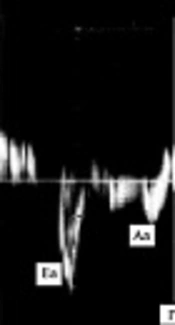
After the standard echocardiographic study, tissue Doppler measurements were performed in the apical 4-chamber view. The cursor was placed on three myocardial segments of the anterior wall of the right ventricle. Myocardial tissue velocities were recorded by placing pulsed-wave tissue Doppler at the basal segment level. Doppler waves were aligned as parallel as possible to each myocardial wall motion axis.
The deflection of myocardial motion was positive when approaching the receiver and negative when moving away from the receiver. A positive wave was recorded during systole, and two negative waves were recorded during the diastole. The highest myocardial velocities during systole, early diastole, and late diastole were recorded as S' wave, E' wave, and A' wave, respectively.
Isovolumic contraction time (ICT), isovolumic relaxation time (IRT), and ejection time (ET) measurements were performed on pulsed-wave tissue Doppler echocardiography. The MPI was calculated using these measurements as follows:
MPI = (ICT + IRT) / ET
3.8. Tricuspid Annular Peak Systolic Velocity Measurement
Tissue Doppler measurements were performed in the apical 4-chamber view. The cursor was placed on the myocardial segments of the anterior wall of the right ventricle. The highest myocardial velocity during systole (S' wave) was recorded as TAPSV.
All participants and their parents were informed about the procedures before giving their consent. The study protocol conformed to the ethical guidelines of the 1975 Declaration of Helsinki, as reflected in prior approval by Celal Bayar University Faculty of Medicine Human Research Committee.
3.9. Statistical Analysis
The data were analyzed with SPSS software version 15.0 for Windows (SPSS Inc., Chicago, IL) using mean, standard deviation (SD), and percentiles for descriptive statistics. Pearson correlation analysis and one-way analysis of variance were used when comparing the means of continuous variables for two or more groups. The Bonferroni correction test was used for post-hoc evaluation in variance analysis. Intra-observer variability and inter-observer variability of 50 participants were evaluated for all three parameters (15). P-values less than 0.05 were considered statistically significant for all analyses.
4. Results
A total of 607 children within the age range of 0-18 years were included, 56% (n = 339) and 44% (n = 268) of whom were male and female, respectively. The mean age of the study population was 6.3 ± 5.3 years (range: 0-18 years). The children’s body weight ranged from 2 to 97 kg, and their height ranged from 46 to 190 cm; however, the BSA ranged from 0.16 to 2.14 m2 (Table 1).
Table 1.
Age, Weight, Height, and Body Surface Area of Study Subjects
| Variables | Mean ± SD (min-max), n = 607 |
|---|---|
| Age, y | 6.3 ± 5.3 (0 - 17) |
| Height, cm | 112 ± 38 (46 - 190) |
| Weight, kg | 25.6 ± 18.9 (2 - 97) |
| Body surface area, m2 | 0.86 ± 0.48 (0.16 - 2.14) |
Observer variability was low for all three parameters. Inter-observer and intra-observer variability values were 2% and 2.7% for TAPSE, 3.2% and 4% for RVMPI, and 2.5% and 2.9%, respectively. There was no statistically significant difference in mean TAPSE and TAPSV values between males and females. The mean RVMPI was higher in females (0.30 ± 0.02) than in males (0.29 ± 0.02) (P = 0.011) (Table 2).
Table 2.
Mean ± Standard Deviation Values of Tricuspid Annular Plane Systolic Excursion, Right Ventricular Myocardial Performance Index, and Tricuspid Annular Peak Systolic Velocity in Both Genders
| Male (n = 339) | Female (n = 268) | P-Value a | |
|---|---|---|---|
| TAPSE, cm | 1.87 ± 0.52 | 1.91 ± 0.48 | 0.384 |
| RVMPI | 0.29 ± 0.02 | 0.30 ± 0.02 | 0.011 |
| TAPSV, cm/s | 11.10 ± 1.58 | 10.88 ± 1.57 | 0.099 |
Abbreviations: TAPSE, tricuspid annular plane systolic excursion; RVMPI, right ventricular myocardial performance index; TAPSV, tricuspid annular peak systolic velocity.
a Student t-test
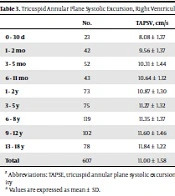
The study population was categorized into nine groups according to their age. The TAPSE, TAPSV, and RVMPI values were calculated for each group (Table 3). The study population was divided into four groups based on age, including 0 - 11 months, 1 - 5 years, 6 - 12 years, and 13 - 18 years, for the comparison of echocardiographic parameters. There was a significant difference between the mean TAPSE values of the groups; nevertheless, the mean RVMPI values of the groups were comparable. There was a significant difference between the groups in mean TAPSV values (Table 4).
Table 3.
Tricuspid Annular Plane Systolic Excursion, Right Ventricular Myocardial Performance Index, and Tricuspid Annular Peak Systolic Velocity Values of Age Groups a
| No. | TAPSV, cm/s | RVMPI | TAPSE (min-max), cm | |
|---|---|---|---|---|
| 0 - 30 d | 23 | 8.08 ± 1.37 | 0.30 ± 0.02 | 0.96 ± 0.08 (0.80 - 1.14) |
| 1 - 2 mo | 42 | 9.56 ± 1.37 | 0.30 ± 0.02 | 1.15 ± 0.11 (0.86 - 1.4) |
| 3 - 5 mo | 52 | 10.31 ± 1.44 | 0.29 ± 0.02 | 1.29 ± 0.12 (1.00 - 1.71) |
| 6 - 11 mo | 43 | 10.64 ± 1.12 | 0.29 ± 0.02 | 1.45 ± 0.13 (1.14 - 1.80) |
| 1 - 2 y | 73 | 10.87 ± 1.30 | 0.29 ± 0.03 | 1.64 ± 0.17 (1.26 - 2.04) |
| 3 - 5 y | 75 | 11.27 ± 1.32 | 0.30 ± 0.02 | 1.89 ± 0.16 (1.50 - 2.33) |
| 6 - 8 y | 119 | 11.35 ± 1.37 | 0.29 ± 0.02 | 2.10 ± 0.20 (1.66 - 2.76) |
| 9 - 12 y | 102 | 11.60 ± 1.46 | 0.30 ± 0.02 | 2.38 ± 0.24 (1.70 - 3.10) |
| 13 - 18 y | 78 | 11.84 ± 1.22 | 0.29 ± 0.03 | 2.49 ± 0.29 (1.77 - 3.16) |
| Total | 607 | 11.00 ± 1.58 | 0.29 ± 0.02 | 1.89 ± 0.50 (0.80 - 3.16) |
Abbreviations: TAPSE, tricuspid annular plane systolic excursion; RVMPI, right ventricular myocardial performance index; TAPSV, tricuspid annular peak systolic velocity.
a Values are expressed as mean ± SD.
Table 4.
Mean Tricuspid Annular Plane Systolic Excursion, Right Ventricular Myocardial Performance Index, and Tricuspid Annular Peak Systolic Velocity Values of Age Categories a
| No. | TAPSE, cm | TAPSV (cm/s) | RVMPI | |
|---|---|---|---|---|
| 0 - 11 mo | 160 | 1.25 ± 0.20 | 9.89 ± 1.67 * | 0.30 ± 0.03 |
| 1 - 5 y | 148 | 1.77 ± 0.21 | 11.08 ± 1.33 # | 0.30 ± 0.03 |
| 6 - 12 y | 221 | 2.23 ± 0.26 | 11.48 ± 1.42 # | 0.30 ± 0.03 |
| 13 - 17 y | 78 | 2.49 ± 0.30 | 11.84 ± 1.26 | 0.30 ± 0.03 |
| P-value | < 0.001 | < 0.001 | 0.580 |
Abbreviations: TAPSE, tricuspid annular plane systolic excursion; RVMPI, right ventricular myocardial performance index; TAPSV, tricuspid annular peak systolic velocity.
a Values are expressed as mean ± SD. * P = 0.000 (between 1st & 2nd groups); # P = Nonsignificant (between 2nd & 3rd and 3rd & 4th groups)
There was a strong positive correlation between TAPSE age and BSA. The multiple regression analysis revealed that 80.6% of the variance in TAPSE could be explained by BSA alone. The TAPSE value was calculated using the regression method as TAPSE = 1.068 + 0.686 × BSA (m2). With the addition of age, the prediction of TAPSE variance increased from 80.6% to 81.1%. The TAPSE value was calculated using the regression method related to age and BSA as TAPSE = 1,143 + 0,025 × age (year) + 0,686 × BSA (m2). The TAPSE was also positively correlated with TAPSV; however, there was no significant correlation between TAPSE and RVMPI (Table 5).
Table 5.
Correlation of Tricuspid Annular Plane Systolic Excursion with Age, Body Surface Area, and Other Echocardiography Parameters
| TAPSE | r | P-Value a |
|---|---|---|
| Age, y | 0.882 | < 0.001 |
| Body surface area, m2 | 0.898 | < 0.001 |
| TAPSV, cm/s | 0.533 | < 0.001 |
| RVMPI | 0.008 | 0.847 |
Abbreviations: TAPSE, tricuspid annular plane systolic excursion; RVMPI, right ventricular myocardial performance index; TAPSV, tricuspid annular peak systolic velocity.
a Pearson correlation analysis
The study population was divided into eight groups according to their BSA. The 5th, 10th, 25th, 50th, 75th, 90th, and 95th percentiles of TAPSE measurements were calculated (Table 6). The study population was divided into nine groups according to their age. The 5th, 10th, 25th, 50th, 75th, 90th, and 95th percentiles of TAPSE measurements were calculated for each group (Table 7). In each age group, ± 2 SD and ± 3 SD values for TAPSE were also calculated (Table 8).
Table 6.
Percentile Distribution of Mean Tricuspid Annular Plane Systolic Excursion Values according to Body Surface Area
| Body Surface Area | No. | 5th | 10th | 25th | 50th | 75th | 90th | 95th |
|---|---|---|---|---|---|---|---|---|
| ≤ 0.25 m2 | 47 | 0.82 | 0.86 | 0.94 | 1.07 | 1.13 | 1.22 | 1.28 |
| 0.26 - 0.50 m2 | 130 | 1.10 | 1.18 | 1.24 | 1.34 | 1.45 | 1.56 | 1.65 |
| 0.51 - 0.75 m2 | 94 | 1.46 | 1.54 | 1.67 | 1.75 | 1.83 | 1.95 | 2.05 |
| 0.76 - 1.00 m2 | 112 | 1.70 | 1.76 | 1.90 | 2.00 | 2.16 | 2.30 | 2.37 |
| 1.01 - 1.25 m2 | 84 | 1.85 | 1.95 | 2.07 | 2.23 | 2.37 | 2.47 | 2.66 |
| 1.26 - 1.50 m2 | 65 | 2.06 | 2.11 | 2.23 | 2.44 | 2.55 | 2.70 | 2.86 |
| 1.51 - 1.75 m2 | 52 | 2.10 | 2.13 | 2.30 | 2.52 | 2.69 | 2.97 | 3.02 |
| ≥ 1.76 m2 | 23 | 1.83 | 2.13 | 2.30 | 2.53 | 2.77 | 2.86 | 3.07 |
Table 7.
Percentile Distribution of Mean Tricuspid Annular Plane Systolic Excursion (cm) Values in Each Age Group
| Age | No. | 5 p | 10 p | 25 p | 50 p | 75 p | 90 p | 95 p |
|---|---|---|---|---|---|---|---|---|
| 0 - 30 d | 23 | 0.80 | 0.82 | 0.90 | 0.96 | 1.00 | 1.09 | 1.13 |
| 1 - 2 mo | 42 | 0.88 | 1.02 | 1.09 | 1.16 | 1.23 | 1.29 | 1.36 |
| 3 - 5 mo | 52 | 1.09 | 1.17 | 1.23 | 1.27 | 1.37 | 1.45 | 1.51 |
| 6 - 11 mo | 43 | 1.22 | 1.27 | 1.35 | 1.45 | 1.53 | 1.65 | 1.67 |
| 1 - 2 y | 73 | 1.33 | 1.38 | 1.51 | 1.67 | 1.73 | 1.87 | 1.95 |
| 3 - 5 y | 75 | 1.61 | 1.68 | 1.78 | 1.90 | 2.00 | 2.14 | 2.20 |
| 6 - 8 y | 119 | 1.74 | 1.81 | 1.96 | 2.13 | 2.25 | 2.36 | 2.40 |
| 9 - 12 y | 102 | 1.96 | 2.06 | 2.22 | 2.40 | 2.53 | 2.70 | 2.77 |
| 13 - 18 y | 78 | 2.04 | 2.12 | 2.28 | 2.50 | 2.70 | 2.90 | 3.00 |
Table 8.
± 2 and ± 3 Standard Deviation Values of Tricuspid Annular Plane Systolic Excursion (cm) for Each Age Group
| Age | No. | -2 SD | +2 SD | -3 SD | +3 SD |
|---|---|---|---|---|---|
| 0 - 30 d | 23 | 0.80 | 1.14 | 0.80 | 1.14 |
| 1 - 2 mo | 42 | 0.86 | 1.39 | 0.86 | 1.40 |
| 3 - 5 mo | 52 | 1.01 | 1.64 | 1.00 | 1.71 |
| 6 - 11 mo | 43 | 1.14 | 1.78 | 1.14 | 1.80 |
| 1 - 2 y | 73 | 1.29 | 2.00 | 1.26 | 2.04 |
| 3 - 5 y | 75 | 1.56 | 2.21 | 1.50 | 2.33 |
| 6 - 8 y | 119 | 1.72 | 2.47 | 1.66 | 2.76 |
| 9 - 12 y | 102 | 1.87 | 2.93 | 1.70 | 3.10 |
| 13 - 18 y | 78 | 1.80 | 3.12 | 1.77 | 3.16 |
5. Discussion
The present study determined the TAPSE, TAPSV, and RVMPI reference values that will guide the diagnosis and treatment in children from newborns to 18-year participants. Despite various difficulties in their use, echocardiographic methods are frequently used in the evaluation of cardiac functions because they are inexpensive, easy to apply, and easy to find and provide rapid results. In parallel with the developments in echocardiography, various echocardiographic methods are used to evaluate right ventricular systolic function (16). The current study’s results could help use all three parameters together to evaluate right ventricular systolic function.
The TAPSE measurement is based on the idea that most of the right ventricular motion is due to subendocardial myocardial fibers longitudinally located in the thin right ventricular wall and that the tricuspid annulus movement along the long axis between the annular plane and apex provides information about global right ventricular functions (17). The TAPSE has been shown to correlate well with the right ventricular ejection fraction (18, 19).
The TAPSE can easily be measured in all patients regardless of heart rate (20). It has been reported that TAPSV and TAPSE can be used to distinguish volume and pressure loading conditions and have high sensitivity and specificity for determining right ventricular systolic dysfunction (21). In a study by Ahmad et al., intra- and inter-observer variability values were less than 10% for TAPSE measurement in adults (22). Koestenberger et al. found this variability of about 3% in a study on children (6). Similarly, in the present study, inter-observer and intra-observer variability values were 2% and 2.7%, respectively.
A study evaluating children and adults together showed that TAPSE was low in absolute value in the pediatric group, increased in adulthood, and then gradually decreased in old age. In this study, TAPSE was positively associated with body mass index in the pediatric group. In addition, TAPSE was lower in female subjects (23). Consistent with the previous studies, the current study observed positive correlations of TAPSE measurements with the age and BSA of the participants (6, 7, 24, 25). In addition, this study noticed no difference between the two genders’ TAPSE values. However, Koestenberger et al. observed a statistically significant difference between the 15-year-old and 16-year-old age groups (6).
In order to simplify the use of TAPSE in clinical practice, the children were also categorized according to their BSA into eight groups to calculate the 5th, 10th, 25th, 50th, 75th, 90th, and 95th percentiles of TAPSE values. The normal ranges of TAPSE values in childhood have been well-defined in the literature (6, 7, 24, 25). The difference in the present study is that normal values were also revealed for TAPSV and RVMPI parameters in the same population.
Despite the simplicity of measurement, there are some limitations to TAPSE. Since it does not involve the movement of the interventricular septum and right ventricular outflow tract, TAPSE is limited to assessing the systolic function of the right ventricular free wall on the longitudinal axis only (26). On the other hand, the functional status of the left ventricle might influence TAPSE measurement (27).
The MPI has been shown to be superior to the conventional parameters of systolic function in predicting prognosis and survival (28). The MPI calculated from conventional pulsed tissue Doppler is quite valuable in the assessment of systolic and diastolic ventricular functions. However, there are some restrictions in MPI calculation with this method. Systolic and diastolic tricuspid annular velocities cannot be calculated from the same view. Therefore, they were calculated sequentially, not in the same cardiac cycle. As a result, the accuracy of results might be affected by fluctuations in heart rate because the results are less reliable when the heart rate is variable, although sinus rhythm is normal. The systolic and diastolic tricuspid annular velocities can be recorded simultaneously with pulsed-wave tissue Doppler, and MPI can be calculated at a single cardiac cycle (29, 30). Therefore, pulsed-wave tissue Doppler was used in the current study.
Comparing the RVMPI obtained with pulse wave Doppler and pulse wave tissue Doppler in children, Harada et al. showed that RVMPI in 40 children had well correlation with the two techniques (29). On the other hand, Robeson and Cui observed a small but statistically significant difference between pulse wave Doppler and RVMPI obtained with tissue Doppler in their study on 308 children aged 1 - 18 years. In the aforementioned study, it was reported that age had a small but significant positive effect on RVMPI obtained with pulse wave tissue Doppler (30). In another study examining 593 children aged 1 day to 18 years, the mean RVMPI was noticed to be 0.33 ± 0.11 (0.04 - 0.33) and correlated with age. However, the authors reported that although this relationship was statistically significant, it was too small to have clinical significance (31). No age-related change in the RVMPI values of healthy children was observed between the 4-age categories in the current study.
The mean RVMPI values in the present study were 0.29 ± 0.02 and 0.30 ± 0.02 for females and males, respectively, with a statistically significant difference. In a study involving 26 male and 24 female newborns, the mean RVMPI values were 0.27 ± 0.15 and 0.21 ± 0.12, respectively; however, the difference was not statistically significant (32). No studies in the literature have been found to report a difference in the RVMPI values between males and females. This difference might arise from a relatively high number of children who participated in the current study.
The TAPSV, measured using pulsed-wave tissue Doppler, has been suggested as a good parameter for the quantitative assessment of right ventricular systolic function in adults (14, 33). The results of a few studies regarding normal TAPSV values in children are contradictory. In a study by Mori et al., including 235 healthy newborns and 131 healthy children aged from 2 months to 18 years, unlike the present study, TAPSV values were observed to be 6.6 and 13.7 cm/s in 0-7-day newborns and elder children, respectively (34). Frommelt et al. reported the mean TAPSV of neonates and older children as 6 ± 1 and 10 ± 5 cm/s, respectively (35). Koestenberger et al. showed the mean TAPSV value of healthy newborns as 7.2 cm/s, which is consistent with the current study’s results. They found the mean TAPSV value of 18-year-old children as 14.3 cm/s, which is different from the present study’s results. It was reported that the TAPSV shows a non-linear increase with age and BSA after the first year of life (12).
In the current study, the mean TAPSV showed a significant increase between the first three age groups; however, the increase between the age groups of 5 - 12 and 13 - 18 years was not statistically significant. The relationship of TAPSV with age in neonates, but not older children, has been reported in the literature (36). Studies reporting no correlation between age and TAPSV are also present in the literature (37, 38). The contradictory results might be due to the fact that different studies include different age groups. In the present study, similar to the results of Koestenberger et al.’s study (12), there was no correlation between TAPSV and gender; nevertheless, a positive correlation was observed between TAPSV and TAPSE.
The main limitation of this study was that the children included in the study were children who were referred to only one pediatric cardiology outpatient clinic. Therefore, they were not randomly selected, and not all groups had an equal number of subjects of both genders. In addition, the right ventricular fractional area of change was not investigated in this study.
5.1. Conclusions
In conclusion, TAPSE, TAPSV, and RVMPI are easy-to-use, reproducible echocardiographic parameters used to evaluate right ventricular systolic functions. This study determined the normal values for TAPSV and RVMPI, which are used in evaluating right ventricular systolic function together with TAPSE in children from newborns to 18-year subjects. It is important to have knowledge of the normal ranges of these parameters to recognize right ventricular dysfunction early in various cardiac disorders. The obtained results of this study showing the 5th, 10th, 25th, 50th, 75th, 90th, and 95th percentiles and ± 2 SD and ± 3 SD of these parameters for different age and BSA groups will simplify their use in clinical practice.