The brachial plexus, composed of the cervical C
5 ~ C
8 and T
1 nerve roots, is a network of nerves that innervates the sensory and motor structures of the upper limbs, shoulders, back, and chest (
10). Brachial plexus neuropathy can occur when the neural structures are subjected to excessive tension, compression, or traumatic injury. The brachial plexus is closely related to the median, radial, and ulnar nerves. Therefore, brachial plexus neuropathy can cause numbness and loss of sensation in the upper limbs, weakened muscle strength in the upper and middle parts of the latissimus dorsi and pectoralis major muscles, functional disorders in the elbow and wrist joints, and even complete paralysis of the upper limbs, which severely affects the normal life and quality of life of patients. It may also hinder the normal growth and development of children with brachial plexus injuries. While some children with brachial plexus injuries may recover spontaneously (
11), others who do not recover or suffer from severe injuries may experience muscle and joint atrophy, and even lifelong disability, if not treated in a timely and effective manner (
12). Therefore, accurately determining the type, location, and severity of the lesion using effective measures is of great significance for improving the prognostic outcome in affected children (
13). Although ultrasound and electromyography can be used for diagnosing brachial plexus neuropathy, ultrasound accuracy is dependent on the examiner’s skill and experience, making it slightly less reliable. Electromyography is an invasive procedure that is difficult to perform in children due to poor cooperation, limiting its clinical applicability. MRI is currently recognized as the most valuable and non-invasive imaging modality for diagnosing brachial plexus neuropathy (
14,
15).
Children, especially newborns, have thin brachial plexus nerve trunks, with high water content and low fat content in the body. This poses a significant technical challenge for imaging the brachial plexus in children using MRI. However, in some well-regarded domestic and international studies (
16), high-resolution brachial plexus MRI has proven to be feasible for evaluating the physical connections between the brachial plexus and the spinal cord in children. As a result, MRI may hold decisive diagnostic value for brachial plexus neuropathy in children (
17,
18).
According to previous studies (
19), MRI of the brachial plexus in China is commonly performed in large 3A-grade hospitals using 3.0T MRI equipment, which provides a stronger magnetic field intensity for clearer and more accurate images. However, some researchers (
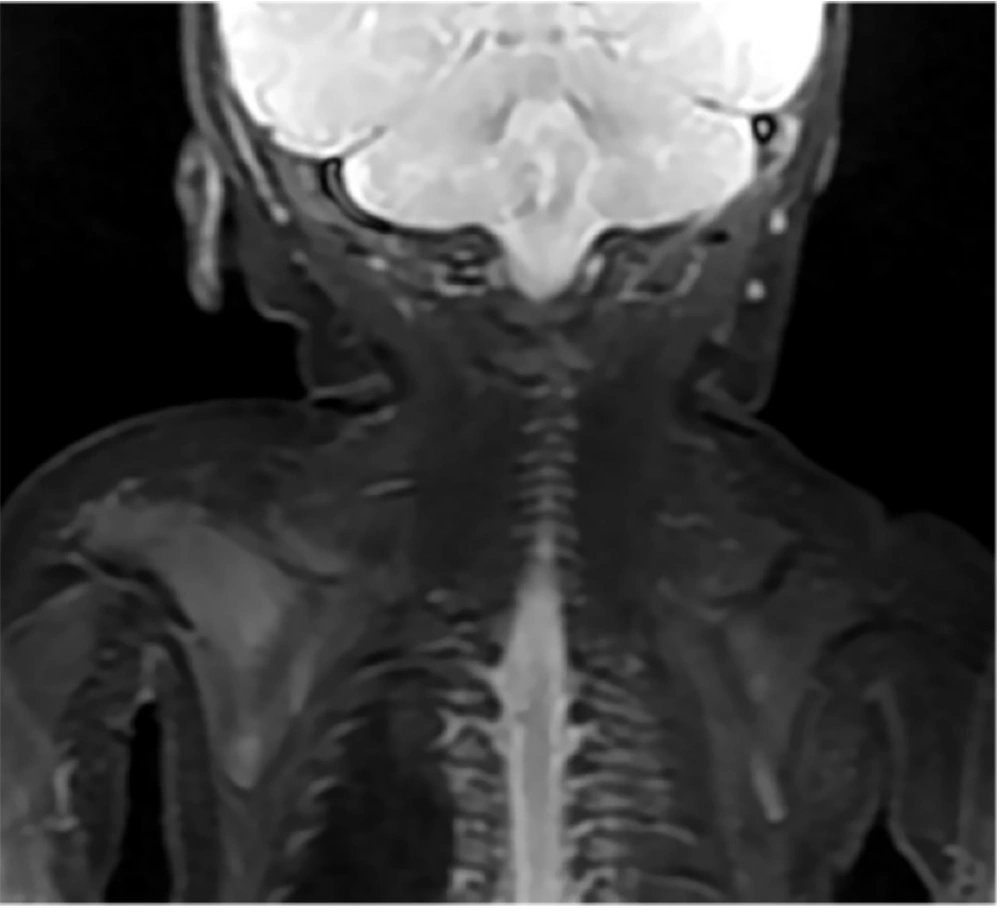
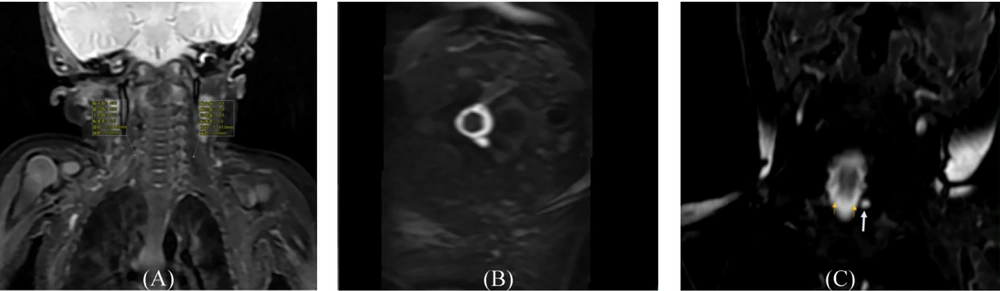
20) have proposed that the uniformity of fat-suppression with 1.5T MRI is higher than that of 3.0T MRI, which helps avoid uneven fat-suppression in the brachial plexus nerve background under high field intensity. Therefore, this study employed 1.5T MRI to acquire high-quality images. The imaging findings in this study revealed that, among the 32 children clinically diagnosed with brachial plexus nerve injuries, MRI images showed thickening, thinning, tortuosity, or uneven thickness of nerve roots, accompanied by high signals in the T
2 fat-suppression sequence in some cases. These are generally considered signs of brachial plexus nerve injury. Additionally, MRI in another case revealed the formation of a meningeal cyst, indicating that the presence of a meningeal cyst does not necessarily imply nerve root discontinuity, which is consistent with previous research (
21).
Furthermore, regarding the MRI features of neurofibroma, Li et al. (
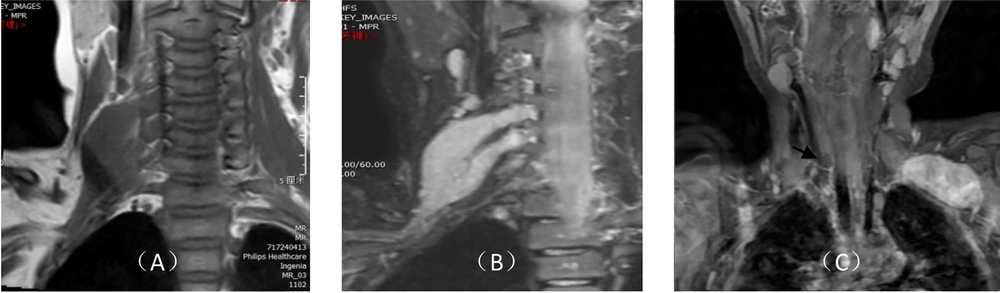
22) found that MRI images of neurofibroma showed uneven signals, with separated short T
2 signal shadows, and plexiform neurofibromas with separation, which were similar to those observed in this study. Meanwhile, the imaging features of neurosheathoma included space-occupying lesions, predominantly oval-shaped with isometric T
1 and slightly longer T
2 signals, located in the lateral upper edge of the thorax, the lower part of the posterior clavicle, and the left side of the brachial plexus. In a prior study (
23), its imaging features were generally summarized as a single oval mass with a clear boundary, a liquid echogenic zone in the tumor, or the "rat tail sign" at both ends, which were consistent with the pathological morphology observed in our study. However, the presence of the liquid echogenic zone was not found in the imaging diagnosis of this tumor in this study, which requires further confirmation. There is also a discrepancy between the MRI diagnosis and the clinical diagnosis in this study, which may be related to the different information and diagnostic perspectives obtained by the imaging and clinical physicians. More communication between the two is needed to reduce diagnostic discrepancies. The findings of this study can provide insights for the clinical diagnosis of pediatric brachial plexus neuropathy, enabling early and accurate diagnosis, which facilitates early treatment and maximizes patient recovery.
This study also has limitations, such as being a single-center retrospective analysis with a short follow-up period, which may limit its generalizability. It is recommended that future multi-center, large-scale observational studies be conducted to further clarify the impact of MRI on different types of brachial plexus neuropathy in children.
5.1. Conclusions
In conclusion, MRI offers advantages in clearly presenting the type, location, and extent of brachial plexus neuropathy in children, which is of great significance for the early diagnosis and treatment of this condition.