
1. Background
Neuroblastoma, a malignant tumor of the peripheral sympathetic nervous system, is one of the most difficult solid tumors of childhood to manage. Despite the advances in current imaging techniques and treatment modalities, the life expectancy of patients in the high-risk group (HRG) is still around 50%, and that of relapsed/refractory cases is quite low (10 - 15%) (1, 2). Nowadays, administration of anti-glycospingolipid disialoganglioside 2 (anti-GD2) in addition to standard treatment approaches appears to be promising. The GD2 is an antigen located specifically on neural tissues and is also expressed in neuroblastoma cells. Dinutuximab beta (DB), a GD2 monoclonal antibody, stimulates the human immune system and ensures the destruction of tumor cells (3, 4). The DB has been used in the maintenance treatment of HRG patients and also as part of the treatment of relapsed/refractory cases, with a survival advantage compared to previous approaches (5, 6). Although DB is one of the newest treatment options that has a role in relatively long survival in high-risk neuroblastoma, it has different adverse effects.
2. Objectives
Considering this situation, the aim of this study is to present our clinical experience with DB in first-line treatment in HRG neuroblastoma and in cases with relapsed/refractory disease, as well as the side effects that had been encountered in our center.
3. Methods
Eight patients were included in the study. While 5 patients with high-risk neuroblastoma diagnosed before July 2020 were treated according to the Turkish Pediatric Oncology Group neuroblastoma (TPOG NB) 2009 protocol, the others were treated according to the TPOG NB 2020 protocol (Table 1). High-risk group criteria are shown in Table 2. In the TPOG NB 2009 protocol, patients were given a total of 6 chemotherapy blocks by alternating A9 (vincristine + dacarbazine + ifosfamide + adriamycin) and A11 (cyclophosphamide + etoposide + cisplatin) blocks, then surgery, radiotherapy if appropriate, and maintenance treatment with 13-cis retinoic acid (RA) was given according to the evaluation response. In the TPOG NB 2020 protocol, the International Neuroblastoma Risk Grouping Staging System (INRGSS) used imaging-based risk factors (IDRFs) and risk classification group (INRG). This treatment was started by alternating A12 (cyclophosphamide + etoposide + cisplatin) and A13 (vincristine + dacarbazine + ifosfamide + adriamycin) blocks for 6 cycles. This was followed by surgery and, if appropriate, radiotherapy to the primary tumor site. After radiotherapy, treatment was completed with 4 cycles of temozolamide for consolidation, and 5 cycles of 13-cis RA for 14 days and anti-GD2 for 10 days in maintenance. According to the International Neuroblastoma Response Criteria (INRC), a new lesion or a measurable increase in existing lesions during follow-up was defined as progressive disease (PD). Patients with PD or relapsed disease received a chemotherapy regimen (usually vincristine + irinotecan + temozolamide-VIT) alternating with anti-GD2. In this study, 2 patients, whose first treatment was given according to the TPOG NB 2009 protocol, received 13-cis RA or chemotherapy with anti-GD2 during relapsed disease. All patients were started on oral gabapentin 3 days before starting anti-GD2, 1x10 mg/kg on the first day, 2x10 mg/kg on the second day, 3 × 10 mg/kg on the third day, and continued thereafter. After the morphine infusion was stopped, the dose of gabapentin was reduced and discontinued. Two hours before the anti-GD2 infusion, morphine was administered at 0.02 - 0.05 mg/kg/h as an intravenous (iv) bolus and continued at 0.03 mg/kg/h simultaneously with the drug infusion. The dose was gradually reduced and discontinued according to the patient's pain response. In addition, paracetamol and ibuprofen were used regularly for pain control. In one patient, analgesia was provided with tramadol due to an allergic reaction that we thought was due to gabapentin and morphine. In order to control allergic reactions, diphenhydramine was administered iv 30 minutes before the start of the anti-GD2 infusion, the dose was repeated every 6 hours, and the dose intervals were increased according to the patient's condition. Cetirizine was given orally in necessary cases. Additionally, adrenaline intramuscular/nebule and prednisolone iv were kept ready in case of life-threatening reactions. Dinutuximab beta, as an anti-GD2, was administered as a continuous iv infusion for 10 days at a dose of 10 mg/m2/day. First DB infusions were given in the pediatric intensive care unit. Two separate large-lumen vascular accesses were provided in all patients. While DB was given as a continuous infusion from one, other drug applications (iv hydration, antiemetic, antipyretic, etc.) were made from the other. Vital findings were constantly monitored. In those who had fever, blood cultures were taken to rule out sepsis, and nonspecific broad-spectrum iv antibiotics were applied. Because of its immunosuppressive effect, corticosteroids were avoided except in life-threatening situations. Patients were monitored for side effects according to the SIOPEN protocol (5, 6). Treatment response evaluations were performed at the 2nd, 4th, and 6th cycles and every 2 - 3 months thereafter. Radiological evaluations were made by metaiodobenzylguanidine (MIBG) if possible, Ga-68 DOTA positron emission tomography (Ga-DOTA-PET), magnetic resonance imaging (MRI)/computed tomography (CT), and bone marrow involvement was evaluated by bone marrow aspiration/biopsy.
Table 1.
Patients’ characteristics
| Patient no | Sex | Diagnosis Age (mo) | Primary Tumor Location | Metastasis | Disease Status (HRG/ Progressive Disease/ Relapsed Disease) | Mutation Analysis | Treatment | Dinutuximab Beta Administration (Number of Cycles) | Adverse Effects | Follow-up Time (mo) | Outcome |
|---|---|---|---|---|---|---|---|---|---|---|---|
| 1 | M | 26 | Surrenal | Bone, bone marrow, retroorbital area | HRG | - | TPOG NB 2020; DB + 13-cis RA | 5 | Fever; Cough; Tachycardia | 40 | A |
| 2 | M | 43 | Surrenal | Bone, bone marrow, spleen, lymph nodes | HRG | - | TPOG NB 2009; DB + 13-cis RA | 5 | Fever; Cough | 48 | A |
| 3 | M | 45 | Abdominal paravertebral | Bone, bone marrow, posterior cerebellum | HRG; Progressive disease | K1205R, K1205Q, L1165P and M1138V mutations in the ALK gene, FGFR3(e17):TACC3(e11) fusion | TPOG NB 2009; DB + 13-cis RA; Lorlatinib | 5 | Fever; Cough; Tachycardia | 46 | A |
| 4 | F | First diagnosis: 19; 1st progression: 21; 2nd progression: 29 | Surrenal | First diagnosis: Bone, lymph nodes; Progression: Bone, lung | HRG | - | First diagnosis: TPOG NB 2020; Progression: RIST, DB + VIT, HSCT, DB + 13-cis RA | 3+5 | Fever | 42 | A |
| 5 | M | First diagnosis: 53; Relapse: 77 | Surrenal | First diagnosis: Lymph nodes; Relapsed disease: Lymph nodes | HRG; Relapsed disease | I655V mutation in the ERBB2 gene | First diagnosis: TPOG NB 2020; DB + 13-cis RA; Relapsed disease: RIST | 5 | Fever; Pain; Pupil paralysis | 44 | A |
| 6 | F | First diagnosis: 19; Progression: 33 | Surrenal | First diagnosis: Bone marrow; Progression: Left parieto-occipital area, cerebellum | HRG; Progressive disease | - | First diagnosis: TPOG NB 2009; Progression: VIT, RT, DB | 1 | Fever; Tachycardia; Capillary leak syndrome | 19 | E |
| 7 | M | First diagnosis: 47; Progression: 67; Relapse: 105 | Surrenal | First diagnosis: Bone marrow, lymph node; Progression: Lymph node; Relapsed disease: Lymph node, bone | HRG; Progressive disease; Relapsed disease | - | First diagnosis: TPOG NB 2009; Progression: VIT, RIST; Relapsed disease: ICE, DB + 13-cis RA/ TEC | 5 | Fever; Tachycardia; Pain; Cough; Urinary retention | 84 | A |
| 8 | M | First diagnosis: 97; 1st relapse: 144; 2nd relapse: 207 | Surrenal | First diagnosis: Lung; 1st relapse: Lung, lymph node; 2nd relapse: lymph node | HRG; Relapsed disease | - | First diagnosis: TPOG NB 2009; 1st relapse: RT, VIT, 13-cis RA; 2nd relapse: RT, DB + 13-cis RA | 5 | Fever; Tachycardia Pain; Constipation; Urticaria | 153 | A |
Abbreviations: M, male; F, female; HRG, high-risk group; TPOG NB, Turkish Pediatric Oncology Group neuroblastoma; DB, dinutuximab beta; RA, retinoic asit; RIST, sirolimus + irinotecan + dasanitib + temozolamide; VIT, vincristine + irinotekan + temozolamide; HSCT, hematopoietic stem cell transplantation; RT, radiotherapy; ICE, carboplatin + ifosfamide + etoposide; TEC, topotecan + etoposide + cyclophosphamide; A, alive; E, exitus.
Table 2.
High Risk Group Defining According to TPOG NB 2009 Protocol and Preceeding TPOG NB 2020 Treatment Protocols
| INSS/ INRG stage | Age (mo) | MYCN | Shimada |
|---|---|---|---|
| TPOG NB 2009 | |||
| 2A-2B | ≥ 18 | + | any |
| 3 | any | + | any |
| 3 | ≥ 18 | - | unfavorable |
| 4 | ≥ 18 | any | any |
| 4 | < 18 | + | any |
| 4S | < 12 | + | any |
| TPOG NB 2020 | |||
| L1 | Any | + | any |
| L2 | Any | + | any |
| M | < 18 | + | any |
| M | ≥ 18 | - | any |
| MS | < 18 | + | any |
3.1. Data analysis
A descriptive study was carried out in which quantitative variables are presented as mean and standard deviation, while qualitative variables are presented as absolute frequency and relative percentage. Survival analysis was performed by Kaplan-Meier analysis.
4. Result
Dinutuximab beta was administered to 8 patients in our center between March 2021-February 2023. Six patients were male. Since 6 patients were in the HRG, they received the drug as a part of first-line treatment for resistant and/or progressive disease, and 2 received it at the diagnosis of relapse (Figure 1). The median age was 45 months (19 - 97 months). The primary tumor was located in the adrenal gland in 5 patients and in the abdominal paravertebral area in one. All patients were metastatic at initial diagnosis. Multiple bone metastases were present in 4 patients, bone marrow involvement in 3, and lymph node infiltration in 3 cases. Intracranial masses (behind the cerebellum, retroorbital area, left parieto-occipital area, and cerebellum) were detected in 2 patients at initial diagnosis, and in one during follow-up. The MYCN amplification was negative for all. The entire treatment process was completed uneventfully with DB maintenance for Patient 1, Patient 2, and Patient 3, and they are disease-free during follow-up (Table 1). Disease-free status has been maintained with additional lorlatinib in Patient 3, who had intracranial metastasis. When progression of bone metastases was detected in the evaluation of Patient 4 after the first 2 cycles of chemotherapy, the RIST (sirolimus + irinotecan + dasanitib + temozolamide) protocol was started. After 6 months with stable disease, DB was administered alternately with VIT when new lesions were detected in the lungs. The lesions disappeared after 3 cycles, and then syngeneic hematopoietic stem cell transplantation (HSCT) was performed with the patient's twin sister. Five cycles of DB alternating with 13-cis RA following the HSCT were applied (Table 1). She is disease-free during follow-up. Relapsed disease was confirmed in Patient 5 when newly emerged cervical, supraclavicular, and mediastinal lymph nodes were detected at routine examination 3 months after cessation of treatment in which DB was used for maintenance. Radiotherapy was applied to the defined locations. Then the RIST protocol was started, and DB was not applied to this patient after relapse. Patient 6 was born at 27 weeks of gestation following a triple pregnancy by in vitro fertilization and was followed in the neonatal intensive care unit with bronchopulmonary dysplasia (BPD). After standard initial chemotherapy, surgery, and radiotherapy were completed, maintenance treatment was started with 13-cis RA. Multiple intracranial masses were detected on MRI in the left parieto-occipital and cerebellar areas performed due to restlessness, crying attacks, and vomiting. Chemotherapy consisting of a VIT block and radiotherapy had been applied, and DB was started 1 month later. However, she was taken to intensive care due to severe capillary leak syndrome during the drug infusion, and died despite all supportive measures. In the 2 patients who received DB due to relapsed disease, primary tumors were located in the adrenal gland, and MYCN amplification was not detected (Table 1). Patient 7 had paraaortic, left iliac, left inguinal, and left popliteal lymph nodes and bone marrow involvement at initial diagnosis. While the metastasis disappeared with first-line treatment, a new lesion was detected behind the left knee. As second-line treatment, VIT for three courses and the RIST regimen for the rest of chemotherapy were applied. After completion of RIST, the patient was in remission on radiological imaging. However, a year later, relapse was identified with widespread bone metastases and left iliac lymph nodes (Table 1). All metastatic lesions disappeared after 3 ICE (carboplatin + cyclophosphamide + ifosfamide) courses, and 13-cis RA with DB was applied. Following 2 cycles, 13-cis RA was removed from the scheme due to a new lesion detected in the left popliteal region. Dinutuximab beta was alternated with topotecan + cyclophosphamide + etoposide, which had been applied for 5 courses in total. The patient is still disease-free at the time of this report (Table 1). Patient 8, who had metastases in the thorax at initial diagnosis, had a first-line uneventful treatment course but experienced a relapse in the lung parenchyma and mediastinal lymph nodes 2 years later. Relapse treatment was completed with VIT blocks followed by radiotherapy and 13-cis RA. Afterwards, the patient's second relapse again occurred in the mediastinal lymph nodes at the age of 17. Re-radiotherapy for the mediastinal relapse area and 13-cis RA with DB were the treatment choices in this case (Table 1). He was still disease-free for 4 years at the time of this report. A total of 39 cycles of DB were applied to all patients. Seven patients completed treatment without serious side effects. One patient died during the first DB infusion due to severe capillary leak syndrome. Relapsed disease was identified in 1 out of 7 surviving patients after treatment. This patient's treatment process was proceeding as disease-free at the time of this report (Table 1).
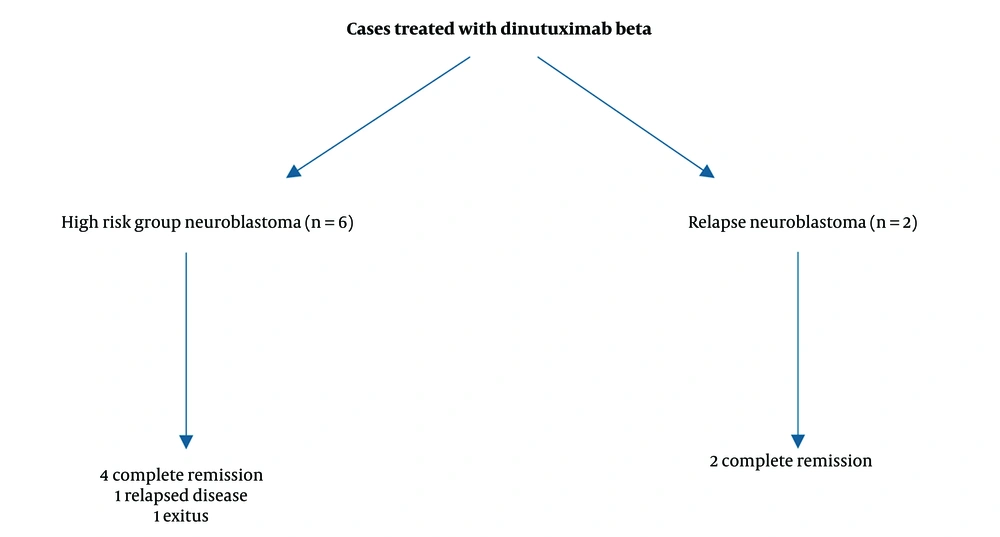
Figure 1.
Dinutuximab beta administration in different streams of patients and outcome
The most common side effect during DB infusion was fever and had been detected in all patients (Table 1). Although it was not seen in the first cycle, it did occur during the second course in Patient 1. Tachycardia and pain were other common side effects. Spasmodic cough attacks developed in 3 patients and were controlled with inhaled adrenaline. One patient had constipation and one had urinary retention associated with morphine. Symptoms improved by reducing/discontinuing morphine. Patient 8 had severe abdominal pain, constipation, tachycardia, fever, widespread muscle pain, and urticarial lesions on the hands, lips, and genital area in the first hours after starting DB infusion (Figure 2), and intramuscular adrenaline was administered in addition to diphenhydramine and cetirizine treatment. However, as the lesions continued, gabapentin and morphine infusion were discontinued. He was switched to tramadol, and all his complaints quickly subsided. Thereupon, other DB infusions were administered with tramadol without any problem. In the case of fever, port catheter infection was detected in Patient 2 and accepted as a symptom independent of DB infusion. Appropriate antibiotherapy was applied, the existing port catheter was removed, and a new port catheter was placed on the opposite side. Blurred vision occurred in Patient 5 immediately after completing the first DB. Lumbar puncture was performed for increased intracranial pressure, and cerebrospinal fluid pressure was normal. Eye examination revealed hypermetropia. Thereupon, it was thought that the existing and previously unknown congenital hypermetropia had worsened with DB, which might have caused possible pupil paralysis. His vision problem was corrected with glasses. In Patient 6, with a history of prematurity and BPD, on the first day of the first DB infusion, edema in the whole body, tachycardia, and fever appeared. The infusion rate was reduced at the beginning and supportive treatment was started. On the fifth day of follow-up, subconjunctival hemorrhages, decreased urine output, respiratory distress, deterioration in liver function tests, and thrombocytopenia occurred. Considering severe capillary leak syndrome, DB was stopped. She was transferred to the intensive care unit and put on a mechanical ventilator. The patient deteriorated with pediatric acute respiratory distress syndrome and pneumothorax, then died despite all supportive efforts.
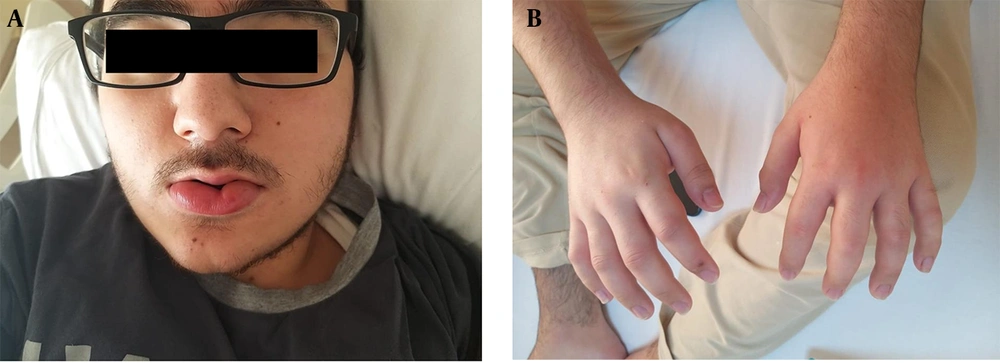
Figure 2.
A, drug-related mucosal reaction on lips; B, drug-related swelling on fingers
5. Discussion
In this study group of 6 patients with HRG and 2 patients with relapsed neuroblastoma, addition of DB to standard chemotherapy provided a median follow-up of 46 months of disease-free period (min: 19-max: 153 months), which can be considered a relatively long survival for these cases. Maintenance treatment with DB in HRG patients has now become the standard treatment approach in Europe, so we applied it to our 6 cases (5-7). A previous study from our department in 2019 had shown a 3-year overall survival of 42% in cases with stage IV neuroblastoma (8). In the current study, 7 patients with stage IV and HRG and/or relapsed/refractory disease are alive with additional immunotherapy with DB. In our previous experience, since there was no access to this drug in our country, these cases did not have the chance to use DB. Although it is not possible to make a comparison with these historical cases and several different factors such as MYCN status, there seems to be a survival advantage with a median follow-up of 46 months. Although the patient group of 8 cases is a small cohort in which to calculate overall and event-free survival, we made such a calculation with Kaplan-Meier analysis and found an event-free survival and overall survival of 87.5% for a median follow-up of 46 months (min 19-max 153 months) at the time of this report. We have only one event, which was the exitus of one case from capillary leak, for the calculation. So both event-free and overall survival were equal. According to our previous study of neuroblastoma stage IV patients, this survival rate is much more favorable. Ongoing studies have also shown some survival advantage in relapsed/refractory neuroblastoma patients with DB, but questions remain regarding which chemotherapy combination with DB will be more effective and less toxic (9, 10). Although VIT is the most common regimen with DB, some studies on topotecan-temozolomide are ongoing (9, 11). In our study, because they had previously been administered, VIT was not combined with DB for two patients with relapsed disease. For these cases, Patient 8 completed treatment by alternating with 13-cis RA, while in Patient 7, DB was combined with 13-cis RA and topotecan + cyclophosphamide + etoposide, and both are disease-free at the time of this report. As a result of long-term follow-up of the patients, it is thought that more delayed relapses of neuroblastoma can be achieved with DB. There is an opinion that DB causes downregulation of GD2 in bone marrow and thus relapses can occur at a later stage (12, 13). However, among patients in our group, Patient 5, who completed maintenance treatment with DB, experienced a very early relapse, 3 months after ceasing treatment, while in complete remission. He has been in complete remission with the RIST protocol now, but the I655V mutation in the ERBB2 gene was detected in the tumor sample with Next Generation Sequencing (NGS). Although a target treatment for this mutation has not yet been defined, the very early relapse might be related to this feature, and we may encounter new relapses from now on. This fact shows us that neuroblastoma is a serious problem at the minimal residual disease level, which we still cannot solve at the treatment level. For example, in Patient 3, with intracranial metastasis at initial diagnosis, one of the standard high-risk cases with DB maintenance, K1205R, K1205Q, L1165P, and M1138V mutations in the ALK gene and FGFR3(e17):TACC3(e11) fusion were detected in the tumor tissue with NGS. The association of ALK mutations with relapsed/refractory neuroblastoma is now well known. Moreover, the development of therapeutic targets for this association provides a significant survival advantage (14, 15). Therefore, after the patient's first-line treatment was completed with DB, lorlatinib, a third-generation ALK inhibitor, was added to treatment. This patient is under follow-up with lorlatinib to maintain his disease-free survival, as he has a high risk of relapse. Various studies have mentioned several adverse effects (AEs) (pain, allergic reactions, fever, hypotension, capillary leak syndrome, neurotoxicity, hematotoxicity, liver toxicity, etc.) that can occur during the administration of DB and the methods of coping with them (16, 17). Adverse effects with DB were manageable in 7 of 8 patients in this study, and the most common was fever. This was followed by tachycardia and pain, respectively. In these patients, all AEs were resolved with appropriate supportive treatments. Similar to the literature, in 6 of these 7 patients, the severity of AEs was more prominent in the first cycle and less serious in subsequent cycles (18, 19). Unlike these cases, no AEs were observed in Patient 1 in the first cycle, but some were observed during the second cycle and continued to decrease in the other cycles. An interesting point is that DB, which might have caused possible pupil paralysis and led to worsening of congenital hypermetropia in one of our cases, was an extremely rare type of neurotoxicity. It is frequently mentioned in the literature that serious AEs occur due to increased inflammatory activity with granulocyte-macrophage colony-stimulating factor (GM-CSF) or interleukin-2 (IL-2) administered simultaneously during DB (5, 17). However, DB was administered alone in this study, and Patient 6, who developed severe capillary leak syndrome, died during the first cycle. We consider that BPD caused serious toxicity with DB in this patient. The abnormal vascular structure occurring in BPD may have facilitated the emergence of capillary leak syndrome with the hyperinflammatory state increased by DB and led to severe pulmonary edema and a mortal course of the condition (20, 21). Therefore, we assume that careful evaluation is required regarding the use of DB in patients with lung problems. The primary limitations of the study are the limited number of patients, its being performed in a single center, and its retrospective nature. Nonetheless, this study contributes to the literature in terms of presenting clinical experiences as well as adverse events on a patient-by-patient basis in an aggressive course of neuroblastoma with a novel therapeutic drug. In conclusion, DB appears to be useful in the initial treatment regimen of high-risk neuroblastoma and for relapsed/refractory neuroblastoma treatment in combination with chemotherapy. Although the majority of side effects caused by DB can be handled by experienced and trained personnel, special consideration should be given to individual risk factors in the patient that could be important during treatment with this novel drug. To obtain more reliable data regarding the use of chemotherapy and targeted therapies together or alone, case-controlled studies with larger numbers of patients are needed. On the other hand, the rarity of the disease makes these studies difficult. Besides, further analyses are necessary to detect high-risk genetic mutations in addition to MYCN in these patients.