
1. Background
Emergency departments (EDs) are vital components of modern healthcare systems, serving as the first point of contact for patients requiring urgent or acute medical attention. These units are expected to provide rapid, efficient, and uninterrupted care to individuals presenting with real or perceived emergencies (1). The critical role of EDs has become increasingly apparent as healthcare demands continue to rise globally, particularly among vulnerable populations such as children.
In recent years, many countries have experienced a significant increase in pediatric emergency visits, much of which is driven by non-urgent complaints that could be managed at the primary care level (2-4). This growing influx of low-acuity cases places a considerable burden on emergency services, leading to overcrowding, extended waiting times, and potential delays in care for truly critical patients (5). Overutilization of emergency services can negatively affect patient safety, provider satisfaction, and system efficiency (6, 7).
Moreover, EDs often shape public perception of hospital quality, as they are frequently the first and sometimes only contact point for many families (8). In this context, emergency departments not only provide acute care but also strongly influence how families perceive overall hospital quality and shape their future healthcare-seeking behavior.
Understanding the demographic and clinical characteristics of pediatric ED visits is essential for health policy makers and clinicians. Identifying patterns in visit timing, age distribution, and common diagnoses can provide valuable insight into system inefficiencies and help guide public health strategies aimed at reducing unnecessary emergency visits. Building on this rationale, the present study analyzes pediatric emergency department visits in a high-volume center in southeastern Türkiye over a one-year period.
2. Objectives
This study aimed to evaluate the demographic and clinical characteristics of pediatric emergency department visits over a one-year period (January 1 and December 31, 2023) in southeastern Turkey. The goal was to identify common complaints, peak visit times, and seasonal trends to inform public health strategies and reduce inappropriate ED use.
3. Methods
3.1. Study Design and Setting
This retrospective descriptive study was conducted using patient data from the pediatric emergency department of Batman İluh State Hospital, a high-volume secondary/tertiary care state hospital in southeastern Turkey. The hospital provides 24-hour pediatric emergency services to an urban and semi-rural catchment area with a rapidly growing and socioeconomically diverse population. The study included all pediatric patients who presented to the pediatric emergency department between January 1 and December 31, 2023. Data extraction was completed on February 15, 2025, through the Hospital Information Management System (HIMS).
3.2. Study Population
The study population comprised all patients under the age of 18 who were admitted to the pediatric emergency department during the study period. After excluding patients aged 18 years and older, a total of 192,661 pediatric visits were included in the final analysis. Individual children could contribute more than one visit; repeat attendances were analyzed at the visit level, reflecting the real-world workload of the department. No sampling was performed, as the aim was to describe the entire pediatric emergency population within the defined time frame. Because the HIMS administrative extract did not include a reliable anonymized patient identifier, the number of unique children and repeat-visit frequency could not be determined. Therefore, all analyses are reported at the visit level (ED attendances; N = 192,661).
3.3. Data Collection and Variables
Anonymized data were obtained from the hospital’s information systems unit, in accordance with institutional and national data protection regulations. The investigators did not have access to any personally identifiable information at any stage of the study. Data were extracted from the HIMS, which is used routinely for clinical documentation and administrative reporting. Primary diagnoses were extracted as ICD-coded entries from the HIMS. For analysis, ICD codes were mapped into clinically meaningful diagnostic categories by grouping codes that represented the same syndrome/condition (e.g., upper respiratory tract infection, acute gastroenteritis, otitis media). When multiple ICD codes were recorded for a visit, the primary diagnosis field was used.
The dataset included the following variables: (1) Demographic data: Age (years) and sex; (2) Temporal variables: Day of the week, time of visit (grouped into three 8-hour intervals: 00:00 - 08:00, 08:00 - 16:00, 16:00 - 00:00), and month/season of visit; (3) Clinical data: Chief complaint and primary diagnosis coded according to ICD-based diagnostic categories; (4) Outcome variables: Disposition at the end of the ED visit, categorized as discharge home, ward admission, pediatric intensive care unit (PICU) admission, referral to a tertiary care center, or death in the ED. Outcome information was obtained from the standardized HIMS “discharge status” and “type of exit” fields.
Triage in the pediatric emergency department followed national Ministry of Health guidelines, with patients categorized into color-coded urgency levels by trained triage nurses. Triage category and comorbidity details were not systematically available in the administrative dataset and were therefore not included in the analysis.
3.4. Ethical Approval
This study was approved by the Non-Interventional Research Ethics Committee of Mardin Artuklu University (Approval Number: 2024/12‑16; Date: December 17, 2024). Institutional permission was also obtained from Batman İluh State Hospital. The analysis was conducted in accordance with the ethical principles outlined in the Declaration of Helsinki. The ethics committee granted a waiver of informed consent because the study used fully anonymized, routinely collected administrative data and involved no direct contact with patients or families. The approval explicitly covered retrospective access to and analysis of data for all pediatric ED visits between January 1 and December 31, 2023.
3.5. Statistical Analysis
All statistical analyses were performed using IBM SPSS Statistics version 26.0. Descriptive statistics were used to summarize the data. Categorical variables were presented as frequencies (n) and percentages (%), and continuous variables were summarized as means and standard deviations where appropriate. For selected key proportions—such as the proportion of visits due to URTI, the proportion of visits occurring in winter, and the proportions resulting in ward admission, ICU admission, or referral—95% confidence intervals (CIs) were calculated using binomial methods. Because the dataset comprised all eligible pediatric ED visits during the study period, no regression modeling or formal hypothesis testing was performed; the analysis was intended to provide a comprehensive descriptive overview of pediatric emergency department utilization.
4. Results
A total of 192,661 ED visits were included in the study. As a reliable anonymized patient identifier was not available, results are presented at the visit level throughout; thus, all percentages in this section use visits (n = 192,661) as the denominator unless otherwise stated. The demographic and presentation characteristics of ED visits are summarized in Table 1. Of all visits, 52.0% were made by male children and 48.0% by female children. The majority of visits involved Turkish citizens (95.08%), while foreign nationals accounted for 4.92% of visits.
Table 1.
Demographic and Presentation Characteristics of Pediatric Emergency Department Visits (N = 192,661 Visits)
| Variables | Number of Visits; No. (%) |
|---|---|
| Gender | |
| Female | 92,532 (48.0) |
| Male | 100,129 (52.0) |
| Nationality | |
| Turkish | 183,277 (95.08) |
| Foreigner | 9,384 (4.92) |
| Season of visit | |
| Winter | 56,257 (29.19) |
| Spring | 48,591 (25.22) |
| Autumn | 47,738 (24.77) |
| Summer | 40,075 (20.82) |
| Time of visit | |
| 08.00 - 16.00 | 42,963 (22.30) |
| 16.00 - 00.00 | 123,784 (64.25) |
| 00.00 - 08.00 | 25,914 (13.45) |
Regarding visit outcomes, the overwhelming majority of visits resulted in discharge home. Overall, 0.94% of visits (n = 1,811) resulted in inpatient ward admission, 0.11% of visits (n = 212) in pediatric intensive care unit (PICU) admission, and 0.09% of visits (n = 173) in referral to a tertiary care center. Four visits ended in death in the ED (n = 4; 0.002% of visits). Given the total of 192,661 visits, these correspond to ward admission, PICU admission, and referral proportions of 0.94% (95% CI 0.90 - 0.98), 0.11% (95% CI 0.10 - 0.13), and 0.09% (95% CI 0.08 - 0.10), respectively.
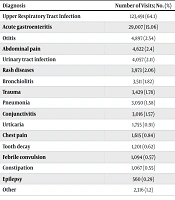
The distribution of diagnoses across ED visits is presented in Table 2. The most frequently recorded diagnosis was upper respiratory tract infection (URTI), comprising 64.1% (n = 123,491; 95% CI 63.9 - 64.3) of all visits. This was followed by:
- Acute gastroenteritis: 15.06% (n = 29,007)
- Otitis media: 2.54%
- Abdominal pain: 2.40%
- Urinary tract infection: 2.11%
- Skin rash: 2.06%
- Bronchiolitis: 1.82%
- Trauma - related injuries: 1.78%
- Pneumonia: 1.58%
Other less common diagnoses included:
- Conjunctivitis: 1.57%
- Urticaria: 0.91%
- Chest pain: 0.84%
- Dental caries: 0.62%
- Febrile seizures: 0.57%
- Constipation: 0.55%
- Epilepsy: 0.29%
Table 2.
Diagnosis distribution across pediatric Emergency Departments visits (N = 192,661 Visits)
| Diagnosis | Number of Visits; No. (%) |
|---|---|
| Upper Respiratory Tract Infection | 123,491 (64.1) |
| Acute gastroenteritis | 29,007 (15.06) |
| Otitis | 4,897 (2.54) |
| Abdominal pain | 4,622 (2.4) |
| Urinary tract infection | 4,057 (2.11) |
| Rash diseases | 3,973 (2.06) |
| Bronchiolitis | 3,511 (1.82) |
| Trauma | 3,429 (1.78) |
| Pneumonia | 3,050 (1.58) |
| Conjunctivitis | 3,016 (1.57) |
| Urticaria | 1,755 (0.91) |
| Chest pain | 1,615 (0.84) |
| Tooth decay | 1,201 (0.62) |
| Febrile convulsion | 1,094 (0.57) |
| Constipation | 1,067 (0.55) |
| Epilepsy | 560 (0.29) |
| Other | 2,316 (1.2) |
Cases not falling under predefined diagnostic categories were grouped under “other,” accounting for 1.2% of visits (n = 2,316).
The age distribution across ED visits is detailed in Table 3. The highest proportion of visits was observed among 1-year-old children (9.2% of visits, n = 17,629), followed by ages 2 years (7.5%), 3 years (7.0%), 4 years (6.9%), and < 1 year (6.2%). Collectively, children aged 0 - 4 years constituted a substantial portion of total visits. Although the proportion of visits gradually declined with increasing age, a slight upward trend was noted in the 14 - 17-year age group; notably, 17 - year-olds accounted for 5.6% of visits.
Table 3.
Age Distribution Across Pediatric Emergency Departments Visits (N = 192,661 Visits)
| Age (y) | Number of Visits; No. (%) |
|---|---|
| 0 | 12,026 (6.2) |
| 1 | 17,629 (9.2) |
| 2 | 14,487 (7.5) |
| 3 | 13,416 (7.0) |
| 4 | 13,284 (6.9) |
| 5 | 12,155 (6.3) |
| 6 | 11,779 (6.1) |
| 7 | 10,960 (5.7) |
| 8 | 10,137 (5.3) |
| 9 | 9,203 (4.8) |
| 10 | 8,275 (4.3) |
| 11 | 7,749 (4.0) |
| 12 | 7,077 (3.7) |
| 13 | 6,788 (3.5) |
| 14 | 7,880 (4.1) |
| 15 | 9,041 (4.7) |
| 16 | 9,927 (5.2) |
| 17 | 10,848 (5.6) |
5. Discussion
Emergency departments play a pivotal role in the healthcare system by providing rapid and often life-saving care to patients with urgent medical conditions. However, increasing population density and easier access to healthcare services have led to a steady rise in emergency department utilization, particularly for non-urgent complaints (9, 10). This increase has placed a substantial burden on pediatric EDs, highlighting the need for efficient triage systems, proper allocation of healthcare resources, and community education on appropriate ED use (11, 12).
Our study adds a large, one-year dataset from a high-volume pediatric ED in southeastern Turkey—a region with a young and rapidly growing population where population-based data on emergency use have been limited—thereby providing context-specific evidence for service planning and parent education.
In this retrospective study, we aimed to characterize the demographic and clinical features of pediatric patients admitted to a high-volume ED in southeastern Turkey over a one-year period. The findings provide valuable insights into the healthcare-seeking behavior of families and the patterns of pediatric emergency use in this region.
Consistent with prior literature, our results showed a slight male predominance in ED visits/presentations (52.0%), aligning with findings reported by Sert et al. and other regional studies (4, 13-16). Foreign nationals accounted for 4.92% of ED visits, which may reflect the province’s migrant population and highlights the importance of considering migrant health needs in pediatric emergency service planning.
Age distribution analysis revealed that the majority of ED visits were made by children aged 0 - 6 years, particularly 1-year-olds. Similar trends have been reported by Karakaş et al. (6), indicating that parental anxiety and heightened vigilance in early childhood may lead to overutilization of emergency services even for mild or self-limiting symptoms. These findings underscore the need for strengthening family medicine and primary care services to manage minor illnesses outside of emergency settings (17-21).
In terms of timing, the highest frequency of admissions occurred between 16:00 and 00:00 (64.25%), which is consistent with previous studies reporting peak pediatric ED utilization during after-hours periods (7-9, 22, 23). Factors contributing to this trend may include parents returning from work, limited availability of outpatient services in the evening, and perceptions that EDs offer faster care.
Seasonal trends showed that winter was the peak period for admissions, followed by spring. This pattern has been reported in several studies (4, 6, 10, 11, 24), and is likely associated with increased transmission of respiratory infections in colder months due to indoor crowding (e.g., schools, daycares) and poor ventilation. In lower socioeconomic regions, inadequate heating and housing conditions may further increase susceptibility to infection (12, 25).
Upper respiratory tract infections (URTIs) were by far the most common diagnosis, accounting for 64.1% of all ED visits—an observation consistent with national and international data (10, 13-16, 26-28). Other common diagnoses included acute gastroenteritis (15.06%), otitis media (2.54%), and abdominal pain (2.4%). The predominance of non-urgent infectious conditions highlights the persistent challenge of unnecessary ED use in pediatrics and points to a need for public education on appropriate care-seeking behavior.
An important finding of this study is that only a small fraction of the admitted patients required hospitalization (0.94%) or intensive care (0.11%), and just four patients died during ED admission. Additionally, 175 patients (0.09%) were referred to tertiary care centers. These figures suggest that while most pediatric ED visits are for non-life-threatening conditions, a small but significant subset of patients do present with severe illness requiring specialized intervention. Maintaining preparedness for such cases remains a core responsibility of emergency departments (22, 29, 30).
Overall, the results of this study emphasize the dual challenge faced by pediatric EDs: Ensuring readiness for critical cases while managing a high volume of non-urgent visits. Enhancing parental health literacy, strengthening primary care infrastructure, and promoting after-hours pediatric clinics may help optimize emergency service utilization in Türkiye and comparable settings (31).
5.1. Limitations
This study has several limitations. First, it was conducted in a single center and relied on routinely collected administrative data, which may contain coding errors or inconsistencies in diagnostic categorization. Second, triage severity, comorbidities, and mode of arrival (e.g., ambulance versus self-presentation) were not systematically available and therefore could not be analyzed. Third, we analyzed visits rather than unique patients, so children with frequent attendances may have been counted more than once; although this approach reflects the true workload of the ED, it may overestimate the proportion of children affected by specific conditions. Fourth, the findings may not be fully generalizable to pediatric EDs in other regions of Turkey or in countries with different healthcare organization, primary care accessibility, and population characteristics. Finally, the use of administrative data precludes detailed assessment of clinical severity, management decisions, and longer-term outcomes after discharge.
5.2. Conclusion
Pediatric emergency departments are essential components of the healthcare system, tasked with the rapid assessment and management of children requiring urgent medical care. However, the overwhelming majority of admissions consist of non-urgent cases, which can compromise the timely diagnosis and treatment of truly emergent conditions. This not only strains healthcare resources but may also lead to reduced quality of care for critically ill patients.
The findings of our study highlight a clear need to optimize emergency service utilization. Health authorities should implement targeted strategies to reduce inappropriate ED visits, including community-based education campaigns, enhancement of primary care accessibility, and the establishment of pediatric urgent care alternatives during after-hours periods. Raising public awareness regarding the appropriate use of emergency services may significantly reduce unnecessary admissions and ensure that critical patients receive the focused care they require.
Reducing ED overcrowding will ultimately contribute to improved efficiency, patient safety, and satisfaction within pediatric emergency settings.