Dear Editor,
Cystic Fibrosis is an autosomal recessive disorder, which is caused by mutations in CFTR gene
on chromosome 7q31.2. The prevalence of CF is approximately 1 in 2500 in Caucasians. In other
populations, it has been seen less frequently. Characteristic features include chronic
pulmonary disease, pancreatic exocrine insufficiency and secretory systems such as
gastro-intestinal and reproductive system function abnormalities. Current guidelines for the
diagnosis of CF suggest that a patient must present one or more characteristic phenotypic
features or a positive newborn screening test result and a positive sweat test or two
CF-causing mutations (1). A screening for CFTR
mutations is essential if the sweat test is not conclusive. Here we present a female who was
diagnosed with CF at age 1-year with a rare homozygous mutation 3849 + 10 kb C > T and
normal sweat chloride concentrations. The proband was a 1-year-old female born to
consanguineous parents (Figure 1). She was born at
38 weeks of gestation with a birth weight of 3610 g, birth height of 51 cm and birth head
circumference of 37 cm. She was admitted to the hospital at 2 months of age because of
respiratory distress syndrome. Her weight was 4700 g (50th percentile), height: 56 cm (75th
percentile) and head circumference was 37.5 cm (25th-50th percentile). Intercostal and
subcostal retractions were seen and bilateral crackles were heard at the lung in physical
examination. Hemoglobin 10.3 g/dL (N: 9-14 g/dL), white blood cells 6670/ µL (N: 6000 -
17500), platelets 577000/µL (N: 150,000 - 450,000), C-reactive protein 21 mg/dL (N: 0-5 mg/dL)
and normal blood biochemistry and liver function tests were detected in laboratory
investigations. Her chest roentgenogram demonstrated bilateral pulmonary infiltrations and
atelectasis (Figure 2). Computerized-tomography
(CT) showed fibro-atelectatic bands in right medial lobe and left lower lobe. Echocardiography
was normal. Steatorrhoea was detected a few times. Her sweat chloride concentrations were 40
mmol/L (evaluated twice) (N: ≤ 40 mmol/L). CF was suspected due to her clinical features and
laboratory findings. Molecular analysis revealed a homozygous mutation 3849 + 10 kb C > T
in CFTR. The patient’s mother and father were heterozygous for this mutation (Figure 1) and there were no clinical findings. CF is a
complex multi-system disorder. The pathological basis of this disorder is based on mutations
in the CFTR gene which encodes the cystic fibrosis transmembrane conductance regulator, a
membrane chloride channel located in the apical membrane of secretory epithelia. CF has a
higher prevalence in populations of European descent, than in any other population group. The
more than 1900 different mutations in the CFTR gene have been reported. The most common
mutations in the CFTR gene have been different from one population to the others in the world.
The people who are carrying the ∆F508 allel in the Mediterranean population have a relatively
low proportion compared with other Caucasoid populations. In the Mediterranean region, more
than 200 different CF mutations accounting for about 85% of the CF alleles have been detected
indicating the highest heterogeneity and the wide diversity of peoples and cultures. The
worldwide frequency of the 3849 + 10 kb C > T mutation which was detected in our case is
approximately 0.2%. In Europe, its frequency is 0.15%. The 3849 + 10 kb C > T mutation was
first described by Highsmith et al. in 13 patients with chronic pulmonary disease but normal
sweat chloride values (2). Feldmann et al. present
CF patients who had 3849 + 10 kb C > T mutation. They had normal sweat chloride
concentration but had pulmonary symptoms (3). In
another sudy, Augarten et al. described patients with the 3849 + 10 kb C > T mutation had
been diagnosed at older age while our case was 1 year old. These patients had nomal pancreatic
and liver functions (4). Stern et al. reported 8
patients who were compound heterozygous for the 3849 + 10 kb C > T mutation with normal
sweat chloride values, but pulmonary disease was seen ranging from mild to severe (5). Gilbert et al. reported 14 patients who were
homozygous for the 3849 + 10 kb C > T mutation. The age ranged between 2 - 32 years. Most
of them had normal pancreatic functions. Seven patients had normal sweat chloride
concentrations (6). In genotype-phenotype
correlation study by Dugueperoux and Braekeleer, the 3849 + 10 kb C > T allel had been
shown to be associated with mild CF phenotype as in our case (7). Liu et al. reported a 20-year-old female. She had a 3849 + 10 kb C
> T homozygous mutation with pulmonary symptoms and normal sweat chloride test (8). Although there are a few studies on CFTR mutation
spectrum, 3849 + 10 kb C > T mutation is not reported before in Turkey. Thus our case is
the first report of CFTR 3849 + 10 kb C > T homozygous mutation. In Turkey, Halicioglu et
al. reported 24 cases with CF. ∆F508 was the most common mutation. Other mutations such as
R1066C, 1677 delTA, 2789 + 5G-A (9) were rarely
seen. In another study from Turkey, 67 CF patients were screened for CFTR gene mutations. The
most common mutation was ∆F508 (28.4%). R347H and N1303K mutations account for 6.7% (10). The C-to-T mutation in intron 19 leads to create
an alternative splice acceptor site. Thus it leads to produce an abnormal mRNA but normally
spliced mRNA has also occurred (2). Because of
this normal transcripts, 3849 + 10 kb C > T mutation is most likely responsible for a
milder phenotype.
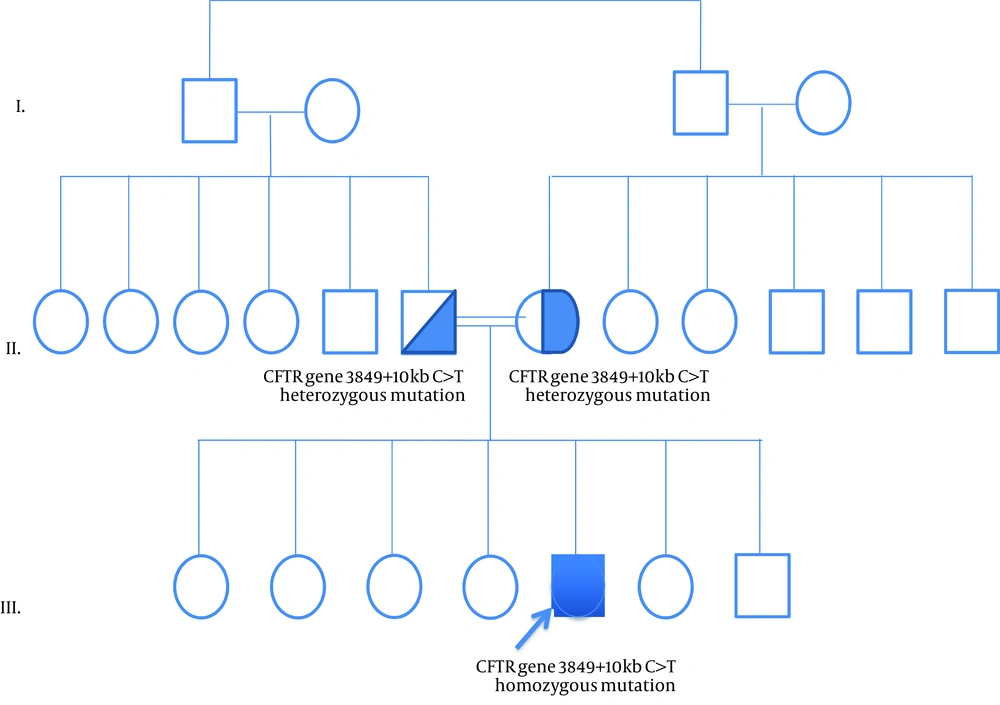
Figure 1.
The Pedigree of the Patient
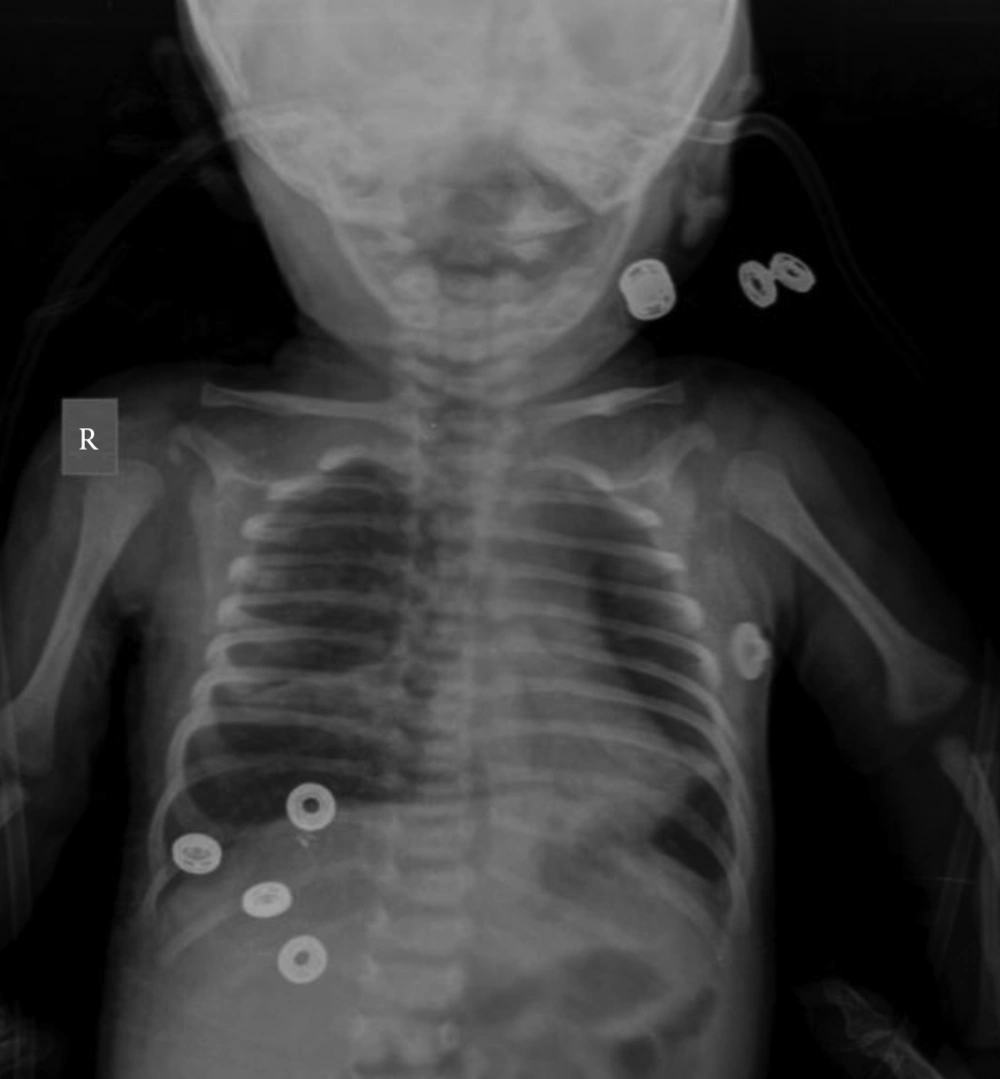
Figure 2.
The Patient’s Chest Roentgenogram Demonstrated Bilateral Pulmonary Infiltrations and Atelectasis