1. Background
The development of intestinal microbiota in newborn infants, and its potential influence on the infants’ health has become an important issue in literature. Moreover, intensive care in critically ill term neonates potentially alters the intestinal microbiota and possibly enables the growth of pathogens. Hence, dysbiosis of the intestine, or imbalance of intestinal microbiota, increases the risk of diseases with inflammatory background such as late onset sepsis (LOS) and necrotizing enterocolitis (NEC) in neonates (1). Furthermore, these clinical conditions include antibiotic associated diarrhea (AAD), multiple organ dysfunction syndrome (MODS), and ventilator associated pneumonia (VAP), all of them resulting in prolonged hospital stays, increase in the cost of intensive care, and greater risks for mortality (2, 3).
Approximately 10% of all NEC cases occur in term infants (4). Over a 20-year period a NEC rate of 0.43% in full-term Chinese neonates has been reported recently. About 40% of cases had late-onset NEC defined as onset of signs and symptoms after 7 days of life; the associated mortality rate was 11.7% (5).
The risk of VAP generally increases as gestational age decreases (6-9) and has been reported to occur in 9% of all ventilator-days of infants with a birth weight above 2,500 g and rates increasing up to 26% at a birth weight below 750 g (10).
Comparably, the risk of late-onset sepsis (LOS) increases by decreasing gestational age. LOS has been diagnosed in 1 - 2 per 1000 live births with a case fatality rate of 3% in full term infants (11).
Oral aminoglycosides have successfully been investigated in the prevention of NEC in some small and old studies (12, 13) and recently have been effective in preterm animal models of NEC prevention compared to parenteral antibiotics (14). And probiotics as summarized recently in a systematic meta-analysis showed significant benefits on NEC rates and all-cause neonatal mortality (15).
Aim of the study was to evaluate a prophylactic multimodal anti-infective regimen (16) given within 24 hours of age in critically ill full-term neonates by means of a retrospective observational STROBE compliant single-center cohort study. Our hypothesis was that this regimen might lead to lower complication rates than reported elsewhere.
2. Methods
All term infants admitted to the neonatal intensive care unit (NICU) of the division of neonatology of the Medical University of Graz between 2005 and 2015 were retrospectively evaluated for analysis. All surgical neonates and those with hemodynamically significant congenital heart disease were treated at the PICU and the pediatric surgery ICU, respectively, and not included in the study.
Inclusion criteria were as follows: admission within the first 24 hours of life, stay at the NICU for at least 7 days, and gestational age of 37 to 42 weeks.
Exclusion criteria were as follows: admission to the NICU beyond the first day of life, stay at the NICU for less than 7 days, or death before day 7. Further, neonates were excluded when data were missing or unavailable regarding outcome parameters.
Ethical aspects: due to the design of the study informed consent was not available, thus, patient data were pseudonymized for study purposes and only BR and KL had access to the original data. The study protocol conformed to the ethical guidelines of the 1975 declaration of Helsinki as reflected in a priori approval by the ethic committee of the Medical University of Graz (number 28-220 ex 15/16 in April 2015) and started in February 2016. Term neonates qualified for NICU treatment in case of need for ventilatory support, signs and symptoms of respiratory distress, need for supplemental oxygen, need for antibiotics, umbilical artery pH < 7.00, Apgar score at 5 minutes ≤ 5, arterial hypotension, floppy infant syndrome, fever, cyanosis, seizures, metabolic acidosis, icterus gravis, or hypoglycemia.
All neonates received a standardized prophylactic multi-modal, anti-infective treatment with enteral probiotics, antifungal agents, and enteral gentamycin starting at the first day of life and ending at discharge (16). The regimen did not change through the study time period and included the following: enteral gentamycin (Refobacin© 40 mg Amp. 15 mg/kg/day divided in 2 doses), Lactobacillus casei rhamnosus (LCR) (Antibiophilus© 1.5 g [contains ≥ 1.5 × 10⁸ colony forming units - CFU] per day divided in 2 doses), and enteral nystatin (Mycostatin© 1 mL = 100.000 IU/kg per day divided in 4 doses).
Outcome parameters were checked for in all medical records of the neonates using the electronic patient data monitoring system (PDMS, Sanitas, Austria) at the NICU as follows:
- Late-onset necrotizing enterocolitis - NEC,
- Multiple organ dysfunction syndrome - MODS,
- Ventilator associated pneumonia - VAP,
- Antibiotic-associated diarrhea - AAD,
- Late-onset sepsis - LOS (onset > 7 days of age).
The standardized enteral feeding regimen applied to all term infants at the NICU and remained unchanged through the study time period. Enteral feeding of breast milk (expressed breast milk or pooled human milk if available) or formula was initiated at day 1. A volume of 5 to 10 mL was initiated every 4 hours when infants were stable. Daily enteral feeding was increased by 5 to 10 mL per feed and did not exceed 20 mL per feed and day. Total fluid intake was 70 mL/kg/d at day 1 with daily increases up to 150 mL/kg/day at day 7 to 10. Enteral feeding was interrupted if there were signs of intolerance defined as the presence of gastric residuals exceeding 25% of the volume offered within the previous 8 hours, abdominal distension, or blood in the stool. A parenteral supply of glucose (5 or 10% solution) was initiated for all children within the first 24 hours of life, and total/partial parenteral nutrition was routinely maintained until 120 - 150 mL/kg/day of enteral feeds were reached. All neonates in the study received concomitant therapy including antibiotics as considered appropriate by the attending physician. Antibiotics were stopped following 2 negative CRP values within at least 24 hours in case of well-appearing neonate. Negative blood cultures were available following 72 hours.
2.1. Data Collection
Data were collected from the local electronic database openMedocs® for all infants regarding gender, gestational age (weeks), birth weight (grams), small for gestational age (birth weight below 10. percentile), umbilical artery pH, length of stay (days), Apgar scores at 1, 5, 10 minutes, days on ventilator support (invasive mechanical plus continuous positive airway pressure - CPAP - ventilation), spontaneous birth, cesarean section, breast milk feeding, formula feeding, combined human milk and formula feeding, duration of antibiotic treatment (days), and main diagnosis for treatment at the NICU. Infectious events were always tested by blood culture for LCR.
2.2. Definition of Outcome Parameters
Late-onset NEC was defined according to the modified Bell’s criteria as stage IIa or more (17, 18) occurring later than 7 days (5). Signs and symptoms included abdominal pain, bloody stools, ileus (subileus), and pneumatosis intestinalis.
A MODS was defined as the presence of at least 2 of 6 defined criteria for multiple organ dysfunction (19, 20) that was mainly adapted from Goldberg et al. (19) not using the scoring system published recently (20):
- Cardiovascular dysfunction (any of the following): despite isotonic intravenous bolus ≥ 40 mL/kg; systolic blood pressure < 5% for age or need for vasoactive drugs; capillary refill time > 3 seconds; urine output < 0.5 mL/kg/h
- Respiratory dysfunction (any of the following): PaCO2 > 65 torr or 20 mmHg over baseline. Proven need for > 50% FiO2 to maintain saturation ≥ 92%
- Neurologic dysfunction (any of the following): seizures, irritability, and lethargy, any different from baseline neurologic function
- Thrombocytopenia: platelets < 80.000/µL or decline of 50% from highest value over past 3 days in neonates with baseline low platelets (< 150,000/µL)
- Renal dysfunction: creatinine ≥ 2 times upper limit for age or 2-fold increase in baseline creatinine in neonates with baseline elevations in creatinine
- Hepatic dysfunction (any of the following): total bilirubin not applicable to newborn. ALT (alanine transaminase) 2 times upper limit of normal for age or 2-fold increase in baseline abnormal ALT
For the diagnosis of VAP, the patient was required to have received mechanical ventilation for at least 48 hours and to have developed new and persistent radiographic evidence of focal infiltrates lasting for a minimum of 48 hours after the initiation of mechanical ventilation. In addition, these patients had to receive antibiotics for treatment of VAP for at least 7 days (6).
AAD was defined as otherwise unexplained diarrhea that occurs in association with the administration of antibiotics. Its presence was characterized by a change in the normal stool frequency with at least 3 loose or watery stools daily for 3 days (3).
LOS was defined as a nosocomial bacterial infection not present or incubating at the time of NICU admission and occurring > 72 hours after NICU admission. We did not differentiate between culture proven and clinical sepsis (clinical symptoms + 2 or more abnormal values including white blood cell count, neutrophils, immature to total neutrophil ratio > 0.2 and C-reactive protein > 8 mg/L) (21).
Statistical analyses were performed using the t-test and Wilcoxon test for numerical data and the chi-square-test using Yates’ correction and Fisher’s exact test as appropriate for categorical data. For all statistical tests, a level of significance of 0.05 was used. Descriptive statistics were done using Microsoft Excel 2007 (Microsoft Corporation, Redmond, WA, USA, 2007), further analyses were done with SPSS version 17 (SPSS Inc., Chicago, IL, USA, 2008).
3. Results
During the study period 2940 term neonates were hospitalized at the neonatal wards, and 1301 neonates were admitted to the NICU. A further 897 neonates had to be excluded, thus the final study population comprised 403 neonates. Details are provided in Figure 1. Their median gestational age was 38 weeks, birth weight 3300 grams, and 56% were of male gender. Demographic data and hospitalization details at the NICU are shown in Table 1.
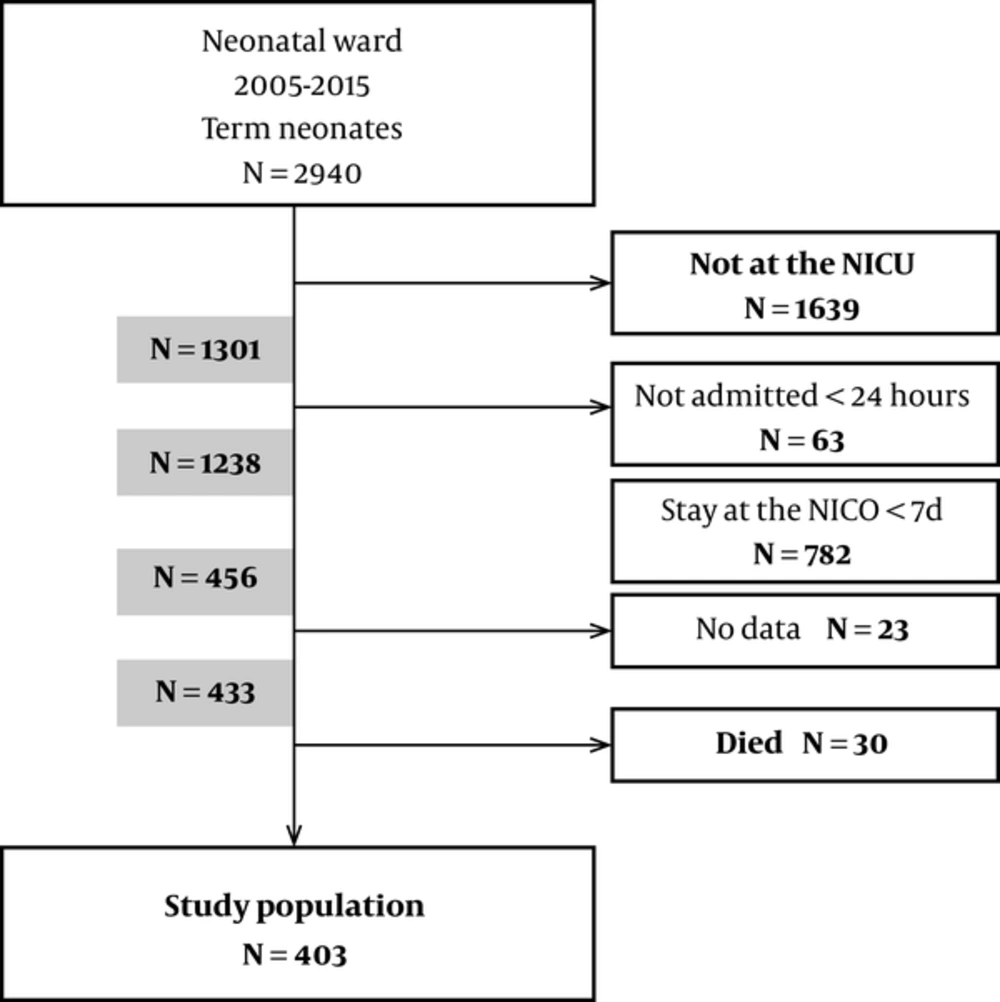
Figure 1.
Flow chart depicturing recruitment of the study population
Main diagnoses (283/403, 70%) included early-onset sepsis/bacterial infection (n = 119), asphyxia (n = 43), meconium aspiration syndrome (n = 40), respiratory distress syndrome (n = 24), delayed adaption (n = 22), wet lung (n = 17), congenital diaphragmatic hernia (n = 9), and pneumonia (n = 9). Other diagnoses included symptomatic hypoglycemia, neonatal abstinence syndrome, apparent life threatening event, floppy infant syndrome, icterus gravis, polycythemia/hyper viscosity syndrome, cyanosis, dystrophy below 3rd percentile, congenital malformation, fetopathia diabetica, gastrointestinal hemorrhage, pneumothorax, thrombosis, hemorrhagic infarction, and some rare diseases including undine syndrome.
None of the neonates exhibited NEC, MODS, VAP or AAD. Sixteen (4.0%) neonates developed LOS (Table 2). Blood cultures were positive in 3/16 of the cases for coagulase negative staphylococci, and all were negative for LCR. Breast milk feeding was evident in 13% (2/16) of the neonates with LOS, compared to 30% (121/387) in the total group, differences were not significant, but there was a trend to lower breast feeding rates in the LOS group (P = 0.055).
Table 1.
Demographic Data and Selected Hospitalization Details of 403 Term Neonates Being Treated at Least for 7 Days at the NICU Between 2005 and 2015
| Valuesa | |
|---|---|
| Male: female | 226 (56): 177 (44) |
| Gestational age, w | 38 (37 - 42) |
| Birth weight, g | 3300 (1250 - 5300) |
| Small for date (< 10.percentile) | 41 (10) |
| Spontaneous birth: caesarean section | 182 (45): 221 (55) |
| Umbilical artery pH | 7.23 (6.38 - 7.46) |
| Apgar at 1/5/10 minutes | 8 (1 - 10)/9 (1 - 10)/9 (1 - 10) |
| Length of stay, days | 10 (7 - 110) |
| Ventilatory support | 246 (61) |
| Days on ventilatory support | 5 (1 - 45) |
| Antibiotics | 334 (83) |
| Duration of antibiotic treatment | 7 (2 - 43) |
| Breast milk feeding | 123 (31) |
| Formula feeding | 63 (16) |
| Breast milk and formula | 217 (54) |
aValues are expressed as No. (%) or median (range).
A total of 30 of 1301 (2.3%) intensive cared term neonates died between 2005 and 2015, and 5 of them during the study time (5/403, 1.2%). All deaths were associated with respiratory failure and none with LOS.
In total 5920 NICU days were available for analysis of our prophylactic multimodal anti-infective regimen resulting in 14.7 g (1.5 × 10⁹ CFU) of LCR per patient, 242 mg enteral gentamycin per patient, and 16.1 mL nystatin per patient. This treatment was safe and no adverse events were observed. No invasive LCR infection was detected during the study time period. There was neither an increase in detection rates of ESBL producing enterobacteria in stool surveillance cultures (done twice a week) nor an increase in gentamycin resistive bacteria as shown in the yearly published local hygiene report (data not shown).
The adherence to the STROBE statement is documented in a supplementary file appendix 1.
Table 2.
Incidence of Common Complications of Intensive Care Treatment in 403 Term Neonates Being Treated at Least for 7 Days at the NICU Between 2005 and 2014
| Valuesa | |
|---|---|
| Necrotizing enterocolitis (grade ≥ IIa*) | 0 (0) |
| Multi-organ dysfunction syndrome | 0 (0) |
| Ventilator associated pneumonia | 0 (0) |
| Late-onset sepsis | 16 (4.0) |
| Antibiotics-associated diarrhea | 0 (0) |
aValues are expressed as number (%) or median (range; *according to the modified criteria of Bell.
4. Discussion
Our prophylactic multimodal, anti-infective regimen given to full-term neonates hospitalized at the NICU over an 11-year period was successful by means of completely avoiding late-onset NEC, MODS, VAP, and AAD. The rate of LOS was low with 4%. Lower rates of breastfeeding (differences marginally not significant) might have played a role. No side effects with the treatment regimen were observed.
Limitations of the study include the lower evidence level of a retrospective compared to a prospective cohort analysis and the interpretation of data in the absence of a control group. As far as our prophylactic multimodal, anti-infective regimen resulted in very low NEC rates (16) we felt that a placebo controlled trial might be unethical. Hence, we compared our complication rates to the published evidence in term critically ill neonates. Another critical point is the use of an oral antibiotic like gentamycin which is based on small and old studies (12, 13). Nevertheless, none of the gentamycin treated neonates developed NEC and none died in contrast to a 10% mortality rate in the controls (12). Recently, NEC lesions were completely prevented by antibiotics (ampicillin, gentamicin, and metronidazole) given via the enteral in contrast to the parenteral route in an animal model of preterm pigs (14). Our long-lasting experience in the use of enteral gentamycin has revealed neither a change in ESBL producing enterobacteria in stool surveillance cultures nor in antimicrobial sensitivity patterns (22). This is also the case for the use of LCR resulting in very low NEC rates as compared to other studies (16).
Studies on complications of intensive care therapy including late-onset NEC, MODS, VAP, AAD and LOS in term infants are scarce. In a prospective investigation on the effect of probiotic treatment in 100 critically ill full-term infants (randomized 1:1) LOS occurred in 4 vs 8%, MODS in 6 vs 16%, nosocomial pneumonia in 16 vs 36%, NEC in 4 vs 6%, and AAD in 6 vs 10% compared to placebo demonstrating a significant reduction in MODS and pneumonia (1). The preparation (30 billion viable lyophilized bacteria) consisted of 2 strains of Lactobacillus (L. casei and L. acidophilus), Bacillus subtilis and Enterococcus faecalis. Compared to our data this trial reported on a comparable rate of LOS with 4%, but higher rates of all other complications.
Septic shock with MODS has been noted in 1.3% of a retrospectively evaluated cohort of 3,800 neonates admitted to the NICU over a 6-year period (23). Mortality rates were remarkably high with a rate of 71% in extremely preterm infants. Thus, a regimen as used in our cohort study is able to prevent severe morbidity and marked mortality that was as low as 1.2%. Mean duration of MODS has been reported with 11 days lasting until 28 days in preterm infants, and mortality rate was 27.5% (20). Of 1806 enrolled pediatric patients 171 (9.5%) were neonates who had a significantly higher risk of MODS (14.6% vs 5.5%) and risk of associated death (75.4% vs 50.9%) compared to older infants (age > 28 days of life) and children (24). Pediatric illnesses with MODS comprise severe infections, multiple trauma, surgery for congenital heart defects, or transplantations (25). Unbalanced inflammatory processes and activation of coagulation lead to the capillary leak syndrome and acute respiratory distress syndrome. Neuroendocrine and metabolic responses lead to insufficiencies of the adaptive immune response with subsequent increased risks for nosocomial infections, which pose children further at high risk for increased morbidity and mortality (25). Thirty-one of 114 (27.2%) pediatric liver transplantation recipients developed MODS (involving two or more organs) and 18 (15.8%) died during hospitalization of whom 16 (89%) had MODS (26). Mortality increased the more organ systems were involved (from 2 organ systems with 29.4% to 80% with 4 organ systems). Adult critically ill patients showed a reduction in their MODS scores 3 days after treatment with viable probiotics (900 billion viable lyophilized bacteria) consisting of 4 strains of Lactobacillus (L. casei, L. plantarum, L. acidophilus, and L. delbrueckii subsp. bulgaricus), 3 strains of Bifidobacterium (B. longum, B. breve, and B. infantis) and Streptococcus salivarius subsp. thermophilus (2). All together results suggest that Lactobacilli play a major beneficial role in regard to a significant mortality rate associated with MODS (15). Beyond a lot of randomized trials on probiotics to prevent LOS there is still missing data regarding the optimal strain(s), dose, time to start and duration of probiotic therapy, as well as the taxonomy and quality of currently available probiotics formulations and products. To date Bifidobacterium and Lactobacillus spp. are the most studied probiotic organisms in neonates (27).
VAP has been reported to occur in 28.3% of 67 mechanically ventilated infants (6). VAP rates were 4 per 1000 ventilator days for infants with a gestational age > 28 weeks. By multivariate analysis, early-onset bacterial infection was an independent risk factor for VAP after adjusting for duration of endotracheal intubation, and VAP was associated with a 3 times increased risk of mortality. The longer the NICU stay the higher the risk of VAP was (6). By having calculated 1,603 ventilator-days in our study some cases with VAP might have been avoided by our multimodal anti-infective regimen.
The incidence of AAD varies between 5% and 39% of patients, with higher rates in hospitalized patients (3). A meta-analysis of randomized controlled trials revealed that probiotics efficaciously prevent AAD in healthy children (28).
Antifungal agents have been proven to reduce invasive fungal infections in very low birth weight infants when given orally (29), thus its effects in sometimes immunocompromised - when critically ill - term infants might be supposed. Interestingly, a recent review found evidence for antifungal capacity of the probiotic strains of lactobacilli (30). Lactobacilli act as antifungals by suppressing Candida growth and biofilm development in vitro, and decreased fungal colonization has been observed in preterm infants (31).
In conclusion, our findings on very low complication rates of neonatal intensive care therapy in term infants look promising but need further validation (by other centers). The use of our prophylactic multimodal anti-infective regimen was very safe; there were no side effects of any kind to be detected.