
1. Context
Biliary atresia (BA) is a rare inflammatory disease of the biliary tract. The progressive fibrosis of the biliary tree in this disease results in blockade of duct and subsequent cirrhosis (1). The symptoms of the disease include persistent jaundice, acholic stool and dark urine (2). The prevalence of this disease varies from 0.5 to 0.8 per 10,000 live births in western countries to 1.1 - 1.5 per 10,000 live births in Japan and Taiwan (2-5).
BA is the most common surgically correctable liver disease in infancy in which for returning normal bile flow, surgical treatment (Kasai operation) should be implemented urgently in the early weeks of life. However, in some infants this procedure may not be successful. Previous studies have showed that more than half of the infants born with this problem may need liver transplant (6-8). On the other hand, some patients live with their native liver for many years and may experience long-term complications such as cholangitis, portal hypertension, variceal bleeding and growth failure (9). These complications may lead to frequent hospital admissions (10) and could have a great impact on the quality of life in these patients. Different studies have evaluated the health-related quality of life (HRQOL) in patients with BA and compared it with that of the healthy population. However, the results were controversial. To the best of our knowledge, no systematic review study and meta-analysis have been done to review these results up to the time of conducting this research study.
2. Objectives
Thus, in the present systematic review and meta-analysis, for the first time, the existing evidence on HRQOL was evaluated in patients with BA and compared with that of healthy population.
3. Data Sources
A systematic search was done on PubMed, Scopus, Embase, Cochrane Library and Web of Science from 1990 to April 2018. The keywords were selected based on MESH terms and including: (I) population: “Biliary atresia” or “Extrahepatic Biliary Atresia” (II) outcome: “life quality” OR “health related quality of life” OR “health-related quality of life” OR “quality of life”(III) comparison: “healthy population” OR “general population”. The search strategy for each database is shown in Appendix 1 in Supplementary File. The reference list of included articles was also checked manually. The Liver and Gastrointestinal Diseases Research Center of Tabriz University of Medical Sciences approved the research protocol.
4. Study Selection
The present systematic review included observational studies (descriptive and analytical studies) which assessed the HRQOL in patients with BA. The original articles or conference papers that had been published from 1990 to April 2018 were included if they reported the HRQOL in BA patients and/or compared the HRQOL between BA patients and the healthy population. All other types of articles including letters to the editors, review articles and articles published in any language other than English were excluded.
5. Data Extraction
Data extraction was done by two independent reviewers. Discrepancies were resolved by discussion and through involvement of a third reviewer. First, the results were screened to exclude duplicates and unrelated articles. Then, the full-texts of the remaining records were screened to select articles which met the inclusion criteria. Finally, for eligible studies, the data about the authors, publication date, methods used for assessing HRQOL, sample size, comparison group (if existed), participants’ characteristics and results were extracted using the predesigned checklist.
6. Quality Assessment
The methodological quality of selected articles was done by two reviewers using JBI critical appraising checklist for descriptive and analytical studies. The following domains were assessed: clear research question, clear definition of population, subject selected based on inclusion criteria, reliable outcome assessment and using objective criteria for outcome assessment, comparison between responders and non-responders.
7. Statistical Analysis
The comprehensive meta-analysis version 2.0 was used in this regard. The mean and standard deviation (SD) HRQOL (total score and domains scores including physical, emotional, social and school functioning) were extracted and then the standard difference of mean (SDM) was computed. Q statistic (P < 0.10) and I2 (I2 > 50%) were used for determination of heterogeneity (11). Based on heterogeneity analysis, fixed or random effect model was used. Publication bias was assessed with a visual inspection of funnel plots and with the Egger bias test (12). One study reported HRQOL scores (total score and domains scores) as median and inter quartile range (IQR) (13). For including these data in the meta-analysis, the median and IQR were converted to mean and SD using method introduced by Hozo et al. (14).
Preferred Reporting Items for Systematic Reviews and Meta-analyses (PRISMA) was used as the method of analysis in this research study.
8. Results
A total of 188 publications were identified after the initial systematic search of databases. Following the removal of duplicate records, 150 articles remained for review out of which 85 were excluded after title appraisal. Then the abstracts of the 65 remaining articles were reviewed and 32 articles were excluded. From the remaining 33 articles, 22 were excluded after appraisal of the full-texts, leaving 10 studies to be included for systematic review (Figure 1) and ultimately only three articles enrolled for meta-analysis. The detailed characteristics of the included studies are presented in Table 1.

Figure 1.
Flow diagram of studies for inclusion in the systematic review and meta-analysis
Table 1.
Characteristics of the Included Studies in the Systematic Review and Meta-Analysis
| Authors, Year | Country | Sample Size | Median Age of BA Patients, y | Results | |||||||
|---|---|---|---|---|---|---|---|---|---|---|---|
| Method of Quality of Life Assessment: PedsQL4 | |||||||||||
| Total Score | Physical Domain | Emotional Domain | Social Domain | School Domain | |||||||
| Lampela et al., 2017 (13) | Finland | ≥ 2 (5.6) | |||||||||
| BA | 20 | 81.22 ± 5.82 | 86.35 ± 4.30 | 76.27 ± 8.12 | 87.5 ± 6.25 | 72.92 ± 8.32 | |||||
| HP | 108 | 83.4 ± 3.46 | 82.5 ± 6.25 | 76.25 ± 2.5 | 90.00 ± 3.33 | 87.5 ± 4.16 | |||||
| Sundaram et al., 2013 (15) | USA | ≥ 8 (9.75) | |||||||||
| BA | 173 | 76.36 ± 16.40 | 82.04 ± 21.50 | 73.74 ± 17.08 | 80.94 ± 18.37 | 68.35 ± 20.39 | |||||
| HP | 945 | 84.58 ± 13.30 | 87.28 ± 16.35 | 81.86 ± 16.01 | 86.49 ± 16.75 | 80.64 ± 17.69 | |||||
| Lee et al., 2016 (10) | Malaysia | 2 – 18 (7.4) | |||||||||
| BA | 36 | 85.5 ± 15.4 | 88.6 ± 21.1 | 83.4 ± 16.4 | 90.2 ± 18.5 | 90.2 ± 18.5 | |||||
| HP | 81 | 87.4 ± 11.5 | 90.8 ± 13.4 | 83.9 ± 17 | 91.2 ± 12.7 | 91.2 ± 12.7 | |||||
| Method of Quality of Life Assessment: SF36C | |||||||||||
| Body Pain | General Health | Mental Health | Physical Function | Role Emotional | Role Physical | Social Functioning | Vitality | ||||
| Howard et al., 2001 (16) | England and Japan | ND | |||||||||
| BA | UK population: 21/Japanese population: 25 | 82.0/81.5 | 66.0/73.5 | 71.0/73.8 | 90.5/88.4 | 84.1/82.9 | 76.2/85.8 | 83.6/88.0 | 71.0/61.1 | ||
| HP | UK population: 9338/Japanese population: 1078 | 79.6/87.6 | 60.8/72.5 | 76.6/81.6 | 93.2/94.2 | 81.2/94.5 | 83.0/95.5 | 81.0/93.8 | 73.4/76.5 | ||
| de Vries et al., 2015 (17) | Netherlands | 23.5 ± 3.3 | 84/87 | ||||||||
| BA | 25 | 63 ± 21 | 76 ± 17 | 91 ± 17 | 81 ± 35 | 73 ± 40 | 88 ± 19 | 64 ± 23 | |||
| HP | 500 | 75 ± 15 | 76 ± 15 | 93 ± 14 | 87 ± 29 | 87 ± 27 | 87 ± 18 | 65 ± 17 | |||
| Method of Quality of Life Assessment: School, University, and/or Sports Performance | |||||||||||
| Valayer, 1996 (18) | France | 71 | ND | School performancea | |||||||
| Professional activityb | |||||||||||
| Nio et al., 1997 (19) | Japan | 21 | 20 to 39 | Satisfactory: 16 of 21 | |||||||
| Unsatisfactory: 5 of 21 | |||||||||||
| - Liver dysfunction (16 patient) | |||||||||||
| - intrahepatic stones (13 patient) | |||||||||||
| - Cholangitis (14 patient) | |||||||||||
| - Cholangitis with hypersplenism (17 patient) | |||||||||||
| - Turner’s syndrome (1 patient) | |||||||||||
| Ohi et al., 1990 (20) | Japan | 48 | More than 10 | Normal lives: 37 patients | |||||||
| - 31 patients were doing well without any problems throughout their postoperative courses. | |||||||||||
| - 6 patients, were enjoying their lives after overcoming sequelae. | |||||||||||
| Unsatisfactory quality of life: 11 patients | |||||||||||
| Lykavieris et al., 2005 (21) | France | 52 | at least 20 | Normal life: 38 patients | |||||||
| Regularly employed: 21 | |||||||||||
| University students: 17. | |||||||||||
| Married or have a stable partnership: 20 | |||||||||||
| Nio et al., 1996 (22) | Japan | 30 | at least 20 | Normal life: 22 patients | |||||||
aAs related to age was normal for eight, 1 year below normal for 11, and 2 or 3 years below normal for seven. In patients with serum bilirubin 18 - 36, 11 of 14 are leading a near normal life, with excellent school performance for at least three of them. Of the 16 patients over 15 years of age, school performance was judged satisfactory for three and poor for 3.
bFor those in their twenties, it appeared normal for age, but with no outstanding achievement. With respect to extracurricular activities, 12 teenagers with serum bilirubin < 18 were shown to be adept at sports (skiing, soccer, tennis, cycling; the eldest in the series is an amateur cycling champion). Of the 16 patients over 15 years of age, professional activity was reported for seven patients, with no outstanding accomplishments or intellectual feats, however.
Out of 10 included studies, three were conducted in Japan (19, 20, 22), two in France (18, 21), and others in Finland (13), Netherlands (17), Canada (15), and Malaysia (10). Moreover, one study included the participants from two different populations, namely UK and Japan (16). The study design of all articles was cross-sectional.
The methodological quality assessment of the studies is presented in Table 2. Reliable method for the assessment of HRQOL was used in only five studies. Inclusion criteria for sample recruitment were clarified in all studies except for two papers.
Table 2.
Methodological Quality of Included Studies
| Authors, Year | Study Design | Clear Research Question | Clear Definition of Population | Subject Selected Based on Inclusion Criteria | Reliable Outcome Assessment | Using Objective Criteria for Outcome Assessment | Compare Responders and Nonresponders |
|---|---|---|---|---|---|---|---|
| Lampela et al., 2017 (13) | Cross sectional | y | y | y | y | N | y |
| Sundaram et al., 2013 (15) | Cross sectional | y | y | y | y | N | y |
| Lee et al., 2016 (10) | Cross sectional | y | y | y | y | N | N |
| Howard et al., 2001 (16) | Cross sectional | y | y | y | y | N | Y |
| de Vries, et al., 2015 (17) | Cross sectional | y | y | y | y | N | Y |
| Valayer, 1996 (18) | Cross sectional | y | y | y | N | N | N |
| Nio et al., 1997 (19) | Cross sectional | y | y | ND | N | N | N |
| Ohi et al., 1990 (20) | Cross sectional | y | y | y | N | N | N |
| Lykavieris et al., 2005 (21) | Cross sectional | y | y | y | N | N | N |
| Nio et al., 1996 (22) | Cross sectional | y | N | ND | N | N | N |
8.1. HRQOL Assessment
HRQOL was assessed using PedsQL4 in three studies (10, 13, 15), SF-36C in two studies (16, 17) and by assessing different parameters including social status, school, university and/o sports performance in five studies (18-22). The HRQOL and their sub-scores were compared in patients with BA and healthy population in five studies using SF-36C (two studies) (16, 17) and PedsQl4 (three studies) (10, 13, 15).
8.2. Outcomes
Three studies assessed HRQOL in BA patients using PedsQL4 and compared the results with healthy control groups. Two of the studies (10, 13) showed that there was no significant difference between BA patients and healthy population regarding HRQOL total score. However, Lampela et al. reported a significantly lower level of school domain in BA patients (P < 0.004) (13). Sundaram et al. reported a low level of HRQOL total score and all the sub-scores in BA patients compared with healthy population (15).
Two studies used SF-36C questionnaire to evaluate the HRQOL in BA patients and compared total score and sub-scores with those of the healthy population. Howard et al. studied the QOL in two populations, namely Japan and UK (16). According to the results, there was no significant difference in the HRQOL scores of BA patients and healthy control group in the UK population. However, in Japanese population, general health and social functioning sub-scores were significantly lower in BA patients compared to the general healthy population of Japan (16). De Vries et al. reported HRQOL in population of the Netherlands and showed that there was no significant difference between BA patients and the general Dutch population regarding all domains of SF-36C except for general health which was significantly lower (P < 0.004) (17).
In five studies the HRQOL in BA patients was assessed using different parameters including social status, school, university, and/or sports performance. In four out of five studies, more than 70% of BA patients had a normal life and satisfactory rate of HRQOL (19-22). In addition, in Valayer’s study that was conducted in France, only 31% of BA patients had normal school performance (18).
8.3. Meta-Analysis
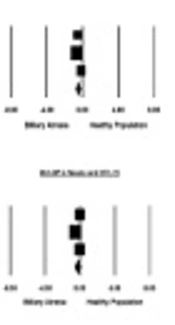
According to Figure 2, the extracted data enables five separate meta-analysis to compare the HRQOL assessed using PedsQL4 between BA patients and the healthy control group (10, 13, 15). No publication bias was observed in the HRQOL score and subscores (Egger test P value > 0.05). Considering the presence of heterogeneity in HRQOL total score (I2 = 52.65, Q = 4.23, P = 0.12) random effect model was used. The results of meta-analysis indicated that the HRQOL in BA patients living with their own liver was significantly lower than general population [SDM = -0.46 (95% CI: -0.74, -0.18), P = 0.001].

Figure 2.
Meta-analysis of comparison the quality of life between biliary atresia and healthy population. A, total score; B, emotional domain; C, physical functioning domain; D, school functioning domain; E, social domain.
In terms of PedsQL4 sub-scores, heterogeneity was found in emotional (I2 = 75.29, Q = 8.09, P = 0.01) and school functioning (I2 = 93.33, Q = 8.09, P < 0.001) subscores. The results of random model meta-analysis showed that the level of school functioning [SDM = -1.18 (95% CI: -2.34, -0.02), P = 0.03] was significantly lower in BA patients compared with those of the normal population. However, in the case of emotional subscore, there was no significant difference between BA patients and the general population [SDM = -0.22 (95% CI: -0.61, 0.16), P = 0.25]. In the case of physical (I2 = 30.38, Q = 2.87, P = 0.2) and social functioning (I2 = 0.00, Q = 1.53, P = 0.4), fixed effect model was used since heterogeneity was not observed between studies. The results of meta-analysis showed that the levels of physical [SDM = -0.40 (95% CI: -0.55, -0.26), P < 0.001] and social functioning [SDM = -0.28 (95% CI: -0.42, -0.13), P < 0.001] were significantly lower in BA patients compared with those of the normal population.
9. Conclusions
There has been much advancement in the management of children with BA and accordingly the survival rate of these children has been improved. Nowadays, a great attention is being paid to the HRQOL of these patients. Although there have been numerous studies to analyze the HRQOL of children with BA, to the best of our knowledge, this study is the first systematic review and meta-analysis aimed to investigate the HRQOL in BA patients who survived with their own liver comparing the results with those of the healthy population. Out of 10 studies that assessed HRQOL in patients with BA, only five studies used valid methods for evaluating HRQOL (using PedsQL4 (3 studies), SF-36 (two studies)) (10, 13, 15-17). These studies compared the HRQOL between BA patients and healthy populations. Of these, only two studies specifically selected the healthy control groups for the study (10, 13). All these studies were conducted on children and adolescents (< 18 years) except for one study that evaluated the HRQOL in BA patients over 18 (17).
Two of the three studies that used PedsQL4 reported a low level of HRQOL total score in BA patients compared with healthy control groups with the greatest difference in school functioning domain (10, 13). Also, two studies used SF-36C questionnaire for outcome assessment (16, 17). According to the results of these studies, there was no significant difference between BA patients and healthy populations in all domains of SF-36 except for general health (in Japanese and Dutch populations) and social functioning (in Japanese population).
Moreover, the results of meta-analysis also showed the lower level of overall score of HRQOL in BA patients compared with healthy populations. In the case of HRQOL domains, we also showed the lower level of HRQOL in all domains except for emotional functioning domain. According to the results, BA patients had a lower HRQOL in psychological domain. The parents of children with chronic diseases had a high distress that was associated with higher depressive symptoms in children (23). A previous study showed that about 85% of parents had been extremely worried when they heard about the diagnosis of BA in their children (13). So, it seems that there is a need for providing psychological counseling sessions for both parents and children, and also developing peer support groups for improving psychosocial functioning.
School functioning is the most affected domain in BA children. This may be due to the frequent hospital or daily care visits (13). This problem may be partially solved by designating a contact person to liaise regularly with families and also children to provide medical and psychological support, and at the same time, lessen the number of hospital visits. Moreover, the motor and language skills may be impaired in these children that affect the school functioning (24, 25).
Social functioning in BA patients was also lower in three studies. This might be due to the growth impairment in BA patients. Previous studies showed that impaired social functioning in BA children was higher than in older adolescents. This might be due to the fact that with increasing age, BA patients accommodate to BA and their negative perception of adverse impact of this disease on social function decreases (26, 27).
The other five studies reported the HRQOL rate based on some information about educational level, sport performance and employment status (18-22). Most of these studies reported that more than 70% of patients had a normal life or satisfactory HRQOL rate. However, the methodological quality of these studies was low. Two studies had not used a valid method for assessing HRQOL and the inclusion criteria had not been reported in them. In addition, there was no complete definition of population in one of the studies. None of these studies compared the characteristics of responders and non-responders.
9.1. Strengths and Limitations
In the present systematic review and meta-analysis, we did a comprehensive search using multiple databases and extracted all English language studies conducted on the HRQOL in BA patients. This reduced the risk of subjective data selection. All the process of conducting this systematic review including the searching phase, quality assessment of articles and data extraction was fulfilled by two reviewers (ShN, ZN) independently using predefined inclusion criteria and valid tools.
Regarding the limitation of this study, as negative findings are published with lower probability the publication bias could not be fully excluded. Second, the quality of systematic review depends on the quality of the included studies. Only some of the included studies in the present systematic review seemed methodologically sound.
In the present study, some of the included studies had not used valid tools for assessing HRQOL, and they had not selected specific control groups, as well. Moreover, due to variety of methods used in different studies, meta-analysis could be done only on three studies using PedsQL4 for assessing HRQOL. One of these studies (13) reported median and IQR. So, these figures were converted to mean and SD using the method introduced by Hozo et al. (14).
In summary, this systematic review demonstrates that the HRQOL of BA patients who lived with native liver was lower than the HRQOL of healthy population especially in the domains of physical, school and social functioning. But it is still believed that there is need for conducting large-scale studies using valid tools for assessing HRQOL in BA patients.