
1. Background
Congenital diaphragmatic hernia (CDH) is a severe anomaly with a birth occurrence of 1/4000 neonates (1). There are different prognostic factors in outcome in CDH infants. Regardless of improvement in intensive neonatal care, it still leads to a high rate of mortality in this group of patients. We carried out a multivariate analysis to identify independent predictors of mortality in our CDH population.
2. Methods
Mofid Children’s hospital is a tertiary care referral hospital in Tehran, which has the pediatric surgery and neonatal intensive care unit. After obtaining approval from the ethical committee in our university, we analyzed 74 records of CDH neonates, which have referred to this hospital for surgery between 2008 and 2015. Neonates with incomplete information or those who were referred to another center were excluded from the study. Information on gestational age, birth weight, age of operation, sex, kind and side of hernia, a positive family history for congenital anomaly, type of delivery and kind of herniated organ as well as findings in an immediate postnatal period including the place of birth, weight, gestational age, Apgar scores at 1 and 5 minutes and the need for the ventilatory support were extracted from hospital records. The perinatal status, clinical course and the postnatal outcome were reviewed. Survival was defined as infants alive at hospital discharge.
All data were entered in an electronic spread sheet and all numerical data are presented as mean ± standard deviation. Data for survived and deceased infants were compared using t test. P < 0.05 was considered as statistically significant.
3. Results
In this study, 74 cases of CDH were identified with the mean age of 5 days (1 - 45 days). The means and standard deviations (SD) of gestational age and birth weight were 37.42 ± 8 weeks and 2915.86 ± 515 g, respectively (Table 1). The mean age at the operation was 8 days (1 - 45 days). Also, 89.2% were identified in infancy and 10.8% in a prenatal period. The mean age at prenatal diagnosis was 35.33 (34 - 36 weeks). Family history for CDH in all cases was negative. Family history for other congenital anomalies was positive in 4.1% (2.7% mental retardation and 1.4% anencephaly). Of these, 27 (36.5%) cases were females and 47 (63.5%) males.
Table 1.
Patients’ Characteristics (n = 74)
| Valuesa | |
|---|---|
| Sex | |
| Male | 64.4 |
| Female | 35.6 |
| Birth weight, g | 2915.86 ± 515 |
| Type of delivery | |
| Natural vaginal delivery | 33.8 |
| Cesarean section | 66.2 |
| Apgar (5 min) | |
| < 7 | 25.9 |
| > 7 | 74.1 |
| Prenatal diagnosis | |
| Yes | 10.8 |
| No | 89.2 |
| Positive FH in CDH | 0 |
| Positive FH in other anomalies | 2.7 |
| Parental consanguinity | 27 |
| Postnatal age at diagnosis, d | birth-28 |
| Age at surgery, d | 1 - 45 (mean: 8) |
| Duration of mechanical ventilation, d | 1 - 138 (mean: 11.5) |
| Duration of hospital stay, d | 1 - 144 (mean: 20) |
| Type of surgery | |
| Open | 90.5 |
| Thoracoscopy | 9.5 |
| Type of hernia | |
| Bochdaleck | 98.6 |
| Morgagni | 1.4 |
| Side of hernia | |
| Left | 76.1 |
| Right | 23.9 |
| Herniated organs | |
| Small intestine | 81.4 |
| Colon | 79.3 |
| Spleen | 45.6 |
| Stomach | 41.8 |
| Liver | 27.1 |
| Kidney | 4.2 |
| Associated anomalies | |
| Cardiac | 70 |
| Brain | 16 |
| Kidney | 6.4 |
| Skeletal | 4.1 |
| Outcome | |
| Survived | 63.5 |
| Exit | 36.5 |
Abbreviations: CDH, congenital diaphragmatic hernia; FH, family history.
aValues are expressed as mean ± SD or %.
The type of delivery in 33.8% was natural vaginal delivery (NVD) and 66.2% was cesarean section (C/S). Also, 25.9% of the patients had an Apgar score less than 7 and 74.1% more than 7.
Twenty-seven percent of the parents were product of consanguineous marriage; 52.1% arrived to our center not intubated and 47.9% intubated. Also, 37.5% were connected to mechanical ventilator before the surgery. We did not use high frequency oscillatory (HFOV) in any patient. The mean duration of postoperative ventilator support was 11.5 (1-138) days and the mean hospitalization duration was 20 (1 - 144) days.
The type of hernia in 73 (98.6%) cases was Bochdaleck and in one (1.4%) case was Morgagni.
Seventeen (23.9%) cases had right-sided and 57 (76.1%) cases left-sided CDH. Also, 6.8% of the neonates had pneumothorax before the surgery that needed chest tube insertion. In this study, 90.5% underwent open surgery and 9.5% thoracoscopic repair. Herniated organ in the thorax in 39 (81.4%) cases was small intestine, 38 (79.3%) colon, 13 (27.1%) liver, 20 (41.8%) stomach, 2 (4.2%) kidney and 22 (45.6%) spleen. three (4.3%) cases recurred. Brain ultrasound was normal in 88.4% of the neonates.
In the present study, 2.3% had asphyxia, 7% hemorrhage and 2.3% had a combination of the two latter pathologies. Skeletal anomaly revealed in 4.1% and congenital renal anomaly in 5.4% of the patients.
Echocardiography in 30% of all cases was normal. Pulmonary hypertension (PHTN) was seen in 21.8%.
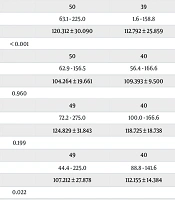
Forty-seven (63.5%) cases survived and 27 (36.5%) cases succumbed. The mean age of death was 28 (1-27) days. No correlation was found between sex and survival (P value = 0.84) and no meaningful relationship between Apgar at 5 minutes after birth survival (P value = 0.055) (Table 2).
Table 2.
Data Comparison in Survived and Deceased Infantsa
| Survived 47 (63.5%) | Deceased 27 (36.5%) | P Value | |
|---|---|---|---|
| Sex | 0.846 | ||
| Male | 63.8 | 36.2 | |
| Female | 61.5 | 38.5 | |
| Apgar | 0.055 | ||
| Apgar < 7 | 28.6 | 71.4 | |
| Apgar ≥ 7 | 70 | 30 | |
| Delivery | 0.181 | ||
| Vaginal | 54.2 | 45.8 | |
| C/S | 70.2 | 29.8 | |
| Diagnosed prenatally | 37.5 | 62.5 | 0.106 |
| Family history for CDH | 0 | 0 | 0.00 |
| Family history for otheranomalies | 0 | 3 (100) | 0.066 |
| Parental consanguinity | 55 | 45 | 0.355 |
| Delivery in local hospital | 0.008* | ||
| Delivery in other cities | 40.7 | 59.3 | |
| 73.7 | 26.3 | ||
| Resuscitation history | 22.7 | 77.3 | 0.00* |
| Status at admission | 0.00* | ||
| Intubated | 34.3 | 65.7 | |
| Not intubated | 89.5 | 10.5 | |
| Preoperative mechanical ventilation | 44.4 | 55.6 | 0.00* |
| Operation type | 0.549 | ||
| Open | 71.9 | 28.1 | |
| Thoracoscopy | 83.3 | 16.7 | |
| Hernia type | |||
| Bochdalek | 63 | 37 | |
| Morgagni | 1 (100) | 0 | 0.866 |
| Side of hernia | 0.248 | ||
| Right | 76.5 | 23.5 | |
| Left | 61.1 | 38.9 | |
| Brain abnormality | 73.7 | 26.3 | 0.045* |
| Skeletal anomalies | 0.02* | ||
| Yes | 0 | 100 | |
| No | 66.2 | 33.8 |
aValues are expressed as %.
The survival rate had a significant statistical correlation with the place of delivery. The death rates were higher in neonates referred from local hospitals in comparison to those from other cities (P = 0.008). Also, the resuscitation history, the status at admission (intubated or not intubated) (P = 0.00), skeletal anomalies (P = 0.02) and brain hemorrhages (P = 0.045) had a significant correlation with the survival rate. However, the direction of hernia, the herniated organs, type of operation (open or thoracoscopic), cardiac and renal anomalies and age at the time of surgery had no significant correlation with outcome.
Thoracoscopy was carried out in 7 neonates (5 males and 2 females with a mean age of 4 (2 - 6) days), 6 diaphragmatic defects were repaired successfully, and one case had to be switched to open surgery 10 minutes after starting because of hypercapnia. All were left-sided CDH. Complete repair with thoracoscope lasted in average 75 minutes (range 60 - 120 minutes).
During the surgery, there was no abnormal blood loss or other complications. The mean postoperative hospital stay was 14 (4 - 35) days. There was one single case of recurrence 7 days after repair that underwent open surgery and expired 2 weeks later. There was no abdominal compartment syndrome after the surgery. All patients were extubated one day after repair. The mean follow-up was 11 (6 - 36) months.
4. Discussion
Congenital diaphragmatic hernia, as an extensive congenital anomaly of the diaphragm, occurs 1 in 2500 to 4000 live births (2, 3). We planned this research to determine the factors influencing the prognosis of congenital diaphragmatic hernia. In our series, the most common (98.6%) type of CDH was Bochdalek and in the left side (76.1%). Only 10.8% of the patients were recognized prenatally, this had no effect on outcome of the disease. Also, the mode of delivery has no effect on prognosis (P = 0.18). Prenatal diagnosis of CDH does not seem to justify decision for cesarean section. The survival rate in patients referred from local hospitals was lower than maternities from other cities (P = 0.008). Possibly more critically ill CDH newborns died before arrival to our center. Positive history of resuscitation and need to intubation may be due to more severe form of illness. Some studies showed that herniation of liver or stomach into chest, was accompanied with a worse prognosis; however, we could not prove that (P = 0.19) (4).
In most reports, the major reasons for mortality from CDH are pulmonary hyperplasia and pulmonary hypertension (5). Improvement in the skills used for neonatal intensive care and the advent of the “gentle ventilation” pointed to advances in the outcome of CDH, with survival rates approximate to 80% - 90% (6). However, the congenital diaphragmatic study teams, and many multicenter - and multicountry-based reports demonstrated a survival rate of roughly 70% (7, 8). In this study, the survival rate of these neonates was 63.5%. Mean age of the deceased was 28 (2 - 27) days. No correlation was found between sex and survival (P = 0.84), and no meaningful relationship was found between the Apgar score at birth and survival (P = 0.055). The survival rate had a significant statistical correlation with the place of delivery, the death rates were higher in neonates referred from local hospitals in comparison to those coming from other cities (P = 0.008). Also, resuscitation history, the status at admission (intubated or not intubated) (P = 0.00), skeletal anomalies (P = 0.02) and brain hemorrhage (P = 0.045) had a significant correlation with the survival rate.
Persistent pulmonary hypertension remains a major cause of mortality and morbidity in CDH. Gosemann et al. (9) reported increased activation of NADPH oxidase in the pulmonary vasculature in experimental diaphragmatic hernia. In this study, echocardiography in 30% of all patients was normal. Pulmonary hypertension was seen in 21.8%.
Gomes Ferreira et al. (10) evaluated risk factors of failure after thoracoscopic repair. They found that the main limiting factor was persistent PHTN of the newborn. In this review, 9.5% of the patients underwent thoracoscopic repair. All were stable before the surgery and without PHTN.
Casaccia et al. (11) collected retrospectively details of 113 high-risk CDH neonates, baseline demographics and disease characters. On the whole, the mortality rate was 41.6% (47/113). They recognized preoperative pneumothorax, birth weight below 2,500 g and liver herniation as independent mortality predictors, and female gender, higher gestational age and a PaO2 more than 90 mmHg as defensive factors. In this report, there was no correlation between sex and survival (P = 0.84) and no meaningful relationship between Apgar score at birth and survival (P = 0.055). Also, the direction of hernia, herniated organs in thorax, type of operation (open or thoracoscopic), cardiac and renal anomalies and age at the time of surgery had no significant correlation with outcome.
Bishay et al. (12) in a randomized controlled trial demonstrated that thoracoscopic repair of CDH is associated with prolonged and strict intra operative hypercapnia and acidosis, in contrast to open surgery. The consequence of thoracoscopy on blood gases through this procedure in neonates necessitates further assessment. The survival rate is reported about 68% (13). In our brief experience with thoracoscopic repair, we had no intraoperative hypercapnia and acidosis.
The highest death risk in CDH was seen in patients related to extracorporeal membrane oxygenation (ECMO) with survival rates about 50% to 65% (14). Even though preoperative stabilization and late surgery has established helpful for CDH patients not related to ECMO.
The optimal timing of CDH repairs in patients requiring ECMO remains controversial. Bryner (15) reported that CDH correction after the ECMO therapy had a better survival than repair on ECMO. Due to lack of this facility, the ECMO was used in none of our patients.
Fisher et al. (16) studied on neonates at risk for CDH recurrence. They recognized that age at repair and the diaphragm patch use were two factors for a higher risk of recurrence. They identified 24 (10%) recurrences. In our experience, the rate of recurrence was 4.3%.
With the increasing use of thoracoscopy by pediatric surgeons, a number of more difficult problems are being approached with this modality. On the other hand there are many advantages of thoracoscopy in children such as being less invasive, less painful, and having shorter hospital stay (17-20).
4.1. Conclusions
As progresses in prenatal evaluation and perinatal management have enhanced outcomes for neonates with congenital diaphragmatic hernia, importance has directed to the long-term follow-up of infants after surgical repair. It needs multidisciplinary CDH clinics and standard timelines for outpatient care .These patients need routine screening for CDH recurrence, a complication that leads to significant potential morbidity.