
1. Background
Even though the incidence of intraventricular hemorrhage (IVH) has declined by increasing the use of antenatal corticosteroids and the postnatal use of surfactant (1-3), it is still a serious problem in premature infants associated with poor neurodevelopmental outcomes (4-6). Imperfect autoregulation of cerebral blood flow (CBF) (7) and increased serum level of interleukins (ILs: interlukin-1 beta, interlukin-6, interlukin-8, interlukin-18) and tumor necrosis factor-alpha were observed to be linked with severe IVH in extremely premature infants and are associated with neurodevelopmental disorders in this group (8-11) Mean platelet volume (MPV) as an accessible predictive marker in thromboembolic events such as strokes and acute myocardial infarction in adults has already been studied (12-14). Destruction of platelets in the periphery increases the production of platelets by bone marrow that leads to an increase in the number of immature platelets in the circulatory system, thus leading to high MPV (14-16).
Clinical evidence suggests that platelets play a crucial role in inflammatory response. Proinflammatory cytokines stimulate megakaryocytes to increase the number of platelets in response to inflammation (17). Due to these physiologic changes, any condition that is associated with activation of proinflammatory cytokines and interleukins should increase MPV. Previous studies suggested the possible correlation between MPV and respiratory distress syndrome (RDS) (18), broncopulmonary dysplasia (BPD) (19) and IVH (20) in preterm infants.
This study aims to assess the feasibility of MPV within 24 hours of birth as a simple accessible tool to identify preterm infants prone to IVH in a large case group with lower gestational age and also to evaluate MPV in relation to IVH grades.
2. Methods
2.1. Study Design
This case control study was conducted during 18 months from January 2014 to June 2015 on all preterm infants (gestational age < 34 weeks) with diagnosis of RDS who were admitted to the NICU of Arash hospital in Tehran, soon after birth. Preterm infants with IVH constituted the case group and those without IVH were included as control group. The study was approved by the local Ethical Committee and written consent was obtained from parents before enrollment. Inclusion criteria: any premature infant with gestational age (GA) of < 34 weeks with diagnosis of RDS in accordance with the European consensus guidelines (21). Exclusion criteria: 1. infants born to a mother with preeclampsia or any drug history which could have negative effects on platelet counts 2. Major congenital abnormalities at birth 3. Congenital thrombocytopenia (platelet < 150,000 × 109/L). 4. Gastro-intestinal tract problems needing surgical intervention.
Demographic data including sex, gestational age, maternal age, birth weight, mother’s underlying disease, parity, metabolic acidosis, pneumothorax, patent ductus arteriosus (PDA), platelets and MPV level were recorded.
2.2. Diagnosis of IVH
On the third day of life, the routine cranial ultrasonography (CUS) was performed. For very sick infants or birth weight ≤ 1000 gr, CUS was carried out within 24 hours of birth. Serial CUS was performed according to grading of IVH (22).
2.3. Blood Samples
To avoid any measurement bias, blood samples for the complete blood cell count (CBC) and blood gas were collected at the time of NICU admission. The CBC test was repeated on the third day. Blood gas analyses were performed in the Radiometer device ABL. Platelet counts and MPV were evaluated via Coulter LH analyzer. Elevated MPV was defined as a value ≥ 11 fl based on Hussein’s study (23), thrombocytopenia was defined as platelet < 150,000 × 109/L, metabolic acidosis defined as pH < 7.2 and base deficit (BE) in the extracellular fluid > 12.0 mmol/L.
2.4. Statistical Analysis
Enrolled infants were stratified into IVH and non-IVH groups. Clinical characteristics of infants were summarized as proportions for dichotomous variables and mean with standard deviation for continuous variables. Comparison of continuous and dichotomous variables between groups was done using Student’s t-test and Chi square test, respectively. Since the sample size was small and data had several unbalanced and highly predictive risk factors (complete separation problem), multiple logistic regression model was performed using firthlogit to examine possible association between outcome of interest (IVH) and MPV. The presence of the aforementioned problem in logistic regression models can result in bias of odds ratio (OR) estimating away from 1. Firthlogit command did not use maximum log likelihood but penalized log likelihood instead to reduce bias. All data analysis was completed using Stata version 14 (STATA Corp, College Station, TX).
3. Results
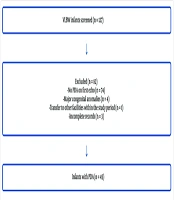
A total of 352 preterm and term infants were admitted to our hospital. Fifty premature infants with IVH were enrolled in the study. The control group consisted of 50 preterm infants who did not develop IVH.
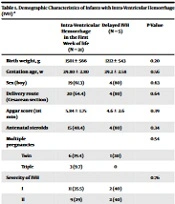
Infants with IVH had lower birth weight (Mean difference: 0.48, 95%CI: 0.08 to 0.87, P = 0.018) and GA (Mean difference: 2.9, 95%CI: 1.95 to 3.92, P < 0.001), compared to infants without IVH. The demographic characteristics, MPV and platelet counts for both groups are shown in Table 1. There was no statistically significant difference regarding other demographic characteristics.
Table 1.
Characteristics of the Study Populationa
| Infants with GMH-IVH (n = 50) | Infants without GMH-IVH (n = 50) | P Value | |
|---|---|---|---|
| GA, w | 27.80 ± 2.88 | 30.74± (1.97) | < 0.001 |
| Birth weight, g | 0.005 | ||
| < 1000 | 25 (50) | 17 (34) | |
| 1001 - 1250 | 20 (40) | 15 (30) | |
| 1251 - 1500 | 0 | 10 (20) | |
| 1501 - 1750 | 5 (10) | 8 (16) | |
| Maternal age | 32.50 ± 7.67 | 31.02 ± (7.35) | 0.327 |
| Parity | 1.40 ± (1.03 | 1.50 ± (0.97) | 0.619 |
| 1st minute Apgar score | 2.18 ± 1.10 | 2.12 ± (1.08) | 0.417 |
| 5th minute Apgar score | 5.69 ± 2.43 | 5.73 ± 2.39 | 0.432 |
| Gender (male/female) | 35/15 | 31/19 | 0.527 |
| Mother’s underlying disease | 0.295 | ||
| Yes | 15 (30) | 20 (40) | |
| No | 35 (70) | 30 (60) | |
| Modes of Delivery | 0.727 | ||
| NVD | 4 (8) | 5 (10) | |
| C/S | 46 (92) | 45 (90) | |
| Pneumothorax | 0.799 | ||
| Yes | 10 (20) | 9 (18) | |
| No | 40 (80) | 41 (78) | |
| PDA | 0.171 | ||
| Yes | 40 (80) | 34 (68) | |
| No | 10 (20) | 16 (32) | |
| Metabolic acidosis | 0.656 | ||
| Yes | 15 (30) | 13 (26) | |
| No | 35 (70) | 37 (74) | |
| Sepsis | 1.000 | ||
| Yes | 35 (70) | 35 (70) | |
| No | 15 (30) | 15 (30) | |
| MPV, fL | < 0.001 | ||
| ≥ 11 | 37 (74) | 10 (20) | |
| < 11 | 13 (26) | 40 (80) | |
| PLT (×103/mL) | 0.041 | ||
| ≥ 150,000 | 15 (30) | 25 (50) | |
| < 150,000 | 35 (70) | 25 (50) |
Abbreviation: GA, Gestational age.
aValues are expressed as mean ± standard deviation or No. (%).
Seventy four percent of infants with IVH had a MPV more than 11 fL compared to twenty six percent in infants without IVH (Crude OR: 10.71, 95%CI: 4.26 to 26.90, P < 0.001). Correlation of MPV with IVH grades are shown in Table 2. Multivariate logistic regression analysis of selected variables demonstrated that MPV (Adjusted OR: 10.68, 95%CI: 3.20 to 35.59, P < 0.001) and GA (adjusted OR: 0.54, 95%CI: 0.40 to 0.74, P < 0.001) were related to the occurrence of IVH. There was no significant association between IVH and other variables (Table 3). Platelet counts were similar in the first hours of life in both groups. On the third day of life, 70% of infants in the IVH group had a platelet count less than 150000, in comparison with 20 % in those without IVH (P = 0.041).
Table 2.
Assossiation of MPV with IVH Gradesa
| IVH Grade | MPV < 11 | MPV > 11 | Total | P Value |
|---|---|---|---|---|
| 1 | 9 (36) | 16 (64) | 25 (100) | 0.055 |
| 2 | 0 | 10 (100) | 10 (100) | |
| 3 | 4 (40) | 6 (60) | 10 (100) | |
| 4 | 0 | 5 (100) | 5 (100) |
aValues are expressed as No. (%).
Table 3.
Adjusted Odds Ratio of GMH-IVH According to Selected Clinical and Demographic Characteristics by Multivariate Analysis
| Variables | Adjusted OR | Std. Err | 95% CI | P Value |
|---|---|---|---|---|
| MPV, fL | 10.68 | 6.54 | 3.20 - 35.59 | < 0.001 |
| GA, w | 0.54 | 0.08 | 0.40 - 0.74 | 0.006 |
| Birth weight, g | 1.49 | 0.50 | 0.76 - 2.90 | 0.238 |
| Maternal age | 0.99 | 0.03 | 0.93 - 1.07 | 0.968 |
| Parity | 0.94 | 0.59 | 0.45 - 1.92 | 0.868 |
| Mother’s underlying disease | 1.43 | 1 | 0.36 - 5.70 | 0.609 |
In the IVH group, 100% of infants who had pneumothorax, had high MPV when compared to 67.5 % of those who had no pneumothorax (P = 0.036), and 100% of neonates with metabolic acidosis, had high MPV in comparison to 62.9 % of those without metabolic acidosis (P = 0.006).
4. Discussion
Despite the increasing survival rate of premature infants during recent decades, IVH is still one of the major causes of neurologic developmental problems (24-26). Inadequate functioning of autoregulation of cerebral blood flow has been considered as pathogenic factor in IVH (8). Furthermore, decreasing systolic and diastolic blood pressure as a result of increased serum levels of interleukins (ILs), especially IL-6, leads to IVH (7, 23). The effect of interleukins on platelet function in vascular inflammation have been noted by previous studies (27). During vascular inflammation and ischemic events interleukins as proinflammatory cytokines stimulate megakaryocytes to increase the number of platelets in response to inflammation that leads to high MPV (17).
In this study the feasibility of MPV within 24 hours of birth as an accessible tool to identify preterm infants prone to IVH in a large case group with lower gestational age was assessed.
In our study, preterm infants with IVH tend to have a high MPV in comparison with those without IVH, with significant difference. This was also studied by Cekmez et al. (28) and Bolouki Moghaddam et al. (20). Unlike their results we found this correlated with higher MPV. This difference may be due to lower GA (mean 27.80 ± 2.88 weeks) and lower birth weight (mean 1050 ± 21.50 grams) in our patients.
In Bolouki Moghaddam’s study (20) mean MPV in the IVH group was 10.00 ± 1.04. In the study by Hussein et al19 mean MPV in the IVH group was 11.6 ± 2.0. Despite the fact that seventy four percent of our infants with IVH had a MPV of more than 11 fL, because high MPV was defined as ≥ 11 fL, we could not calculate mean MPV in the IVH group.
Canpolat et al reported high MPV in premature infants with RDS (18). We did not find any significantly increased MPV due to RDS. Even though the correlation between high MPV and inflammatory events especially sepsis (29) and BPD (20) have already been discussed, there are still a few studies with low sample size on assessing the role of high MPV to identify preterm infants prone to IVH and other morbidities during neonatal periods particularly in very premature infants. Multivariate logistic regression analysis of selected variables demonstrated that MPV (P < 0.001) and GA (P < 0.001) were related to the occurrence of IVH. This may suggest that MPV and GA can be considered as independent risk factors for development of IVH as Hussein et al. did it (23). They considered MPV > 11 fL as an independent risk factor that increased the risk of IVH (P < 0.001). In their study male gender, birth weight < 1250 gr and the 5th minute Apgar score < 8 were considered as other independent risk factors of IVH (27). In our study there was no significant association between IVH and other variables. As our hospital has specialized units for high risk pregnancy and assisted reproductive systems (in vitro fertilization, egg freezing, etc), routine antenatal use of corticosteroids and in some cases magnesium sulfate along with administration of surfactants and using hybrid modes of mechanical ventilation after birth may explain the lack of other independent risk factors of IVH. 25% of neonates had IVH grade 1, of whom 64.0% had MPV > 11. 22% of neonates with MPV > 11 had IVH grade 3,4. Although there are weak correlations between IVH grading and MPV > 11 in comparison with the other group (P value 0.055), unfortunately, the small number of IVH cases in each grade preclude a meaningful comparison between these IVH groups based on statistical analysis.
On the third day of life, thrombocytopenia was detected in the IVH group whereas it was not seen in the second group. This can be one of the relative risk factors for occurrence of IVH (30) and this is in concordance with Mayda-Domac et al. (14) who found an inverse relationship between platelet count and MPV in preterm neonates. Larger size of younger platelets can explain this event.
In the IVH group, all of the infants with pneumothorax or metabolic acidosis had high MPV. Metabolic acidosis leads to arterial dilatation with hypotension and can damage the immune response (31). On the other hand, large fluctuation of CBF secondary to pneumothorax, ischemic and inflammatory events lead to IVH as a complication of pneumothorax. This may explain the higher MPV in these situations. According to our knowledge, this is the first time that the correlation of MPV and pneumothorax or metabolic acidosis has been studied. It seems that higher MPV index has the potential to act as a simple cost effective test for identifying critical preterm infants at the risk of IVH and can help early decision making of the care level and treatment that infants require.
4.1. Limitation
Despite proper sample size of our study in comparison to the previous studies, we were unable to achieve a meaningful comparison between high MPV with IVH grades due to the small numbers of IVH cases in each grade. Further studies are needed to evaluate the best cut-off value of MPV as a predicting factor in IVH. Multicenter studies in this regard will be more appropriate.
4.2. Conclusions
High MPV within 24 hours of birth could be determined as a simple available laboratory test for identifying the NICU-admitted premature infants at risk of IVH.