


1. Background
Mental health problems in workplace, as one of the most important dimensions of human resource development in organizations are prevalent in working populations (1). In this regard, job stress, as a mental health threatening factor, has an important role in the workplace (2). Based on global burden of diseases, WHO has estimated that mental diseases such as stress will be the second causes of disabilities up to the year 2020 (3). US national institute of occupational safety and health has defined job stress as an affective and physical harmful response when employee’s skills, resources, and needs cannot meet job expectations and requisites (4). Nowadays, organizations more than ever seek to increase and improve their intangible assets as a source of value creation (5). So, social capital as an intangible asset has received significant attention. Social capital, which has been defined by variables such as social confidence, reciprocity norms, and density of social networks (6), can lead to team collaboration improvement, facilitation in knowledge transfer, organizational commitment, and quality improvement in services and goods. In many studies, social capital has been known as influential factor on health (7), so that presence of social capital in the community can promote cooperation, collaboration, and coordination (8) and provide affective support. Organizational commitment is a mental state that indicates a desire, a need and an obligation to continue employment in an organization (9). When employees are satisfied with their job and trust their organization, their job commitment is increased proportionally. Organizational commitment decreases intention to leave the organization and job (10-13) and job stress (14, 15). The role of social capital as a mediator has been approved by different studies (16). For example, a study in Taiwan has shown its role in the relationship between human capital and career mobility (17); also, some researchers emphasized on positive impact of social capital on self-control and on mental and social performance (18). To the best of our knowledge, no study showed a cumulative effect of social capital and organization commitment on job stress and also there is no study to examine the mediator role of social capital variable on the relation between organization commitment and job stress variables.
2. Objectives
The present study examined the mediating role of organizational social capital in the relationship between organizational commitment and job stress.
3. Materials and Methods
3.1. Study Design and Participants
The population of this cross-sectional study (n = 813) included KUMS male and female staff. The study was approved by the deputy of research and technology and by the Institutional Review Board of Kermanshah University of Medical Sciences, Iran (Code: 93025). Considering d = 0.05 and also p and d equal to 0.5, 311 samples were entered into the study, and eventually, 302 valid questionnaires were entered to the analysis process (response rate: 97%). Sampling method was multi-stage stratified sampling; at t first, the number of employees of each deputy of KUMS was specified and then samples were selected randomly using the list of the personnel. Trained questioners were employed to obtain data. Informed consent was obtained from the participants, and they filled out the questionnaires voluntarily, but in the event of disagreement, they were replaced by the next person.
3.2. Inclusion Criteria
The inclusion criteria were the employee's satisfaction to enter the study; also, the participants should not have worked in the hospital centers and other administrative centers on the time of the study. Educated interviewers visited the University deputies. Considering the small number of unanswered questions for the main variables, these values were completed through missing value analysis by the regression method.
3.3. Questionnaires
To collect the required data, 4 questionnaires were used:
background/demographic questionnaire: this tool was about employees’ demographic information that included age, sex, marital status, education level, years of service, management history, and employment type. Health and Safety Executive (HSE) Stress Questionnaire: This questionnaire was developed by IOSH and consist of 35 questions that measure job related issues in 7 subscales (role area: 5 questions; relational area: 4 questions; authorities’ support: 5 questions; coworkers’ support: 4 questions; control: 6 questions; demand: 8 questions; and changes: 3 questions). The questionnaire’s validity has been obtained using Cronbach’s alpha and split-half method of 0.78 and 0.65, respectively (19). The Cronbach’s alpha of this questionnaire was estimated to be 0.854 in the present study. Also, the results of confirmatory factor analysis, based on our data, revealed that all subscales of the questionnaire have an acceptable weighting factor (X2/df = 2.11; GFI = 0.82; CFI = 0.80; RMSEA = 0.061). The method of scoring in the Likert spectrum is from 1 to 5 (score 1: always, Score 5: never). Higher scores indicated more job stress. Scoring method in communication and demand areas is reverse. The lowest score is 35 and the highest is 175.
3.3.1. Organizational Social Capital Questionnaire
This questionnaire includes 15 questions about different dimensions of social capital (structural: 5questions, cognitive: 4 questions, and relational: 6 questions), which is designed based on Ghoshal and Nahapiet model. The questionnaire’s validity has been approved by content method and its reliability has been approved with Cronbach’s alpha of 0.95 (20). The Cronbach’s alpha of total organizational social capital was estimated to be 0.808 in the present study. Also, the results of confirmatory factor analysis, based on our data, showed that all subscales of the questionnaire have an acceptable weighting factor (X2/df = 2.05; GFI = 0.89; CFI = 0.89; RMSEA = 0.065). The scoring method in Likert spectrum is 5-choice (totally disagree: 1, totally agree: 5). Higher scores indicate higher levels of social capital.
3.3.2 Organizational Commitment Questionnaire
This questionnaire has 24 questions and assesses 3 areas of affective commitment, normative commitment, and continuous commitment. The reliability of this questionnaire was calculated through Cronbach’s alpha method and was found to be 0.79 for affective commitment, 0.81 for normative commitment, and 0.84 for continuous commitment; and the validity coefficient was 0.79 for affective commitment, 0.84 for continuous commitment, and 0.81 for normative commitment (21). The Cronbach’s alpha of total organizational commitment was found to be 0.669 in the present study. Also, the results of confirmatory factor analysis, based on our data, revealed that all subscales of the questionnaire have an acceptable weighting factor (X2/df = 2.89; GFI = 0.88; CFI = 0.87; RMSEA = 0.07). The questionnaire has 7 options for scoring. The minimum and maximum scores include 24 and 168, respectively. The questions number 4, 5, 6, 8, 9, 10, 15, 16, 17, 18, 19, 21, and 24 score reversely.
3.4. Statistical Analysis
Mean and standard deviation were used to describe the study main variables. Pearson correlation test was used to examine the correlation between main variables. To determine the factors that influence the dimensions of job stress, backward multivariate regression analysis was used. Structural equation model was used to specify the mediator role of social capital. Data were analyzed by SPSS-18 and Amos-18 soft wares.
3.5. Ethical Issues
Informed consent was obtained from all respondents, and they were also informed about the purpose of the study. All information given by the respondents was kept confidential, and the questionnaires were anonymous.
4. Results
Among 302 respondents, 51.6% were female. The mean age of the respondents was 40.13 ± 15/03. Of the participants, 16% had high school diploma, 12.8% AA, 41.7% BA, 24.7% MA, and 4.9% Ph.D. Moreover, 76.5% of the respondents were married. Descriptive results showed that the respondents’ mean scores in job stress, organizational social capital and organizational commitment variables were 90.51, 50.26, and 105, respectively.
Also, Pearson correlation test revealed a significant reverse correlation between job stress and organizational social capital (r = -0.504, P < 0.001) and between job stress and organizational commitment (r = -0.317; P < 0.001); moreover, a significant positive correlation was found between organizational commitment and social capital (r = 0.374, P < 0.001).
With respect to the relationship between subscales of the main variables of the study, the results of Pearson correlation test showed that the most correlation was between colleagues support and structural capital (r = -0.525, P < 0.001). The correlation coefficient results of other subscales are presented in Table 1.
Table 1.Mean, Standard Deviation and Correlation Coefficients of the Study Variables
| Main Variables | Domains | Mean ± SD | 1 | 2 | 3 | 4 | 5 | 6 | 7 | 8 | 9 | 10 | 11 | 12 | |
|---|---|---|---|---|---|---|---|---|---|---|---|---|---|---|---|
| Job Stress (JS) | 1 | Role | 8.87 ± 2.90 | 1 | |||||||||||
| 2 | Relations | 9.20 ± 3.42 | 0.123* | 1 | |||||||||||
| 3 | Authorities Support | 13.71 ± 3.69 | 0.187** | 0.272** | 1 | ||||||||||
| 4 | Coworkers Support | 9.85 ± 2.96 | 0.138* | 0.309** | 0.594** | 1 | |||||||||
| 5 | Control | 17.00±3.70 | 0.286** | -0.056 | 0.357** | 0.367** | 1 | ||||||||
| 6 | Demand | 23.56 ± 5.09 | 0.031 | 0.516** | 0.104 | 0.136* | 0.046 | 1 | |||||||
| 7 | Changes | 8.28 ± 2.54 | 0.168* | 0.289** | 0.742** | 0.405** | 0.281** | 0.140* | 1 | ||||||
| Social Capital (SC) | 8 | Structural SC | 16.68 ± 3.31 | -0.133* | -0.320** | -0.445** | -0.525** | -0.175* | -0.116* | -0.419** | 1 | ||||
| 9 | Cognitive SC | 10.12 ± 3.31 | -0.137* | -0.233** | -0.305** | -0.274** | -0.115* | -0.085 | -0.241** | -0.496** | 1 | ||||
| 10 | Relational SC | 23.45 ± 5.91 | -0.108 | -0.284** | -0.428** | -0.438** | -0.207** | -0.073 | -0.395** | -0.532** | -0.527** | 1 | |||
| Organizational Commitment (OC) | 11 | Affective OC | 36.85 ± 7.74 | -0.228** | -0.314** | -0.285** | -0.233** | -0.098 | -0.183** | -0.180* | -0.355** | -0.096 | -0.235** | 1 | |
| 12 | Normative OC | 34.33 ± 5.74 | -0.130* | -0.092 | -0.079 | -0.098 | -0.032 | -0.040 | -0.064 | -0.383** | -0.132* | -0.229** | -.249** | 1 | |
| 13 | Continuous OC | 33.80 ± 6.29 | -0.036 | -0.183** | -0.179* | -0.193** | -0.046 | -0.081 | -0.145* | -0.307** | -0.096 | -0.208** | -0.461** | -0.177** | |
The results of regression test related to predictors of each dimension of JS indicated that structural and communication capital areas of OSC and continuous and affective areas of OC variable in the main model related to JS variables remained (Table 2).
Table 2.Results of Regression Analysis Related to Predictors of Each Dimension of Job Stress
| Dependent Variables | Regression Results | Predictors | B | Beta | P Value |
|---|---|---|---|---|---|
| Role Domain | F = 16.41 | Affective OC | -0.085 | -0.228 | < 0.001 |
| P = 0.001 | |||||
| R = 0.228 | |||||
| R2 = 0.052 | |||||
| Relations Domain | F = 18.78 | Affective OC | -0.094 | -0.213 | < 0.001 |
| P = 0.001 | |||||
| R = 0.399 | Structural OSC | -0.185 | -0.178 | 0.006 | |
| R2 = 0.159 | Relational OSC | -0.072 | -0.124 | 0.052 | |
| Authorities Support Domain | F = 34.78 | Affective OC | -0.053 | -0.112 | 0.039 |
| P = 0.001 | Structural OSC | -0.304 | -0.273 | < 0.001 | |
| R = 0.509 | |||||
| Relational OSC | -0.155 | -0.248 | < 0.001 | ||
| R2 = 0.259 | |||||
| Coworkers Support Domain | F = 67.49 | Structural OSC | -0.364 | -0.407 | < 0.001 |
| P = 0.001 | Relational OSC | -0.111 | -0.222 | < 0.001 | |
| R = 0.558 | |||||
| R2 = 0.311 | |||||
| Control Domain | F = 13.41 | Relational OSC | -0.130 | -0.207 | < 0.001 |
| P = 0.001 | |||||
| R = 0.207 | |||||
| R2 = 0.043 | |||||
| Demand Domain | F = 10.37 | Affective OC | -0.120 | -0.183 | < 0.001 |
| P = 0.001 | |||||
| R = 0.183 | |||||
| R2 = 0.033 | |||||
| Changes Domain | F = 29.66 | Continuous OC | 0.052 | 0.116 | 0.024 |
| P = 0.001 | Structural OSC | -0.229 | -0.298 | < 0.001 | |
| R= 0.480 | Relational OSC | -0.107 | -0.247 | < 0.001 | |
| R2 = 0.230 | |||||
| Total Job Stress | F = 43.60 | ||||
| P = 0.001 | Affective OC | -0.352 | -0.187 | < 0.001 | |
| R = 0.552 | Structural OSC | -1.30 | -0.298 | < 0.001 | |
| R2 = 0.305 | Relational OSC | -0.535 | -0.218 | < 0.001 |
Structural Equation Model Model (SEM): The analysis of offered model (Model 1) indicated that it was not a good fit (Table 3); thus, to improve goodness of fit indices, model modification was applied (model 2). Results showed that the second model had acceptable fit (Table 3).
Table 3.Direct and Indirect Coefficients of the Main Variables of the Study
| Model | X2 | df | X2/df | GFI | CFI | IFI | TLI | AIC | RMSEA |
|---|---|---|---|---|---|---|---|---|---|
| 1 (Suggested Model) | 280.65 | 62 | 4.53 | 0.89 | 0.81 | 0.81 | 0.76 | 338.64 | 0.108 |
| 2 (Finalized Model) | 173.87 | 60 | 2.79 | 0.92 | 0.90 | 0.90 | 0.88 | 235.86 | 0.079 |
The significant effect of mediating role of OSC was done using Bootstrap test (a sample size of 5000 was determined for Bootstrap). The basic principle in the Bootstrap approach is that indirect effects do not have normal distribution. Mackinnon et al. (2004) have suggested that the bootstrap method provides the most accurate confidence interval for indirect effects (22). The indirect effect is displayed in Table 4. Also, as Table 4 presents, OC had a significant indirect effect on JS through OSC.
Table 4.Direct and Indirect Coefficients of the Main Variables of the Study (Finalized Structural Model)
| Paths | Direct Coefficients | Indirect Coefficient | |||||
|---|---|---|---|---|---|---|---|
| B | β | P Value | B | β | P Value | ||
| OC | OSC | 1.46 | 0.56 | 0.001 | - | - | - |
| OC | JS | 0.001 | 0.001 | 0.99 | 0.15 | - 0.37 | 0.001 |
| OSC | JS | 0. 10 | - 0.66 | 0.001 | - | - | - |
Based on Table 4 and Figure 1, when OSC enters in the relationship as a mediator, indirect standard coefficient of OC and JS become -0.37 (P < 0.001). So, when OC causes more decrease in JS, OSC increases in the organization significantly. Also, OSC has a mediating role in the relationship between OC and JS.
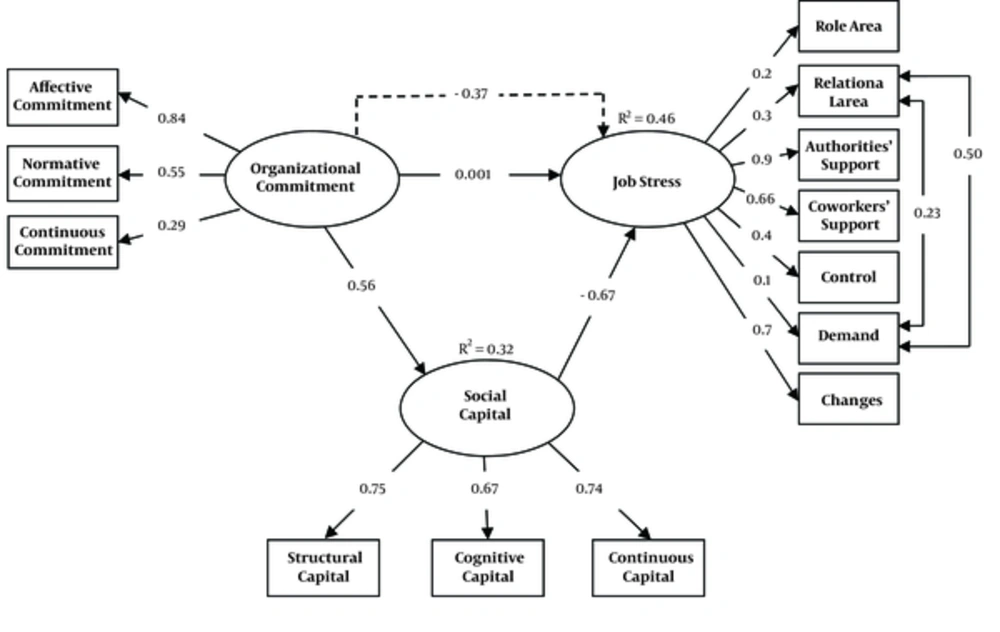
Figure 1.
The Finalized Structural Model (N = 302)
5. Discussion
This study showed a reverse and significant relationship between social capital and job stress, so that by increase in organization’s social capital, job stress reduces increasingly. Also, data analysis showed that organizational social capital solely explains 14% of job stress changes. This result is consistent with previous studies (23-25). As an example, results of a research in 2004 showed that understanding social support by employees has caused more decrease in job stress and increase in the job performance (23). Moreover, other studies have emphasized on the relationship between social capital and health (7). Some theorists suggest that social capital relates to health for 4 reasons: first, social media presents economic interests that decrease stress and anxiety. Second, these networks strengthen health measures. Third, the networks can present demand for health services better. Fourth, interaction and social activity cause more activation of body immune system (26). Another result of this study was the positive correlation between organizational commitment and organizational social capital, which is consistent with some researches done in Iran (27). A study showed that trust, communication, and concentration have a significant direct effect on employee’s organizational commitment (28). On the one hand, good social relationship between employees causes more affective attachment between them, and on the other hand, boosts positive emotions and satisfaction with the job and the organization, and also creates more efficacy and less burnout. Other results revealed a reverse and significant relationship between organizational commitment and stress. This result is consistent with previous studies (14, 15). Considering the stronger relationship between affective commitment and job stress dimensions, it can be stated that affective support helps health more explicitly (8). Some theorists, such as Anthony Giddens, believe that affective support is a type of protective support (29). In this study, social capital had a mediating role between organizational commitment and job stress, so that organizational commitment has a more decreasing role when social capital is present. Considering the prominent role of social capital as an intangible social element on different areas, social capital has an effective role on the organization performance. In a similar research, it was found that social capital plays a mediating role in the relationship between self-control and psychological well-being in females, but not in males (18). Furthermore, in a systematic review, it was found that neighborhood social capital has the mediating role in the relationship between neighborhood deprivation and youths’ health and welfare (30). Another study showed that social capital has a mediating role in the relationship between social intermediation and access to financial services in the Uganda Micro Finance Industry (31). This finding is inconsistent with that of the present study. Perhaps, this finding was due to lack of attention to the other structural and communicational indices of social capital.
5.1. Conclusion
Based on the results of this study, it can be concluded that social capital has a reverse relationship with job stress. Also, considering the important role of social capital in the organization and its mediating role between organizational commitment and job stress, it can be stated that social capital growth in the organization decreases job stress and increases organizational commitment. Presence of social capital in the organization improves indirect relationship of other variables. One of the limitations of this study was its cross-sectional method. One of the assumptions of the mediator models was the causal relationship between independent variable with mediator and dependent variables. Causal relationship cannot be tested in cross-sectional studies. Accordingly, mediation model in cross-sectional studies should be explained with caution. Therefore, to confirm the causal relationships between variables, it is suggested that prospective methods be used in future studies. Despite the limitations, this study had some strength. First, the proposed model suggests an empirical framework for researchers. Also, the proposed model can be used as a guide for future studies.


