1. Background
Concept of organizational commitment in the domain of organizational behavior developed and attracted researchers in the beginning of 1950. Organizational commitment plays an important role in achieving organizational goals. Organizational commitment is individual’s psychological attachment to the organization (1). Commitment is a desire to try harder for better performance of the organization (2). According to Allen and Meyer, organizational commitment consists of three main features: continuous commitment, affective commitment and normative commitment (3). Affective commitment refers to the emotional attachment to the organization, continuous commitment relates to the desire to remain in the organization because the costs of leaving or the rewards of staying in the organization, and normative commitment reflects a compulsion to remain in the organization as a member (4). Commitment is not something that can be directly seen, but can be predicted with some variables such as demographic characteristics, job satisfaction and occupational stress (2). Paying attention to the humans` spirit and motivation of employees has high priority (5).
Job satisfaction is supposed to be a collection of individuals` beliefs, attitudes and feelings towards their jobs (6). In other words, it is related to job requirements, received salaries, equipment, working condition, promotion, coworkers, management support, job security and demographic characteristics such as gender, work tenure, educational level and age (4). The study by Sabooteh et al. (7), on midwives working in maternity wards of Isfahan city, Iran, classified job satisfaction as 23.8% low, 69.5% moderate and 6.7% high. Chang stated that job satisfaction has a positive and significant influence on organizational commitment. The job satisfaction of health workers is an important topic of human resources for health (HRH) research (8).
Occupational stress is the harmful physical and emotional responses given because of mismatching between requirements of the work and capabilities and resources or needs of the worker (2). Kordi et al. (9) in Mashhad, Iran, expressed that 21.3%, 19.3% and 59.3% of midwives feel low, moderate and sever stress, respectively. Although occupation is a very important source of livelihood and social status, it can lead to dissatisfaction and physical and mental dementia. From the perspective of social psychology, all employees in any occupation with the social roles are exposed to stress by workplace. Some occupations are associated with higher mental and physical stresses. Medical team members are people with high levels of pressure. Stressful factors with the synergistic effect of dissatisfaction of work can be threat their mental or psychosocial health (10, 11). Ghareeb et al. (12), in a study in Egypt on nurses expressed an inverse correlation between work stress and organizational commitment.
Stress and job dissatisfaction have organizational outcomes such as reduction in performance, increase in the rate of absence, turnover intentions and resignation, decreased job performance, life satisfaction and reduction in organizational commitment (13).
In healthcare organizations, employees are the most important resources (4). Midwives, because of the nature of their job, are influenced by various stressors affecting their job satisfaction and organizational commitment. Midwives play an important role in the promotion of maternal and child survival in the country, relatively little is known about how they experience their work and occupational attitudes (14). Commitment is so important to keep employees, and faithful workers do their jobs with higher quality. Therefore, finding and its related factors can help managers to develop quality of their organization (5). Despite the importance of these subjects, studies about commitment and its relationship with job satisfaction and occupational stress are limited among midwives. Therefore, the first step is to identify the current situation of teaching hospitals regarding the status of organizational commitment, occupational stress and job satisfaction in midwives. The next step is the appropriate training for midwives regarding the topics of organizational behavior, which is the most essential and necessary step.
2. Objectives
The current study aimed to determine the predictive power of job satisfaction and occupational stress in organizational commitment among midwives.
3. Methods
The current descriptive-correlation survey was conducted in 2014; one hundred and seven midwives working in the maternity wards of teaching hospitals affiliated to Mashhad University of Medical Sciences (include Hashemi Nejad, Emam Reza, Ghaem and Omulbanin), Mashhad, Iran, were included in the study by simple sampling method in case of having inclusion criteria as: having at least associate degree of midwifery, one year of work experience, satisfied with participation in the study and living in Mashhad. First, the study was approved by the ethical committee of faculty of nursing and midwifery of Mashhad University of Medical Sciences. Then, after getting permission from head of the hospital, the researcher attended the maternity ward and distributed self-administered questionnaires.
Data were collected by three questionnaires as demographic questionnaire (which contained visual analog scale (VAS) of occupational stress), Minnesota job satisfaction questionnaire (MSQ) and Allen & Meyer organizational commitment questionnaire. Although questionnaires were standard, face and content validity were used to measure validity of all questionnaires. - Questionnaires were confirmed by 10 faculty members of the university. Reliability of organizational commitment questionnaire with Cronbach’s alpha in Mosadeghrad & Ferdosi (4) study was 0.77 and in the current study was 0.84; job satisfaction with Cronbach’s alpha in the study by Weng et al. (15) was 0.86 and in the current study was 0.85. Lesage & Berjot (16) in an article entitled “validity of occupational stress assessment using a visual analogue scale” declared the reliability of VAS as a high level of correlation between the VAS and perceived stress scale (PSS) and in the current study it was 0.85 on parallel evaluation.
Organizational commitment questionnaire contains three components according to Allen & Meyer as continuous commitment, affective commitment and normative commitment. It employed a 7-point Likert scale from 1 for strongly disagree to 7 for strongly agree and for reverse questions, 1 for strongly agree to 7 for strongly disagree. The range of scores is 24 - 168; 24 - 59 is very low commitment, 60 - 95 is low commitment, 96 - 131 is high commitment and 132 - 168 is very high commitment. It has 24 questions. Job satisfaction questionnaire includes 20 questions with a 4-point Likert scale. The range of scores is as follows: the score 20 - 35 very dissatisfied, 36 - 50 dissatisfied, 51 - 65 satisfied and 66-80 very satisfied. Visual analog scale of occupational stress is a horizontal line with a length of 10 cm and the range of absolutely no stress and extreme stress. It is divided into four grades: 0-2.5 as grade I, 2.6 - 5 grade II, 5.1 - 7.5 grade III and 7.6 - 10 grade IV.
After questionnaires were given codes, data were transferred into SPSS ver. 19, and analyzed by descriptive methods to describe demographic characteristics. Distributions of data were evaluated by the Kolmogorov-Smirnov test. Since data were normal, Pearson correlation test was used to measure organizational commitment correlation with job satisfaction and occupational stress. Also analysis of variance and the Spearman rho test were used to evaluate the relationship of the three variables with demographic factors.
4. Results
A total of 107 respondents participated in this survey. The demographic data revealed that the mean age of the participants was 36.18, and most of them were married (79.4%). The employment data revealed that they worked in their current job for an average of nearly 12 years. The midwives in this study held predominantly bachelor’s degree (99.1%).
The mean score of organizational commitment was 75.61 ± 11.09; the minimum and maximum scores were 49 and 115, respectively. Organizational commitment frequency is shown in Figure 1.
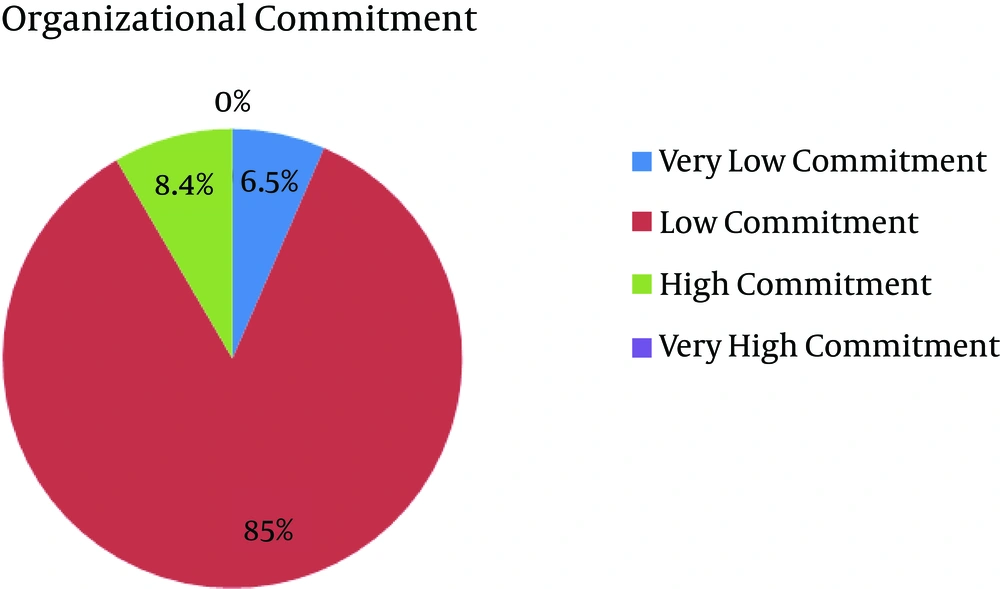
Figure 1.
Organizational Commitment Frequency
The mean score of job satisfaction was 50.98 ± 9.89; the minimum and maximum scores were 27 and 76, respectively. Job satisfaction frequency is shown in Figure 2.
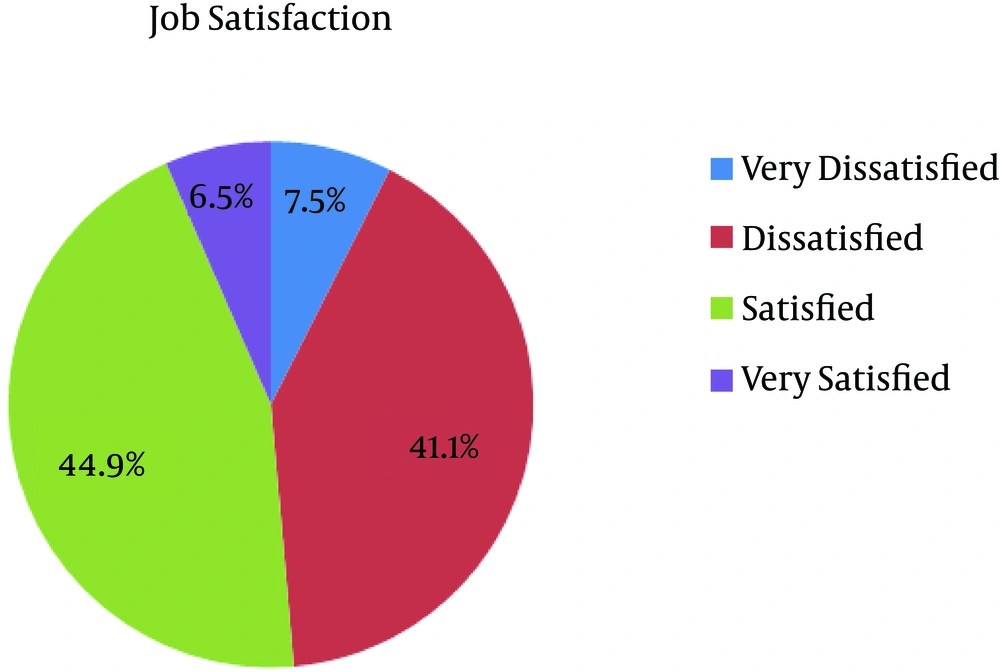
Figure 2.
Job Satisfaction Frequency
The mean score of occupational stress was 4.22 ± 1.99; the minimum and maximum scores were 0.50 and 9.80, respectively. Occupational stress frequency is shown in Figure 3.
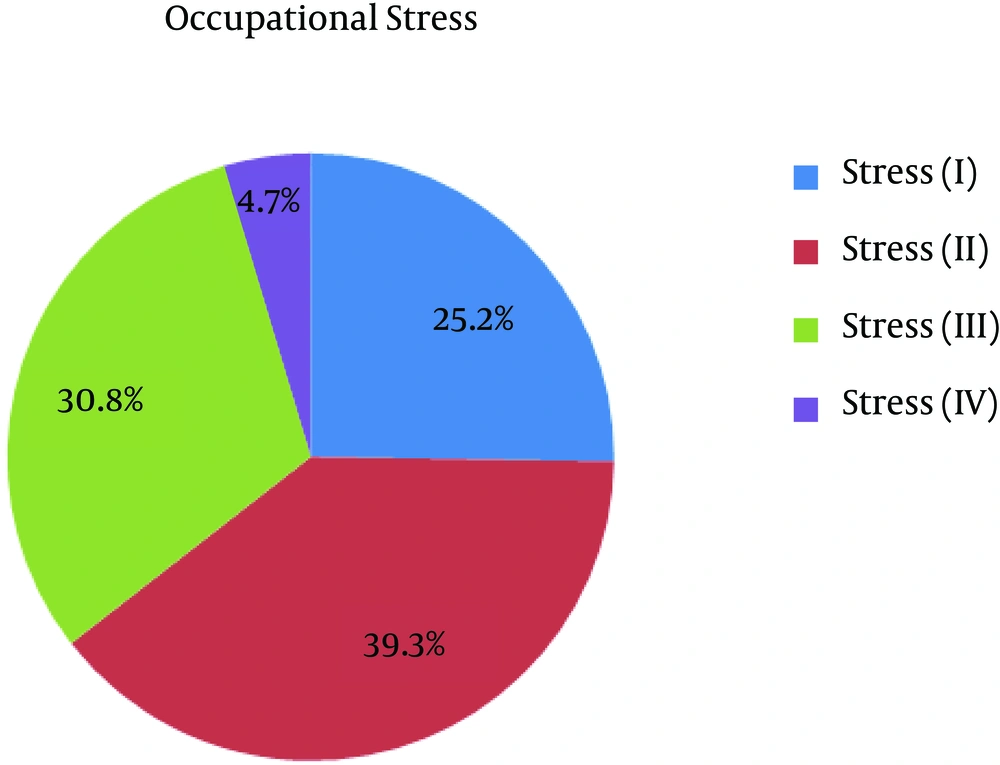
Figure 3.
Occupational Stress Frequency
To find the relationship between variables and components of organizational commitment Pearson correlation test was used. Table 1 indicates negative and significant correlation between occupational stress, affective commitment and normative commitment, but there was not significant correlation with continuous commitment. This table also indicates positive and significant correlation between all components of organizational commitment and job satisfaction. Besides, Pearson correlation also showed negative and significant correlation between occupational stress and job satisfaction (P < 0.001, r = -0.451).
Table 1.
Correlation Among Organizational Commitment, Job Satisfaction and Occupational Stress
| Variables Commitmen Subscales | Job Satisfaction | Occupational Stress | ||
|---|---|---|---|---|
| P Value | Pearson Correlation | P Value | Pearson Correlation | |
| Affective commitment | < 0.05 | -0.336 | < 0.001 | 0.196 |
| Normative commitment | < 0.001 | -0.257 | < 0.001 | 0.319 |
| Continuance commitment | < 0.001 | -0.138 | 0.155 | 0.288 |
| Total | < 0.001 | -0.305 | < 0.001 | 0.348 |
To find the more powerful predictors, linear regression was used and it indicated that job satisfaction can predict organizational commitment, which is shown in Table 2.
Table 2.
Linear Regression Analysis of the Factors Predicting Organizational Commitment (n = 107)
| Model | Unstandardized Coefficients | Standardized Coefficients | Ta | Sig.b | |
|---|---|---|---|---|---|
| B | Std. Error | Beta | |||
| (Constant) | 64.933 | 7.270 | 8.932 | 0 | |
| Job satisfaction | 0.296 | 0.114 | 0.264 | 2.600 | 0.011 |
| Occupational stress | -1.036 | 0.564 | -0.186 | -1.837 | 0.069 |
aT, tolerance.
bSig., significance.
Table 3.
Mean and Standard Deviation of Organizational Commitment, Occupational Stress and Job Satisfaction Based on Educational Levels, Marital Status and Type of Employment
| Variables | Occupational Stress | Sig.a | Occupational Stress | Sig. | Job Satisfaction | Sig. |
|---|---|---|---|---|---|---|
| Educational levels | 0.999 | 0.702 | 0.034 | |||
| Associate degree | 41.8 ± 10.3 | 2.00 ± 0 | 41.8 ± 10.3 | |||
| Bachelor degree | 2.1 ± 0.85 | 2.1 ± 0.85 | 52.0 ± 9.9 | |||
| Master degree | 2.5 ± 1.2 | 2.5 ± 1.2 | 48.2 ± 7.8 | |||
| Marital status | 0.444 | 0.013 | 0.089 | |||
| Married | 2.0 ± 0.87 | 2.0 ±.87 | 52.0 ± 9.9 | |||
| Single | 2.3 ± 0.61 | 2.3 ±.61 | 48.2 ± 7.8 | |||
| Other | 3.2 ± 0.50 | 3.2 ±.50 | 41.5 ± 10.5 | |||
| Type of employment | 0.399 | 0.59 | 0.131 | |||
| Official recruitment | 52.5 ± 10.2 | 2.1 ±.92 | 52.5 ± 10.2 | |||
| Contract work | 49.6 ± 9.5 | 2.2 ±.80 | 49.6 ± 9.5 |
aSig., significance.
Table 4.
Correlation of Job Satisfaction, Organizational Commitment and Occupational Stress With Age and Work Experience
| Variables | Organizational Commitment | Occupational Stress | Job Satisfaction | |||
|---|---|---|---|---|---|---|
| The Spearman rho test | Correlation | Sig.a | Correlation | Sig. | Correlation | Sig. |
| Age | 0.112 | 0.131 | -0.210b | 0.030 | 0.249c | 0.010 |
| Work experience | 0.155 | 0.110 | -0.221b | 0.018 | 0301c | 0 |
aSig., significance.
bCorrelation is significant at the 0.05 level (2-tailed).
cCorrelation is significant at the 0.01 level (2-tailed).
5. Discussion
The study aimed to identify job satisfaction and occupational stress as predictors of organizational commitment among midwives working in hospitals. Although there are many conclusions that can be drawn based upon the current study, the study focused on some major ones. The study revealed a positive link of job satisfaction, and a negative link of occupational stress with organizational commitment, but just job satisfaction can predict organizational commitment. It means that satisfied employees had higher levels of organizational commitment. Rouhi et al. (17) showed positive correlation between job satisfaction and affective commitment (rs = 0.491), normative commitment (rs = 0.414) and continuous commitment (rs = 0.294). Besides, their findings showed that job satisfaction had negative and significant correlation with occupational stress. These findings were consistent with those of other previous studies in health care settings. Lavassani et al. (18) I declared the highest correlation between organizational commitment and job satisfaction (rp = 0.59), then between job satisfaction and occupational stress (rp = 0.38) and the lowest correlation between organizational commitment and occupational stress (rp = -0.24). Job satisfaction is shaped immediately after entering an organization, while commitment develops slowly; therefore, Job satisfaction is observed as a prerequisite of organizational commitment (19). Lambert & Paoline reported that job satisfaction is a powerful antecedent of organizational commitment (20). In the current study, occupational stress did not show a relationship with continuous commitment, although Yaghoubi et al. (13) reported relationship with all components of organizational commitment, which can be due to using different tools, different groups of subjects and different environmental workplaces.
According to Figure 1, most midwives had low organizational commitment and no one had very high commitment. The study by Seyedghibi et al. (21) on nurses in Shiraz hospitals showed that the frequency of too low commitment was (2.3%), low commitment (64.5%), high (32.5%) and very high commitment (0.8%). El-Demerdash et al. (22), in their study on nurses in Tanta (Egypt) university affiliated hospitals observed that nurses in the emergency or intensive care and general units declared (17.9%) high, (75.6%) moderate and (6.5%) low commitment. Rouleau et al. (14), in the study on midwives working in Senegal hospital declared that only 41.1% of the studied midwives had the intention of remaining in their current position for the next several years. These differences in results can be due to diverse work conditions in different cities and countries, different work units and application of different questionnaires. Organizational commitment is an important variable in the intellect of employees, which by affecting the employees’ performance, increases productivity, improves service delivery and enhances quality. Researchers consider the organizational commitment as an important variable in understanding the employees’ behavior (21). Therefore, it is necessary for managers to periodically evaluate the commitment in employees and assess individual occupational and organizational factors influencing organizational commitment to improve midwives function.
According to Figure 2, about 48.6% of the subjects had job dissatisfaction in the current study. Hadizadeh Talasaz et al. (6) in their study on midwives working in healthcare centers indicated that about 5.6% of the subjects were very dissatisfied, 33.3% dissatisfied, 56.7% satisfied and about 4.4% were very satisfied, which was similar to the current study results. But Skinner et al. (23), in a study on the Australian midwives reported that 39% of the subjects were very satisfied, 57% moderately satisfied and 4% were dissatisfied. This difference should be announced to managers to enhance staff’s job satisfaction to achieve organizational goals. The job satisfaction of health professionals is influenced by a range of individual factors such as work experience, age and educational level. Being older, experienced and more educated are associated with job satisfaction; older midwives were more likely to have experienced many work scenarios; thus, they managed and understood hazy or difficult work situations with certainty (23).
According to Figure 3, most midwives declared stress grades II and III. Nourani Saadoldin et al. (24) reported that the mean score of occupational stress among midwives in maternity wards was higher than that of midwives in health care centers. Kordi et al. (9) observed mild (21.3%), moderate (19.3%) and severe (59.3%) occupational stress in the studied subjects. It seems that midwives in Mashhad experience high occupational stress. There was a relationship between occupational stress and work experience, and also age and marital status, which was similar to the results of other studies; this may be due to adaptability, experience and confidence which they gain by aging and more work experience. Also, the single midwives feel lonely and unhappy which increases the level of stress among them (12).
5.1. Limitation
The findings of the current study should be considered according to the following limitations:
The study examined a population of midwives in the teaching hospitals of a city; therefore, it should be generalized cautiously to other populations.
The study examined only a certain period of time, which would not cover factors with long-term effects. A multiple time period approach is suggested for further studies.
5.2. Conclusion
The current study aimed to understand employees’ work-related attitudes such as organizational commitment, job satisfaction and occupational stress. The results of this study provided valuable guidelines for researchers and managers who try to increase organizational commitment among staff. Since organizational commitment makes employees believe in the goals and values of the organization, inclines them to try hard in the organization and makes them eager to be a member, managers should recognize factors that reinforce organizational commitment. Findings indicated that even with the pressures and challenges in the midwifery profession, midwives can still be committed and engaged by enhancing their job satisfaction.
5.3. Recommendations
According to the findings of the present study, it is recommended to: 1) establish a committee including a group of midwives to plan some programs to recognize factors that could enhance organizational commitment and job satisfaction among them; 2) plan regular meetings between supervisors and their staff to discuss and solve their problems; 3) a proper stress reduction program is also needed.