


1. Background
Eating disorders (EDs) are characterized by severe problems in eating behavior and body weight (1). Moreover, persistent eating-related behaviors that cause significant impairment of physical health and psychosocial function are found in EDs. The EDs are common in adolescents and young adults and are often severe, causing many psychiatric and physical complications and affecting the quality of life and even mortality (2, 3). People with ED (especially people with anorexia nervosa) have a significant mortality rate (4). Due to the increasing prevalence of EDs among all age groups, economic, social, and cultural issues have become major concerns (5). Related studies revealed the high prevalence of EDs among university students (6, 7).
Research has examined the relationship between self-esteem and ED (8-10). According to the transdiagnostic theory of Fairburn et al. (11), low self-esteem and high levels of perfectionism are the two main characteristics of EDs (11). Low self-esteem is a persistent factor and a predictor of EDs (8, 9). Higher self-esteem predicts better treatment outcomes in patients with EDs (10). Research shows that self-esteem is associated with perfectionism (12-14) and emotional reactivity (15-17).
Furthermore, the relationship between self-efficacy and ED has been assessed (18, 19). Self-efficacy associated with emotion regulation was a strong predictor of self-injury and ED. Evidence suggests that self-efficacy is, directly and indirectly, related to EDs (20). In addition, eating self-efficacy has been predicted to have a relationship with avoiding binge eating (18) and lower levels of disordered eating (19) following psychotherapy. Research shows that self-efficacy is correlated with perfectionism (21-23) and emotional reactivity (20, 24, 25). Considering the protective role of self-esteem and self-efficacy, emotional reactivity is correlated with EDs (26-29). Perfectionism also can be a risk factor that maintains EDs (30-32). Given the protective role of self-esteem and self-efficacy against psychopathology, they may play a mediating role in the relationship of emotional reactivity and perfectionism with ED.
2. Objectives
The EDs have numerous psychiatric and physical complications and are even accompanied by mortality (2, 3). These disorders are highly prevalent among students. Therefore, identifying and determining the predictors can be an essential step in treating these disorders. With this background in mind, the current study aimed to investigate the mediating role of self-esteem and self-efficacy in the relationship of negative reactivity and perfectionism with EDs.
3. Methods
3.1. Subjects and Methods Sample
We conducted this descriptive correlational study on 340 students studying at the University of Tehran, Iran, during 2018 - 2019. The participants were selected through the convenience sampling method. Kline (33) recommends a sample size of about 200 for confirmatory factor analysis with ten factors (33). Confirmatory factor analysis is more accurate when the sample size is larger than 250 (34). Therefore, 340 people were selected by the convenience sampling method, of which 38 students completed the questionnaires incompletely and were excluded from the study.
Final data analysis was performed on 302 individuals. The inclusion criteria were being a student and participating voluntarily. The main exclusion criterion was having a severe medical illness. The data were analyzed by the Pearson’s correlation coefficient and structural equation modeling using the SPSS software version 22 and Liserl-8.80. This research received ethical approval (IR.IUMS.REC.1398.1138) from Iran University of Medical Sciences in 2019.
3.2. Data Collection Tools
3.2.1. Perth Emotional Reactivity Scale
This 30-item scale measures 15 items of negative reactivity and 15 items of positive reactivity. It is regarded as the most comprehensive tool for measuring emotional reactivity based on negative and positive emotions. Participants responded to the items on a five-point Likert scale from strongly disagree (1) to strongly agree (5) (35). This scale was validated by Mousavi Asl et al., showing good validity and reliability in the Iranian society (36).
3.2.2. ED Inventory-Perfectionism Scale (EDI-P)
It measures eating-related perfectionism based on a six-point scale from zero to three (always: 3; usually: 2; often: 1; sometimes, rarely, or never: 0). A higher score on this scale indicates greater perfectionism (37).
3.2.3. ED Examination Questionnaire-Short Form
The ED Examination Questionnaire-Short Form (EDE-QS) is a suitable tool for assessing the psychopathology of EDs and distinguishing between people with and without EDs. The EDE-QS consists of 12 items developing a reliable and valid tool with acceptable psychometric properties (38).
3.2.4. Weight Efficacy Lifestyle Questionnaire‑Short Form
The Weight Efficacy Lifestyle Questionnaire‑Short Form (WEL-SF) is an 8-item questionnaire that provides a valid tool for measuring self-efficacy related to eating behaviors suitable for use in research and clinical settings. Participants responded on a scale from zero (not at all sure that I can resist overeating) to 10 (quite sure I can resist overeating). A higher score represents greater self-efficacy. This scale had appropriate psychometric properties (39).
4. Results
The final analysis of 302 students with an age range of 47 - 19 years demonstrated that 169 participants (56%) were male, and 133 (44%) were female. The mean ± standard deviation of the age of the subjects was 23.83 ± 4.57 years.
According to Table 1, ED was correlated with perfectionism (r = 0.4, P = 0.01) and general negative reactivity (r = 0.53, P = 0.01), while it had a negative significant relationship with self-esteem (r = -0.48, P = 0.01) and self-efficacy (r = 0.53, P = 0.01). Self-esteem had a negative significant relationship with perfectionism (r = -0.12, P = 0.05) and negative reactivity (r = -0.68, P = 0.01). Furthermore, self-efficacy had a negative significant relationship with perfectionism (r = -0.28, P = 0.01) and negative reactivity (r = -0.5, P = 0.01).
Table 1.Mean, Standard Deviation, Correlations Between Eds, Self-esteem, WEL-SF, General Negative Reactivity, and Perfectionism a
| Variables | Mean ± SD | 1 | 2 | 3 | 4 | 5 |
|---|---|---|---|---|---|---|
| ED | 9.11 ± 6.76 | 1 | -0.48 ** | 0.4 ** | 0.53 ** | -0.53 ** |
| SE | 35.25 ± 9.39 | 1 | -0.12* | -0.68 ** | 0.48 ** | |
| P | 8.16 ± 4.32 | 1 | 0.38 ** | -0.28 ** | ||
| GNR | 48.56 ± 13.56 | 1 | -0.5 ** | |||
| WEL-SF | 45.24 ± 19.44 | 1 |
Abbreviations: ED, eating disorder; SC, self-esteem; GNR, general negative reactivity; WEL-SF, Weight Efficacy Lifestyle Questionnaire-Short Form; P, perfectionism.
a **Correlation is significant at 0.01 level.
The mediation of the relationship of negative reactivity and perfectionism with ED by self-esteem and self-efficacy was investigated based on the proposed research model. The assumptions, including the data level for all interval variables, data normality, linearity, as well as the absence of skewed data and multicollinearity, were examined. The results showed that all the assumptions were met. The findings of the proposed model fit indices are presented in Table 2, showing that the proposed model had the desired fit (X2/df = 1.95, CFI = 0.94, IFI = 0.94, RMSEA = 0.06). The CFI, NFI, and IFI values > 0.9 and RMSEA < 0.08 were considered acceptable fit (33). The normal chi-square is expected to be lower than 3 for an acceptable model (40). The fit indices of the proposed model are given in Table 2, indicating the desirable and acceptable fit of the research model.
Table 2.Model Fit Indices, the Mediating Role of Self-esteem and Self-efficacy in the Relationship of Perfectionism and Negative Reactivity the ED
| Indices | PNFI | NFI | RMSEA | AGFI | IFI | CFI | X2/df |
|---|---|---|---|---|---|---|---|
| Quantity | 0.9 | 0.92 | 0.06 | 0.79 | 0.93 | 0.92 | 2.21 |
As could be seen in Figure 1, perfectionism (t = 3.74, ß = 0.27) and self-esteem (t = 2.52, ß = - 0.23) have direct significant effects on ED. On the other hand, negative emotional reactivity has a direct, but insignificant, effect (t = 1.27, ß = 0.13) on ED. In the structural model, the significance of the path coefficient is determined based on the t value. If t > 1.96, the relationship between the two constructs is significant.
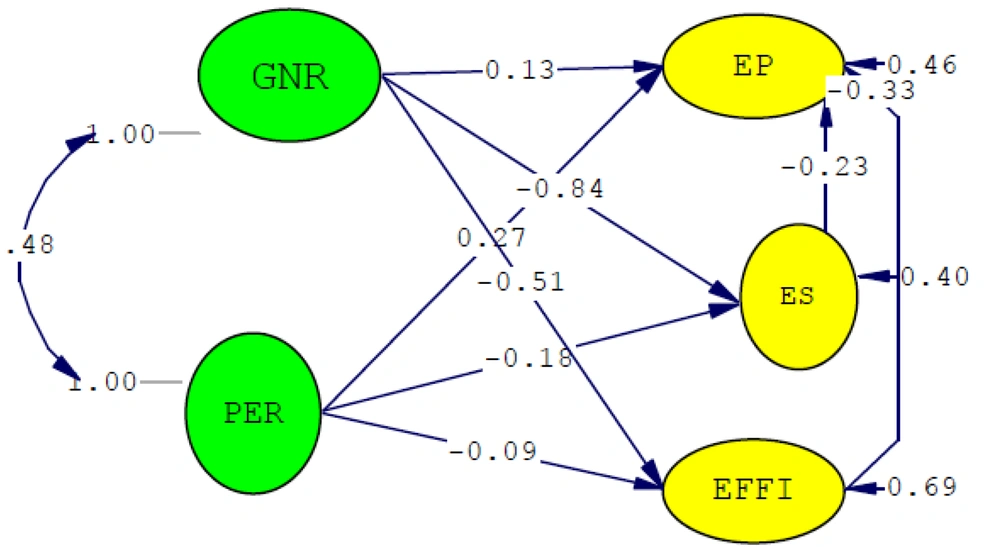
Figure 1.
Mediating role of self-esteem and self-efficacy in the relationship of perfectionism and negative reactivity with EDs. ES, self-esteem; EFFI, self-efficacy; EP, eating psychopathology; PER, perfectionism; GNR, negative reactivity.
5. Discussion
The findings of the present study showed that the construct of perfectionism has a significant correlation with EDs. In addition, perfectionism was a valid predictor in the model for EDs. Chang et al. (41) demonstrated that perfectionism was correlated with EDs (41). The results of Fedewa et al. revealed that people with depression and EDs scored higher in negative perfectionism (42). It can explain the development and maintenance of EDs, including anorexia nervosa, bulimia nervosa, and ED not otherwise specified (EDNOS) (11). The results of the present investigation are consistent with other studies (30-32).
People with EDs have many worries about their mistakes as a component of perfectionism. We can also mention the role of perfectionism in trying to gain social prestige and status. High levels of maladaptive perfectionism result in doubts about the quality of personal behavior, extreme attention to errors, and high sensitivity to criticism that predisposes people to EDs. To evaluate oneself, such characteristics make one likely to seek out more objective or external sources, including social feedback about body weight. The self-critical component of perfectionism is more related to EDs and negative emotions abundant in people with EDs.
Moreover, the results of data analysis showed that negative reactivity had a significant positive correlation with EDs. In addition, perfectionism is a valid predictor in the model for eating pathology. The obtained results are in line with other studies (26-29). Hochgraf et al. reported that emotional reactivity plays a role in the relationship between parental hostility and ED symptoms during puberty (26). Emotional dysregulation is strongly associated with the symptoms of EDs (43). Emotional reactivity is involved in EDs and non-suicidal self-injurious behaviors (44). People with EDs have difficulty determining emotion levels and applying appropriate emotion regulation strategies. In the absence of adaptive emotion regulation skills, it is assumed that sensitive and gifted individuals may resort to problem eating behaviors to regulate their emotions. Researchers claim that abnormal eating habits reduce negative emotions (45).
Moreover, the path analysis model showed that self-esteem and self-efficacy are significant mediators in the relationship of negative reactivity and perfectionism with eating psychopathology. These results are congruent with the findings of other investigations (46). Self-efficacy acts as a moderator in the relationship between the dimensions of perfectionism and binge eating or binge drinking (46). Puttevils et al. showed that self-esteem modulates the relationship between perfectionism and ED symptoms (47). Self-esteem plays a mediating role between personality traits and EDs (48). In another study, Foroughi, Khanjani, and Mousavi Asl (49) examined the relationship of negative emotion, perfectionism, and external shame with concern about body dysmorphia mediated by compassion. The results of path analysis showed that self-compassion played a mediating role in the relationship of negative emotion and perfectionism with concerns about body dysmorphia (49).
Moderate and higher self-efficacy associated with eating act as a moderator between dietary restriction and extreme overeating, and this relationship was not significant for those with low self-efficacy (50). Self-efficacy related to emotion regulation was a strong predictor of self-harm and disordered eating. Evidence also shows that Emotion regulatory self-efficacy is both directly and indirectly related self-injury and disordered eating (20). Self-efficacy is an essential determinant of the ability of a person to manage stressful and emotional situations successfully. Increased levels of self-efficacy allow the regulation of emotional distress and reduce ED.
People who have low self-esteem and a high sense of loneliness and shyness pay too much attention to themselves and suffer from negative evaluations. These negative evaluations and false beliefs are excessive, causing discomfort and preventing positive emotions in interpersonal and social relationships. Self-esteem positively predicts coping with difficult emotional experiences and is associated with positive emotion regulation, such as clarity and emotional recovery. Low self-esteem leads to the worsening and persistent overidealization of weight and body (e.g., the core of psychopathology) and affects the feelings of frustration about capacity for change in a person and consequent adherence to treatment. Psychological treatments, such as motivational interviewing and cognitive-behavior therapy, have been developed for other psychiatric disorders in Iran. Such treatments also need to be developed and implemented for people with EDs.
One of the limitations of this study was the difference in the nature of the samples (e.g., student or general population or clinical sample) which may influence the results and their generalization. Moreover, the present study participants may not represent the general population due to the sampling method. Consequently, this investigation can be performed in the future on clinical populations and the general population with more controlled intervention plans.
5.1. Conclusions
The EDs are common in adolescents and young adults, leading to a variety of psychiatric and physical complications that affect the quality of life and even mortality. Moreover, perfectionism and negative reactivity are essential factors in EDs that can be mediated by self-esteem and self-efficacy. Therefore, more effective interventions and protocols are needed to address perfectionism and negative reactivity. Further research on the effectiveness of interventions based on the mediating role of self-esteem and self-efficacy is recommended.



